
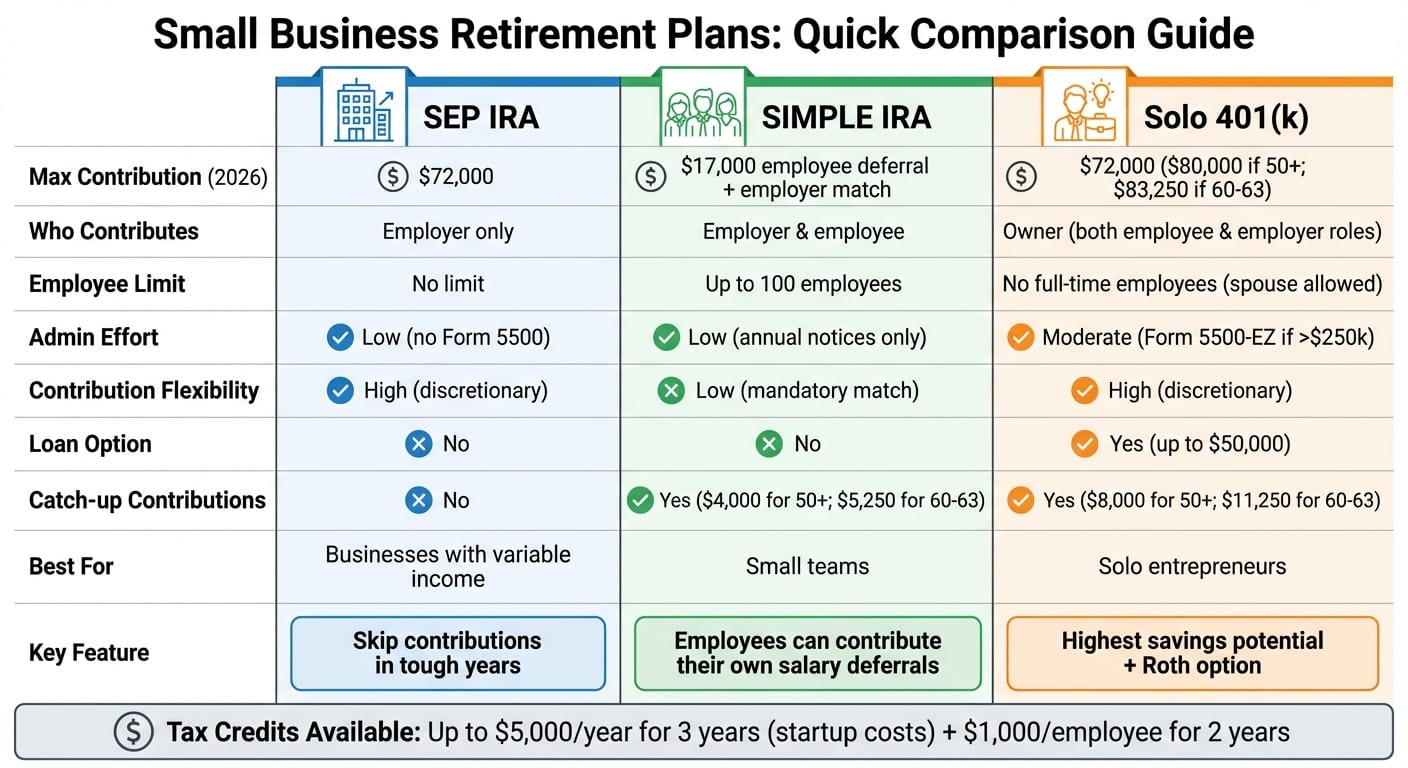
If you're running a small business, choosing the right retirement plan depends on your team size, income stability, and savings goals. Here's a quick breakdown of three popular options:
- SEP IRA: Best for businesses with fluctuating profits. Employers fund contributions (up to $72,000 in 2026) and can skip contributions during tough years. No employee deferrals are allowed.
- SIMPLE IRA: Ideal for small teams (up to 100 employees). Employees can contribute up to $17,000 in 2026, with employers required to match contributions or make fixed contributions annually.
- Solo 401(k): Perfect for solo entrepreneurs or businesses with no full-time employees (besides a spouse). Allows for both employee and employer contributions, with limits up to $80,000 for those aged 50+ in 2026. Offers additional perks like loans and Roth contributions.
Quick Comparison:
Each plan has different tax benefits, contribution rules, and setup requirements. Consider your business size, employee needs, and willingness to handle paperwork when deciding.
Top Retirement Plans for Self Employed & Small Business Owners in 2026
1. SEP IRA
A SEP IRA is an easy-to-manage retirement plan that works for all types of businesses, whether you're running a sole proprietorship, partnership, corporation, or you're self-employed. Its simplicity and flexibility make it a strong contender when comparing retirement plan options.
Eligibility
To qualify for a SEP IRA, employees must be at least 21 years old, have worked for the business in three of the last five years, and earned at least $750 in 2024 and 2025. Employers, however, can choose to loosen these requirements. For instance, they might allow younger employees (18 and older) or reduce the length of required service. Certain groups can be excluded, such as employees covered by union agreements where retirement benefits were negotiated, nonresident aliens with no U.S. income, and those who don't meet the minimum criteria.
Contribution Limits
For 2026, the maximum contribution is the lesser of 25% of compensation or $72,000 - far surpassing the SIMPLE IRA's $17,000 deferral limit. However, SEP IRAs don't permit catch-up contributions for employees aged 50 or older. Contributions are entirely funded by the employer; employees cannot make salary deferrals. Additionally, if you're an owner, you must contribute the same percentage of compensation to all eligible employees' accounts.
Tax Advantages
SEP IRAs come with significant tax benefits. Contributions are fully tax-deductible for businesses, reducing taxable income. For employees, these contributions aren't counted as part of their gross income. Plus, small businesses with 50 or fewer employees may qualify for a tax credit of up to $5,000 annually for the first three years to cover startup costs. On top of that, there's an additional credit of up to $1,000 per employee for contributions made during the first two years.
Administrative Requirements
Setting up a SEP IRA is straightforward. You can use IRS Form 5305-SEP, which most financial institutions provide for free. There's no need for annual Form 5500 filings or complicated nondiscrimination testing. Contributions are flexible - you can adjust or skip them depending on your business's financial situation each year. Even better, you can establish and fund a SEP IRA as late as your business's tax filing deadline, including extensions. For the 2026 tax year, this could be as late as October 15, 2027. Lastly, contributions are immediately 100% vested, meaning employees own the funds as soon as they're deposited.
With its tax savings, flexibility, and ease of setup, a SEP IRA is an attractive retirement plan for small business owners looking to balance tax benefits and cash flow. Its low-maintenance nature and adjustable contributions make it an excellent choice for many.
2. SIMPLE IRA
A SIMPLE IRA is tailored for small businesses with 100 or fewer employees, requiring that employees earn at least $5,000 in the prior year. Unlike a SEP IRA, which is entirely employer-funded, a SIMPLE IRA allows both employers and employees to contribute. However, if you choose this plan, you generally can't offer another retirement plan alongside it.
Eligibility
Employees are eligible if they’ve earned at least $5,000 in any two prior years and are expected to earn a similar amount this year. Employers can loosen these rules if desired, such as covering all employees regardless of income.
Contribution Limits
For 2026, employees can contribute up to $17,000. Those aged 50 or older can add a $4,000 catch-up contribution, and individuals aged 60 to 63 have an additional "super" catch-up of up to $5,250. Employers must contribute annually, choosing between matching employee contributions up to 3% of compensation or making a fixed 2% contribution. The SECURE Act 2.0 also allows for extra employer contributions, up to the lesser of 10% of compensation or $5,000.
Tax Advantages
SIMPLE IRAs offer tax-deferred growth and reduce taxable income for both employees and employers. However, withdrawals within the first two years are subject to a steep 25% penalty. Employers benefit from fully deductible contributions as business expenses, while employees lower their taxable income through salary deferrals. Small businesses may also qualify for startup cost credits during the first three years, plus additional per-employee credits in the initial two years. Employees might be eligible for the Saver’s Credit, which can cover up to 50% of their salary deferrals.
Administrative Requirements
Setting up a SIMPLE IRA is straightforward. Employers can use IRS Form 5304-SIMPLE or 5305-SIMPLE, depending on their setup preferences. Unlike other plans, there’s no need for Form 5500 filings or nondiscrimination testing. Contributions are immediately 100% vested, and employees must be given a 60-day window (typically from November 2 to December 31) annually to adjust their salary reduction agreements. New SIMPLE IRAs must generally be established by October 1 of the plan year. If your business grows beyond 100 employees earning $5,000 or more, you may need to transition to a different plan, such as a 401(k).
This streamlined setup makes it a practical choice for small businesses and leads us into the next option: the Solo 401(k).
3. Solo 401(k)
A Solo 401(k) is designed for self-employed individuals and business owners who don’t have full-time employees, apart from a spouse or partner. This plan allows for both salary deferrals and profit-sharing contributions, making it a strong option for building retirement savings. Compared to SEP and SIMPLE IRAs, it offers even greater flexibility for those without traditional employees.
Eligibility
You’re eligible for a Solo 401(k) if you’re a sole proprietor, LLC owner, freelancer, independent contractor, or operate an S-Corp or C-Corp, provided you don’t have W-2 employees working more than 500 hours per year. Your spouse can participate in the plan, but hiring even one full-time employee typically disqualifies you. To set up a Solo 401(k), you’ll need an Employer Identification Number (EIN); a Social Security Number won’t suffice.
Contribution Limits
One of the standout features of a Solo 401(k) is the ability to contribute as both an employee and an employer. For 2026, you can contribute up to $24,500 in salary deferrals, while employer contributions can reach up to 25% of your compensation - or 20% of your net self-employment income if you’re a sole proprietor or single-member LLC. If you’re 50 or older, you can add an $8,000 catch-up contribution, or a $11,250 "super catch-up" if you’re between 60 and 63. This means your total contributions can range from $72,000 to $83,250, depending on your age and income.
Tax Advantages
The Solo 401(k) provides valuable tax options. You can choose pre-tax contributions to reduce your taxable income now or make Roth contributions for tax-free withdrawals during retirement. Unlike Roth IRAs, a Solo 401(k) doesn’t impose income limits on Roth contributions.
"The Solo 401(k) is often the most powerful retirement tool available to solo entrepreneurs and S-Corp owners... It allows you to contribute both as the employee and as the employer, dramatically increasing your savings potential." – Christopher Stroup, Silicon Beach Financial
Another benefit is the ability to borrow up to 50% of your account balance or $50,000 (whichever is less) without facing taxes or penalties. Additionally, if you use your Solo 401(k) to invest in real estate, you’re exempt from Unrelated Debt Financed Income (UDFI) when using non-recourse leverage - something SEP IRAs don’t offer.
Administrative Requirements
Timely setup and compliance are crucial for maintaining a Solo 401(k). To make salary deferrals for 2026, you must establish the plan by December 31, 2026. Profit-sharing contributions can be made up until your business’s tax-filing deadline, including extensions. Once your total plan assets exceed $250,000, you’ll need to file IRS Form 5500-EZ annually. If your business expands and you hire additional employees, you may need to switch to a different retirement plan.
Advantages and Disadvantages of Each Plan
Every retirement plan caters to different business needs, so understanding the pros and cons is key to making the right choice.
SEP IRAs are highly flexible, allowing contributions of up to $72,000 in 2026, or nothing at all during tough financial years. This makes them a great option for solo entrepreneurs or small businesses with unpredictable income. However, the employer shoulders the entire funding burden. Plus, if you have employees, you’re required to contribute the same percentage to their accounts as you do to your own.
SIMPLE IRAs are designed for small teams, as employees can contribute their own salary deferrals - up to $17,000 in 2026. Employers are required to make annual contributions, either by matching 3% of employee salaries or providing a fixed 2% contribution. One drawback is the steep 25% early withdrawal penalty if funds are accessed within the first two years. If you’re looking for higher savings limits, the Solo 401(k) may be a better fit.
Solo 401(k)s offer the highest potential for saving, allowing contributions of up to $72,000 in 2026 ($80,000 for those aged 50 or older) by combining employer and employee contributions. Additional perks include the option for participant loans (up to $50,000) and Roth contributions with no income restrictions. However, the plan requires more administration, such as filing Form 5500-EZ if assets exceed $250,000, and it’s limited to businesses without full-time employees, except for a spouse.
Here’s a quick comparison of the key features:
For solo entrepreneurs aiming for maximum savings, the Solo 401(k) stands out. SIMPLE IRAs are great for small teams sharing contributions, while SEP IRAs work well for businesses with fluctuating profits. Use the table above to weigh your options and find the plan that aligns with your goals.
How Mezzi Helps You Choose the Right Plan
Picking the right retirement plan goes beyond just glancing at contribution limits or crunching numbers on a spreadsheet. It’s about finding the perfect fit for your business’s financial reality. Mezzi simplifies this process by analyzing your actual business and personal account data to recommend a plan that maximizes tax savings while respecting your cash flow.
One key factor Mezzi considers is employee headcount. For solo entrepreneurs or those employing only a spouse, the platform often highlights the Solo 401(k) for its higher contribution limits. For businesses with up to 100 employees, Mezzi evaluates whether the mandatory 3% match of a SIMPLE IRA or the flexibility of a SEP IRA’s discretionary contributions better aligns with your financial situation. This tailored approach ensures recommendations that genuinely match your needs.
Mezzi also uncovers tax credits that many business owners overlook. For example, if you have at least one employee earning $5,000 or more (a Non-Highly Compensated Employee), you could qualify for up to $5,000 annually in startup cost credits for three years. Plus, there’s an additional $1,000 per employee earning less than $100,000 in FICA wages for five years. For a business with 50 eligible employees, this could mean up to $50,000 in credits during the first year alone.
As an SEC-registered fiduciary, Mezzi offers institutional-grade planning without the typical 1% AUM fee. You can ask specific questions, like whether Roth or Traditional contributions make more sense for you, or if transitioning from a SEP to a Solo 401(k) is the right move. The answers are personalized, based on your connected accounts, rather than relying on generic calculators. This data-driven approach complements the earlier breakdown of each plan’s features.
Tim, CEO of Somnee, puts it best: "I loved chatting with the AI to optimize my portfolio. Mezzi is unmatched".
Conclusion
Each retirement plan has its own perks, tailored to fit different business setups. Picking the right one comes down to understanding your employee structure and cash flow. For solo entrepreneurs or those employing only a spouse, the Solo 401(k) offers the highest contribution limits. If you have a team of up to 100 employees, the SIMPLE IRA is a straightforward option, combining easy administration with employee deferrals and employer matching. For businesses with fluctuating profits, the SEP IRA is a flexible choice, allowing contributions during profitable years and skipping them when times are tight.
While SEP IRAs and SIMPLE IRAs come with minimal paperwork, a Solo 401(k) does require filing Form 5500-EZ once the plan’s assets exceed $250,000. That said, the added effort brings benefits like participant loans - something you won’t find with SEP or SIMPLE IRAs.
This is where Mezzi steps in to make things easier. By analyzing your unique business data, Mezzi pinpoints tax-saving opportunities and recommends a retirement plan that truly fits your needs.
The right choice ultimately depends on your business size, income stability, and how much administrative work you’re willing to handle. The ideal plan should balance cash flow, employee needs, and tax advantages while keeping things manageable. Mezzi simplifies this process by combining your business data with these factors - contribution limits, tax benefits, and ease of administration - to deliver tailored recommendations, skipping generic tools or drawn-out advisor consultations.
FAQs
Can I switch plans later if my business grows?
Yes, you can change plans as your business expands. Options like SEP IRAs, SIMPLE IRAs, and solo 401(k)s are built with flexibility in mind, making it easier to adjust or switch plans to suit your changing needs. Just make sure to carefully review the rules and requirements for each plan to ensure the transition goes smoothly.
What counts as a full-time employee for a Solo 401(k)?
A full-time employee, in the context of a Solo 401(k), is generally defined as someone working at least 1,000 hours per year for the business. This standard helps establish eligibility and ensures the plan remains tailored to self-employed individuals who don’t have full-time employees.
Which plan gives me the biggest tax break this year?
The SEP IRA stands out for offering one of the biggest tax breaks available to small business owners. It allows contributions of up to 25% of compensation or $69,000 in 2024 - whichever is lower. On top of that, every contribution made is fully tax-deductible for the employer.
While options like Solo 401(k)s and SIMPLE IRAs also come with tax benefits, the SEP IRA typically provides the largest immediate deduction. This makes it an excellent choice for business owners aiming to maximize their savings.
Disclosures:
- This content is for informational purposes only and does not constitute investment advice or a recommendation to buy or sell any security.
- Past performance is not indicative of future results. No guarantee of future performance or outcomes is implied.
- Registration does not imply a certain level of skill or that the SEC has approved the company or its services.
Related Blog Posts
- 401(k) vs. IRA vs. Brokerage Account: How to Choose the Right Account for Your Goals
- HSA vs. 401(k) and IRA: Key Differences
- How does contributing to a SEP IRA affect my taxable income this year?
- Which investments can help me retire comfortably within the next few years?
Yes, you can change plans as your business expands. Options like SEP IRAs, SIMPLE IRAs, and solo 401(k)s are built with flexibility in mind, making it easier to adjust or switch plans to suit your changing needs. Just make sure to carefully review the rules and requirements for each plan to ensure the transition goes smoothly.
A full-time employee, in the context of a Solo 401(k), is generally defined as someone working at least 1,000 hours per year for the business. This standard helps establish eligibility and ensures the plan remains tailored to self-employed individuals who don’t have full-time employees.
The SEP IRA stands out for offering one of the biggest tax breaks available to small business owners. It allows contributions of up to 25% of compensation or $69,000 in 2024 - whichever is lower. On top of that, every contribution made is fully tax-deductible for the employer.
While options like Solo 401(k)s and SIMPLE IRAs also come with tax benefits, the SEP IRA typically provides the largest immediate deduction. This makes it an excellent choice for business owners aiming to maximize their savings.