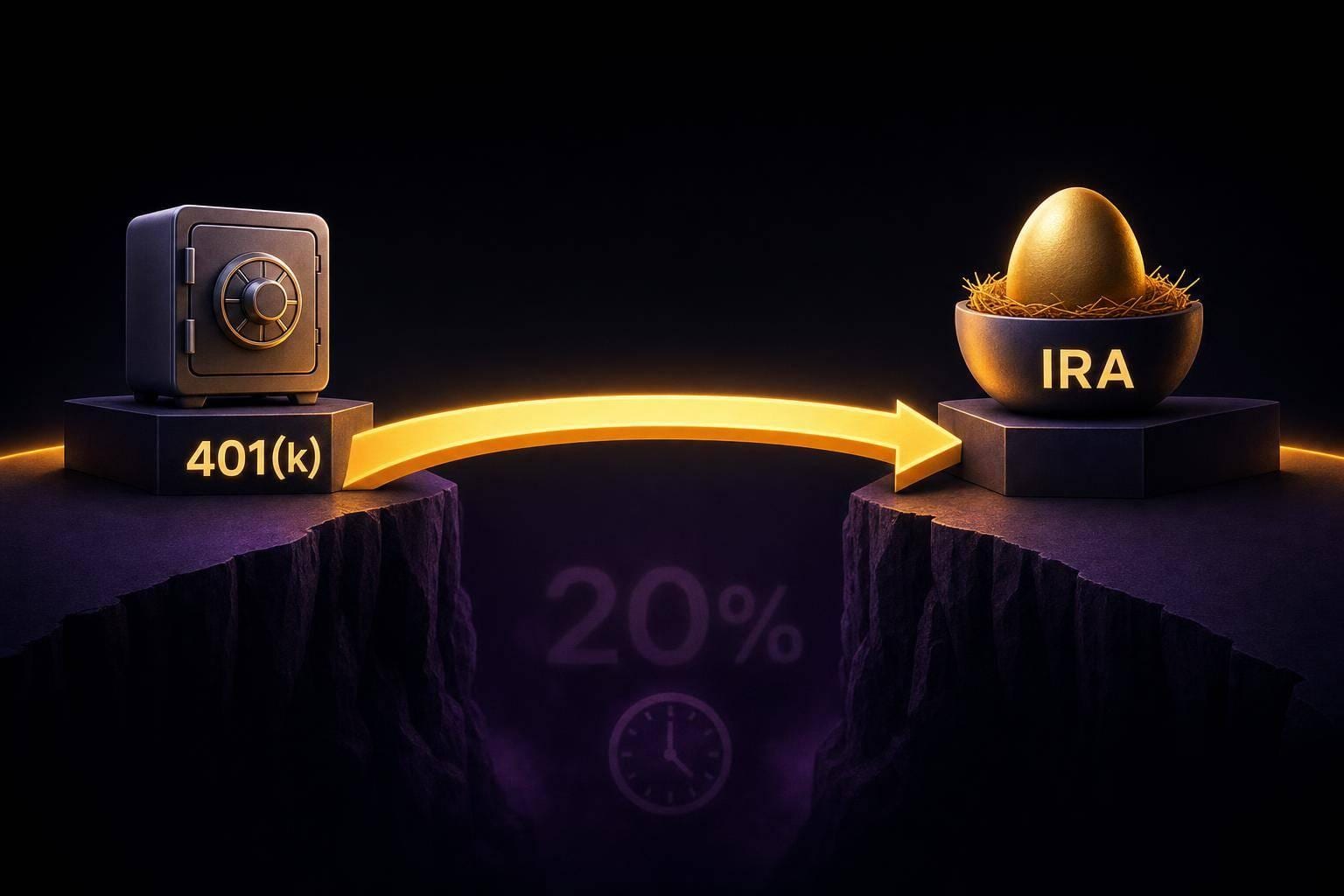
One form choice may decide whether your full 401(k) balance reaches your IRA or whether 20% gets withheld first.
If I want the cleanest path, a direct rollover may be the route many people use. The money goes from the old plan to the IRA custodian, so the usual 20% federal withholding on an eligible payout to me may not apply. If the check comes to me instead, I may have only 60 days to redeposit the full gross amount - not just what I received.
Here’s the short version:
Direct rollover: money goes to the IRA custodian, and 20% withholding may not apply
Indirect rollover: money comes to me first, and 20% may be withheld
On a $100,000 payout, I may receive $80,000 and may need to replace $20,000 from other cash to complete a full rollover
If I miss the 60-day window, the unpaid part may be treated as taxable income
If I’m under 59½, the amount not rolled over may also face a 10% early withdrawal tax
A few small details may shape the tax result: who the check is payable to, how the deposit is coded, and whether the full amount lands in the IRA on time.
| Method | Who gets the money first | 20% withholding | 60-day rule | Cash gap risk |
|---|---|---|---|---|
| Direct rollover | IRA custodian | May not apply | May not apply | Low |
| Indirect rollover | Me | May apply | May apply | High |
In other words: the article boils down to one idea - if the funds never become payable to me, the rollover may stay much simpler on both the cash and tax side.
How a 401(k) Rollover Works: Checks, Taxes, and Investments
Direct Rollover vs. Indirect Rollover
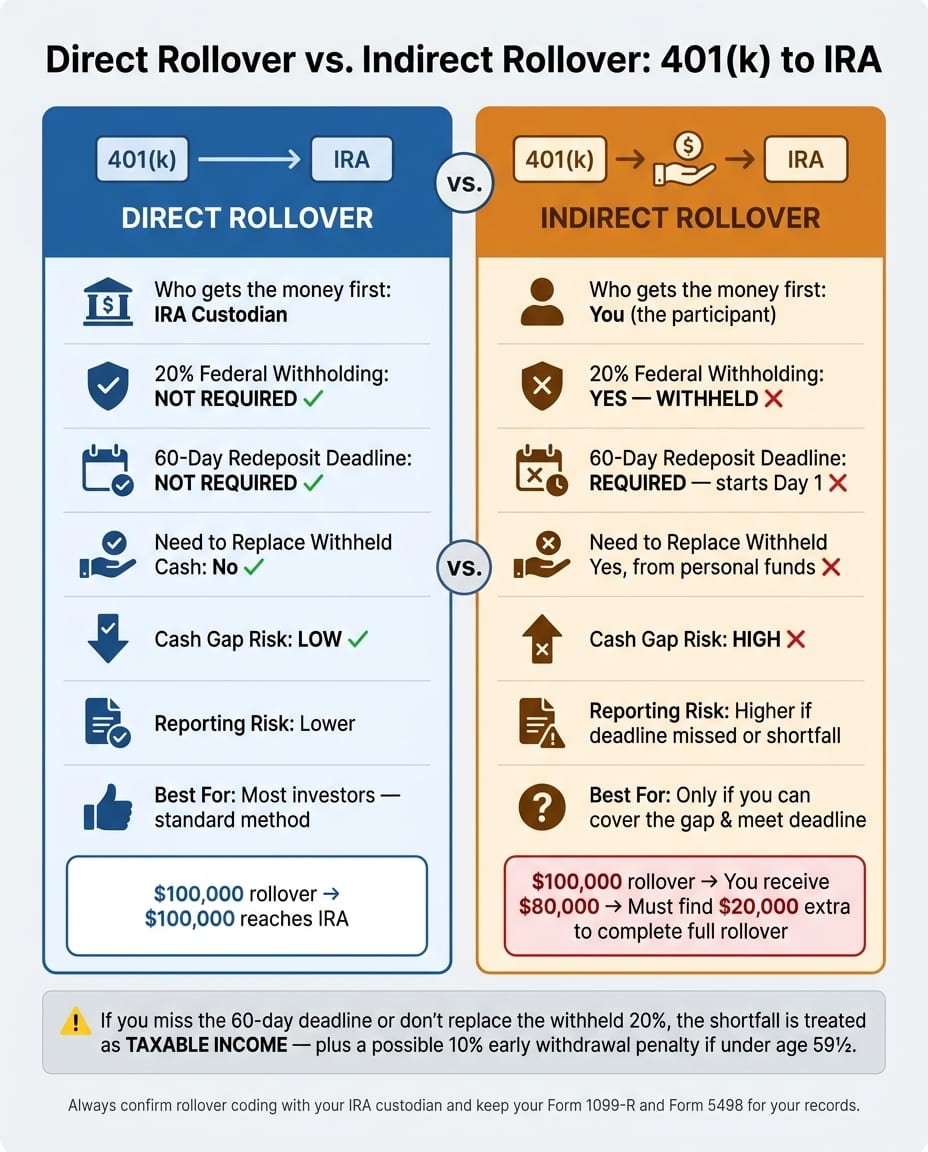
These two methods work very differently in practice. For many investors, a direct rollover may be the simpler path.
How a Direct Rollover Works
In a direct rollover, the old plan sends the money straight to your IRA custodian. That may happen by wire or by a check made payable to the IRA custodian for benefit of [your name] (FBO).
Because you never receive the funds, the IRS generally does not treat the transfer as a distribution to you. That means the 20% withholding rule and the 60-day redeposit deadline may not apply.
Your IRA statement should show a rollover contribution. Form 1099-R should usually show Code G and a taxable amount of $0. If the form appears to be coded the wrong way, you may want to request a corrected Form 1099-R before you file. That’s usually the reporting pattern people look for before moving ahead.
How an Indirect Rollover Works
With an indirect rollover, the plan sends the distribution to you, usually as a check in your name. The IRS treats that payment as a distribution, and the plan generally must withhold 20% of the amount for federal income taxes.[9][2]
Say you receive $10,000. The plan withholds $2,000 and sends you $8,000.[2] If you want to roll over the full $10,000, you may need to replace that withheld $2,000 with outside cash and deposit the full amount within 60 days.[2][6]
If you roll over only the $8,000 you received, the missing $2,000 may be treated as a taxable withdrawal. And if you’re under age 59½, a 401(k) withdrawal rules and a 10% early withdrawal penalty may also apply.
Direct Rollover vs. Indirect Rollover: Side-by-Side Comparison
This side-by-side view may help you confirm the method before you request the transfer.
| Feature | Direct Rollover | Indirect Rollover |
|---|---|---|
| Who gets the money first | IRA custodian | You, the participant |
| Mandatory 20% federal withholding | No | Yes, generally on eligible rollover distributions from employer plans |
| 60-day redeposit deadline | Not required | Required |
| Need to replace withheld cash | No | Yes, if you want to roll over the full amount |
| Reporting risk | Lower | Higher if the deadline is missed or the full amount is not restored |
| Best use case | Standard method for most investors | Only if you can cover the withholding gap and meet the 60-day deadline |
Direct rollovers may avoid withholding and the 60-day deadline because the money never passes through your hands. Next, follow the steps to request the direct rollover correctly.
Step-by-Step: How to Execute a Direct 401(k)-to-IRA Rollover
If you chose a direct rollover, follow these three steps. This workflow may help keep the full balance invested and may avoid withholding. The aim is a clean transfer, with the funds moving straight from the old plan to the IRA.
Step 1: Open the IRA and Get the Rollover Instructions
For pre-tax money, open a Traditional IRA or rollover IRA first. A direct move to a Roth IRA may be treated as a taxable conversion.[5][21]
Once the account is open, collect these details from the new custodian:
IRA account number
Custodian legal name and mailing address
Check or wire instructions, often formatted as [Custodian Name] FBO [Your Name] IRA [Account Number]
Any rollover form or acceptance letter the custodian requires
Step 2: Contact the Old Plan and Request a Direct Rollover
When you contact the old plan administrator, ask for a direct rollover to an IRA. Be specific. A vague request may result in a check made payable to you.[12][13][15]
Also confirm that the check or wire is payable to the IRA custodian FBO you, not to you personally, and that no federal withholding will be taken.[11][14] That payee language may keep the transfer outside the usual withholding rules. Provide the custodian name, address, and IRA account number in writing or through the plan portal.[20]
Complete the distribution request form, rollover election form, and 402(f) notice acknowledgment. Keep copies.[12]
If the plan mails a check, verify that it is payable to the custodian FBO you. Do not deposit it yourself; forward it exactly as instructed.[20][4]
Step 3: Confirm the Deposit, Coding, and Tax Records
When the funds arrive, verify that the custodian coded the deposit as a rollover, not a regular IRA contribution.[22] If the custodian codes it the wrong way, contact the custodian right away and request a correction before year-end tax reporting is finalized.[22]
At this stage, the goal is a paper trail that matches a direct rollover from start to finish. Keep Form 1099-R from the old plan and Form 5498 from the IRA custodian.[17][18] Form 1099-R should show the Box 1 gross amount, Box 2a $0, and Code G in Box 7.
Save the final 401(k) statement, all distribution and rollover forms, the 402(f) notice acknowledgment, the custodian's rollover instructions, and the deposit confirmation. Those records may matter if there's a tax notice or a coding issue later.[22]
Once the deposit and records are confirmed, use the checklist below.
How the 60-Day Rule and Withholding Work When You Receive the Money First
When a plan pays you first instead of sending the money straight to another retirement account, the rollover may become more complicated. In most cases, 20% withholding applies, and the 60-day clock starts right away. That’s the main issue with an indirect rollover: the money hits your hands first.
Example: How 20% Withholding Creates a Cash Shortfall
On a $100,000 distribution, the plan withholds $20,000 and sends you $80,000.[3][8] If you want to roll over the full $100,000, you may need to come up with that missing $20,000 from other funds and deposit the full amount within 60 days.
If you deposit only $80,000, the IRS may treat the missing $20,000 as a taxable distribution.[3][5][27] If you're under 59½, that unrolled amount may also face a 10% early withdrawal penalty.[27][29][31] If you complete the full rollover, the withheld amount is treated as tax paid and reconciled on your return.[8][28][30]
That cash gap is the trap. The plan may send you less than the full balance, but the rollover target may still be the gross amount.
What the 60-Day Deadline Actually Means
Day 1 starts the day after you receive the funds, and weekends and holidays still count.[23][7] So if you receive the check on March 1, day 1 is March 2, and the 60-day deadline lands on April 30.
If the deadline is missed, whatever amount was not rolled over may be treated as ordinary income for that year.[3][9][26] IRS relief for missed deadlines does exist, but it may be available only in limited cases, so it may not make sense to treat it as part of the plan.[3][9][25]
Some people try to finish the deposit well before day 60 to leave room for mail delays or custodian processing time.
Indirect Rollover Deadlines and Tax Outcomes: Timeline Table
This timeline shows what may happen at each stage.
| Period | Action Required | Tax Result | Penalty Risk (Under Age 59½) |
|---|---|---|---|
| Distribution date (Day 0) | Receive the net amount (for example, $80,000); 20% withheld from the gross. | No tax yet; withheld amount treated as tax paid. | No penalty yet. |
| Days 1–60 | Deposit the full gross amount (for example, $100,000), using personal funds to replace the withheld 20%. | Full rollover: no tax; shortfall: taxable income. | No penalty on the rolled-over amount; shortfall may be penalized. |
| After Day 60 | Rollover window closes; no further deposits count unless IRS relief applies. | Any unrolled amount is ordinary income for the year. | 10% early withdrawal penalty applies unless an exception applies. |
The rule may be simple on paper: move the full gross amount within 60 days, and the withheld tax may work as a credit. Roll over less than that, or miss the deadline, and the unrolled amount may become taxable income. Use this timeline, then move to the checklist to gather the paperwork before you request the transfer.
Rollover Checklist, Common Mistakes, and Key Takeaways
Checklist: Documents and Account Details to Have Ready
Before you contact the old plan, put everything in one place. A small mismatch - like the wrong payee address or an old account number - may slow the transfer.
| Item | What to Confirm |
|---|---|
| Old 401(k) plan name and administrator contact | Phone number and mailing address |
| Old account number | Exact number as it appears on your statement |
| Receiving IRA account number | Confirmed with the new custodian before you call |
| IRA custodian's payee line and mailing address | Used on the FBO payee line |
| Distribution request form | Obtained from the old plan; confirm signature requirements |
| Rollover contribution form | Obtained from the IRA custodian; confirms the deposit type |
| Government-issued ID | For identity verification |
| Request log | Track request date, follow-up date, check number, deposit date, and amount |
It may also help to confirm that the IRA is already open and that the receiving institution accepts rollovers from employer plans. If you receive an FBO check, forward it straight to the IRA custodian.
With that prep done, it’s worth reviewing the mistakes below before sending the request.
Mistakes That Trigger Taxes, Delays, or Misreporting
One wrong move may turn a clean rollover into a taxable distribution. Here are the errors that come up most often:
Choosing a distribution paid to you instead of a direct rollover. Mandatory 20% federal withholding generally may apply to the taxable amount. To roll over the full balance, you may need to replace the withheld amount from other funds.[24][1][10]
Depositing an FBO check into a personal bank account. Even if the check is payable to the IRA custodian FBO your name, send it straight to the custodian.[19][16][32]
Rolling over only the net amount received. The rollover amount may need to match the gross distribution, not just the amount received after withholding.[1][10]
Missing the 60-day deadline. Any amount not rolled over may be treated as ordinary income for the year, and a 10% early withdrawal penalty may apply if you are under 59½.[3][9][26]
Wrong deposit coding. If the custodian codes the deposit as a regular annual contribution instead of a rollover, a correction may be needed before year-end tax reporting is finalized.[17]
Conclusion: The Straightforward Way to Avoid the 20% Withholding Trap
For many people, the simplest path may be a direct rollover to the IRA custodian. That usually means requesting a direct rollover, confirming that the check is payable to the custodian FBO your name, and not taking personal possession of the funds. It may also help to keep the 1099-R, rollover confirmation, and custodian deposit record together for your files.[1][10][33]
FAQs
Can I roll over Roth 401(k) money the same way?
Yes. You may roll over Roth 401(k) money to a Roth IRA using the same rollover methods that apply to a traditional 401(k).
A direct rollover may be the cleaner option for many people because it’s designed to keep the tax-advantaged status of your savings in place and may avoid mandatory withholding issues. An indirect rollover may still be possible, but the same 60-day deadline and withheld-amount rules may apply.
What if my 401(k) includes company stock or after-tax contributions?
Handling a 401(k) that includes non-Roth after-tax contributions may get messy fast. The main reason: pro rata distribution rules.
Those contributions went into the plan with after-tax dollars. So if you take a distribution or set up a rollover, part of the money may be taxable and part may not. If your tax form says the taxable amount is not determined, you may need to calculate that portion yourself.
Before you start any rollover, it may make sense to check with your plan administrator about how the plan handles these assets. That extra step may help you avoid costly mistakes.
How long does a direct rollover usually take?
A direct rollover may take as long as the old 401(k) plan administrator and new IRA custodian need to process the trustee-to-trustee transfer.
Mezzi does not provide a set timeline. Instead, it notes that direct rollovers move funds between institutions without the 60-day redeposit deadline that applies to indirect rollovers.
Disclosures:
This content is for informational purposes only and does not constitute investment advice or a recommendation to buy or sell any security.
Past performance is not indicative of future results. No guarantee of future performance or outcomes is implied.