
How you pay the tax on a Roth conversion may change how much stays invested. On a $100,000 conversion in the 24% federal bracket, the tax bill may be $24,000. If that tax comes from cash or a taxable account, the full $100,000 may land in the Roth. If it comes from withholding, only $76,000 may stay in the Roth.
Here’s the short version:
Cash savings may leave the Roth fully funded, but may cut into liquid reserves.
Selling taxable investments may also keep the Roth whole, but the sale may trigger capital gains tax.
Withholding from the conversion may feel simpler, but it may leave less in the Roth and may create a 10% penalty on the withheld amount if you’re under age 59½.
A simple example shows the gap. At 6% annual growth over 20 years, $100,000 in a Roth may grow to about $320,000. By contrast, $76,000 may grow to about $243,000. That’s a difference of about $77,000, based only on how the tax was paid.
Doing a Roth Conversion? Here’s How to Pay the Tax Bill
Quick Comparison
| Method | Amount that may reach Roth | Main tradeoff | Extra tax risk | Under 59½ issue |
|---|---|---|---|---|
| Cash savings | $100,000 | Lower outside cash | None from funding source | None |
| Sell investments | $100,000 | Smaller brokerage balance | Capital gains tax may apply | None |
| Withholding | $76,000 | Less tax-free growth | No capital gains tax | 10% penalty may apply on withheld amount |
If I were comparing these options, I’d usually frame the choice around three things: how much reaches the Roth, what extra tax may show up, and how much cash stays outside the account.
Cash savings vs. selling investments vs. withholding from the conversion
Each funding source may change how much reaches the Roth, how much tax may be due, and how much cash stays outside the account. A simple way to look at it: start with the source that causes the least disruption, then compare tax cost, liquidity, and portfolio mix.
Using cash savings: keep the full conversion amount in the Roth
Paying from a checking or savings account keeps the full converted amount in the Roth. Nothing is withheld, and no assets are sold. On a $100,000 conversion with a $24,000 tax bill, the Roth receives the full $100,000 - all of it compounding tax-free from day one.[5][3][2]
The tradeoff is lower available cash outside the account. Some people use cash only if doing so may leave their short-term reserve intact.
Selling taxable investments: keep the Roth whole, but watch capital gains
When outside cash isn't available, selling taxable investments is a common fallback. The Roth stays whole, but the sale may add capital gains tax and may shift your allocation.[1][6]
For example, selling $24,000 of stock with a $10,000 gain at a 15% long-term capital gains rate adds $1,500 in tax. Selling positions with little or no embedded gain, or pairing the sale with harvested losses, may keep that added cost lower. It also may make sense to check the cost basis on each position before deciding what to sell.[1]
Withholding from the conversion: simpler now, weaker later
Withholding sends part of the conversion to the IRS automatically. You convert $100,000, elect 24% withholding, and $76,000 goes to the Roth while $24,000 goes to the IRS.[7][3]
The downside is lower tax-free compounding: only $76,000 grows tax-free instead of $100,000.[7][3] For investors under age 59½, there may be another issue. The withheld amount is treated as a distribution from the traditional IRA, not a conversion, which may trigger a 10% early withdrawal penalty on that portion - an extra $2,400 on a $24,000 withholding.[8][9] Some people use withholding only when outside cash or taxable investments are not available.
The next section puts the three methods side by side on the same conversion amount.
Side-by-side comparison of the three funding methods
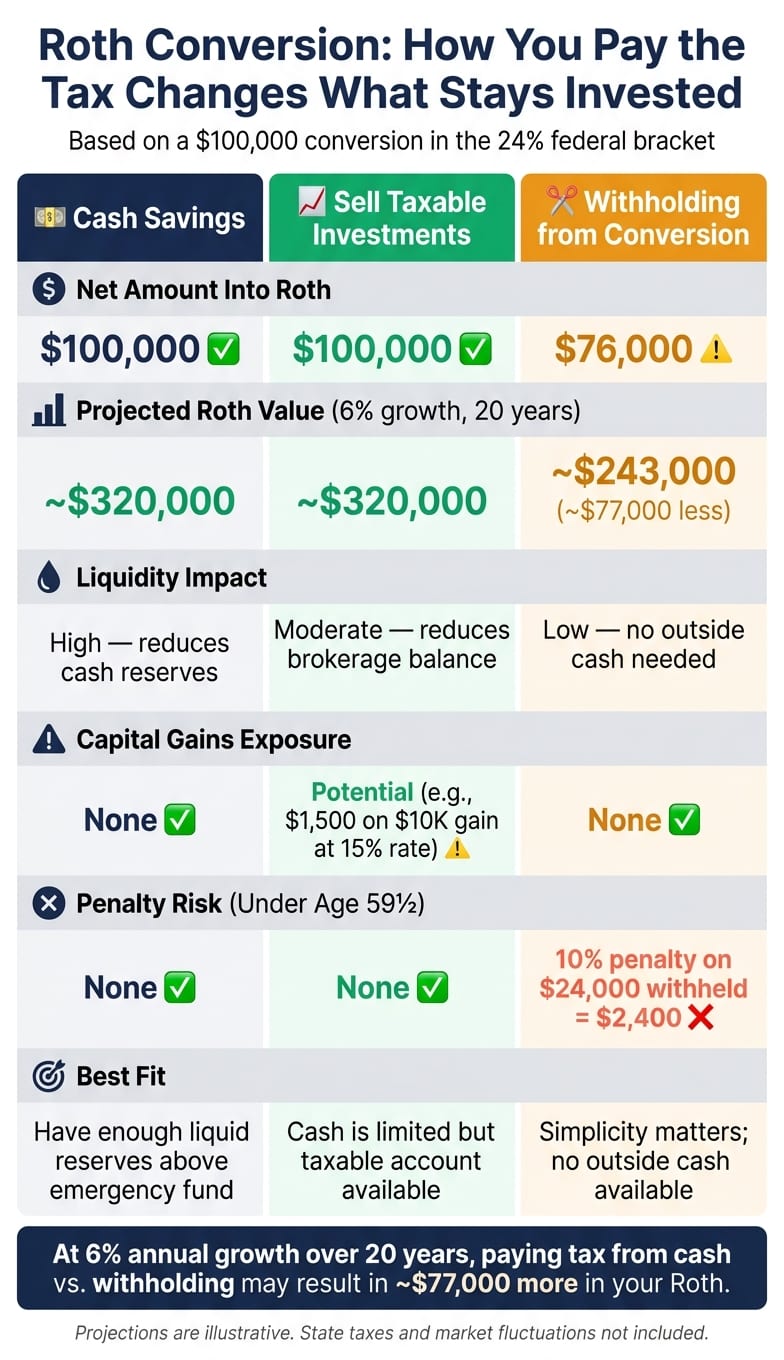
Same $100,000 conversion, three different outcomes
Assumptions: $100,000 conversion, 24% federal bracket, under age 59½; state taxes and market moves excluded.
The difference may build over time. Here’s the same $100,000 conversion laid out side by side.
| Factor | Cash Savings | Selling Investments | Withholding from Conversion |
|---|---|---|---|
| Net amount into Roth | $100,000 | $100,000 | $76,000 |
| Long-term growth | Maximum - the full $100,000 may stay in the Roth and compound | The full $100,000 may still compound in the Roth, but selling appreciated positions may add capital gains tax on top of the conversion tax | Reduced - only $76,000 may remain in the Roth to compound |
| Liquidity impact | High - may reduce cash reserves | Moderate - may reduce your brokerage balance | Low - no outside cash needed |
| Capital gains exposure | None | Potential - depends on embedded gain; selling positions with little or no built-in gain may keep that added cost lower | None |
| Penalty risk (under 59½) | None | None | 10% on the $24,000 withheld = $2,400 |
| Best fit | May make sense when you have enough liquid reserves to cover the tax without straining cash flow | May fit when cash is limited but you have a taxable account to draw from | May fit when simplicity matters or you do not have enough outside cash |
The funding source may come down to a few moving parts: liquidity, tax bracket, age 59½ status, and any embedded gains in the assets you may sell.
How to choose the right funding source
With the tradeoffs on the table, the goal may be to choose the funding source that does the least harm.
Start with liquidity, tax bracket, and age 59½ status
One approach is to start with cash.
Some people first look at cash that sits above their emergency reserve and near-term spending needs. If cash may be tight, taxable holdings may be the next place to check.
Your tax bracket may change how costly withholding feels. In a higher bracket, withholding may take a bigger bite because less of the conversion may end up in the Roth.
Age 59½ is a key cutoff for withholding. If you're under 59½, withholding may trigger a taxable distribution and a 10% penalty.
Check embedded gains and portfolio disruption before selling
Before selling anything, review cost basis.
A large embedded gain may make a sale much more expensive than it first appears. That cost may be worth modeling before you sell.
Selling also isn't always just a clean tradeoff. Sometimes it may do two jobs at once. If a taxable position has grown into an outsized share of your portfolio - say, a single tech stock at 20% of your brokerage account - using the conversion tax bill as a reason to trim it may both fund the tax and reduce concentration risk.
When selling taxable assets moves your portfolio closer to its target allocation, the added capital gains cost may be worth it for some investors. On the other hand, selling well-diversified index funds that already match your target mix just to raise cash may push your allocation off course with no clear offset. After that, check whether the sale changes your overall allocation.
Use connected-account analysis to see the full picture
The picture may get easier to read when you look at all accounts together.
Instead of viewing one account at a time, look across everything at once so you can weigh cash, taxes, and allocation side by side. Those are the three outputs you're trying to balance: Roth balance, outside liquidity, and portfolio mix.
Mezzi is designed to connect your accounts through read-only access and surface insights across your household balance sheet. Mezzi is designed to show the tradeoffs across accounts so you can compare cash, sales, and withholding in one view.
Next, a calculator may help estimate the tax bill before you act.
Tools to estimate the tax bill and next steps
An account-wide view may help test the tax bill before choosing cash, a sale, or withholding.
What a useful Roth conversion calculator should show
Before converting, it may help to run the numbers. A useful calculator should show the tax bill and how much may land in the Roth under each funding method.
It may let you enter your traditional IRA balance, after-tax basis, federal and state tax rates, expected return, and years until withdrawal. Then it may show current tax due, projected Roth value, and the net difference versus leaving the money in a traditional account.[10]
State tax may change the result by a lot. Rates range from 0% to 13.3%, so a calculator needs a state-tax input field.[11]
It also helps to compare three scenarios side by side:
Pay with cash
Sell taxable investments
Withhold from the conversion
One calculator example shows why this matters. On a $100,000 conversion at a 24% tax rate, withholding leaves only $76,000 in the Roth. At 7% annual growth over 20 years, that missing $24,000 starting balance may compound into a meaningful long-term gap.[12]
The tool should separate conversion tax from capital-gains tax on any taxable sale. It should also flag any quarterly estimated-tax requirement and keep conversion tax separate from capital-gains tax on taxable sales.[6][4]
FAQs
Should I pay Roth conversion taxes from outside the IRA?
Many people do. Paying Roth conversion taxes with cash from outside your IRA lets the full converted amount stay in the Roth IRA, which may maximize long-term, tax-free growth.
If you withhold taxes from the converted amount, less money stays invested. And if you're under age 59½, using IRA assets to pay the tax may also trigger a 10% early withdrawal penalty.
When does selling investments make more sense than using cash?
Using cash from non-retirement accounts may be the cleaner option in many cases, since it preserves your Roth IRA balance for tax-free growth.
Selling investments may be more of a fallback when you don't have enough liquid cash on hand. That said, it may also make sense for some people who are already rebalancing their portfolio and want to liquidate underperforming assets while covering the tax bill at the same time.
When possible, some investors avoid using IRA assets. Pulling money from an IRA may reduce long-term compounding, and in some cases it may also trigger a 10% early withdrawal penalty.
How do state taxes and estimated payments affect my choice?
State taxes may change the cost of a Roth conversion by a lot. Some states tax conversions at 0%. Others go as high as 13.3%. That gap alone may shift the math, so it may make sense to check your state's rules before converting.
A Roth conversion may also push your federal tax bill high enough that quarterly estimated payments may come into play. In some cases, people use IRS Form 1040-ES to reduce the chance of penalties. Converting earlier in the year may give you more time to plan for that tax hit instead of scrambling late in the calendar year.
The source of the tax payment matters too. Using outside cash may preserve more money inside the Roth, where future growth may occur. It may also reduce the chance of a possible 10% early withdrawal penalty that may apply if conversion-related taxes are paid from retirement funds.
Disclosures:
This content is for informational purposes only and does not constitute investment advice or a recommendation to buy or sell any security.
Past performance is not indicative of future results. No guarantee of future performance or outcomes is implied.
Savings and performance examples are hypothetical and for illustrative purposes only. Actual results will vary based on individual circumstances, portfolio composition, market conditions, and fees.