
In a low-income year, the first dollars of tax room may matter the most. A Roth conversion may make more sense when future ordinary income may be higher. Realizing long-term capital gains may make more sense when you have low-basis taxable investments and unused 0% capital-gains room. For many people, a split approach may fit better than choosing only one.
Here’s the short version:
Roth conversions add ordinary income now.
Gain harvesting adds long-term capital gains now.
Both may use up the same annual tax room.
A Roth conversion may reduce future RMDs.
Gain realization may reset cost basis in taxable accounts.
Both moves may increase MAGI and may affect IRMAA.
Taxable assets may get a step-up in basis at death; Roth IRAs generally do not.
In 2026, the 0% long-term capital gains rate may apply up to about $49,450 of taxable income for single filers and $98,900 for married filing jointly. The article’s framework also flags 2026 IRMAA thresholds of $109,000 for single filers and $218,000 for married filing jointly.
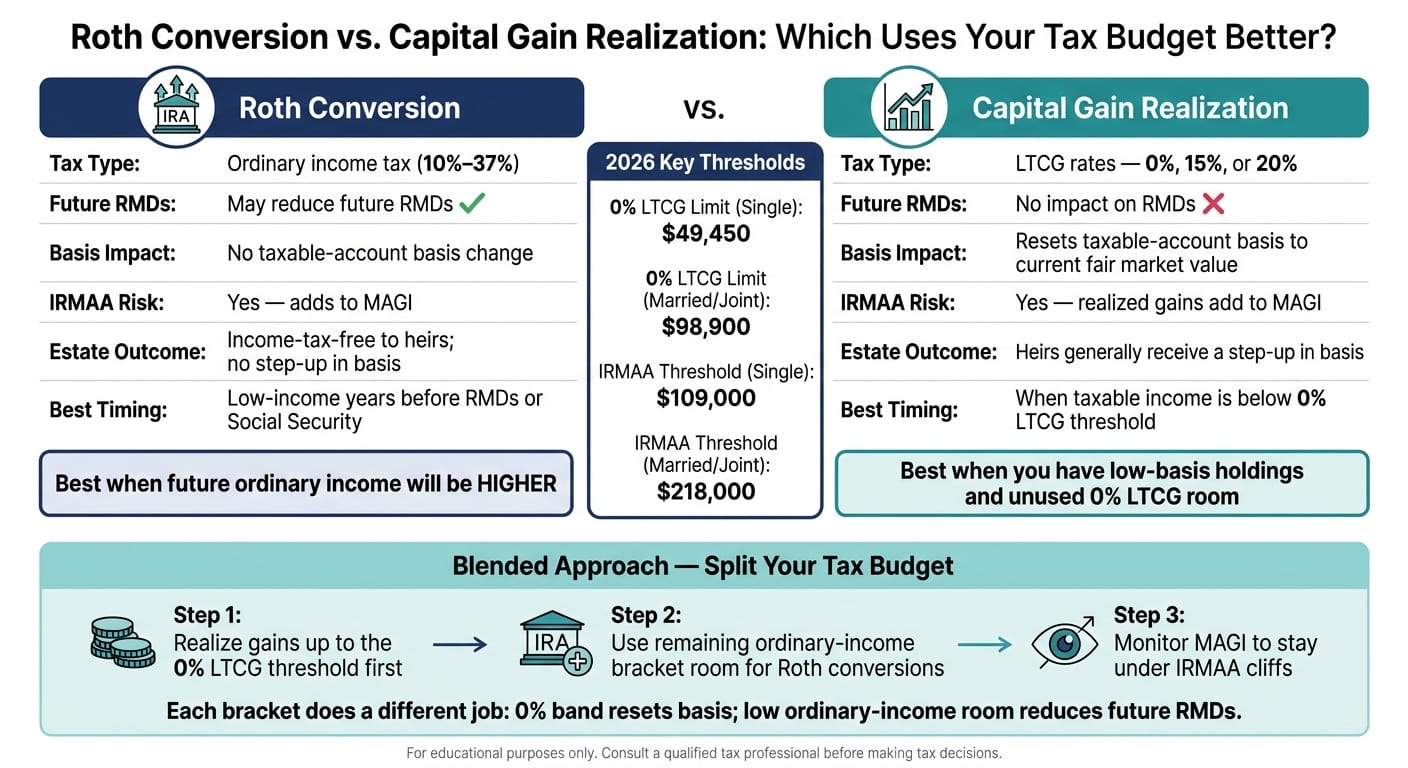
Should You Convert to Roth or Harvest Gains at 0%? Complete Tax Comparison (2026 Strategy)
Quick Comparison
| Move | Tax paid now | What it may do later | Main tradeoff |
|---|---|---|---|
| Roth conversion | Ordinary income tax | May lower future RMDs and build Roth assets | May use up low tax brackets fast |
| Capital-gain realization | 0%, 15%, or 20% LTCG tax | May reset basis in taxable holdings | May use room that might have gone to conversions |
| Blended approach | Mixed | May split the tax budget across both goals | May take more planning |
My takeaway: if someone has unused 0% LTCG room, that space may be worth using first. After that, any remaining room in a low ordinary-income bracket may be used for Roth conversions. But if future RMDs or future tax rates may be much higher, the balance may shift toward conversions.
That’s the core idea of the article: compare both moves against the same tax-year limits, then weigh future income, taxable gains, MAGI thresholds, and estate goals before using that year’s tax budget.
Roth Conversion vs. Capital-Gain Realization: Core Tradeoffs
Roth conversions: pay ordinary income tax now for tax-free withdrawals later
Once the tax budget is fixed, the main question becomes simple: which move may buy more future value?
A Roth conversion shifts pre-tax retirement money into a Roth IRA. You pay ordinary income tax on the amount converted today, and that money may then grow and later be withdrawn tax-free. Over time, one of the main upsides may be smaller RMDs, which may keep taxable income lower in retirement.[2][3][4]
The catch is the upfront tax cost. Converted dollars are taxed at ordinary income rates - 10%, 12%, 22%, 24%, and above - which are often higher than long-term capital gains rates. A large conversion may also push MAGI high enough to trigger IRMAA two years later.[1]
Capital-gain realization: use the 0% or 15% LTCG rate to reset your cost basis
Intentional gain realization means selling appreciated taxable holdings in a low-income year, ideally while those gains still fit inside the 0% or 15% LTCG band. In 2026, the 0% federal long-term capital gains bracket applies up to about $49,450 of taxable income for single filers and $98,900 for married couples filing jointly.[5][7][10] For households with large embedded gains and income below those thresholds, that may create an opening.
The main draw is locking in a lower rate now, so future appreciation starts from a higher basis. That may reduce tax drag when you eventually sell or rebalance. It does not reduce future RMDs, since taxable accounts do not have RMD rules.
How taxable and Roth accounts differ for heirs
Appreciated taxable assets generally receive a step-up in basis at death. In plain English, heirs usually inherit the asset at its fair market value on the date of death, which may erase embedded capital gains built up during the owner's lifetime.[2][6] Roth IRAs work differently. They may pass to heirs income-tax-free, but they do not get a basis step-up because the money has already been taxed.
That sets up a plain tradeoff. Realizing gains now may shrink appreciation that otherwise might disappear through a step-up at death, while Roth IRAs may pass to heirs income-tax-free. This may matter more for people deciding whether a tax budget is better used for their own lifetime flexibility or for what they may leave behind.
| Dimension | Roth Conversion | Capital-Gain Realization |
|---|---|---|
| Current tax rate | Ordinary income (10%–37%) | LTCG rates (0%, 15%, or 20%) |
| Future RMD impact | May reduce future RMDs | No impact on RMDs |
| Higher MAGI can trigger IRMAA two years later | Yes; conversion amount added to MAGI | Yes; realized gains added to MAGI |
| More flexible account mix | Builds a tax-free Roth bucket | Resets basis in taxable bucket |
| Estate consequence | Income-tax-free to heirs; no basis step-up | Heirs generally get a step-up in basis to fair market value |
| Best timing | Low-income years before RMDs or Social Security | When you still have room in the 0% or 15% LTCG bracket |
Those tradeoffs may look different in low-income retirement years, early retirement, and taxable accounts with large gains. The next section tests them in common real-world scenarios.
Which Move Wins in Common Scenarios
The best use of your tax budget may depend on which account may create the larger tax bill over time.
Retirees in low-income years before Social Security or RMDs begin
This stretch may be a good time to use the 0% LTCG band first. After that, any ordinary-income room that remains may be used for conversions.
With no Social Security income, no RMDs, and only modest interest or dividends, some retirees may have room to use both brackets in an efficient way. A common approach is to realize gains up to the 0% capital-gains limit first, then use any leftover ordinary-income room for Roth conversions. In 2026, a married couple filing jointly may realize long-term capital gains up to about $98,900 of taxable income at a 0% federal rate.[13][14] If conversions fill that room first, later gains may spill into the 15% band.
Early retirees expecting higher income later
For households that expect income to move up later - from Social Security, a pension, consulting work, or the start of RMDs from a large pre-tax balance - the math may tilt more toward Roth conversions during the lower-income window.
Roth conversions may make more sense when future ordinary income may push withdrawals or RMDs into higher brackets. In that setup, gain harvesting may still have a place, but only while the 0% band remains open. Roth conversions may also reduce future RMD pressure. For many households, a split approach may fit best: realize gains up to the 0% LTCG threshold first, then use the remaining low-bracket room for conversions, while staying aware of IRMAA exposure.[11][12][15]
Investors with large unrealized gains in taxable accounts
When taxable gains - not retirement balances - are the main constraint, resetting basis may come first.
Waiting for a step-up in basis may make sense only if the position is unlikely to be sold and other assets may cover spending. Otherwise, partial gain realization over time may be a better use of a limited tax budget - especially when an investor expects to spend from the taxable account during life, wants to diversify a concentrated position, or expects future ordinary income to be higher. If the taxable position is the main constraint, the tax budget may be used there first to reset basis. If taxable accounts hold the largest embedded gain, using tax room there may matter more than adding more Roth balance.
| Strategy | Current-Year Tax Cost | Future RMD Effect | Basis Impact | IRMAA Exposure |
|---|---|---|---|---|
| Roth-heavy | Higher (ordinary income tax) | Maximum reduction | No taxable-account basis change; more Roth basis | High; adds to MAGI |
| Gain-heavy | Lower if kept within the 0% LTCG bracket | No reduction | Resets taxable-account basis to current fair market value | Adds MAGI; may still fit inside 0% LTCG room |
| Blended/Split | Moderate | Partial reduction | Partial taxable basis reset and some Roth basis | Managed if sized to stay under IRMAA cliffs |
The blended approach may work well because each bracket may be used for a different job: the 0% LTCG bracket for basis resets, and the remaining low ordinary-income room for Roth conversions.
A Step-by-Step Framework for Allocating Your Annual Tax Budget
After looking at the common scenarios above, you may use this yearly checklist to decide whether Roth conversions or gain harvesting gets first claim on your tax budget.
Start by projecting your ordinary income for the year. Then subtract deductions and measure the room left before you hit the top of your ordinary-income bracket. That gives you your conversion room. Next, calculate your remaining 0% long-term capital gains room on its own by subtracting projected taxable income from the 0% capital-gains threshold. Before you settle on any amount, check MAGI against IRMAA and the 3.8% net investment income tax, since both may affect the result.
Key questions that usually determine the answer
Once you have those numbers, four questions usually point to the likely priority:
Will future income rise before Social Security or RMDs begin? Large pre-tax balances and future RMDs may point to higher ordinary income later. If that looks likely, conversions now may come out ahead.
How large are your unrealized gains in taxable accounts? If you hold concentrated or low-basis positions that you may want to sell during your lifetime, using the 0% LTCG bracket to reset basis may have immediate value.
Are you close to an IRMAA cliff or another income-sensitive threshold? If so, both conversions and large gain realizations may need to be reduced or spread across multiple years.
Are you optimizing for lifetime spending or for heirs? That difference may shift the math quite a bit, depending on your estate goals.
Compare Roth-heavy, gain-heavy, and blended outcomes side by side.
When splitting the tax budget beats choosing just one move
For many households in retirement transition years, the answer may not be all-or-nothing. A blended approach - realizing gains up to the 0% LTCG threshold first, then using any room left in your ordinary-income bracket for Roth conversions - lets each part of the tax budget do a different job. The 0% band resets basis. The ordinary-income room that remains may reduce future RMDs.
If neither move stands out, splitting the tax budget between both may make sense. The table below maps common situations to a likely starting point:
| Fact Pattern | Key Characteristics | Likely Priority |
|---|---|---|
| Early retiree, low income, modest taxable gains | Temporarily low income, meaningful pre-tax balances | Roth conversion |
| Retiree before RMDs, large pre-tax balances | Large future RMDs expected, higher brackets likely later | Roth conversion |
| Retiree with large low-basis taxable holdings, in 0% LTCG range | Significant unrealized gains, moderate pre-tax balances | Gain harvesting |
| Couple near IRMAA threshold, moderate pre-tax and taxable gains | MAGI close to Medicare premium tier, limited room before cliff | Blended |
| New single filer after spousal death, large inherited pre-tax accounts | Higher single-filer rates, RMD pressure | Roth conversion |
| Investor still working, high current bracket | High wages now, lower expected retirement income | Defer major moves |
The right mix may depend on current balances, income, and bracket room, which may be easier to evaluate in one place. Mezzi is designed to pull your 401(k), IRA, Roth, and taxable balances into one view so you can run this checklist using current numbers.
Conclusion: Real Account Data May Help You Compare the Two Moves
The better move may depend on your current income, account mix, future tax brackets, and thresholds like IRMAA. The fastest way to compare the two may be to test both against the same year's tax room, especially how much ordinary-income room remains versus how much unused 0% LTCG room you have.
Mezzi is designed to connect your IRA, Roth IRA, 401(k), and brokerage accounts in one view. That may show your remaining bracket room, low-basis positions, and how a conversion or gain realization may affect MAGI and IRMAA relative to the 2026 thresholds of $109,000 for single filers and $218,000 for married filing jointly[19]. Without connected account data, that level of detail may be tough to see.
Mezzi provides educational guidance only and is not tax, legal, or investment advice; review major moves with a qualified tax professional.
Here's the shortest way to apply the framework.
4 key takeaways
1. Every tax-budget dollar is scarce. You may recognize only so much income or gains each year before moving into a higher marginal rate or crossing a threshold like IRMAA. So each tax dollar you choose to pay now may deserve a deliberate look.
2. Roth conversions may help most when future ordinary income may be higher. Converting during lower-income years may reduce lifetime taxes and may shrink future forced distributions.
3. Realizing gains may help most when you have low basis and unused 0% long-term capital gains room. If taxable income stays below $49,450 (single) or $98,900 (married filing jointly) in 2026, harvesting gains to reset basis may fit inside the 0% federal rate[16][17][18][8][9].
4. For many households, splitting the annual tax budget between the two may fit, based on bracket room and future tax exposure. Some households may divide that tax budget across both moves. The right split may depend on your actual numbers, not assumptions.
FAQs
How do I split my tax budget between both moves?
First, estimate your baseline MAGI. That may include income sources like Social Security, dividends, and interest. Then subtract that number from your target tax-bracket ceiling and IRMAA threshold to see how much room you may have for Roth conversions and capital-gain realization.
Because both may increase taxable income, many people sort them by long-term tradeoffs. Roth conversions may make more sense in lower-income years. Capital gains may come first if rebalancing is part of the goal. It may also make sense to leave a $2,000 to $10,000 buffer for unexpected income near year-end.
When does a Roth conversion beat the 0% capital gains rate?
A Roth conversion does not automatically beat the 0% long-term capital gains rate. The two moves do different jobs, and they’re taxed in different ways.
A Roth conversion may be taxed as ordinary income. That may increase adjusted gross income, may move someone into a higher tax bracket, or may trigger Medicare IRMAA. By contrast, if taxable income qualifies for the 0% long-term capital gains rate, realizing gains may be the more tax-efficient move for some people.
How close can I get to IRMAA without going over?
To stay below an IRMAA threshold with some cushion, some people aim to keep their MAGI about $2,000 to $5,000 under the next tier. IRMAA works like a cliff, so going over by even $1 may trigger the full surcharge for the year.
To estimate your room, subtract your projected baseline MAGI from your target IRMAA threshold, then subtract your buffer. MAGI includes taxable income plus tax-exempt interest, and the standard deduction does not reduce it.
Disclosures:
This content is for informational purposes only and does not constitute investment advice or a recommendation to buy or sell any security.
Mezzi provides educational guidance only and is not tax, legal, or investment advice; review major moves with a qualified tax professional.
Past performance is not indicative of future results. No guarantee of future performance or outcomes is implied.