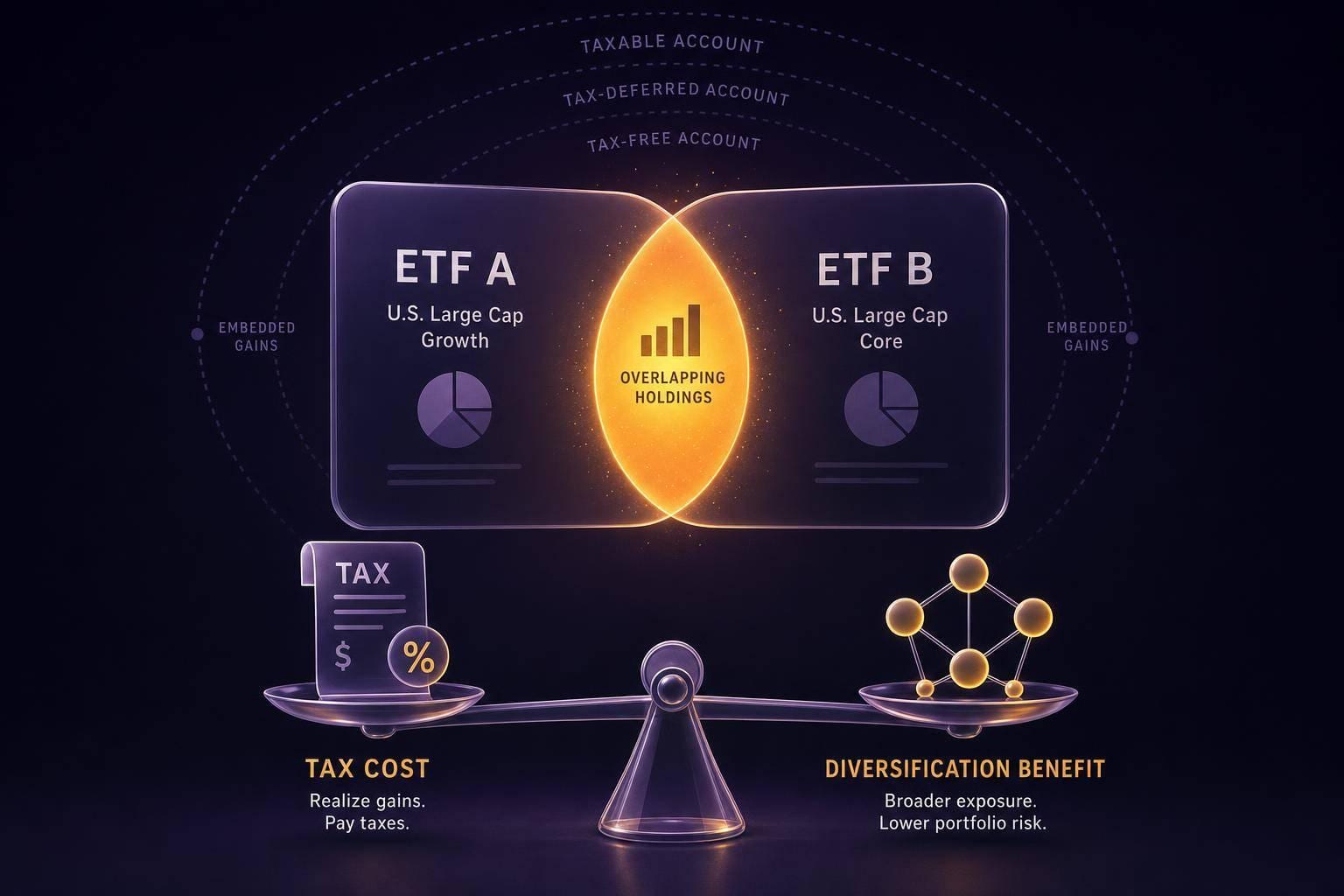
If two ETFs overlap a lot, selling one may not make sense if the tax bill is high. In many cases, the better question may be: how much new diversification do I get after paying taxes?
Here’s the short version:
VOO, IVV, and SPY may be near-duplicates because they track the same S&P 500 index.
VOO and SPY may overlap by about 96% by weight.
SCHD and VYM may look similar, but they may share only about 19% by weight.
In a tax-advantaged account, selling a duplicate ETF may be simpler since current capital gains tax may not apply.
In a taxable account, a sale may trigger capital gains tax and, for some investors, NIIT, which may wipe out much of the cleanup value.
Some investors skip the sale and instead:
send new money to the fund they want to keep
redirect dividends
use tax-loss harvesting when losses are available
The main idea is simple: high overlap alone may not be enough reason to sell. If the funds are almost the same, the diversification gain may be small. If the embedded gain is large, the tax cost may be larger than the payoff.
Quick Comparison
| Pair or situation | What it may mean |
|---|---|
| VOO vs. SPY | Near-duplicate exposure |
| VTI vs. ITOT | Near-duplicate total-market exposure |
| VTI vs. VOO | High overlap, but VTI may add mid- and small-cap stocks |
| SCHD vs. VYM | Similar theme, but different stock mix |
| High overlap in IRA/401(k)/Roth | Consolidation may be easier |
| High overlap in taxable with large gains | Holding and redirecting new money may make more sense for some investors |
So before selling, I’d frame it this way: compare the tax bill with the small slice of diversification you may gain. That single check may keep a cleanup move from becoming an expensive one.
The ETF Overlap Nobody's Talking About
How to tell if your ETFs are actually redundant
Before you sell, check whether the overlap is real. Similar fund names don't always mean you own the same thing.
Use weighted overlap, not just shared holdings
Counting shared holdings is a weak way to test redundancy. A 0.05% position and a 7% position both show up as one shared holding, but they may affect your portfolio in very different ways. Weighted overlap is a better yardstick. It looks at what share of your money in each fund may be duplicating the same exposure. To calculate it, add the smaller weight for each shared stock. The result shows how much of your portfolio may be duplicated.
The better question isn't how many tickers match. It's how much of your portfolio overlaps.
VOO and SPY overlap about 96% by weight.[7] VTI and ITOT overlap about 93%.[7] VTI and VOO overlap in the high 80s because VTI includes mid- and small-cap stocks that VOO doesn't hold.[7][8] Owning either of the first two pairs may amount to paying two expense ratios for what may be one exposure.
When overlap is harmless versus when it is just duplication
Overlap by itself doesn't tell you whether to act. These ranges may work as a screen, not a final verdict. Context still matters.
| Overlap Range | What It Usually Means for Broad U.S. ETFs |
|---|---|
| Above 70–80% | Likely duplication for broad U.S. equity ETFs[2][6] |
| 40–70% | Worth reviewing; may be intentional or manageable[6] |
| Below 40% | Usually complementary; distinct exposures[2][3] |
Overlap may matter less when one fund adds a real tilt or when account rules may limit your choices. When two funds fill the same role - for example, two broad U.S. large-cap index funds - overlap above roughly 70–80% may be a strong sign that one is redundant.[4][5] You may not be getting more diversification. You may just be adding more complexity.
But when one fund adds a clear tilt - small-cap, value, international, or sector exposure - overlap in the 30–50% range may be intentional. In that case, the shared holdings may simply make up the core, while the non-overlapping slice may add the extra exposure.
How Mezzi's X-Ray can review all accounts at once
Most investors don't hold every ETF in one place. They may have a total-market ETF in a taxable brokerage account, an S&P 500 fund in a 401(k), and another broad ETF in a Roth IRA. That's why portfolio-level overlap may matter more for a sell-or-hold call, especially across taxable and retirement accounts.
Mezzi's Portfolio X-Ray connects taxable, traditional IRA, Roth IRA, and 401(k) accounts with read-only access. It shows overlapping holdings, top holdings across accounts, and which ETFs may add distinct exposure.
Once you know where the overlap is real, the next step may be weighing the tax bill against the diversification gain.
Selling now versus keeping the overlap: a direct comparison
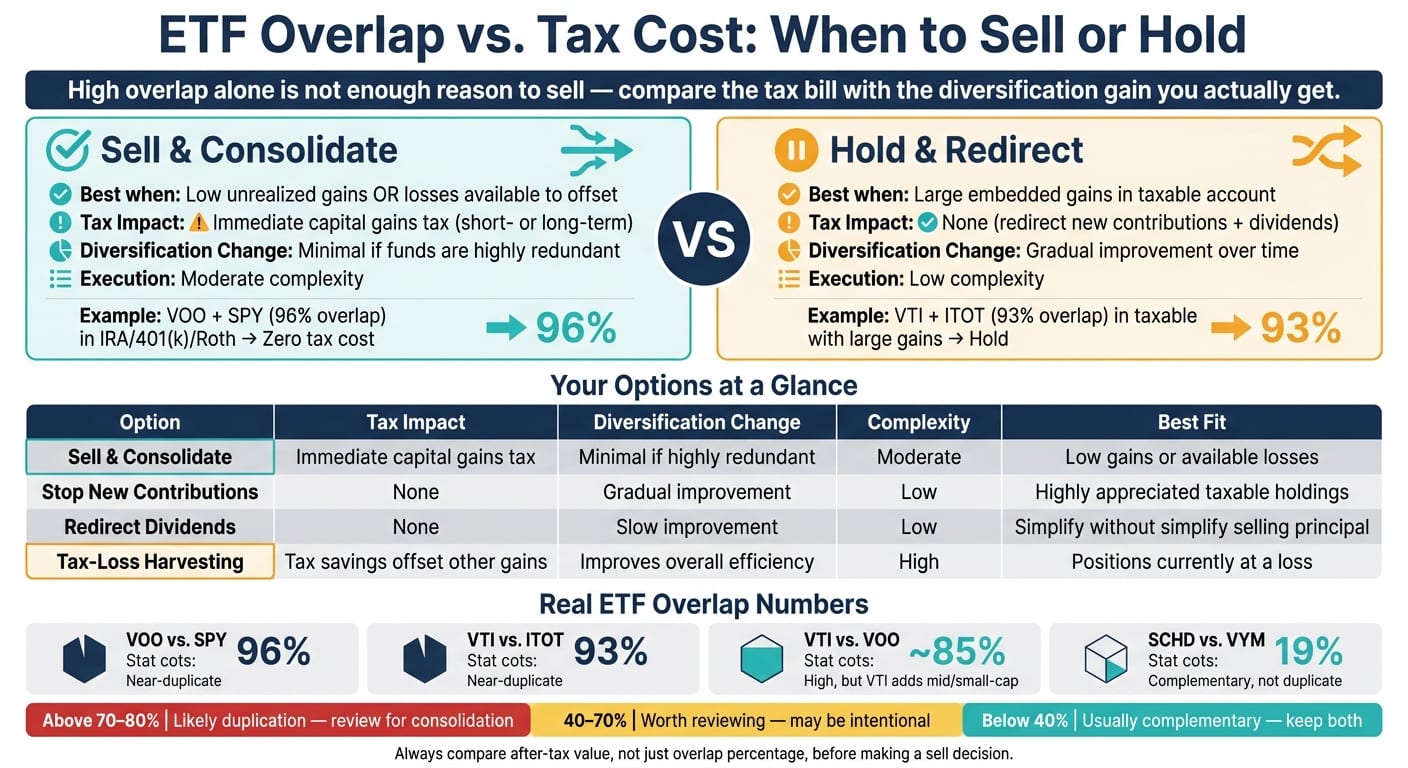
Once you confirm the overlap is real, the next step may be pretty simple: compare the tax cost of selling with what you’d gain from consolidation. In plain English, you’re weighing two sides before making a sale.
In a taxable brokerage account, selling may trigger capital gains tax and NIIT. In a traditional IRA, Roth IRA, or 401(k), no current capital gains tax may be due.
The diversification benefit you get from consolidating
A lot of investors may overrate how much diversification they’d gain. VTI and ITOT overlap by about 93% by weight[7], so merging them into one total-market fund may change almost nothing about your risk exposure. If the funds track the same index, consolidation may lower cost, but it may not change risk in a meaningful way. The clearest upside may be this: moving from a higher-cost fund to a lower-cost one may reduce your annual expense ratio while keeping the same exposure.
Now compare that with a case where one fund adds a different tilt. SCHD and VYM are both dividend ETFs, but they overlap by only about 19% by weight because one screens for quality and dividend growth while the other targets high current yield[1]. Selling one of those to tidy things up may remove complementary exposure, not just duplication.
So the value of selling may depend almost entirely on what you’re consolidating.
When the tax cost outweighs the cleanup benefit
The hardest case tends to be a taxable holding with a large embedded gain and two broad-market ETFs that overlap a lot. The overlap may be high, but the cost to exit may be high too. In that setup, a one-time sale may not be worth it for some investors.
| Option | Tax Impact | Diversification Change | Execution Complexity | Best Fit |
|---|---|---|---|---|
| Sell & consolidate | Immediate capital gains tax (short- or long-term) | Minimal if funds are highly redundant | Moderate | Low unrealized gains or available losses |
| Stop new contributions | None | Gradual improvement over time | Low | Highly appreciated taxable holdings |
| Redirect dividends | None | Slow improvement | Low | Simplify without selling principal |
| Tax-loss harvesting | Potential tax savings that may offset other gains | May improve overall efficiency | High (requires monitoring wash sales) | Positions currently at a loss |
Stopping new contributions to the redundant fund may cost nothing today and may slowly shift your balance toward the fund you plan to keep. Redirecting dividends works in much the same way, just at a slower pace. And if you have other positions at a loss, harvesting those losses first may offset some of the gain from selling the overlapping ETF and may reduce the tax hit.
That gap between tax cost and cleanup benefit may be the thing to measure if you’re deciding whether to simplify now or wait.
A step-by-step framework for deciding what to do with high-overlap ETFs
Once weighted overlap suggests the funds may be doing almost the same job, the next step is deciding whether cleaning that up may be worth the tax hit. A simple way to think about it: look at the overlap level, the embedded gain, and the account type together.
| Scenario | Approach Some Investors Consider | Diversification gain | Tax Cost Now |
|---|---|---|---|
| High overlap (>70%), tax-advantaged account | Consolidating into the lowest-expense-ratio fund | High - may eliminate redundancy | Zero |
| High overlap (>70%), taxable account, low gains or losses | Selling the redundant fund, possibly alongside tax-loss harvesting | High - may improve portfolio efficiency | Low or offset by losses |
| High overlap (>70%), taxable account, large gains | Holding existing shares and sending new contributions to the fund they want to keep | Low - the tax bill may outweigh the cleanup benefit | High - immediate capital gains tax |
| Moderate overlap (40–70%), any account | Monitoring; simplifying may be considered if one fund has a meaningfully higher expense ratio | Moderate | Varies by account type |
| Low overlap (<40%), any account | Keeping both | None - funds are already complementary | N/A |
When simplifying usually makes sense
High overlap in a tax-advantaged account may support consolidation because there may be no current tax bill. In that setup, removing a duplicate fund may be fairly straightforward.
When holding both is better
In taxable accounts with large embedded gains, holding the current shares and directing new contributions to the fund you want to keep may make more sense. That approach may lower overlap over time without creating an immediate capital gains tax bill.
Ways to reduce overlap without a large sale
Some investors use a slower approach instead of selling all at once. That may include:
Sending new contributions to the fund they plan to keep
Reinvesting dividends in the preferred fund
Using tax-loss harvesting when losses are available
This kind of gradual cleanup may trim overlap while limiting taxes in the near term.
Conclusion: Selling may make sense only when the diversification gain beats the tax cost
Holding two near-identical ETFs may add little diversification, but selling in a taxable account may trigger a tax bill that’s larger than any diversification gain. So this choice may be less about cleaning things up and more about after-tax value.
The core question is simple: Does consolidation improve the portfolio enough to justify the tax cost? With broad U.S. index funds, removing duplicate tickers may do less than people expect when it comes to true weighted overlap or diversification.
Some investors may consolidate more freely in tax-advantaged accounts. In taxable accounts with large gains, holding may often make more sense. Another path some people use is to direct new contributions to the fund they want to keep, instead of selling right away.
That’s the standard here: selling may make sense only when the diversification gain beats the tax cost. If it doesn’t, keeping both funds may be a reasonable choice when the overlap is intentional.
FAQs
How do I calculate weighted overlap between two ETFs?
Identify the holdings both ETFs may share, then apply each holding’s weight based on its share of your total portfolio.
In practice, that means pulling each fund’s holdings and weights, finding the securities that appear in both, and then adding up your weighted exposure to those same stocks. That may show two things at once:
how many holdings overlap
how much of your portfolio may be concentrated in those overlapping positions
It’s a simple idea, but it may change the picture. Two ETFs may look different on the surface, yet still hold many of the same names under the hood.
How can I estimate the tax bill before selling an overlapping ETF?
In a taxable brokerage account, you may estimate your tax bill by calculating your capital gain: sale price minus cost basis. If you held the shares for more than 1 year, the gain may be treated as long-term. If you held them for 1 year or less, it may be treated as short-term.
It also may make sense to factor in any capital-gains distributions you already owe, along with whether losses in other parts of your portfolio may offset gains. If losses exceed gains, up to $3,000 may be used against ordinary income.
One more thing: some investors try to avoid triggering a wash sale by not buying substantially identical holdings within 30 days.
When is it better to keep overlapping ETFs instead of consolidating?
It may make sense to keep overlapping ETFs if selling them would trigger an immediate tax bill that may outweigh the diversification benefit of simplifying your holdings.
That may be especially relevant in taxable accounts. Keeping overlapping funds may also be a practical way to mix broad market exposure with a more specific growth strategy, such as pairing a total market fund with a large-cap fund.
Disclosures:
This content is for informational purposes only and does not constitute investment advice or a recommendation to buy or sell any security.
Past performance is not indicative of future results. No guarantee of future performance or outcomes is implied.
Savings and performance examples are hypothetical and for illustrative purposes only. Actual results will vary based on individual circumstances, portfolio composition, market conditions, and fees.