
Selling the same 100 shares at the same price may lead to a very different tax result. In a taxable account, the main difference often comes down to which tax lot gets sold and whether that lot may be short-term or long-term.
Here’s the short version:
FIFO usually means your broker sells your oldest shares first
Specific share identification means you pick the exact shares to sell
That choice may change your cost basis, gain or loss, and holding period
A sale may be taxed one way at 11 months and another way at 13 months
If you don’t choose lots in time, FIFO may apply by default
The trade record matters just as much as the trade itself
A few examples from the article make the point fast:
Sell shares bought at $20 when the stock trades at $50, and you may report a $3,000 gain on 100 shares
Sell shares bought at $60 at that same $50 price, and you may report a $1,000 loss
Sell a $25 lot instead of a $40 lot at a $60 sale price, and the reported gain may shift from $3,500 to $2,000
That’s the core idea: same stock, same sale date, same number of shares - but a different tax result may follow from a different lot choice.
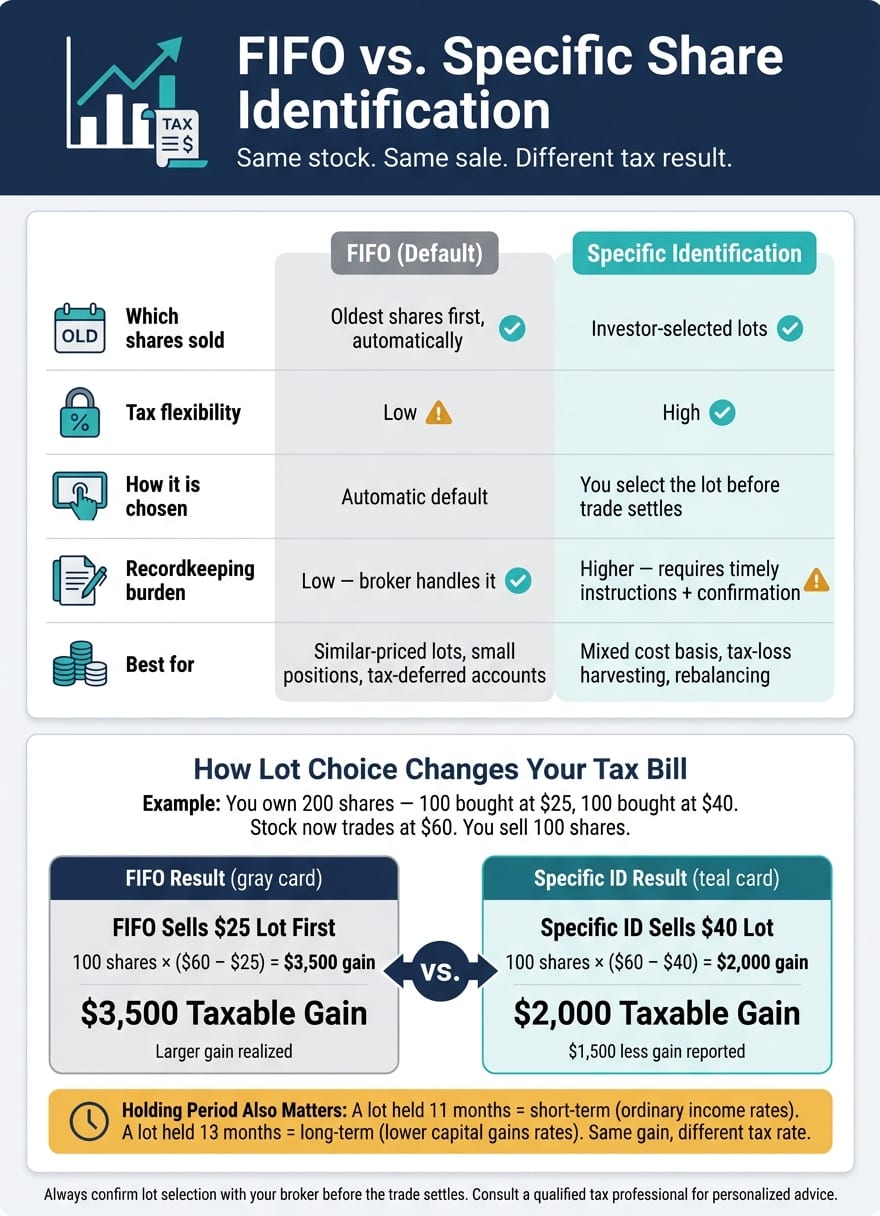
Quick Comparison
| Method | How shares are chosen | Tax flexibility | Main tradeoff |
|---|---|---|---|
| FIFO | Oldest shares first | Lower | Less control over gain, loss, and holding period |
| Specific Identification | Exact lots chosen by the investor | Higher | More recordkeeping and broker confirmation |
If I were boiling the full article down to one line, it would be this: lot selection may shape your tax bill, so the sale order may be worth checking before the trade settles.
Specific share identification vs. FIFO: how each method works
These two methods differ in one main way: one lets you choose the lot, and the other follows a default order. That choice may determine which gain or loss gets realized when shares are sold.
Specific share identification: you pick the exact lots
With specific share identification, you tell your broker which tax lots to sell by purchase date and share count before, or at the time of, the trade. The gain or loss is then figured using the cost basis of those exact shares, rather than an average cost or a default sale order.[4][7]
Here’s a simple example. Say you own 300 shares of a stock:
100 bought at $20
100 bought at $40
100 bought at $60
If the current price is $50, you may specifically identify the $60 lot. Selling those shares would produce a $1,000 realized loss instead of a gain.[8] If you choose the $20 lot instead, and that lot has been held long-term, the sale would create a $3,000 long-term gain taxed at capital gains rates.[8]
The election has to be made by the time of sale and confirmed by the broker. If that doesn’t happen, FIFO generally applies.[6][3]
FIFO: the oldest shares are sold first by default
FIFO (First In, First Out) applies automatically when you don’t specify lots.[5] Under this method, the broker sells your oldest shares first. If a stock has gone up over time, those earlier lots often have the lowest cost basis, which may mean a larger taxable gain.
Using the same 300-share example, FIFO would sell the 100 shares bought at $20 first. At a $50 sale price, that would produce a $3,000 long-term gain.[8] Same number of shares. Same sale price. But a very different tax result from specific identification.
Side-by-side comparison: control, flexibility, and recordkeeping
The contrast stands out pretty fast when you put the two methods next to each other.
| Feature | FIFO | Specific Identification |
|---|---|---|
| Which shares are sold | Oldest shares first, automatically | Investor-selected lots |
| Tax flexibility | Low; often triggers larger gains in rising markets | High; target gains, losses, or holding periods |
| How it is chosen | Automatic unless you select lots | You select the lot |
| Recordkeeping burden | Low; broker handles it automatically | Higher; requires timely instructions and written confirmation |
FIFO may feel simpler. Specific identification may offer more control over gain, loss, and holding period, which may shape the tax tradeoffs discussed below.
How the tax result changes depending on which method you use
Example: selling 100 shares bought across multiple dates and prices
Say you own 200 shares of a stock in a taxable brokerage account. You bought them in two lots: 100 shares at $25 and 100 shares at $40. The stock now trades at $60, and you want to sell 100 shares.
Under FIFO, the $25 lot gets sold first. That sale creates a realized gain of $3,500 (100 × $35).
Under specific identification, you may choose the higher-cost lot instead - the 100 shares bought at $40. In that case, the gain may be $2,000 (100 × $20). Same stock. Same sale size. Different tax result. The only change is which lot gets matched to the sale.[11][12][13]
Short-term vs. long-term treatment can matter more than the share price
Share price sets the size of the gain. Holding period may shape how that gain is taxed.
If one lot was bought 11 months ago and another was bought 13 months ago, and both have the same unrealized gain, selling the 11-month lot may trigger a short-term gain taxed at ordinary income rates. Selling the 13-month lot instead may qualify for long-term capital gains rates, which are generally lower for most U.S. taxpayers.[1][2] In cases like this, holding period may matter just as much as cost basis.
The holding period starts the day after purchase. Day 365 is still short-term. Day 366 is long-term.[9]
After-tax tradeoffs beyond this year's tax bill
This choice also changes the basis of the shares left in your account.
Picking the highest-cost lots today may reduce your current tax bill, but it also leaves lower-basis shares behind. If those shares are sold later, tax may still apply at that point. For some people, that may reduce this year's tax bill if they expect a lower tax rate in a future year. It may also line up with loss carryforwards or charitable donations of appreciated shares.[10]
On the flip side, if someone wants to realize gains this year to offset available losses, selling a lower-basis lot on purpose may make more sense.
Selling shares without paying attention to which lot gets sold may lead to a larger gain than needed. It may also leave fewer choices later if you need to rebalance or raise cash.[12]
When specific identification helps and when FIFO is fine
Situations where specific identification tends to reduce taxes
Once lot choice may affect both your gain and your holding period, the next step is pretty simple: when is specific identification worth the extra hassle?
It tends to matter most when your lots have big gaps in cost basis. In those cases, the shares you pick may change the tax outcome of a single sale by a meaningful amount. Some investors use specific identification when they want to trim a position that has gone up, sell a lot that sits at a loss, or pick shares held for more than one year so the sale may qualify for long-term treatment.
This tends to come up with concentrated positions that were built over time at different prices. If the lots carry mixed cost bases, it may make sense to review them before placing a sale. Otherwise, you may end up selling shares that create a larger taxable gain than expected.
Situations where FIFO may be acceptable or unavoidable
FIFO may be perfectly fine when the lots were bought at roughly similar prices, when you're selling a small position, or when the trade happens inside a tax-deferred account where lot selection may not affect current taxes.
There are also cases where FIFO becomes the default, whether you like it or not. If your broker does not accept lot instructions before settlement, FIFO may apply automatically.
Use the table below to line up the sale type with the method that may fit best.
Decision table: which method fits common sell scenarios
| Scenario | Likely better method | Tax reason | Main risk |
|---|---|---|---|
| Rebalancing a taxable portfolio | Specific identification | Sell the highest-cost lots first to reduce gain | More recordkeeping and broker steps |
| Tax-loss harvesting | Specific identification | Choose the loss lot directly | Wash-sale rule if you repurchase too soon |
| Cash withdrawal from a mixed-basis position | Specific identification | Limit gains by selecting higher-basis shares | You must select lots before settlement |
| Older low-basis holdings | Specific identification | Avoid unintentionally selling the oldest, largest-gain shares | FIFO may realize a larger gain |
| Lots bought at similar prices | FIFO may be fine | Tax difference between lots is minimal | Slightly less control over which gain or loss is realized |
| Selling out of a small position | FIFO may be fine | Simplicity outweighs precision when the dollar difference is small | Marginally higher tax bill in some cases |
What to check at your brokerage and how Mezzi can help you review the decision
Check your lot-selection settings before the trade settles
After you decide which tax result you want, the next step is making sure the broker sells the right lot. The tax value of specific identification may only apply if the brokerage records the exact shares you meant to sell.
Once you know which shares you want to sell, check that the broker may execute that lot, not FIFO by default. Go to your brokerage's cost basis or tax settings page - often labeled "Cost Basis Method", "Tax Preferences," or "Gain/Loss" - and confirm the current default. At order entry, choose lots per trade if your broker allows it.
Look for a lot-selection tool labeled something like "Choose lots", "Select tax lots," or "Spec ID." The preview should list the exact lots sold: date, share count, and cost basis. If the preview only says "FIFO" or "oldest shares," specific identification may not be in effect. Screenshot or save the preview before confirming the order; that record may serve as documentation if questions come up later.
Review confirmations, cost basis records, and year-end tax forms
The job isn't finished when the order fills. The records need to match the lot you chose.
After execution, check the trade confirmation, realized gain/loss report, and remaining tax lots. Confirm the holding period classification - short-term or long-term - matches what you expected. If a sale you expected to be long-term shows as short-term, the broker may have sold the wrong lot.
Also verify that the lots you sold are gone and the ones you kept still appear with their original purchase dates and cost basis intact. It may be easier to catch mismatches now, before they show up on Form 1099-B.
Conclusion: pick the lot on purpose, then document it
Lot selection only matters if the broker executes it correctly, so check the trade record and keep proof.
FIFO may realize a larger gain than you intended, especially when your oldest lots have the lowest cost basis. Specific identification may give you more control over which gain or loss you realize and whether the sale may qualify for long-term treatment, but that control may only work if you select the lots at order entry and verify that the brokerage processed it correctly.
Mezzi may support the planning side of this process. Mezzi may surface cost basis, purchase dates, unrealized gains or losses, long-term thresholds, tax-loss candidates, and wash-sale risk - when you've recently bought the same or a very similar position in another account - in one view. Choose the lot on purpose, verify the fill, and save the proof for tax time.
The tax considerations in this article are general educational information. Tax outcomes depend on your situation, and brokerage platforms vary in how they implement lot selection. Consult a qualified tax professional for guidance tailored to your situation.
FAQs
How do I choose tax lots at my brokerage?
Check your account’s unrealized gains and losses report to review each lot’s purchase date, cost basis, and current gain or loss.
When you place a trade, look for specific identification or specified lot. That option may let you pick the exact shares to sell instead of using the default FIFO method.
If you place the order by phone, you may tell your broker which shares to sell based on purchase date and price.
When does a gain become long-term?
A gain becomes long-term when you’ve held the investment for more than one year. If you held it for one year or less, it’s short-term.
That distinction may matter for taxes. Long-term capital gains may be taxed at lower rates - 0%, 15%, or 20% - while short-term gains may be taxed at ordinary income rates.
Should I always use specific identification?
No. Specific identification may give you more control over tax-loss harvesting and capital gains, but it also calls for careful record-keeping and clear instructions to your brokerage. If something gets missed, unexpected tax issues may follow.
Many investors prefer simpler methods like FIFO or average cost in tax-deferred retirement accounts. In taxable accounts, specific identification may be useful if you’re able to track your tax lots closely.
Disclosures:
This content is for informational purposes only and does not constitute investment advice or a recommendation to buy or sell any security.
Tax outcomes depend on your individual circumstances. Consult a qualified tax professional for guidance tailored to your situation.
Past performance is not indicative of future results. No guarantee of future performance or outcomes is implied.