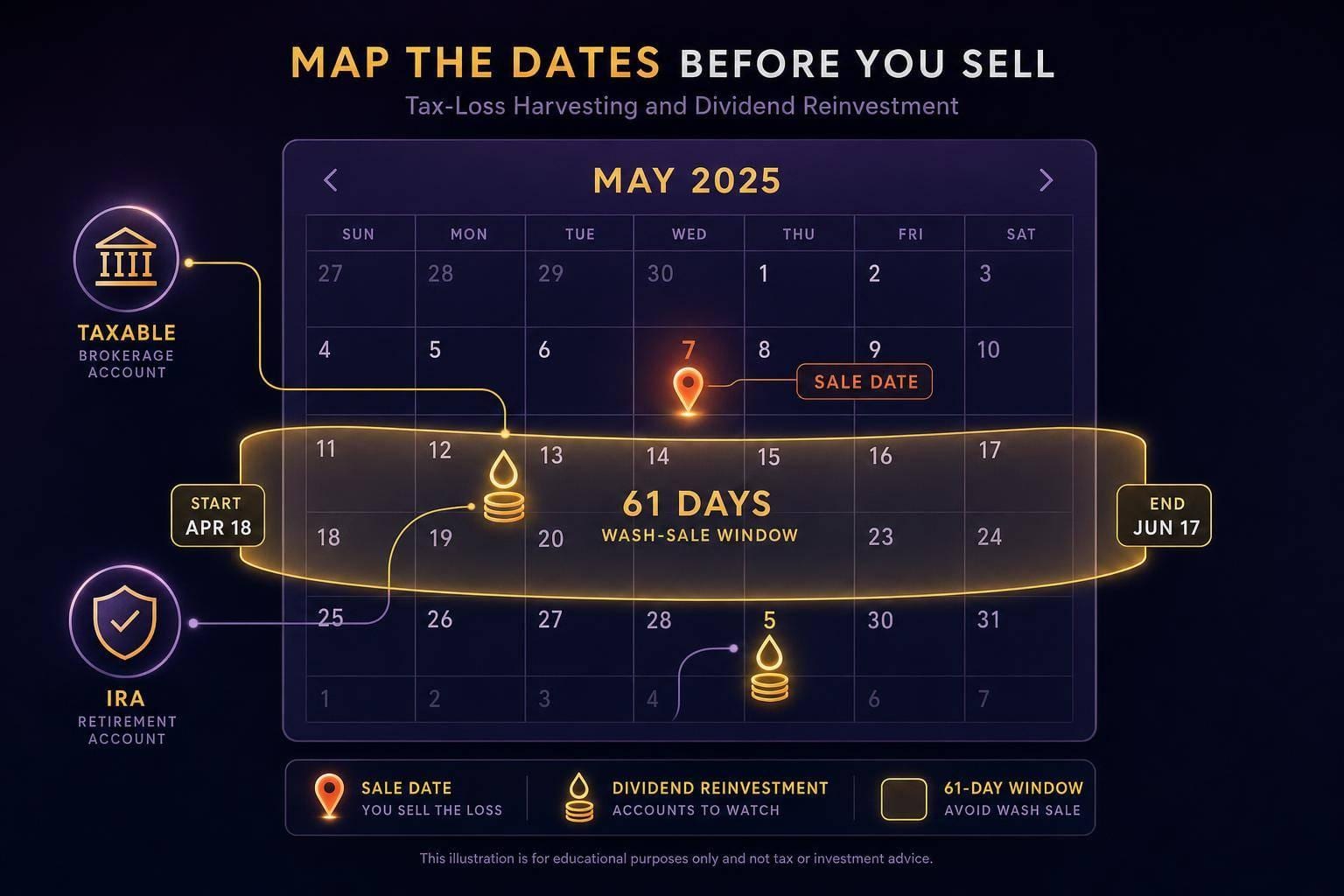
A tax loss may be reduced by a tiny dividend reinvestment. If I sell at a loss and a DRIP buys even a fractional share within the 61-day wash sale window - 30 days before, the sale date, and 30 days after - part of that loss may be disallowed.
Here’s the short version:
DRIP shares may count as purchases, even if I did nothing manually.
The reinvestment date may be the date that creates wash sale risk, not the record date.
The rule may apply across all my accounts - taxable, IRA, spouse accounts, and other brokers.
In a taxable account, a disallowed loss may be added to the basis of replacement shares.
In an IRA, that same disallowed loss may be lost for tax purposes.
Selling on 09/19/2026 may mean the first cleaner rebuy date is 10/20/2026, if no other matching buys happened inside the window.
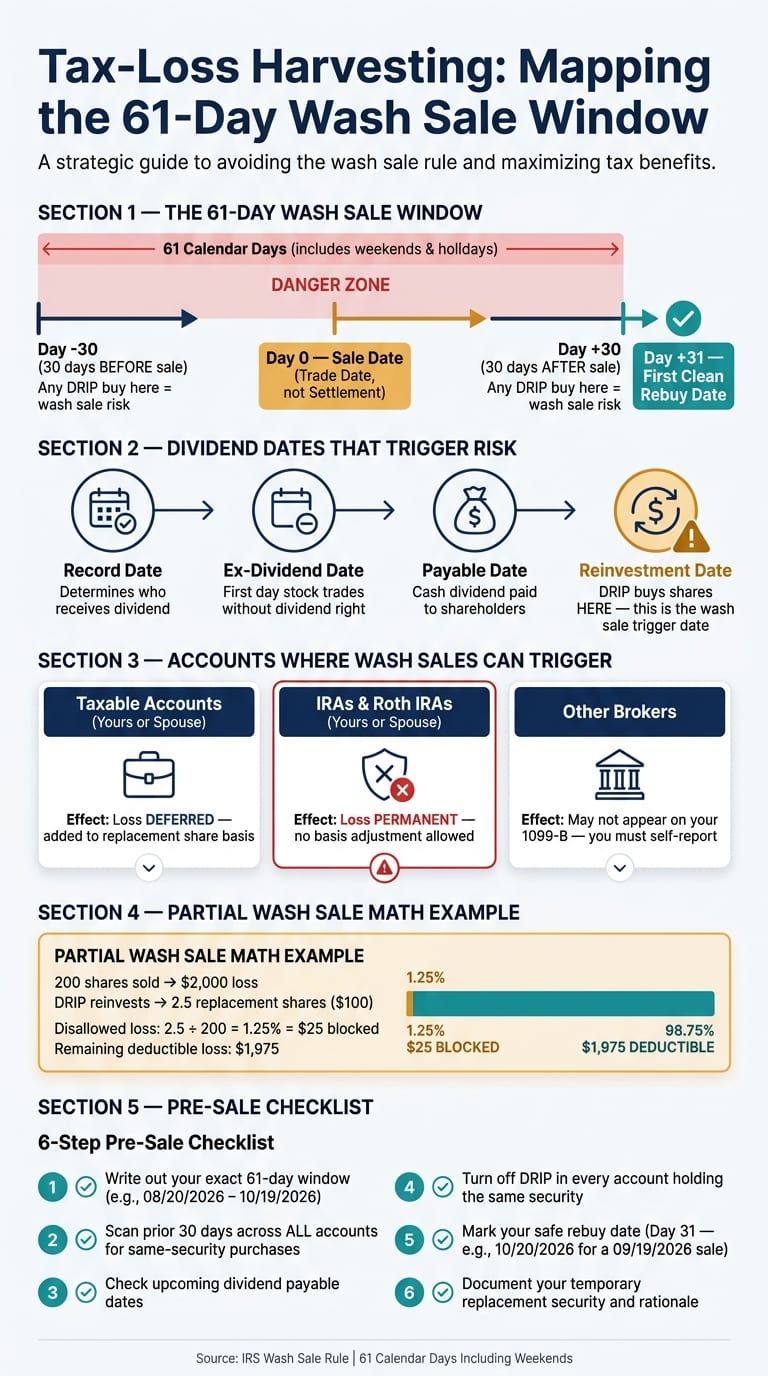
A small example shows the issue fast: if I sell 200 shares for a $2,000 loss, then a dividend reinvests into 2.5 shares, only 1.25% of the loss may be blocked. That may still matter, especially across many trades.
| Item | What I may need to check |
|---|---|
| Sale timing | Trade date, not settlement date |
| Dividend timing | Ex-dividend, record, payable, and reinvestment dates |
| Auto buys | DRIP, recurring buys, and scheduled purchases |
| Other accounts | IRA, Roth IRA, spouse accounts, and outside brokers |
| Rebuy timing | Day 31 after the sale may be the first cleaner date |
The big idea: this may be less about picking the right tax trade and more about mapping dates before I sell.
Tax-Loss Harvesting
Step 1: Map the exact dates before you sell
Before you sell, map the dates that may turn a loss into a wash sale. Then mark the sale date and every automatic buy that may land inside the window.
How the 61-day wash sale window works
Start with the trade date of your sale. The wash sale clock runs from that date, not settlement.[7][19]
From there, mark three more dates on your calendar:
30 days before the sale: Any purchase of the same or substantially identical security during this 30-day period, including DRIP buys, may trigger a wash sale.[7][18]
30 days after the sale: The window continues through this date. Any repurchase during this stretch, whether manual or automatic, may disallow part or all of your harvested loss.
Day 31 after the sale: This may be the earliest clean repurchase date. Buying on or after day 31 may keep the harvested loss intact, as long as no other purchases exist inside the window.[21][9]
The window spans 61 calendar days total, not business days, so weekends and holidays do not pause the clock.[18][20]
Which dividend dates actually trigger the problem
Next, lay the dividend schedule over that window.
| Date | What it means | Why it matters for wash sale risk |
|---|---|---|
| Record date | The company determines which shareholders are entitled to the dividend | This tells you whether the dividend may belong to your account, which may help you spot a future reinvestment before it happens |
| Ex-dividend date | First day the stock trades without the right to the upcoming dividend | This may help you see whether you may still receive the dividend even if you sell before the payable date |
| Payable date | The date the dividend is actually paid in cash to shareholders | This shows when the dividend is paid; reinvestment may happen the same day or on a separate date |
| Reinvestment date | The date the DRIP uses dividend cash to buy new shares | This is the actual purchase date for DRIP shares that may trigger wash sale risk[5][11][21] |
Treat the reinvestment date as the buy date that may trigger the wash sale. If a reinvestment falls inside the window, some investors move the sale date or pause DRIP first. For example, a DRIP buy on Feb. 10 or Mar. 20 would fall inside the 61-day window around a Mar. 1 sale.
Once the dates are mapped, check every account that may still buy the same holding.
Step 2: Find every account where reinvestment can trigger a wash sale
Start with a full account review. The wash sale rule may apply across every account on the same tax return, and it may also apply to a spouse's account on a joint return.[2][13] So a DRIP purchase in one account may block a loss you planned to claim in another.
It helps to split your review into taxable accounts, IRAs, and accounts held at other brokers. That makes it easier to see which purchases may actually taint the loss.
| Account bucket | Can purchases trigger a wash sale? | What happens to a disallowed loss? |
|---|---|---|
| Taxable brokerage accounts (yours or spouse's) | Yes | Deferred - added to the basis of replacement shares |
| IRAs and Roth IRAs (yours or spouse's) | Yes | Permanent - no basis adjustment allowed in an IRA[1][23] |
| Accounts at other brokers | Yes | Deferred or permanent; cross-broker wash sales may not show on one 1099-B |
Taxable accounts: how small DRIP purchases create partial wash sales
A wash sale does not need to wipe out the full loss. If only a small number of replacement shares are bought inside the window, only that matching portion of the loss may be disallowed.
Here’s the math. An investor sells 200 shares of ABC Corp on December 1 and realizes a $2,000 capital loss. Because they were a shareholder of record on November 30, a December 15 dividend gets reinvested and buys 2.5 new shares at $40 each, for a $100 reinvestment. That 2.5-share purchase creates a partial wash sale. The disallowed piece is 2.5 ÷ 200 = 1.25% of the loss, or $25. The other $1,975 loss may still be deductible.[22][1][4]
Before selling, pull a tax-lot report, mark the lots you plan to close, and check for any DRIP purchases that may fall inside the 61-day window. Even a fractional share counts.[25] That’s why the tax-lot report may be the fastest way to catch a partial wash sale before the trade happens.
IRAs, spouse accounts, and multiple brokers: where the costly mistakes happen
The priciest version of this problem often involves an IRA. Say you sell XYZ stock in a taxable account on June 10 and realize a $1,000 loss. Then, on June 25, a dividend in your traditional IRA gets reinvested into XYZ. That IRA purchase counts as a replacement share under the wash sale rules, so part or all of the $1,000 loss may be disallowed. And unlike a wash sale in a taxable account, there may be no later basis adjustment to offset it.[1][23] The loss may be gone for good.
Multiple brokers add another layer. Brokers only have to report wash sales based on activity inside their own system. Cross-broker wash sales may not appear on one 1099-B, so correct reporting may still fall on you.[22][1][4][24]
A simple way to check:
List every broker and account that may buy the same holding
Review DRIP settings in each account
Pull at least 60–90 days of transaction history
Look for any purchases that may land inside the window
Consider whether to pause DRIP in every account holding the same security before the sale date
Step 3: Pause reinvestment, pick your timing, and document the trade
Once you've mapped every account, some investors pause DRIP before any reinvestment lands inside the 61-day window, choose a sale date that stays clear of dividend activity, and write down the trade details.
Here’s how that may look in practice. Say you plan to sell a fund at a loss on 09/19/2026. That fund has a dividend payable on 09/25/2026 - six days after the sale. If DRIP stays on, the reinvestment on 09/25/2026 lands right inside the 30-day post-sale window and may create a partial wash sale.[3][26][27] Even a small reinvestment, like $12 for a fraction of a share, may disallow part of the loss. The simplest fix may be to turn off DRIP before the payable date so that reinvestment does not occur.
Once the dates are mapped, the next step may be to stop every automatic buy before the sale goes through.
A pre-sale checklist you can run in minutes
Check these six items before placing the trade:
Write out your exact sale window (for the hypothetical 09/19/2026 sale above: 08/20/2026 through 10/19/2026).[14][29]
Scan the prior 30 days across every account - including IRAs and spouse accounts - for purchases of the same security, including DRIP buys and auto-invest contributions.
Check upcoming payable dates; that may be the buy date that triggers the wash sale.
Consider turning off DRIP in every account holding the same security before the payable date, leaving it off through the end of the 61-day window.
Mark your earliest clean rebuy date - day 31 after the sale. For a 09/19/2026 sale, that's 10/20/2026 at the earliest.[30][32][6]
Record any replacement security you use during the waiting period and why you chose it.
Some investors also clear any scheduled buys before day 31.
How to stay invested without repurchasing the same holding
If you want market exposure during the waiting period, a temporary substitute may be one way to avoid rebuying the same security. Examples some investors use include the following (illustrative only, not recommendations; whether two funds are substantially identical may be worth reviewing with a tax professional):
| Example Security Sold | Potential Replacement |
|---|---|
| Vanguard S&P 500 ETF (VOO) | iShares Core S&P 500 ETF (IVV) or Schwab U.S. Large-Cap ETF (SCHX) |
| Vanguard Total Stock Market (VTI) | iShares Core Total USD Stock Market (ITOT) or Schwab US Broad Market (SCHB) |
| Vanguard FTSE Developed Markets (VEA) | iShares Core MSCI EAFE (IEFA) |
| Vanguard FTSE Emerging Markets (VWO) | iShares Core MSCI Emerging Markets (IEMG) |
For individual stocks, some investors rotate into a sector ETF or another company in the same sector, since stocks of different corporations are not ordinarily substantially identical.[15][16][31] Whatever you use, document the ticker, the purchase date, and your rationale for using it as a temporary replacement.[28][30][8]
Conclusion: Build a repeatable date map and let Mezzi surface missed accounts and dates
After you map the dates, the last check may be pretty simple: make sure no reinvestment lands inside the window. Dividend reinvestment may quietly trigger a wash sale because each DRIP purchase counts as a buy inside the 61-day window.[4][3][10][35][36] The reinvestment date is the buy date; the record date only helps predict it.[4][17][34][35] That issue may show up in a taxable account, an IRA, a spouse's account, or another brokerage account you may not have checked yet.
At heart, this may be a calendar problem. Map the window, consider pausing DRIP, and document the trade across every account. When done the same way each time, that process may take only minutes and may help preserve the tax benefit tied to the loss.
A monitoring layer may help catch the accounts and dates that are easy to miss. Mezzi may surface potential wash sale risk across connected accounts, including upcoming dividend dates and the 31-day clock.[12][3][10][33] It also tracks the 61-day window and when the 31-day waiting period ends.
Mezzi monitors. You still place the trades and change DRIP settings.
The key rule for self-directed investors
The rule may be simple: treat every loss sale as a date check before it becomes a trade. Confirm the wash sale window, review all recent and upcoming reinvestments across every account, pause DRIP when appropriate, and check for any spouse or linked account holding the same security.[12][3][10][33]
FAQs
Does a fractional DRIP purchase trigger a wash sale?
Yes. A fractional DRIP purchase may trigger a wash sale because a reinvested dividend may count as buying the same security again.
That may apply whether the purchase is fractional or full, if it happens within 30 days before or after the loss sale. It may also apply in accounts you control, such as IRAs or spousal accounts.
What if the reinvestment happens in my IRA or my spouse’s account?
The wash sale rule may apply across accounts you control, including IRAs, 401(k)s, and your spouse’s accounts.
That means a sale in your taxable account may still trigger a wash sale if a DRIP or another purchase of a substantially identical security happens in any of those accounts during the 61-day window.
Here’s the part many people miss: the tax treatment may change based on where the replacement purchase happens.
In a taxable account, the loss is generally deferred.
In an IRA or your spouse’s account, the loss may be permanently lost because those accounts generally don’t allow cost basis adjustments.
It’s a small detail on paper, but it may have a big effect when dividends are set to auto-reinvest or when the same holding sits in more than one account.
How do I know the earliest safe date to buy back the investment?
To stay outside the wash sale window, a repurchase generally needs to come at least 31 days after the sale date.
The wash sale rule applies to the 30 days before and after your sale. That means no purchases may occur during that window in any account you control, including IRAs, 401(k)s, spousal accounts, and accounts with automatic dividend reinvestment.
Disclosures:
This content is for informational purposes only and does not constitute investment advice or a recommendation to buy or sell any security.
Past performance is not indicative of future results. No guarantee of future performance or outcomes is implied.