
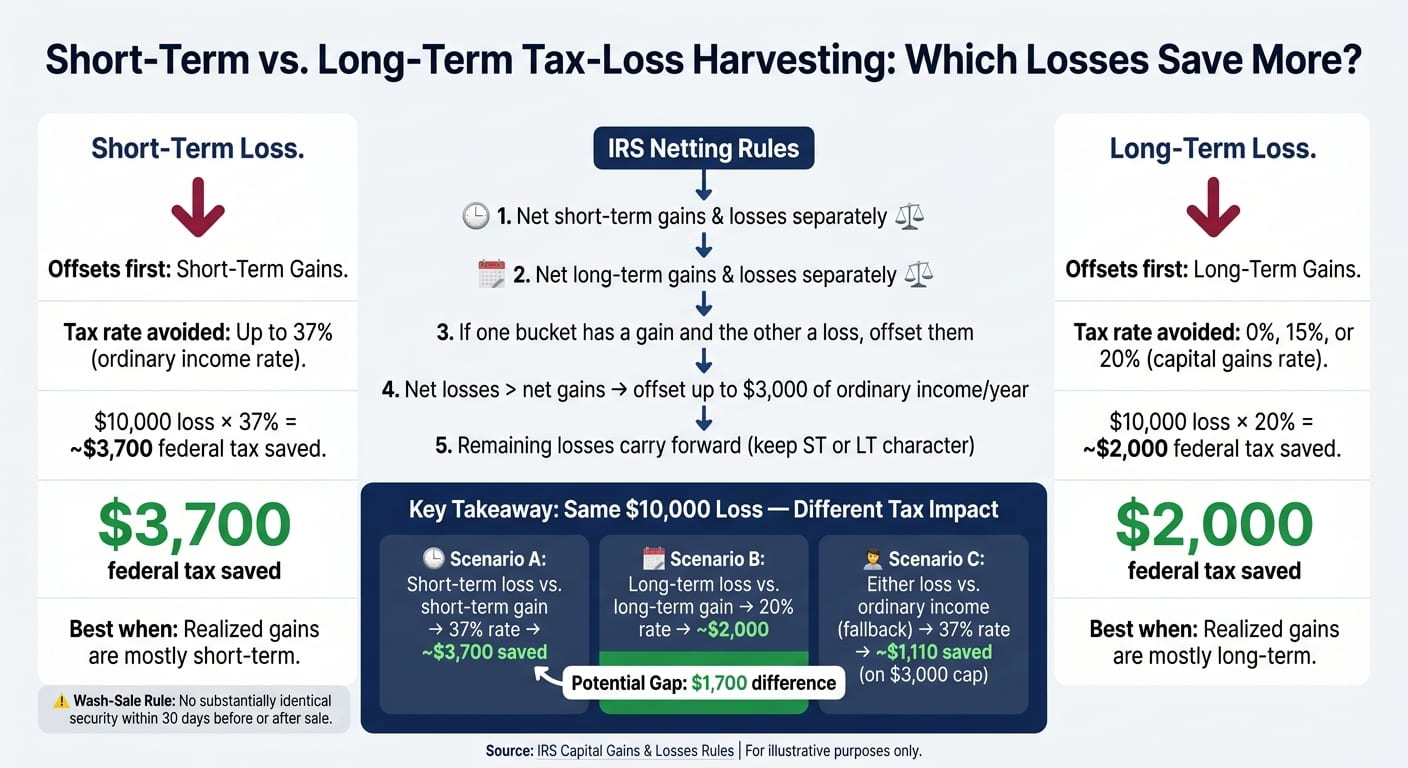
If I have both short-term and long-term gains, a short-term loss may have more near-term tax value per $1 than a long-term loss. The reason may be simple: short-term gains may be taxed at ordinary income rates, while long-term gains may get lower capital gains rates.
Here’s the short version:
Short-term losses may offset short-term gains first
Long-term losses may offset long-term gains first
If one bucket ends in a gain and the other ends in a loss, the IRS netting rules may offset them against each other
If total losses are more than total gains, up to $3,000 per year may offset ordinary income
Extra losses may carry forward, keeping their short-term or long-term character
A wash sale may disallow the loss if a substantially identical security is bought within 30 days before or after the sale
For example, a $10,000 loss used against gains taxed at 37% may reduce federal tax by about $3,700, while that same $10,000 loss used against gains taxed at 20% may reduce tax by about $2,000. That gap may be material for some high earners with taxable accounts.
Tax-Loss Harvesting Explained
Quick Comparison
| Topic | Short-Term Loss | Long-Term Loss |
|---|---|---|
| Offsets first | Short-term gains | Long-term gains |
| Tax rate it may offset first | Ordinary income rates, up to 37% federally | Long-term capital gains rates, often 0%, 15%, or 20% federally |
| Near-term tax value per dollar | May be higher | May be lower |
| May fit best when | Realized gains are mostly short-term | Realized gains are mostly long-term |
| If losses exceed gains | May offset up to $3,000 of ordinary income; excess may carry forward | Same rule |
I’d read this topic one way: the size of the loss matters, but the type of loss may matter too. The article breaks down the IRS netting order, shows simple dollar examples, covers lot selection and specific ID, and explains how some investors try to avoid wash-sale problems across taxable accounts, IRAs, and spouse accounts.
IRS Rules: How Short-Term and Long-Term Gains and Losses Are Netted
The IRS puts capital gains and losses into two buckets: short-term for assets held 1 year or less, and long-term for assets held more than 1 year. The holding period starts the day after purchase and ends on the day of sale.[3][2]
From there, the IRS follows a set order. It first nets short-term gains and losses. Then it nets long-term gains and losses separately. After that, if one bucket still shows a gain and the other shows a loss, the two amounts are offset against each other. That sequence may shape how much tax value a loss has.
If total capital losses end up higher than total capital gains, net capital losses may offset up to $3,000 of ordinary income per year. Any amount left over may carry forward, keeping its original short-term or long-term character.[4][5][8]
Why Short-Term Losses Usually Help Most
Short-term losses may be most useful when they offset short-term gains. Why? Because short-term gains are taxed at ordinary income rates, and those rates are often higher than long-term capital gains rates.[7][8]
A long-term loss works a bit differently. It first offsets long-term gains, which may be taxed at the lower 0%, 15%, or 20% federal rates. So if two losses are the same size, the short-term loss may produce more tax savings per dollar harvested.
That said, long-term losses still have a clear role. If a portfolio has mostly long-term gains and not much short-term exposure, a long-term loss may be the better match. And if losses in either bucket are larger than gains, the leftover amount may still reduce ordinary income, up to the $3,000 annual cap.[4][6][8]
Example: The Same $10,000 Loss Used Against Short-Term vs. Long-Term Gains
Here’s how the same $10,000 loss may look in different cases for a high-income investor in the 37% ordinary-income bracket and 20% long-term capital gains bracket, before state tax.
| Scenario | Loss Type | Gain Type Offset | Federal Rate Avoided | Estimated Federal Tax Savings |
|---|---|---|---|---|
| A | Short-term loss | Short-term gain | 37% | ~$3,700 |
| B | Long-term loss | Long-term gain | 20% | ~$2,000 |
| C | Either loss | Ordinary income (via $3,000 limit) | 37% | ~$1,110 (on $3,000 max) |
The gap between Scenario A and Scenario B comes to $1,700 in federal tax. That’s the part many people miss. The loss amount is the same, but the tax effect may differ based on what it offsets.
Scenario C shows the fallback case. If there are no gains to offset, the loss may reduce ordinary income, but only up to $3,000 per year. That cap may limit the near-term tax effect, even for investors in the top bracket.[4][6][8]
Once you know which losses may save the most, the next step is finding the right lots to sell.
How to Harvest the Right Losses: A Step-by-Step Process
After you know which losses may save the most tax, the next job is choosing the right lots and avoiding a wash sale.
Step 1: Review Realized Gains by Category Across All Taxable Accounts
Some investors start with the gain category that may create the biggest tax bill, then harvest losses against that bucket. Check your year-to-date realized gains and losses from every taxable account you hold - individual brokerage, joint accounts, taxable trust accounts, and any taxable robo-advisor portfolios. Most brokerages show this in a Tax Center or Realized Gains/Losses area, with short-term and long-term gains broken out separately.
Pull all taxable accounts together first. Each brokerage only shows part of the picture.
Looking at one account by itself may point you to the wrong loss category.
Once you total all accounts, you may be in a better spot to target the loss bucket that offsets the higher-tax gains first. With that gain bucket identified, the next step is choosing the exact loss lots that match it.
Step 2: Find Loss Lots and Use Specific-Lot Selection
After you identify the higher-value gain bucket, scan each holding for lots that may offset it. Open the lot view for each position in your taxable accounts. Most U.S. brokerages let you expand a position and see each purchase lot: the date bought, cost basis, current value, and unrealized gain or loss. Lots are usually marked ST for short-term or LT for long-term right in that screen.
Check dividend reinvestment lots first. They’re often short-term, and they’re easy to miss. A position that looks like a modest long-term loser at the position level may still contain several short-term loss lots from recent dividend reinvestments. Those lots may be worth harvesting on their own.
When placing a sell order, some investors switch the cost-basis method to specific identification instead of accepting the default FIFO (first in, first out). FIFO usually sells the oldest shares first, which may create gains instead of losses. That may undercut the harvest. Specific identification lets you pick the exact lots that produce the loss type you want.
| Cost Basis Method | How It Works | Tax Impact for Loss Harvesting |
|---|---|---|
| Specific ID | You choose the exact lots to sell | More control; may let you target short-term or long-term losses with precision |
| FIFO (Default) | Oldest shares sold first | Often sells low-cost lots, which may create gains instead of losses |
| Average Cost | Blended cost across all shares | Limits flexibility; common for mutual funds and often less useful for harvesting |
After you pick the lots, the final move is reinvesting without losing the deduction.
Step 3: Reinvest Without Triggering the Wash-Sale Rule
Once the loss lots are sold, the replacement buy needs to preserve market exposure without triggering a wash sale. Some investors reinvest right away into a security they believe is different enough to avoid wash-sale treatment. For broad U.S. equity ETFs, that often means switching between funds that track different indexes - for example, selling VTI and buying ITOT or SCHB. Swapping between S&P 500 funds such as SPY, IVV and VOO is a grayer area, since all three track the same index.
A harvested loss only helps if the trade survives wash-sale rules. If you buy a substantially identical security within 30 days before or after the sale, the loss may be disallowed. And that test applies across all accounts, including IRAs and a spouse's account.[9][10][11][12]
Keep records of the sale, replacement buy, and lot IDs so Form 8949 and Schedule D reporting may be more straightforward at tax time.
Wash-Sale Risk and Cross-Account Tracking
Once you pick the loss lots, the next risk may come from an accidental buy that breaks the deduction. After you choose the loss lots, check every account for buys inside the wash-sale window.
Wash-sale risk may apply to buys made both before and after the sale, across every linked account. Brokerage wash-sale reporting usually only sees trades at that firm, so cross-account and IRA purchases may still disallow the loss. In a taxable account, the disallowed loss is generally added to the cost basis of the replacement shares, which may defer the loss until those shares are sold.[13][15][17] In an IRA, the loss may be permanently lost rather than deferred.[15][16][17]
What to Check Before You Sell
Check these risk points before you place the sale.
Dividend reinvestment (DRIPs): Some investors turn off automatic reinvestment for any security they plan to harvest before they sell. A reinvested dividend inside the 30-day window may disallow part or all of the loss.
Automatic and recurring purchases: Payroll-linked investing, scheduled auto-invest plans, and robo-advisor rebalancing may all buy the same or a substantially identical security inside the window without much notice. Check every account for pending or scheduled buys in the same holding.
Spouse and retirement accounts: A purchase your spouse makes in their individual brokerage account, or a purchase in your own Roth IRA, may trigger a wash sale that affects the loss in your taxable account. You may need a full household view, not just an account-level one.
Overlapping ETF exposure: The IRS looks at same index, same risk - not just ticker symbols. Some investors replace with a fund tracking a different index, not a near-clone of the same index, or wait out the window.[14][15][16][18][19]
If you sell often, the tracking method may affect how much wash-sale risk you catch in time. That’s why the tracking method matters before you sell, not after.
Comparison Table: Manual Tracking vs. Brokerage-Only Views vs. Mezzi's Cross-Account Guidance
| Feature | Manual Tracking (Spreadsheets) | Brokerage-Only Views | Mezzi Cross-Account Guidance |
|---|---|---|---|
| Lot Visibility | High effort; requires manual data entry from all statements | Limited to lots held within that specific brokerage | Automated; pulls read-only data from all linked brokerages |
| Wash-Sale Detection | Prone to human error; difficult to track 61-day windows | Usually only sees activity inside that brokerage | Flags cross-account and spousal wash-sale risk across connected accounts |
| Replacement Planning | Manual research required to find non-identical alternatives | Generally does not suggest replacement securities | Suggests similar alternatives intended not to be substantially identical |
| IRA/Spouse Risk | Extremely difficult to coordinate manually | No visibility into external or spousal accounts | Integrated household view across all connected accounts |
| Monitoring Frequency | Usually periodic (e.g., year-end) due to complexity | Continuous for that firm, but incomplete across institutions | Year-round scanning of all connected accounts |
That’s where Mezzi’s household-level view may become useful. Mezzi pulls linked-account data, flags wash-sale exposure across the household before you sell, and tracks when the window closes.
Using Mezzi to Find the Most Tax-Efficient Losses
Once you know which losses may deserve attention first, Mezzi pulls taxable, IRA, Roth IRA, and spouse accounts into one household view. That setup may make it easier to compare unrealized losses with year-to-date gains across all lots. From there, the next step may be deciding which type of loss to harvest first.
Mezzi scans linked accounts daily and ranks lots by estimated tax benefit. If you have $30,000 in realized short-term gains, a $12,000 short-term loss may save more tax than a similar long-term loss, so Mezzi may rank that lot higher based on its estimated benefit.[1][4]
Mezzi also flags wash-sale conflicts before you trade and suggests replacement securities that may preserve exposure without being substantially identical.[20][21]
Comparison Table: Short-Term Losses vs. Long-Term Losses and When Each Is Worth Harvesting
Use this rule of thumb when both loss types are available:
| Loss Type | Offsets First Under IRS Rules | Typical federal rate | When It's Usually Most Worth Harvesting | How Mezzi Helps |
|---|---|---|---|---|
| Short-term losses | Short-term gains first | Up to 35%–37% (ordinary income rates)[4] | When you have meaningful realized short-term gains in taxable accounts | Ranks higher-value short-term loss lots and estimates tax impact |
| Long-term losses | Long-term gains first | Typically 15%–20% (long-term capital gains rates)[4] | When realized gains are mainly long-term, or when you're building a carryforward for future gains | Identifies long-term loss lots and models carryforward value |
Conclusion: The General Rule and When It Does Not Apply
The practical answer is pretty simple. Short-term losses may offer the biggest near-term tax benefit because they offset gains taxed at ordinary rates. Long-term losses may make more sense when your gains are mostly long-term, or when you're building carryforwards. Either way, household-wide wash-sale tracking may matter a lot.[4][20][21]
FAQs
Which loss should I harvest first?
Some investors start with tax lots that have the highest cost basis, since they may produce the largest realized losses. If you have short-term gains, some investors first look at short-term losses, because those losses may offset gains that may be taxed at higher ordinary income rates.
When possible, some investors use specific identification or HIFO instead of FIFO. It also may make sense to check whether the tax value of a sale outweighs any trading costs. And to reduce wash-sale risk, some investors avoid repurchasing the same or substantially identical security within 30 days before or after the sale.
Do carried-forward losses keep their tax type?
Yes. Carried-forward losses keep their original tax character as short-term or long-term.
In later tax years, they’re generally applied to gains of the same type first. After that, any remaining amount may be applied to the other category.
Can a buy in my IRA trigger a wash sale?
Yes. If you sell a security at a loss in a taxable account and then buy the same security - or one the IRS may view as substantially identical - in your IRA within 30 days before or after that sale, it may trigger a wash sale.
This IRS rule may apply across accounts you own or control, including IRAs, 401(k)s, and even spousal accounts. And here's the part many people miss: when the purchase happens inside an IRA, the disallowed loss is permanently disallowed. It does not get added to the cost basis of the new shares in the IRA.
Disclosures:
This content is for informational purposes only and does not constitute investment advice or a recommendation to buy or sell any security.
Past performance is not indicative of future results. No guarantee of future performance or outcomes is implied.
Savings and performance examples are hypothetical and for illustrative purposes only. Actual results will vary based on individual circumstances, portfolio composition, market conditions, and fees.