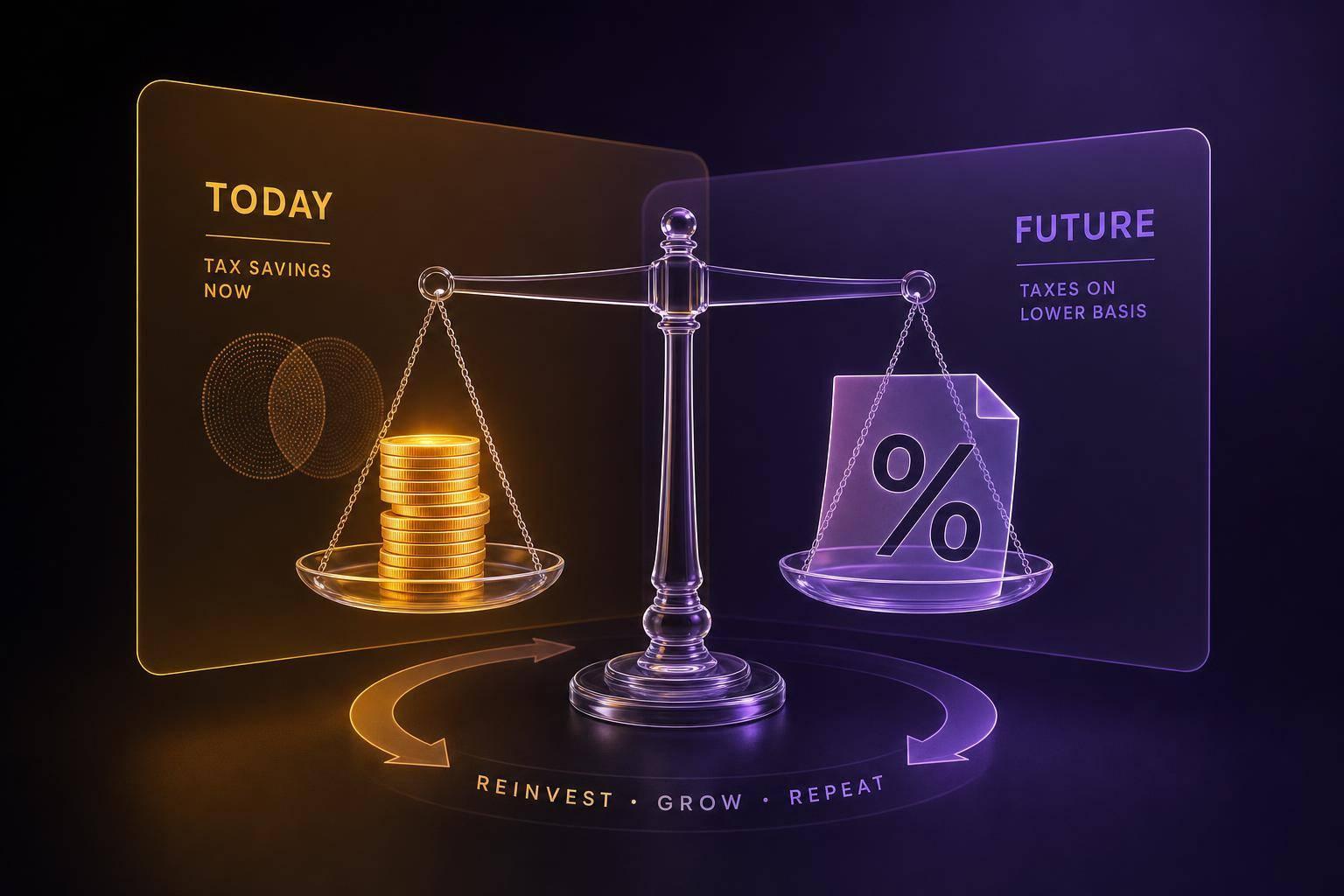
Tax-loss harvesting may make sense when your tax savings today are larger than the tax cost you may face later from a lower cost basis. A loss may offset capital gains now, up to $3,000 of ordinary income each year, and any extra loss may carry forward. But the result may change based on your tax rate, the type of gains you offset, wash sale rules, holding period, and whether you reinvest the tax savings.
Here’s the short version:
A harvested loss may offset short-term gains, long-term gains, or up to $3,000 of ordinary income per year
Short-term gains may be taxed as high as 37%, while long-term capital gains may be taxed at 0%, 15%, or 20%
The wash sale rule may block the loss if you buy a substantially identical security within the 61-day window
A lower cost basis may mean a larger taxable gain later
The math may look better when tax rates are high now, lower later, and the tax savings are reinvested
The math may look weaker when you have few gains, large carryforwards, high wash sale risk, or long-term gains already in the 0% bracket
A simple way I’d frame it: this may be less about “getting a deduction” and more about swapping a tax bill now for a tax bill later. If I’m modeling it, I’d look at today’s tax rate, future tax rate, loss size, expected return, holding period, state tax, and whether the savings stay invested.
| Factor | When harvesting may look better | When it may look weaker |
|---|---|---|
| Current tax rate | Higher federal + state rates | Lower brackets |
| Gains to offset | More short-term gains | Few or no gains |
| Future tax rate | Lower than today | Higher than today |
| Use of tax savings | Reinvested | Spent |
| Wash sale risk | Low across all accounts | Higher due to DRIPs, spouse trades, or retirement buys |
Bottom line: tax-loss harvesting may be worth it for some investors, but only after checking the future tax tradeoff and making sure the loss survives the wash sale rule.
Every Type of Tax-Loss Harvesting Explained
How tax-loss harvesting works in U.S. taxable accounts
When you sell a security in a taxable brokerage account for less than what you paid, you realize a capital loss. That loss may first offset gains of the same type: short-term losses against short-term gains, and long-term losses against long-term gains. If there’s still a net loss left over, it may offset capital gains more broadly, and then up to $3,000 per year may reduce ordinary income. Any amount beyond that may carry forward. But that tax treatment still depends on the wash sale rule.
This approach applies only to taxable brokerage accounts. Losses inside an IRA, 401(k), or another tax-advantaged account do not create a deductible capital loss.
Short-term gains are taxed at ordinary income rates - up to 37%. Long-term gains are taxed at 0%, 15%, or 20%, depending on income. So the type of gain you offset may change the tax impact.
Here’s the basic idea:
A $1,000 harvested loss used against a short-term gain in the 32% bracket may reduce tax by about $320
The same $1,000 loss used against a long-term gain taxed at 15% may reduce tax by about $150
That’s why some investors may look to offset short-term gains first. Still, the wash sale window may disqualify the loss.
The wash sale rule and the 61-day window
The wash sale rule blocks you from claiming a loss if you buy a "substantially identical" security - usually the same fund or ETF - within a 61-day window: 30 days before the sale, the day of the sale, and 30 days after. Sell an S&P 500 ETF at a loss on November 15, and you may not buy it back until December 16.
A disallowed loss is not gone. Instead, it gets added to the cost basis of the replacement shares. In other words, the tax benefit may be deferred rather than erased. But if those replacement shares land in a retirement account, that deferred loss may never turn into a usable tax benefit.
Why seeing all your accounts matters
Wash sale risk does not stay inside one brokerage account. Automatic dividend reinvestment, scheduled 401(k) contributions, and a spouse rebalancing into the same fund may all trigger a wash sale without anyone noticing. And brokerages usually report wash sales only within their own platform. They may not see activity at another institution or in a spouse’s account.
Mezzi's all-account view surfaces overlapping holdings across taxable, retirement, and spouse-linked accounts, so you may spot wash-sale risk before it happens and flag trades inside the 61-day window before you buy. Those rules set up the numbers you’ll model next.
How to model today's tax savings against future tax costs
Once a harvest clears the wash-sale rule, the next step may be pretty simple: compare today’s tax savings with the future tax bill that may come from a lower cost basis.
A harvest swaps a tax break now for a larger gain later. One way to frame it: net benefit = today’s tax savings + growth on reinvested savings − future tax on the extra gain.
The inputs you need
You need seven inputs:
the tax rate the loss offsets today
your state tax rate
the size of the harvestable loss
your expected return on any reinvested savings
your holding period
the tax rate you may face when you sell
whether you reinvest or spend the savings
State taxes may change the math in a meaningful way, especially in high-tax states.
3 scenarios that show how the outcome changes
In the hypothetical scenarios below, the same harvest may look very different depending on tax rate, holding period, and whether the tax savings get reinvested.
Scenario 1 - High-income investor, short-term gains, savings reinvested
An investor in the 37% federal bracket with a 10% state rate has $40,000 in short-term gains and a position showing a $40,000 loss. She harvests the loss and offsets the full $40,000 of short-term gains at a combined rate of about 47%, which may produce immediate tax savings of $18,800.
If she reinvests that $18,800 and it earns an assumed 6% per year for 10 years, it would grow to about $33,600. Because the basis is lower, she later has an extra $40,000 gain taxed at a combined long-term rate of about 30%, which may create a future tax cost of $12,000. Discounted at the same 6% rate, that future cost is worth about $6,700 in today’s dollars, leaving a net present value benefit of about $12,100.
Scenario 2 - Moderate-income investor, limited current gains, mostly carryforwards
An investor in the 24% federal bracket with a 5% state rate harvests a $30,000 loss but has only $2,000 of long-term gains and no short-term gains. The loss offsets $2,000 of long-term gains at a 20% combined rate, saving about $400, and $3,000 of ordinary income at a 29% combined rate, saving about $870. That brings total immediate savings to about $1,270.
The remaining $25,000 carries forward, so a large share of the result may depend on future gains and when they appear.
Scenario 3 - Small harvest, narrower gap
An investor realizes a $3,000 loss and uses it against ordinary income in the 32% federal bracket. Immediate tax savings are $960, while the future tax cost is $450, leaving a $510 difference before any growth from reinvestment.
When the math works and when it does not: a comparison table
| Variable | Higher-value case | Lower-value case |
|---|---|---|
| Current tax rate | High (e.g., 37% plus state) | Low (e.g., 10%–12% bracket) |
| Gains available to offset | Significant short-term gains | No gains or limited current gains |
| Future tax rate | Lower than today | Higher than today |
| Tax savings | Fully reinvested and compounded | Spent immediately |
| Holding period | Long (more time to compound) | Short (less time for deferral value) |
The table works as a sensitivity guide. These levers may shape when harvesting adds value and when it may not.
When tax-loss harvesting adds value and when it does not
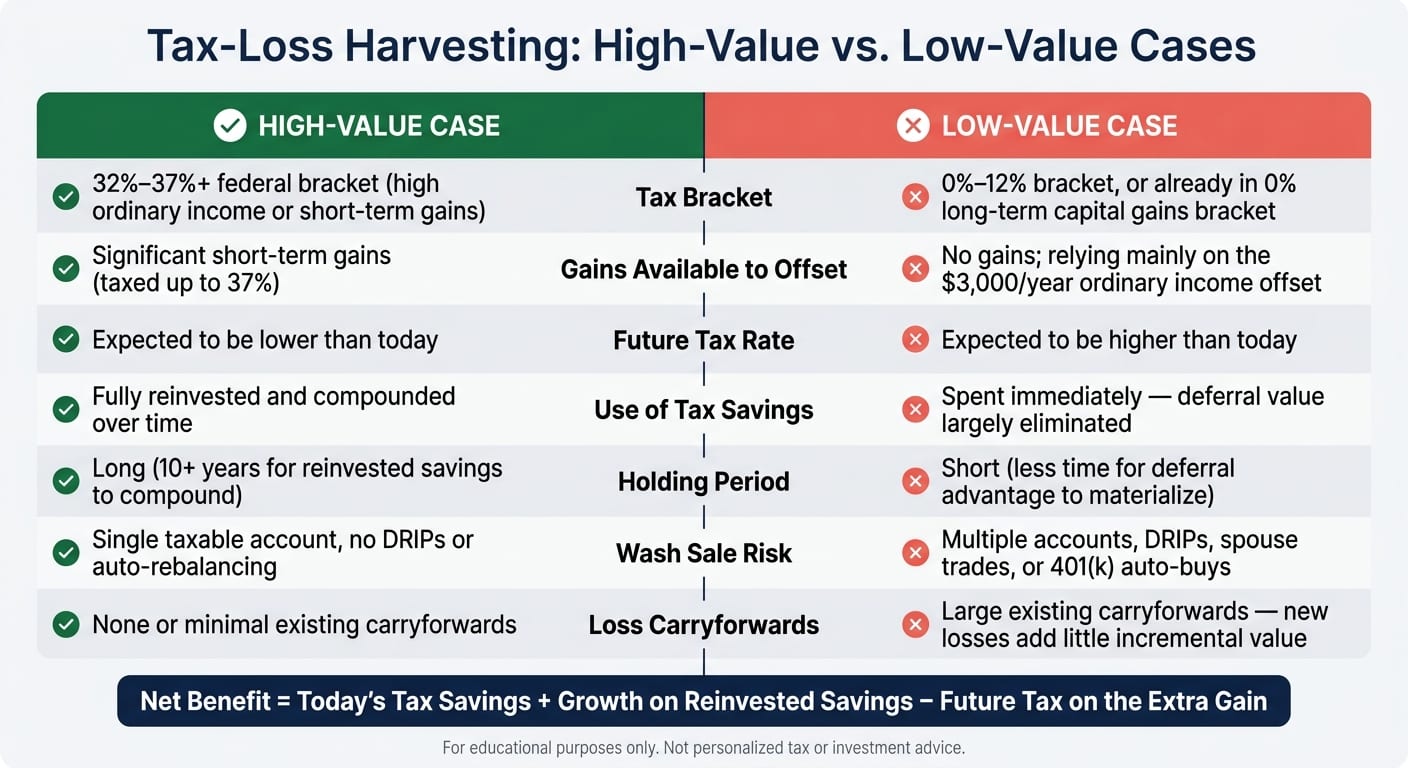
The modeling in the previous section points to a pretty simple idea: the same harvest may matter a lot in one case and very little in another. What usually decides it? Whether the tax break you get now may be larger than the tax bill you may face later because of a lower cost basis. That’s the lens to use when sorting a situation into a high-value or low-value case.
A few concrete factors usually drive the gap.
Signs a harvest is probably worth doing
Tax-loss harvesting may have more value when higher current tax rates line up with realized short-term gains. If you’re sitting on a sizable unrealized loss in a broadly diversified ETF, and you may swap into a similar fund without triggering the wash sale rule, the mix of immediate tax savings and low trading friction may make the trade more worthwhile.
Year-end capital gain distributions from mutual funds may also make harvesting more attractive, since the harvested loss may offset that tax bill directly.
One more point matters here: if the tax savings are reinvested, the long-run value may be higher. If that cash gets spent instead, much of the upside may fade.
Signs the benefit is marginal
If your long-term gains already fall in the 0% bracket, harvesting may mostly defer tax rather than create much current savings. At the same time, the lower basis may still lead to a larger gain later.
If you have no gains this year, the deduction may stop at $3,000 against ordinary income. And if you already carry large loss carryforwards from prior years, adding more losses may not do much. That may be even more true if future gains are expected to stay modest.
Wash sale issues may also weaken the case. Multiple accounts, DRIPs, or purchases by a spouse may disallow the loss, so the trade may need to stay clean across all accounts. Some investors pause DRIPs for 31 days around the trade for that reason.
High-value versus low-value cases: a comparison table
Use the table below as a quick screen before you trade.
| Condition | High-value case | Low-value case | Main risk | What to check first |
|---|---|---|---|---|
| Tax bracket | 32%–37%+ federal | 0%–12%, or 0% LTCG bracket | No immediate rate to offset | Current-year taxable income |
| Gains available | Significant short-term gains | No gains; relying mainly on the $3,000 offset | Slow carryforward use | Realized gains YTD |
| Trading costs | Low (liquid ETFs, tight spreads) | High (thinly traded funds, wide spreads) | Costs exceed tax savings | Bid-ask spread and position size |
| Loss carryforwards | None or minimal | Large existing carryforwards | New losses add little value | Prior-year Schedule D carryforward amount |
| Wash sale risk | Single taxable account, no auto-buys | Multiple accounts with DRIPs or auto-rebalancing | Loss disallowed | Holdings across all accounts |
Limits, compliance, and next steps
Even when the math looks good on paper, a few real-world limits may change the result. Four tend to matter most.
Wash sale rules are usually the biggest compliance issue. A loss may be disallowed if repurchases happen within the 61-day window across taxable accounts, retirement accounts, or spouse-linked accounts. Automatic dividend reinvestment is a common tripwire that many investors may miss. That’s a big reason the earlier savings model may overstate the value.
Future tax-rate uncertainty sits right at the center of the tradeoff in this article. If your tax rate ends up lower now than later, the benefit may shrink or even reverse.
Incomplete cost basis data connects back to the inputs used in the model. Missing lot records from DRIPs, transfers, or corporate actions may distort basis and may misstate both today’s tax savings and a later tax bill.
Disconnected household accounts may weaken the model and may increase compliance risk. They may hide wash sale conflicts and leave the picture incomplete.
Once those blind spots are addressed, the next step may be to run the trade across full household data.
This material is educational only and is not personalized tax, legal, or investment advice.
How Mezzi helps you evaluate the tradeoff
Mezzi links household accounts so you may see wash sale risk across the full picture, flags wash sale conflicts before you trade, and models how a harvest may change current taxes and future basis. You may adjust assumptions - expected return, holding period, current and future tax brackets, reinvestment plan - and see a range of outcomes instead of one number.
Mezzi does not execute trades. Every decision to harvest stays with you, which may make sense for a strategy so dependent on personal circumstances.
Key takeaways
After these checks, the choice may come down to net benefit, not just the size of the immediate deduction.
Harvesting may make sense when today’s tax savings may exceed the later tax cost: losses offset high-rate short-term gains, savings are reinvested, and all household accounts are visible and clean.
Skipping it may make sense when future tax rates, wash sale risk, or unreliable basis data may make the estimate uncertain or unfavorable.
FAQs
How do I estimate my net tax-loss harvesting benefit?
Compare any near-term tax break against trading costs and the later tax effect of a lower cost basis.
Start by finding unrealized losses in taxable accounts. Then split them into short-term and long-term losses.
From there, apply your marginal tax rate to the losses you may harvest. After that, subtract:
fees
bid-ask spreads
possible future capital gains tax tied to replacement assets
If losses are higher than gains, up to $3,000 may offset ordinary income each year. Any extra losses may carry forward.
When is tax-loss harvesting usually not worth it?
Tax-loss harvesting may not be worth it when the tax break may end up smaller than the cost, friction, or trade-off.
That may happen if fees, bid-ask spreads, or redemption costs are higher than the tax savings you may get. The same may apply if you don’t have enough capital gains, or your tax rate may not be high enough for the offset to make much difference.
It may also make less sense if the move means selling strong investments, triggering a wash sale, or throwing off your long-term allocation just to get a small tax benefit.
How can I avoid triggering a wash sale?
To avoid a wash sale, you may need to avoid buying the same security - or one the IRS may view as substantially identical - within 30 days before or after selling it at a loss.
That creates a 61-day window. And it may apply across all your accounts, including IRAs, 401(k)s, and your spouse’s accounts.
If you want to stay invested, some investors buy a similar asset instead - but not one that may count as substantially identical.
A few things may trip people up by accident:
Automatic purchases
Dividend reinvestments
Trades in a spouse’s account
Those moves may trigger a wash sale even if you didn’t mean to.
Disclosures:
This content is for informational purposes only and does not constitute investment advice or a recommendation to buy or sell any security.
Past performance is not indicative of future results. No guarantee of future performance or outcomes is implied.