
Read this if you have children or grandchildren under 18 and can invest money they will not need for decades.
Trump Accounts are live. New money goes into an S&P 500 fund by default. Four more U.S. stock funds are expected to become available.
The government's free $1,000 for eligible families likely does not change your plan. The real opportunity is opening a retirement account before your child earns a dollar.
You can add up to $5,000 each calendar year through the year your child turns 17. Your child does not need a job or earned income.
Invest $5,000 every year and you have contributed $90,000. At a hypothetical 7% annual return, it could be worth roughly $170,000 at age 18. Leave that money invested for another 40 years at the same return and it could reach about $2.5 million before taxes.
That is a real opportunity, but only if you give the account the right job.
Our take
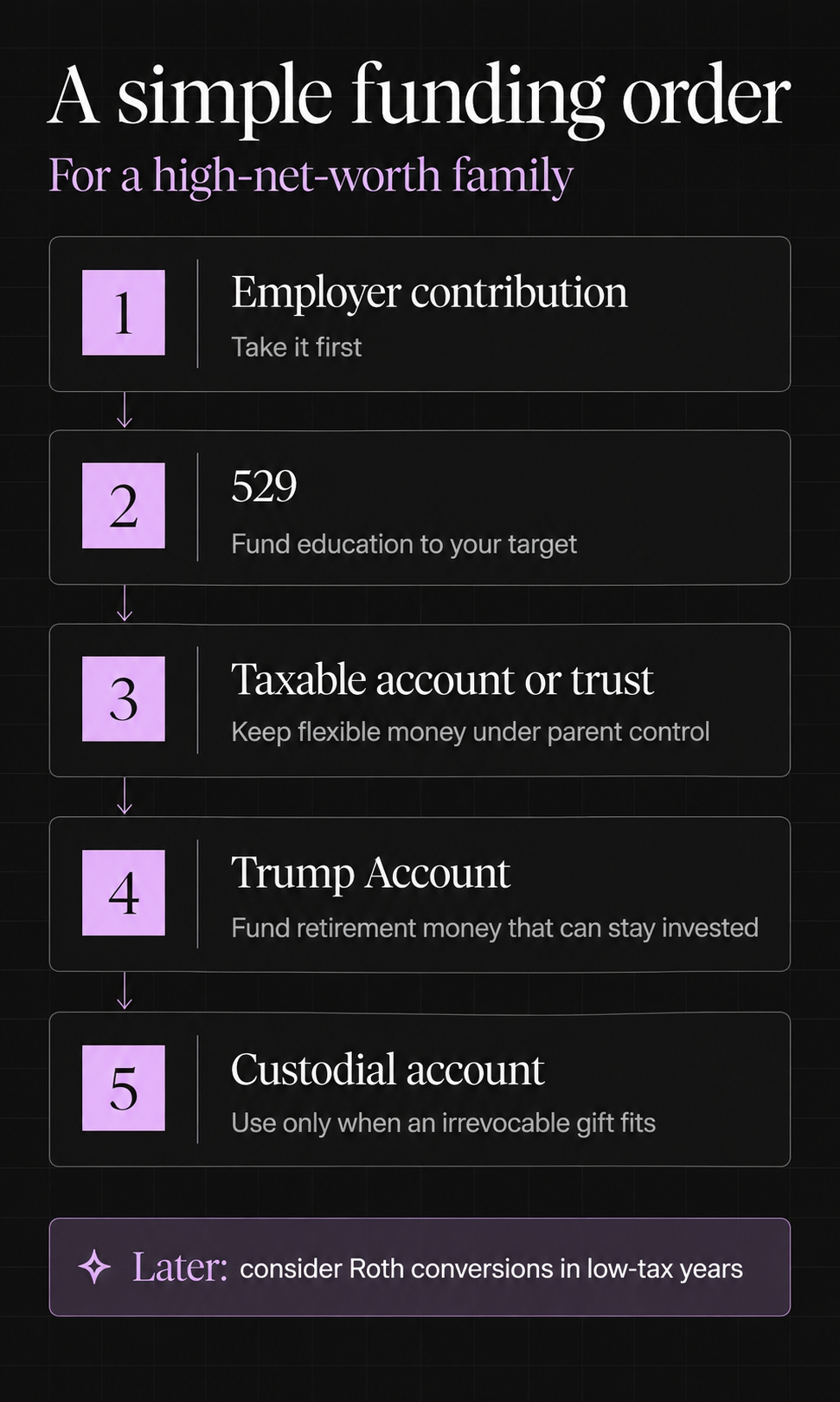
If education is on track and you have plenty of flexible savings, fund the Trump Account for one purpose: retirement money your child can leave invested for decades.
Use a 529 for education and a parent-owned investment account or trust for flexibility. Use a custodial account only when an irrevocable gift and eventual handover of control fit the plan.
Before contributing, check both parents' employers. Employer contributions for each employee are capped at $2,500 a year in total and count toward the child's $5,000 annual account limit, so take employer money before adding family funds.
After age 18, consider moving the account into a Roth IRA in stages during low-tax years. The taxable portion counts as income, and the kiddie tax can apply through age 23.
The same $90,000 in four accounts
Assume the same contributions and the same hypothetical return. Each account reaches roughly $170,000 before taxes.
529: Best suited to education. Qualified withdrawals can be tax-free, you keep control, and up to $35,000 of unused funds may eventually move tax-free to the beneficiary's Roth IRA, subject to annual limits and other rules.
Investment account in your name: You keep the most flexibility. Dividends and gains can create taxes along the way. Selling the investments may also create a tax bill.
Custodial account: The tax treatment is similar to a regular investment account. The money belongs to your child, the gift cannot be reversed, and your child takes control at the age set by state law.
Trump Account: Investment growth is not taxed each year. After the childhood rules end, withdrawals generally follow traditional IRA tax rules. Its biggest opportunity is a move to a Roth IRA at the right time.
There is no single winner. Choose based on what the money is for: education, flexibility, a completed gift, or retirement.
What to buy
Investment choices are limited. At launch, new contributions automatically go into a fund holding 500 large U.S. companies. Additional choices are expected, but they are also U.S. stock funds; some spread the money across thousands of companies.
None includes companies outside the U.S. or bonds. If your child's plan needs either, hold that part elsewhere and review all of the child's investments together.
The investment rules are not final. Public comments remain open until October 20, so details may change.
Ask Mezzi
Click any question below to ask Mezzi.
Get one month of Mezzi Advisory free with code ADVISORYONE.
Important disclosures
This content is for informational purposes only. It is not investment, tax, or legal advice or a recommendation to buy or sell any investment. Past performance does not predict future results. Tax and estate-planning results depend on your circumstances; consult qualified tax and legal professionals.
The examples assume $5,000 invested at the end of each year for 18 years and a constant 7% annual return, followed where stated by another 40 years at the same return. They leave out fees, taxes, inflation, future changes in contribution limits, and government or employer contributions. Actual returns will vary, losses are possible, and no result is guaranteed.
Trump Account rules and limits are based on current law and IRS and Treasury guidance as of September 6, 2026. Moving money to a Roth IRA generally adds the taxable portion to income that year. The kiddie tax depends on age, student status, support, earned income, and other facts. The investment rules and October 20 comment deadline come from proposed regulations and may change. The availability of investment choices in the app may also change as new features arrive.