
What a 10% payout actually buys you
High yielding funds are all the rage on Wall Street. These funds are paying 7%-12% income, sometimes much more. Popular ones include JEPI, JEPQ, and the Yieldmax funds.
Investors, especially retirees, love income. Wall Street is happy to sell it to them, hence Bloomberg's James Seyffart calling this category of funds as “boomer candy.”
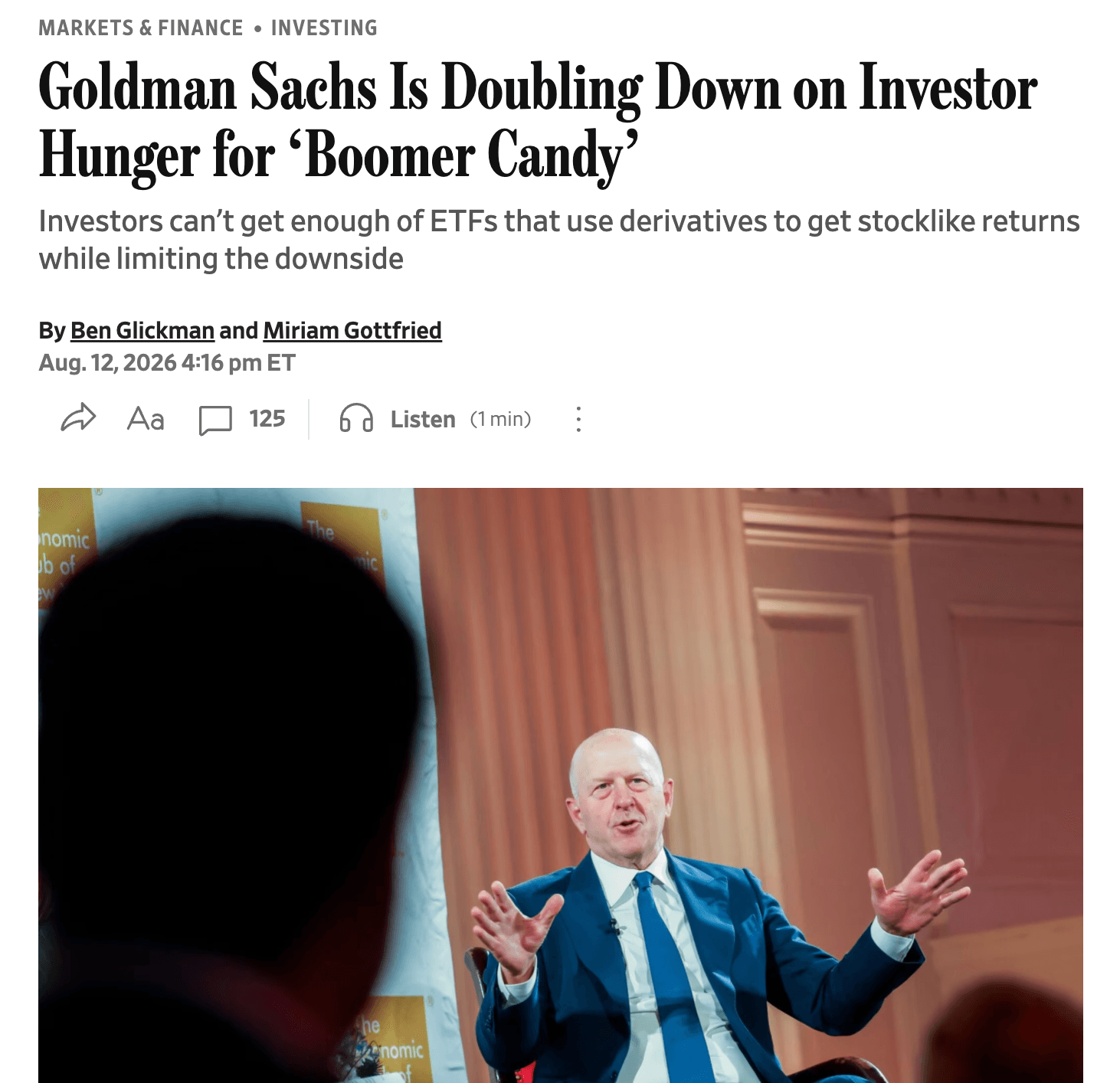
These funds are not scams. But they are easy to misunderstand.
The most important thing to know: A high payout is not the same as a high return.
The money has to come from somewhere
Imagine putting $100,000 into an income fund that pays 10% a year. It is tempting to picture $10,000 arriving annually while your original $100,000 keeps growing untouched.
That is not how it works. The stocks inside a fund like this pay only about 1% to 2% in dividends. To reach 10%, the fund manufactures the rest using an options strategy: holding stocks and selling call options to other investors, collecting cash premiums upfront in exchange for capping its potential stock gains.
If the market drifts, the fund keeps that cash. If the market surges, it hands over the gains and keeps the cash anyway.
Here is the part that people often don't appreciate. When any fund pays a distribution, its share price drops by roughly that amount the same day. The money moved out of the fund and into your account.
One example
You make a $100,000 investment in JEPI. For the year ended June 30, 2026, JEPI paid out 8.06%, but investors made only 7.77% in total.
The investor received only $8,060 in distributions. But the shares ended the period worth roughly $99,710, less than the initial investment.
Combined, the investor made about $7,770. How is that possible?
Total return includes both the cash you receive and the change in the value of your shares. If the payout was larger than the total return, the share price must have declined.
Do you need the cash today?
Over the five years ended June 30, 2026, an S&P 500 index fund such as SPY or VOO returned roughly 13% each year against 7% for JEPI.
At those rates, $500,000 would have grown to about $932,000 in SPY versus $717,000 in JEPI. That gap of roughly $215,000 built up in only five years, because every bit of growth you skip is money that can no longer earn growth of its own.
Regular income can justify the trade *if you need the cash today*. If you plan to reinvest every distribution, you are sacrificing growth for income you do not need.
Judge the investment by its total return, not the size of its monthly check.
How Mezzi helps
The hard part is understanding how much income you need from your investments, tracking their true performance, and determining whether you have the right portfolio allocation across all your accounts.
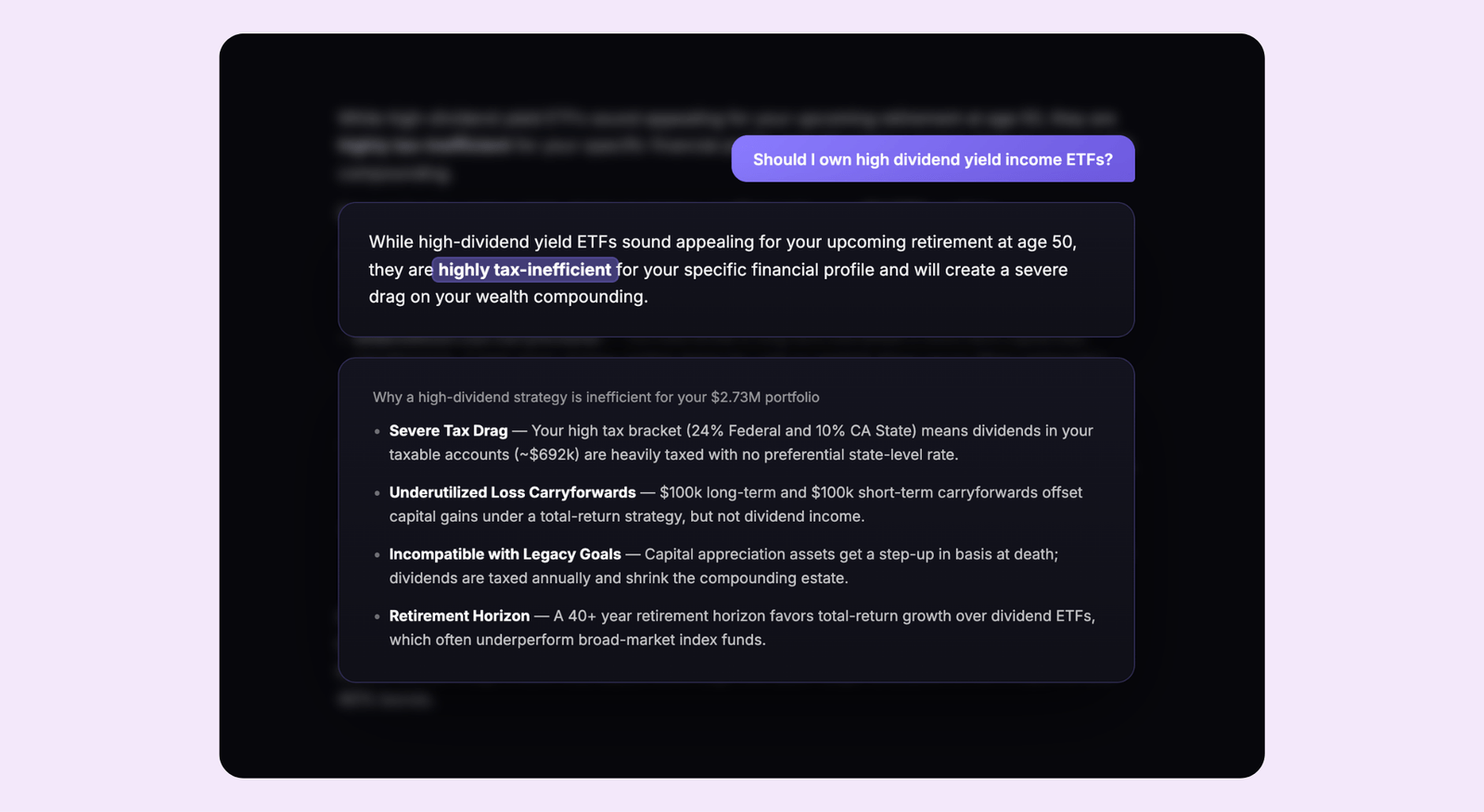
Ask Mezzi:
- “Do I need the income from my high yield income funds?"
- “Which accounts should hold my income fund investments?"
- “How did my income funds perform vs. total return of the S&P 500?"
- “Are these funds a good fit for me?"
IMPORTANT DISCLOSURES
This content is for informational purposes only and does not constitute investment advice or a recommendation to buy or sell any security. Past performance is not indicative of future results. No guarantee of future performance or outcomes is implied. Savings and performance examples are hypothetical and for illustrative purposes only. Actual results will vary based on individual circumstances, portfolio composition, market conditions, and fees. Performance figures are standardized net asset value returns published by each fund company as of June 30, 2026. Index risk statistics are from Cboe as of July 31, 2026. Fund flow figures are Morningstar Direct data for the derivative income category, which spans S&P 500, Nasdaq and single-stock option income funds.