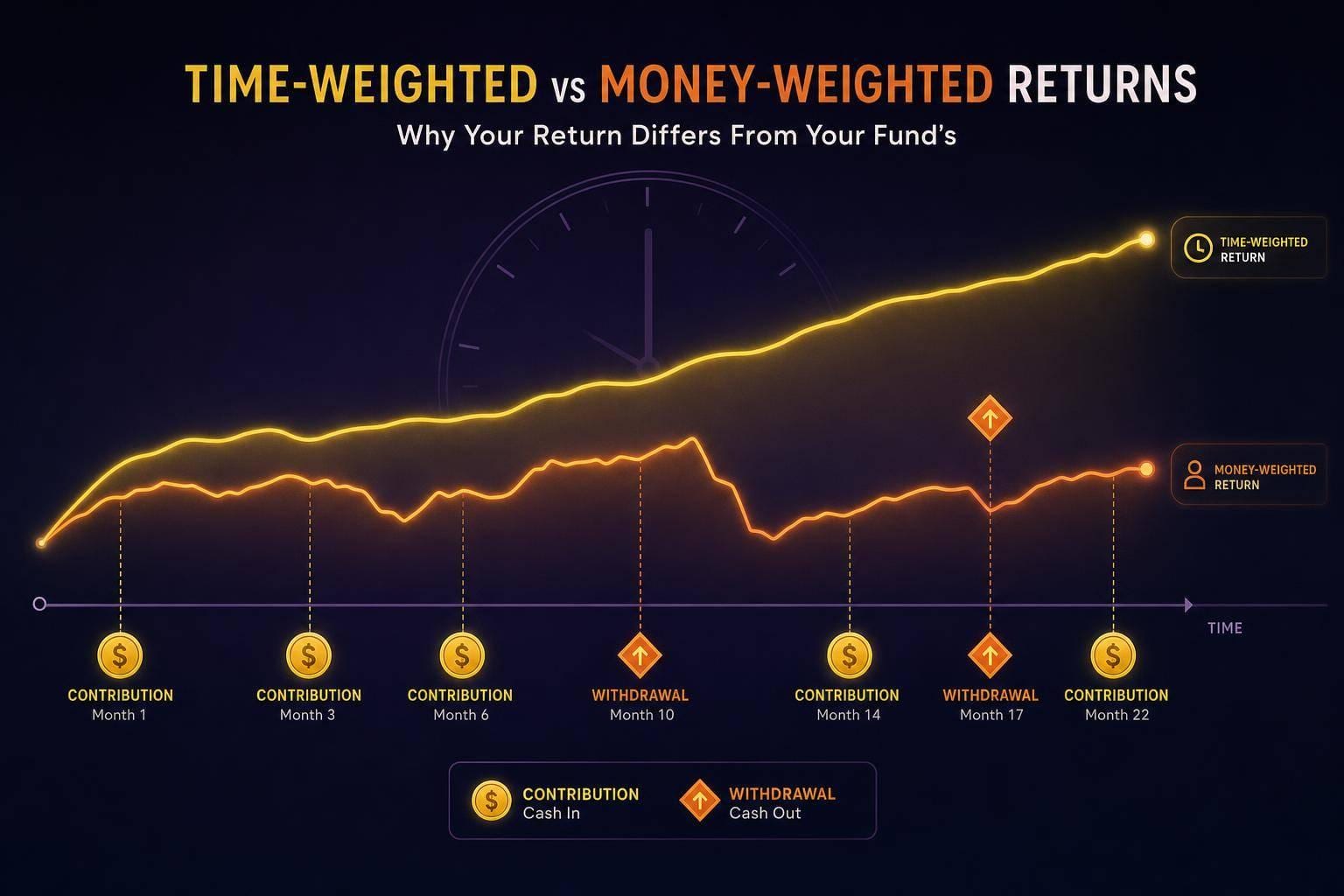
Two return numbers may both be right. If your fund shows one return and your account shows another, the gap may be tied to cash-flow timing - when you added or took out money.
Here’s the short version:
Time-weighted return (TWR) may show how the investment itself performed.
Money-weighted return (MWR/IRR) may show how your dollars performed based on deposits and withdrawals.
A large deposit before a 10% drop, or a withdrawal before a 12% rebound, may change your personal result even if you held the same fund.
Fees, taxes, and date ranges may also push the numbers apart.
I’d sum it up like this: TWR is about the fund. MWR is about your experience. If I want to look at a manager or compare a fund to the S&P 500 using portfolio analyzer tools, TWR may fit that question. If I want to look at my own timing and progress, MWR may be the better lens.
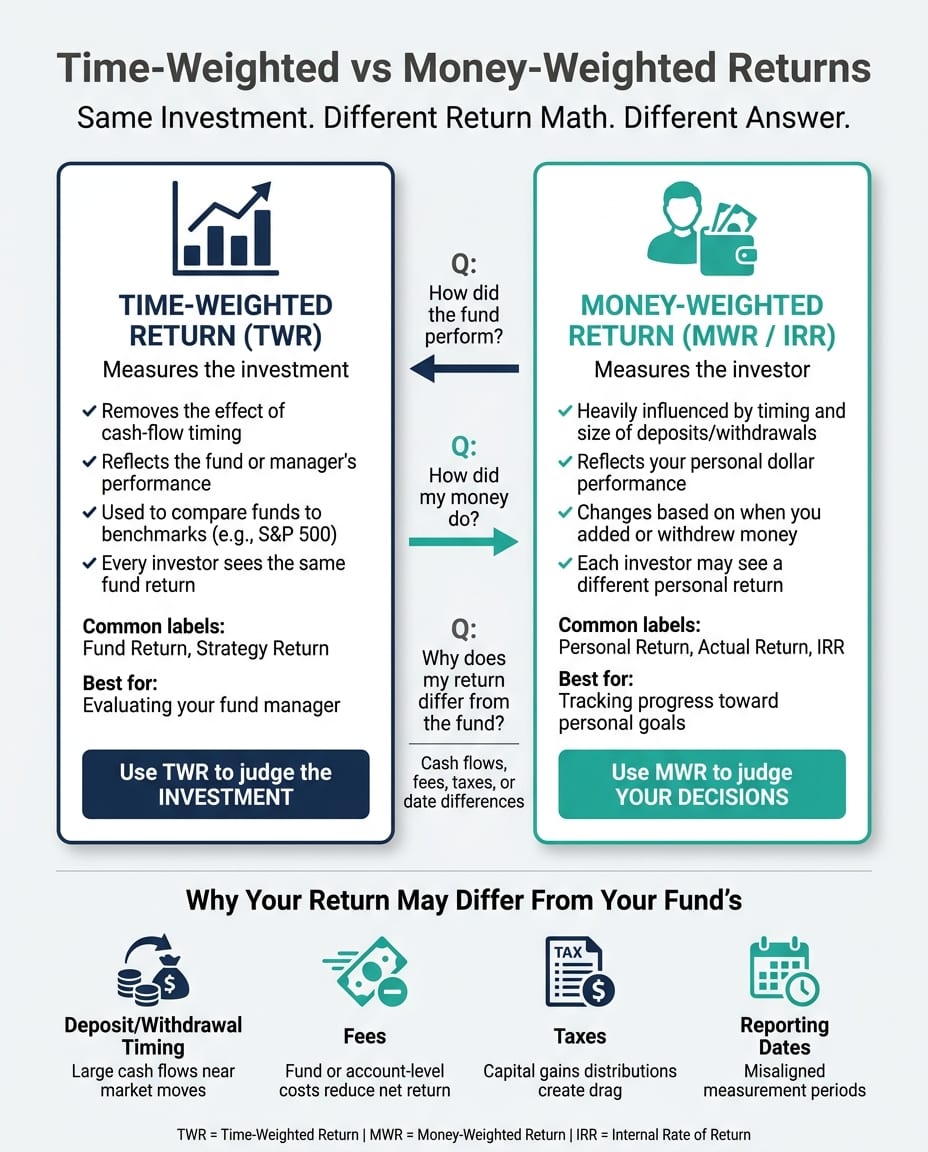
Time Weighted Returns vs Money Weighted Returns
Quick Comparison
| Question | Metric that may fit |
|---|---|
| How did the fund or strategy perform? | TWR |
| How did my actual invested dollars do? | MWR / IRR |
| Why doesn’t my statement match the fact sheet? | Cash flows, fees, taxes, or date differences may explain it |
That’s the whole idea of the article, in plain English: same investment, different return math, different answer.
Time-weighted return measures the investment, not your timing
Time-weighted return (TWR) answers one question: how did the investment perform, with cash-flow timing stripped out? If your account statement looks different from your fund fact sheet, TWR may be the fund's number.
Here's the basic idea. TWR breaks the full period into smaller segments, with each segment ending at a deposit or withdrawal. It measures each segment on its own, then links those segment returns together. Since each segment stands alone, cash flows do not distort the result.
What time-weighted return tells you
TWR may be the right yardstick when the goal is to look at a fund manager's result against a benchmark like the S&P 500. That may make comparisons across funds and strategies more even.
Why funds report time-weighted performance
Funds often publish TWR to show the manager's result. In that setup, every investor may see the same fund return, even though each person's own return may differ.
Time-weighted return vs. money-weighted return: side-by-side comparison
| Feature | Time-Weighted Return (TWR) | Money-Weighted Return (MWR / IRR) |
|---|---|---|
| What it measures | Performance of the investment or manager | Performance of the investor's actual dollars |
| Treatment of cash flows | Removes the effect of timing and size | Heavily influenced by timing and size |
| Best for | Comparing to benchmarks like the S&P 500 | Tracking progress toward personal goals |
| Common labels | "Fund Return", "Strategy Return", "Fund Return" | "Personal Return", "Actual Return", "IRR" |
TWR tells you what the investment did. MWR shows what it did for you.
Next, money-weighted return shows how those same cash flows changed your own result.
Money-weighted return measures your actual experience
TWR strips out cash flows. Money-weighted return (MWR) does the opposite: it gives those cash flows weight based on when they happened. In plain English, MWR measures the return on the dollars you actually invested, using the timing and size of each deposit and withdrawal.
Your fund's return tracks the investment itself. MWR tracks your result.
What money-weighted return tells you
MWR gets at a personal question: what return may your money have earned, given when you added it and when you took it out? Every cash flow changes the result based on its timing and size.
A big deposit made right before a market jump means more of your dollars take part in that gain. A big deposit made right before a drop means more of your balance may be exposed to that loss.
That’s the core idea. Same fund, different timing, different personal return.
A simple example with one deposit and one withdrawal
Say you start the year with $100,000 in a fund and add another $50,000 halfway through the year, just before a 10% decline. You then withdraw $30,000 during the downturn, before the fund rebounds 12% in the final quarter.
In that case, your personal return may differ from the fund's reported return. Why? Because more of your money was in the fund during the decline, and less money remained for the rebound.
The fund's return ignores those cash-flow dates. Your return does not.
That same timing effect may show up as the return gap in real accounts.
How investor behavior creates a return gap
This may explain why two investors in the same fund report different personal returns. A few common patterns may widen the gap:
Adding more after a rally
Putting money in right before a selloff
Taking money out during a downturn
None of that changes the fund's holdings. It changes the investor's own result. So if there's a gap, it may reflect cash-flow timing rather than a reporting error.
Next, see the main reasons that gap widens.
Why your return differs from your fund's
The gap usually comes down to cash-flow timing. Put simply, the numbers may differ because they measure two different things.
A fund's return often shows how the investments performed on their own. Your personal return may reflect when money went in and out. That's why the right comparison matters.
Deposit and withdrawal timing is the main driver
The gap may get bigger when cash flows are large compared with your portfolio and happen close to a big market move. If you add money just before a market drop, your MWR may look worse than the fund's TWR because more of your dollars may have been exposed to that decline. On the flip side, a large deposit before a strong rally may push your MWR above the fund's TWR.
This is the part that throws many people off. The fund may have one return number, but your experience may look different because your money showed up at a different moment.
Fees, taxes, and measurement dates can widen the difference
Three other factors may push the numbers apart:
Fees at the fund or account level may reduce your net return.
Taxes in taxable accounts may create drag through capital gains distributions, which may lower your after-tax result.
Reporting periods that don't line up with the fund's measurement dates may make the numbers look different even when performance may be similar.
Which return metric answers which question: a quick reference
Use this quick guide to match the metric to the question.
| If you want to answer… | Use this metric |
|---|---|
| Is my fund manager doing a good job compared to the market? | Time-Weighted Return (TWR) |
| Did my decision to move money into the market last month help or hurt? | Money-Weighted Return (MWR/IRR) |
| Am I on track for my specific retirement goal? | Money-Weighted Return (MWR/IRR) |
Before assuming the return is wrong, it may help to check timing, fees, taxes, and measurement dates first. That filter may help separate fund performance from your own investing decisions in Mezzi.
How to use both return measures inside Mezzi
After you’ve checked timing, fees, taxes, and measurement dates, Mezzi may show both return views in one dashboard. Mezzi connects to your 401(k), IRA, HSA, and taxable brokerage accounts through read-only access, so you may see both TWR and MWR in one place.
Use time-weighted return to judge strategy and manager performance
If you want to know whether a fund, ETF, or investment strategy may be doing its job, TWR is the right lens. Inside Mezzi, that may make it easier to ask one clean question: did this investment perform as expected?
Use TWR to judge the investment. Use MWR to judge your decisions.
Use money-weighted return to judge your own decisions and progress
MWR tells a different story: yours. Mezzi shows that personal return across all connected accounts, so you may see whether your timing may have helped or hurt your long-term plan.
Conclusion
TWR measures the investment. MWR measures the investor. Seeing both side by side in Mezzi may help you use the right return for the right question.
FAQs
Can my return be negative if the fund had a positive year?
Yes. Your personal return may be negative even if a fund reports a positive year.
Your money-weighted return (MWR/IRR) depends on the timing and size of your deposits and withdrawals. So if you invest a large amount right before a market dip, your return may be negative even though the fund’s time-weighted return was positive.
When should I use TWR instead of MWR?
Use Time-Weighted Return (TWR) when you want to measure investment performance without letting your own deposits or withdrawals shape the result.
It may be a better fit when you're looking at a fund manager's skill, comparing investment approaches, or benchmarking against indexes like the S&P 500. That’s because TWR is designed to show how the underlying investments performed without the distortion that cash flows may introduce.
How does IRR differ from MWR?
IRR is another name for MWR. They refer to the same metric: one that measures your actual investment experience by factoring in the timing and size of your deposits and withdrawals.
Unlike TWR, which ignores cash flows to isolate investment performance, IRR/MWR includes them. So it may show how your decisions to add or remove money are associated with your overall results.
Disclosures:
This content is for informational purposes only and does not constitute investment advice or a recommendation to buy or sell any security.
Past performance is not indicative of future results. No guarantee of future performance or outcomes is implied.