
The short answer: the title on a taxable brokerage account may shape who controls it now, who gets it later, and whether it stays out of probate. In many cases, TOD may work for simple beneficiary transfers, joint ownership may work for shared access now, and a revocable living trust may fit families that want more control at incapacity or after death.
A key point many people miss: account title and beneficiary forms may override a will. So even a large account - whether it holds $50,000 or $500,000 - may pass based on the registration on file, not the estate plan someone thought covered everything.
Here’s the whole article in plain English:
- TOD: one owner keeps full control during life; named beneficiaries may receive the account at death, often without probate
- Joint ownership: two or more owners share access now; with JTWROS, the survivor may get the account automatically
- Trust ownership: the trust owns the account; the trustee manages it under written terms, which may cover incapacity and staged distributions
- The main tradeoffs come down to 5 points:
- control during life
- what happens at death
- probate exposure
- how easy it may be to change who receives the account
- setup and paperwork
What is a Transfer on Death VS. Living Trust?
Quick Comparison
| Option | Control During Life | At Death | Probate | Flexibility | Setup |
|---|---|---|---|---|---|
| TOD | Owner keeps control | Named beneficiary may receive it | Often avoided | High for changing names/percentages | Low |
| Joint ownership (JTWROS) | Shared by co-owners | Survivor may take full ownership | Often avoided at first death | Low; survivorship drives the result | Low |
| Revocable living trust | Trustee manages under trust terms | Trust terms control transfer | Often avoided if funded | High; terms may control timing and conditions | More paperwork |
If you’re trying to pick one, a simple way to think about it is this: TOD may be about transfer at death, joint ownership may be about access during life, and trust ownership may be about control across both life and death. The rest of the article walks through those tradeoffs in a simple side-by-side way.
TOD: the simplest path to a direct beneficiary transfer
TOD keeps the account in your name while you're alive and transfers it to the people you name after death through the brokerage's process, often outside probate. The main issue is pretty simple: what stays under your control during life, and what only takes effect at death.
What the owner controls during life
With TOD, you keep full control while alive. You may trade, withdraw cash, rebalance, and change beneficiaries. The people named as beneficiaries have no access or authority until your death.
That flexibility may be one of TOD's biggest upsides. In many cases, you may change, add, or remove beneficiaries by sending in a new beneficiary form, without retitling the account. But there's a catch: outdated or inconsistent beneficiary forms may lead to transfers you didn't intend.
What happens at death and where TOD falls short
Take a simple example. A single parent owns a taxable brokerage account and names two adult children as equal TOD beneficiaries. After death, the brokerage transfers the account to the children once it receives the death certificate and transfer forms, often without probate.
That's the appeal. It's clean and direct.
But TOD only goes so far. A few limits may matter:
- Incapacity: TOD does nothing if you lose capacity; a power of attorney or trust may still be needed.
- Predeceased beneficiary: If no contingent beneficiary exists, the account may pass into probate.
- Coordination: Mismatched designations across accounts may override parts of your estate plan.
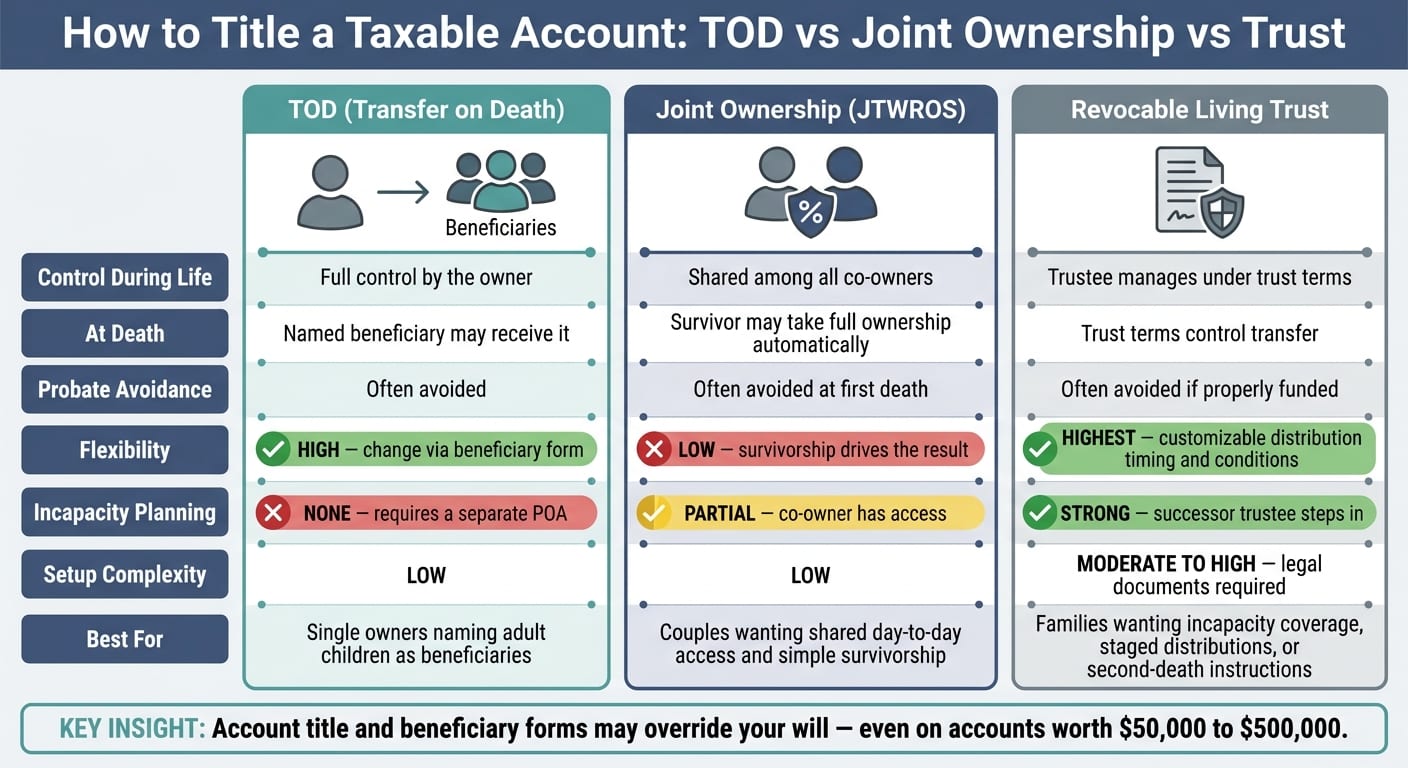
Here's how TOD compares with joint ownership and trust ownership on the main decision points:
| Decision Point | TOD | Joint Ownership (JTWROS) | Revocable Living Trust |
|---|---|---|---|
| Control during life | Full control by the owner | Shared among all owners | Trustee controls the account under the trust terms |
| Probate avoidance | Usually yes, if a beneficiary survives | Yes, passes to the surviving owner | Yes, if properly funded |
| Beneficiary flexibility | High - change via beneficiary form | Low - survivorship controls the outcome | Highest - customizable distribution terms |
| Administrative complexity | Low - simple form | Low - add a name to the account | Moderate to high - legal documents required |
| Incapacity planning | None - requires a separate POA | Partial - co-owner has access | Strong - successor trustee steps in |
TOD may fit investors who want a simple way to pass a taxable brokerage account to adult beneficiaries while keeping full control during life. Joint ownership changes that setup by adding a co-owner during life. It addresses a different issue by giving another person access now, though that may also create added risk.
Joint ownership: shared access with risks many owners overlook
Joint ownership gives another person access now, not just after death. That may make day-to-day life easier. But it also may mean giving up some control.
That’s why joint title is a different tool from TOD. TOD mainly deals with who receives the account after death. Joint ownership changes who may use the account during life, not just who may inherit it later.
JTWROS vs. tenants in common: how each works in practice
JTWROS and tenants in common (TIC) may look similar at first glance, but they work very differently when one owner dies.
JTWROS is built around survivorship. When one owner dies, the surviving owner automatically owns the account, usually outside probate. That simple setup may be one reason JTWROS is often used by spouses.
TIC takes a different path. Each owner holds a stated share, such as 70/30. When one owner dies, that share does not pass to the other owner automatically. Instead, it passes under the deceased owner’s will, trust, or state intestacy rules, which often means probate for that portion.
| Feature | JTWROS | TIC |
|---|---|---|
| Survivorship at death | Automatic; passes to the surviving co-owner | None; the decedent's share passes through their estate |
| Probate treatment | Typically bypasses probate | The decedent's share often requires estate settlement |
| Best fit | Co-owners wanting simple survivorship and shared day-to-day access | Co-owners who want separate interests and independent estate treatment |
The key issue isn’t only who inherits first. It’s also how much control each owner may give up while both people are alive.
A JTWROS title overrides your will for that account. The surviving co-owner gets the asset, even if the will says something else. If the added owner is not a spouse, that person also gets immediate legal access. The account may also be exposed to that person’s creditors.
Example: a married couple sharing a brokerage account
A spouse-to-spouse account shows why JTWROS is so common. It’s simple. But that same simplicity may come with estate-planning tradeoffs.
Take a married couple - David and Karen - who open a joint taxable brokerage account as JTWROS. On a normal day, the setup may feel easy: either spouse may log in, place trades, or transfer funds. When David dies, Karen keeps the account automatically, usually outside probate.
That may work well in a straightforward family setup. But things may look different if David and Karen have children from prior marriages. Under JTWROS, Karen inherits the full account when David dies and may direct it however she chooses, including to her own children. David’s children from a prior relationship would have no claim. Joint title by itself does not address second-death planning.
Basis step-up rules also vary by state, so both the account title and state law may affect the tax result after death.
When shared access isn’t enough, trust ownership may offer more control and a clearer succession plan.
Trust ownership: more setup, more control over what happens next
If TOD feels too narrow and joint ownership seems to give away too much access right now, a revocable living trust may offer more control. A revocable living trust may own a taxable brokerage account. The account gets retitled in the trust's name, and the trustee manages it under the trust terms. In many cases, the person who created the trust also serves as the first trustee, so day-to-day control - trading, withdrawing funds, and managing investments - may continue much like before.
Why trust ownership goes beyond naming beneficiaries
TOD names who gets the money. A trust may also spell out when assets are distributed, how much gets distributed, and under what conditions. That's a big difference for households with more involved estate-planning needs.
For example, a trust may hold a child's inheritance in a continuing trust until age 35, release funds in stages, or limit distributions to health, education, maintenance, and support. It may also address what happens if a beneficiary dies or needs long-term oversight. A TOD form usually offers much less flexibility - often just beneficiary names and percentages.
The tradeoff is extra setup. A trust needs legal drafting, retitling, and ongoing funding. Legal fees may vary based on complexity. TOD, by contrast, may be as simple as filling out a beneficiary form for each account.
One detail people sometimes miss: incapacity planning. TOD only takes effect at death. If the trust creator becomes incapacitated before death, a trust-owned account may be managed by a named successor trustee without a court-appointed conservator, because the trust document lays out how that handoff may work.
Example: retitling a brokerage account into a revocable living trust
Consider a married couple in their mid-60s with three adult children. Working with an estate-planning attorney, they create a revocable living trust, name themselves as co-trustees, and retitle their taxable brokerage account into the trust. Inside the trust document, they state that at the second spouse's death, assets will be divided into three equal shares, with each share held in a continuing trust with discretionary distributions until age 35.
The result may be a single coordinated plan. If one spouse dies first, the other may continue as trustee without changing the setup. At the surviving spouse's death, the successor trustee may settle debts and carry out the staged distributions directly, without opening separate probate proceedings for the trust-titled assets.
That tradeoff - more control, more setup - sets up the next section.
How to pick the right title for your taxable account
The tradeoffs above may help narrow this down. In many cases, the choice comes back to two simple questions: Who may need access now? And who may receive the account later?
A direct decision framework for common investor situations
A simple way to think about it is to match the title to your household setup:
- TOD may fit a single owner who wants to name adult children as beneficiaries and may be comfortable with them receiving the account outright. If you have minor children, a beneficiary with special needs, or you want distributions over time, a revocable living trust may be worth the extra setup.
- JTWROS may fit when two people may need shared day-to-day access and survivorship may be the goal. If you have children from a prior relationship, or you want instructions that apply after the second death, trust ownership may handle that more cleanly.
- Trust ownership may fit families that want incapacity coverage, distributions over time, or instructions for the second death, when that added control may justify the extra setup.
Key points to review before you update account titles
Before you change a title, check that the account form, beneficiary form, and estate documents all point to the same result. Your will, beneficiary forms, and account titles may need to match. For that asset, the account form may control. Brokerages also tend to have their own forms and rules for TOD and trust registrations, so it may make sense to verify the process with your institution directly.
Mezzi may help you view this in one place. By connecting your taxable accounts through read-only aggregation, Mezzi may help you spot potential probate exposure and beneficiary mismatches across accounts - without moving a single dollar. That kind of cross-account visibility may be hard to get from any one institution, and titling gaps may show up there.
Account titling is a legal decision. An estate-planning attorney may want to review any title change before you file it.
FAQs
Can I switch from TOD to a trust later?
Yes. You may move from a Transfer on Death (TOD) designation to a trust later.
In many cases, that means retitling the account in the name of the trust and updating any beneficiary designations so they line up with the trust’s terms. A revocable living trust may still let you keep control during your lifetime, while also offering more flexibility in how assets may pass to heirs.
What happens if a TOD beneficiary dies first?
If a TOD beneficiary dies first, there usually needs to be a living contingent beneficiary on the account. Without one, the TOD designation may fail. In that case, the account may pass under the account’s default or backup rules, and probate may be required.
A TOD transfer only works if the named beneficiary is alive when the account owner dies. That’s why some account owners name contingent beneficiaries as a way to reduce delays and uncertainty.
Should spouses use joint ownership or a trust?
For spouses, joint ownership may be a simple way to manage money together and pass assets straight to the surviving spouse, which may help avoid probate.
A trust may offer more control in more complex estate setups, like blended families, or in cases where a couple may want to spell out how and when assets are distributed. Many couples use both: joint accounts for day-to-day needs and a trust for larger or more important assets.
Disclosures:
- This content is for informational purposes only and does not constitute investment advice or a recommendation to buy or sell any security.