
The short version: a 60/40 portfolio may look balanced before taxes, but what you keep may vary a lot based on account type, income type, and how rebalancing happens.
I’d boil the article down to this:
Bond interest may create most of the yearly tax drag when bonds sit in a taxable account, since that income may be taxed at ordinary income rates.
Stocks may be more tax-friendly in taxable accounts, since much of the return may come from unrealized gains and qualified dividends, which may face lower tax rates.
The same 60/40 mix may lead to different after-tax results if one household holds bonds in an IRA and another holds them in a brokerage account.
Asset location may matter as much as fund selection for after-tax results: many investors place bonds in pre-tax accounts, stock funds in taxable accounts, and higher-growth stock assets in Roth accounts.
Rebalancing may add taxes if it triggers gains in taxable accounts; some investors instead use new cash, dividends, or trades inside tax-advantaged accounts first.
A simple yearly review of where each asset sits, embedded gains, and withdrawal plans may show tax leakage that a single-account view may miss.
Here’s the core idea in one line: the 60/40 split may stay the same, but the after-tax outcome may look very different.
| Topic | What the article points to |
|---|---|
| Bond sleeve | May face yearly ordinary income tax in taxable accounts |
| Stock sleeve | May defer taxes longer and may get lower dividend/gain rates |
| Account location | May change after-tax growth without changing portfolio risk mix |
| Rebalancing | May trigger extra taxes if done through taxable sales |
| Household review | May show mismatches across taxable, pre-tax, and Roth accounts |
If I were reading this for one takeaway, it would be this: pre-tax return numbers may hide a lot, and taxes may change how a 60/40 portfolio feels in practice.
The Hidden Problem with Applying 60/40 Across All Your Account Types (High-Level Deep Dive)
Why taxes reduce the real return of a 60/40 portfolio
After-tax return means the growth you keep after taxes on interest, dividends, and realized capital gains. In a taxable brokerage account, that tax drag may compound over time.
Here’s the rough idea, using a hypothetical example for illustration only: if a 60/40 portfolio earns 2.4% from bonds and 3.6% from stocks in a taxable account, the after-tax return may fall to 4.88% for an investor in the 24% federal bracket. Over 30 years, $100,000 may grow to about $418,000 instead of $574,000. That’s a gap of about $157,000 tied to taxes alone. Same allocation, very different after-tax result. And in many cases, the bond sleeve may create the biggest drag.[11]
Bond interest is usually the largest source of annual tax drag
Most of the annual tax drag may come from the 40% bond sleeve. Corporate bond interest and most bond fund distributions are taxed as ordinary income at federal rates from 10% to 37%, plus state taxes. U.S. Treasury interest is taxable at the federal level but exempt from state and local income taxes. Unlike capital gains or qualified dividends, this income is generally taxed every year as it’s paid.[10][11]
The math is pretty simple. If the bond portion of a $500,000 portfolio yields 4%, that produces $8,000 in annual interest. For an investor in the 32% federal bracket, about $2,560 may go to federal taxes, leaving $5,440 to reinvest. That smaller base may then earn less the next year, and the gap may build over time.
Bernstein's framework puts ordinary investment income at about 40.8% including surtaxes for high-income investors, versus 23.8% for qualified dividends and long-term capital gains.[12]
Municipal bonds are one exception. Their interest is generally exempt from federal income tax, and in-state bonds may also avoid state tax. For investors in higher tax brackets, munis may deliver a higher after-tax yield even when the stated yield looks lower.
Stocks are often more tax-efficient, but still taxable
Stocks usually come with less annual tax drag. Two things drive that.
A large share of returns from broad stock index funds may come from price appreciation, which usually isn’t taxed until shares are sold.
Much of the income they pay may qualify as qualified dividends, which get lower tax rates.
Qualified dividends and long-term capital gains are generally taxed at 0%, 15%, or 20%, depending on income.[3][10]
Still, stocks aren’t tax-free. Some dividends are taxed as ordinary income. Active funds with high turnover may distribute short-term capital gains each year, and those are also taxed as ordinary income. Even broad index funds may distribute gains during heavy outflows. Low-turnover index funds may reduce that risk, but they don’t remove it.[7][8][9]
Pre-tax vs. after-tax: a side-by-side 60/40 comparison
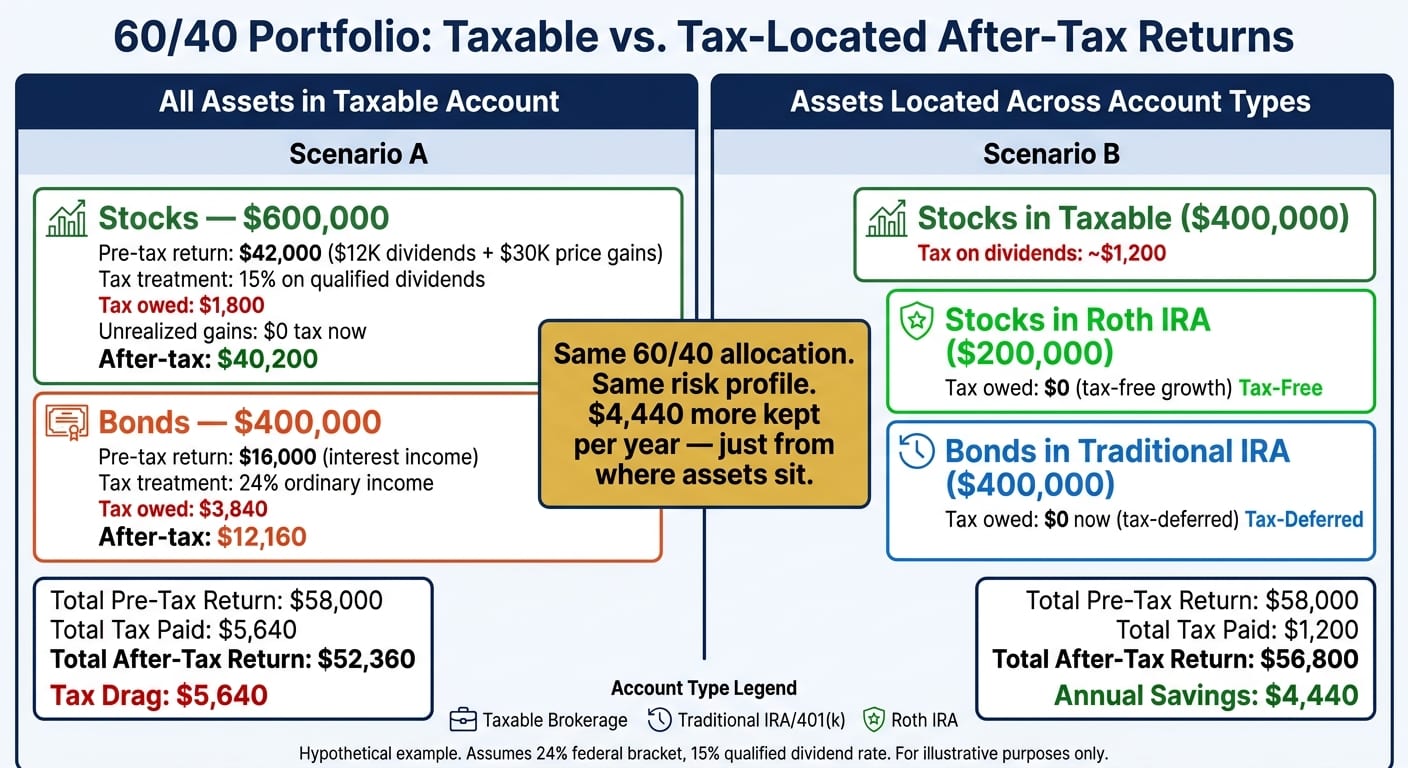
A hypothetical example showing where the return goes
Here’s what tax drag may look like in dollar terms. It gets a lot easier to spot when you line up the same 60/40 mix side by side.
Take a $1,000,000 portfolio with a 60/40 split, all held in a taxable brokerage account. The $600,000 stock sleeve earns a total return of 7%. That breaks down to about 2% from dividends ($12,000) and 5% from price appreciation ($30,000). The $400,000 bond sleeve earns 4%, which produces $16,000 in interest income.
If nothing gets sold, the stock sleeve may have only a modest current-year tax cost. Most of the $12,000 in dividends is assumed to be qualified and taxed at 15%, which comes to about $1,800 in federal taxes. The $30,000 in price appreciation stays unrealized, so no tax may be due on that amount yet.
Bonds work differently. That $16,000 of interest is taxed as ordinary income. At a 24% federal rate, that comes to $3,840 in taxes before any of it gets reinvested, leaving $12,160.
| Sleeve | Allocation | Pre-Tax Return | Income Type | Tax Treatment | After-Tax Amount |
|---|---|---|---|---|---|
| Stocks | $600,000 | $42,000 ($12K div. + $30K gains) | Qualified dividends; unrealized gains | 15% on dividends; no current tax on unrealized gains | $40,200 ($10,200 div. + $30,000 gains) |
| Bonds | $400,000 | $16,000 | Taxable interest | 24% ordinary income | $12,160 |
| Total | $1,000,000 | $58,000 | Mixed | Mixed | $52,360 |
The table puts the tax leakage out in the open. Most of the $5,640 gap may come from bond interest that gets taxed each year. If rebalancing triggers realized gains, after-tax returns may be lower still.[3][16]
Why the same allocation can do better across multiple account types
Now take that same 60/40 mix and spread it across different account types. The mix itself doesn’t change. The risk profile doesn’t change. What changes may be the tax bill. That’s the whole point of asset location.[11][17]
Say a household has $1,000,000 invested at 60/40, split like this:
$400,000 in stocks in a taxable account
$200,000 in stocks in a Roth IRA
$400,000 in bonds in a Traditional IRA
In this setup, the bond interest compounds tax-deferred inside the IRA, so there may be no $3,840 current-year tax bill on that income. The Roth stock growth may later be available as tax-free withdrawals in retirement. And the taxable account holds the assets that tend to be more tax-aware anyway: low-turnover stock index funds with mostly qualified dividends.[6][11][2]
With that arrangement, the taxable stocks create a $1,200 dividend tax bill, the Roth stocks owe nothing now, and the IRA bonds defer tax entirely. That puts the household’s current-year after-tax amount at about $56,800, compared with $52,360 in the fully taxable version. That’s a difference of roughly $4,440 in one year, even though the risk mix stays the same.[6][11][17]
Vanguard describes asset location in simple terms as "bonds in traditional, stocks in taxable" for many investors, due to the ordinary-income tax on bond interest vs. preferential rates on stock dividends and gains.[11][2]
Over time, that gap may compound.
How to make a 60/40 more tax-efficient without changing the allocation
Match each asset type to the account where it is taxed least
Once taxes change the return, account placement may become the next lever. The 60/40 mix stays the same, but the after-tax result may look better when each holding sits in the account where taxes may be lower.
Bonds often fit better in tax-deferred accounts. Bond interest may be taxed as ordinary income, so it may compound more favorably inside a traditional 401(k) or IRA, where no annual tax bill applies.[5][27] Stock index funds often fit better in taxable accounts, where qualified dividends and long-term gains may face lower rates.[24][25][26]
If a taxable account still needs bond exposure, municipal bonds may fit better than taxable bond funds. Some investors use municipal bond funds in taxable accounts when they want bond exposure and may want to reduce federal tax.[4][1][23] Put those same munis inside a traditional IRA or Roth, and that built-in tax break may no longer matter much.[14][20][4][23]
Roth space may make more sense for stock funds with higher growth potential, since more of that compounding may stay outside future tax.[18][14][13][15]
That said, good asset location alone may not do the whole job. A portfolio may still lose ground on taxes if rebalancing sales happen in the wrong place.
| Account Type | Holdings Commonly Placed Here in a 60/40 Portfolio | Likely Tax Consequence |
|---|---|---|
| Taxable brokerage | Broad stock index funds, long-term individual stocks, municipal bond funds | Qualified dividends and long-term gains may be taxed at lower rates; muni interest may be federally tax-exempt. |
| Traditional 401(k) / IRA | Taxable bond funds, high-yield bonds, REITs, high-turnover active funds | Growth is tax-deferred; withdrawals may be taxed as ordinary income at a future marginal rate. |
| Roth IRA / Roth 401(k) | Highest-growth equity funds | Contributions are after-tax; qualified withdrawals may be tax-free. |
Rebalance with tax awareness instead of selling blindly
After placement, rebalancing may be the second place where tax drag shows up. Selling in taxable accounts may trigger gains that some investors may prefer to avoid.
One common approach is to use new contributions and cash flows to move back toward the target mix before selling anything in a taxable account.[21][13][15] If that isn't enough, some investors rebalance inside tax-advantaged accounts first. Moving between stocks and bonds inside a traditional IRA or Roth triggers no current tax, which may absorb much of the drift before the taxable account needs to be touched.[21][13][22]
If selling in a taxable account becomes necessary, investors often start with lots showing losses or the smallest embedded gains. Realized losses may offset capital gains dollar-for-dollar.[19][21] There is one catch: the wash-sale rule disallows a loss if you buy the same or nearly identical fund within 30 days before or after the sale.[19][21] Some investors swap into a similar, but not substantially identical, fund so they may keep market exposure while preserving the harvested loss.
How to check whether your own 60/40 is actually tax-efficient
After placement and rebalancing, the next step is figuring out whether your full household setup may keep more of the return.
Tax efficiency tends to show up at the household level. A bond fund that looks fine inside one account may still create unnecessary ordinary income tax across the full portfolio.
A household-level checklist for a tax-efficient 60/40
Start by mapping what you own and where it sits. The six questions below cover some of the most common gaps in a household-level review:
| Checklist Item | What to Look For |
|---|---|
| Account types and balances | Do you have assets spread across taxable, Traditional, and Roth accounts? Without all three, location options may be limited. |
| Bond placement | Are bond funds in Traditional 401(k)s or IRAs? |
| Stock fund placement | Are broad stock index funds in taxable accounts? |
| Embedded gains | Do any taxable positions carry large unrealized gains that may trigger a large tax bill if sold during rebalancing? |
| Annual tax drag | Is annual tax drag material in dollar terms, not just percentages? |
| Withdrawal sources | May future withdrawals come from taxable, pre-tax, or Roth accounts - and does your current placement support that plan? |
Running through this checklist once a year - or after any major account change - may surface placement mismatches before they turn into more tax drag over time.
This is where a full-household view matters. Single-account checks may miss tax leakage that shows up only when all accounts are viewed together. Mezzi shows taxable, Traditional, and Roth accounts in one read-only view through Plaid and Finicity, which may make household-level tax mismatches easier to spot.
Conclusion: A 60/40 may still fit your risk, but tax leakage may be worth reviewing
A 60/40 mix may still make sense for some households. The tax drag often comes from asset location and rebalancing, not from the allocation itself.
FAQs
Should I hold bonds in a taxable account?
For many investors, it may not be the most tax-efficient placement. Interest from taxable bonds may be taxed at ordinary income rates, which may go as high as 37%. That may create a steady tax drag on returns.
Because of that, these holdings may fit better in tax-deferred accounts like 401(k)s or Traditional IRAs. If those accounts are already full, some investors give priority to municipal bonds or U.S. Treasury securities in taxable accounts, since they may offer federal or state tax advantages.
When does rebalancing create taxes?
In a taxable account, rebalancing may create taxes when appreciated assets are sold, since those sales may trigger capital gains taxes. Some funds, including certain target-date funds, may also create taxable events through internal rebalancing.
There’s another wrinkle. Frequent trading to maintain a target allocation may realize short-term gains, and those gains may be taxed at higher ordinary income rates. Because of that, some investors choose to handle more of their rebalancing inside tax-advantaged accounts like IRAs or 401(k)s, where trades may be less likely to create an immediate tax bill.
How can I check my 60/40 for tax drag?
Bring your 401(k)s, IRAs, and taxable accounts into one view. That way, you may get a clearer read on your full 60/40 allocation and where each holding sits across accounts.
Then check for possible tax drag. A few places people often look:
Bonds or REITs held in taxable accounts
High-turnover funds
Duplicate exposures across multiple accounts
Taxable sales that may have qualified for long-term capital gains rates
Tax-loss harvesting may also help offset gains in some cases.
Disclosures:
This content is for informational purposes only and does not constitute investment advice or a recommendation to buy or sell any security.
Past performance is not indicative of future results. No guarantee of future performance or outcomes is implied.
Savings and performance examples are hypothetical and for illustrative purposes only. Actual results will vary based on individual circumstances, portfolio composition, market conditions, and fees.