
If I leave work between age 55 and 59½, I may still have ways to take retirement money without the extra 10% IRS penalty. The main paths may depend on where the money sits: a 401(k) or 403(b) may fall under the Rule of 55, while an IRA may need a 72(t) SEPP setup. And if I move a 401(k) into an IRA too soon, I may lose one of those paths.
Here’s the short version:
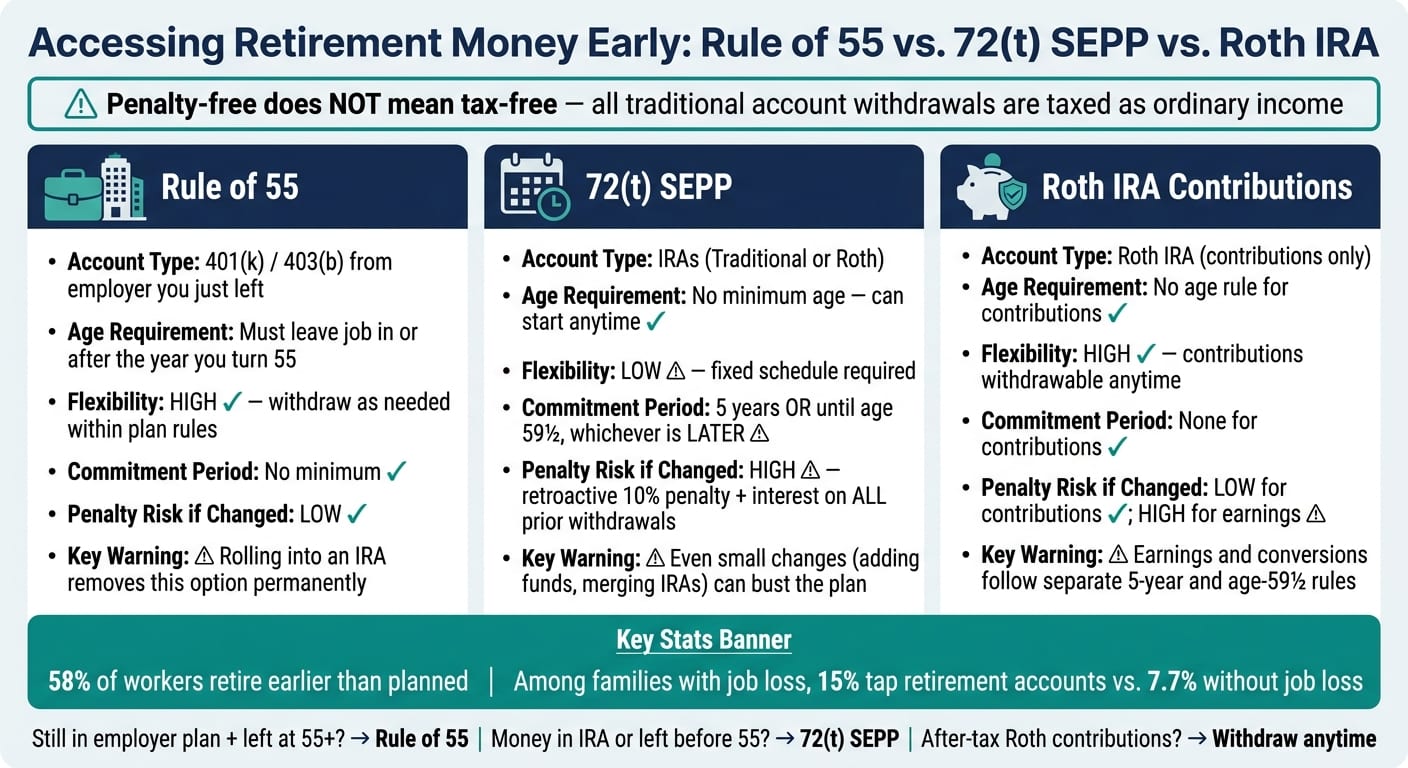
- Rule of 55 may apply only to the current employer plan I just left
- 72(t) SEPP may apply to IRAs, but it may lock me into a set withdrawal schedule
- Penalty-free still may mean taxable
- Roth IRA contributions may usually come out tax- and penalty-free, but earnings may follow different rules
- Plan rules may limit how often I can withdraw from a 401(k) or 403(b)
- A bad rollover move may shrink my options fast
A few numbers show why this topic comes up so often: 58% of workers retire earlier than planned, and among families dealing with job loss, 15% tap retirement accounts, versus 7.7% among those without job loss.
Quick comparison
If I’m trying to bridge the years before 59½, the key question may not be “Do I have enough saved?” It may be “Which rule fits which account?”
Rule of 55: 5 Costly Decisions Most People Get Wrong
Rule of 55: How to Access a 401(k) or 403(b) After Leaving a Job
For workers leaving a job at 55 or later, the main issue may be timing. The money generally needs to stay in the employer plan long enough for the Rule of 55 to apply. Under this rule, some workers may take money from an employer plan before age 59½ without the 10% early-withdrawal penalty.
Eligibility: You Must Leave Your Job in or After the Year You Turn 55
To qualify, you must leave the employer that maintains the plan, and that departure must happen during or after the calendar year you turn 55. That timing detail matters more than many people expect. If you leave in January of the year you turn 55, you may still qualify even if your birthday comes later that year. But if you left at 54, the Rule of 55 does not apply to that plan, even if you wait until you're older.
Just turning 55 while still employed doesn't trigger the exception. The rule is tied to leaving the job, not simply reaching the age.
Which Accounts Qualify and Which Do Not
The Rule of 55 applies only to the employer plan you just left, usually a 401(k) or 403(b). It does not apply to IRAs. Older 401(k) accounts from prior employers are also outside the rule unless you rolled them into your current employer's plan before leaving. In some cases, that may increase the amount available under the rule.
Plan rules still control how withdrawals may happen. Some plans may allow installments, while others may require a lump sum. That's why some workers check with the plan administrator before leaving, so they know which payout formats the plan offers.
The Rollover Mistake That Can Lock Your Money Back Up
Rolling eligible 401(k) or 403(b) money into a traditional IRA will usually end Rule of 55 access for those dollars. If someone may need the money before 59½, keeping those funds in the employer plan may preserve that option.
If the money is already in an IRA, or if it gets rolled out of the plan, the next option may be 72(t) SEPP.
72(t) SEPP: The IRA Option When Rule of 55 Does Not Apply
If Rule of 55 isn't available, SEPP under IRC Section 72(t)(2)(A)(iv) may allow penalty-free IRA withdrawals. The catch: the rules are tight, and even a small slip may create problems.
How SEPP Works and How Long You Are Locked In
SEPP requires scheduled withdrawals from a retirement account at least once per year. The amount must be calculated using one of three IRS-approved methods: the RMD method, fixed amortization, or fixed annuitization.
Here's the basic difference:
- The RMD method recalculates each year and usually results in the lowest payments.
- Fixed amortization and fixed annuitization produce fixed annual payments for the full schedule.
Once you begin, you must continue without interruption until the later of five full years or age 59½. Start at 57, and you may be locked in until 62. Start at 50, and the commitment may last close to a decade.
SEPP is not a take-money-when-you-want setup. It's closer to a fixed withdrawal stream that runs for a set period. And because the schedule stays fixed, a minor change may break the plan.
Why Small Mistakes Can Trigger Retroactive Penalties
A SEPP violation counts as a modification. That may trigger the 10% penalty, plus interest, on prior withdrawals.
A few examples of changes that may bust the plan:
- Adding money to the SEPP account
- Combining the SEPP IRA with another IRA
- Rolling funds out of the account
To lower that risk, some people set up a separate IRA just for SEPP and keep it apart from other retirement accounts.
When SEPP Makes More Sense Than Rule of 55
Rule of 55 may be the better fit when it applies.
SEPP may make more sense when most of your retirement assets sit in IRAs, when you left work before the calendar year you turned 55, or when your employer plan has weak or rigid withdrawal options.
For example, a 52-year-old with $800,000 in a traditional IRA and $50,000 in an old 401(k) who wants to retire now may not have access to the Rule of 55 for most of that money. In that case, SEPP from the IRA may be the main tool for generating penalty-free income until 59½.
Next, compare how SEPP and Rule of 55 differ by account type, tax treatment, and flexibility.
Account-by-Account Comparison: 401(k), 403(b), Traditional IRA, and Roth IRA
Now that the two main exceptions are clear, the next step is looking at which accounts they may open up. The path may depend on the account: the Rule of 55 may apply to employer plans, 72(t) SEPP may apply to IRAs, and Roth withdrawal rules may shape what happens with after-tax dollars.
Employer Plans: 401(k), 403(b), and Similar Accounts
For 401(k) and 403(b) plans, the Rule of 55 may be the clearest early-access exception. If you separate from the employer that sponsors the plan in or after the calendar year you turn 55, you may take distributions from that plan without the 10% penalty, even if you are still under 59½.
There’s one catch that trips people up: the Rule of 55 stays with the plan tied to the employer you left. It does not extend to older employer plans or IRAs.
Because of that, keeping money in the employer plan may preserve that option. Before leaving, it may make sense to check the plan’s summary plan description. Some plans may allow only lump-sum distributions, while others may limit how often withdrawals happen. That may make the Rule of 55 less useful for someone trying to set up a steady stream of cash flow.
That’s why employer plans may be the easiest match for the Rule of 55. IRAs follow a different playbook.
Traditional and Roth IRAs: More Exceptions, but Different Rules
Traditional IRAs do not qualify for the Rule of 55. For people under 59½, SEPP may be the main penalty-free route.
Roth IRAs work differently from every other account type here. Roth IRA contributions may usually be withdrawn anytime without taxes or penalties. But conversions and earnings follow their own 5-year and age-based rules, which may change the tax result.
So yes, access matters. But access alone doesn’t tell the full story. Taxes may still shape the actual cost.
Taxes, Tradeoffs, and How to Decide Before You Withdraw
The Tax Cost Is Still Real Even Without the Penalty
Skipping the 10% early-withdrawal penalty doesn't mean the IRS stops there.
Every dollar taken from a traditional 401(k), 403(b), or traditional IRA may be taxed as ordinary income in the year of the withdrawal. That income may stack on top of your other taxable income and may push part of the withdrawal into a higher federal bracket.
Take a 56-year-old single filer with $40,000 in other taxable income who withdraws $80,000 from a traditional 401(k) under the Rule of 55. Total income may jump to $120,000, and a large share of that $80,000 may be taxed at 22% or 24%. That may add well over $10,000 in federal taxes compared with taking nothing.
Pre-tax withdrawals may also increase your Modified Adjusted Gross Income (MAGI). That may reduce or remove ACA marketplace premium tax credits and may lead to higher Medicare IRMAA premiums two years later. Higher MAGI in your late 50s may also mean higher Medicare premiums later.
Once the penalty is no longer the issue, the next step may be figuring out which source of cash creates the lowest tax hit.
A Simple Decision Order for Early Retirees and Job Changers
A simple order may help keep taxes and penalties lower:
- Check taxable accounts first. Brokerage accounts, savings, and CDs are often the most flexible source and may come with a lower tax cost. Long-term capital gains may be taxed at 0%–20%, which may be lower than ordinary income rates. Using these accounts for near-term spending may preserve retirement balances and may keep MAGI lower for ACA and IRMAA purposes.
- Verify Rule of 55 eligibility before rolling anything over. If you left your employer in or after the year you turned 55, the 401(k) or 403(b) from that job may allow penalty-free withdrawals. Moving that money into an IRA first removes that option.
- Tap Roth contributions before Roth earnings. Contribution basis may be available before earnings without adding to taxable income. That may help protect ACA subsidies and may leave more room for future Roth conversions.
- Evaluate 72(t) SEPP only if needed. If Rule of 55 doesn't apply and taxable assets may not cover enough, SEPP may open IRA access. But it comes with a fixed payment schedule for at least 5 years or until age 59½, whichever is longer. It may work, but it doesn't leave much room to pivot.
Mezzi may let you view your 401(k), IRA, Roth, and taxable accounts in one read-only dashboard so you can compare withdrawal sources before moving money.
Conclusion: How to Bridge the Gap from 55 to 59½
Getting from 55 to 59½ may come down to matching the account with the IRS rule that fits it. Rule of 55 may be the most direct path for some people. It doesn't require a fixed withdrawal schedule and stays tied to the employer plan you left. 72(t) SEPP may be more rigid, but some people use it when Rule of 55 isn't available. Roth contribution basis may offer tax-free access at any age, though using it may leave less money in place for future tax-free growth.
One mistake may be easier to avoid than most: rolling a qualifying 401(k) into an IRA before checking Rule of 55 eligibility. Once the rollover happens, that penalty-free path goes away, and the list of options gets shorter.
The right move may depend on your account mix, the timing of your job separation, your current tax bracket, and how much flexibility you want.
FAQs
Can I use the Rule of 55 if I already rolled my 401(k) into an IRA?
No. The Rule of 55 generally applies only to your current employer’s 401(k) or 403(b) if you leave that job during or after the calendar year you turn 55.
Here’s the catch: once those funds are rolled into an IRA, the Rule of 55 generally no longer applies. At that point, standard IRA withdrawal rules may require you to reach age 59½ to avoid the 10% early-withdrawal penalty.
Which early-withdrawal option offers more flexibility?
It depends on your goals and the type of account you have.
Roth IRAs may offer the most flexibility in many cases because you may withdraw your original contributions at any time without taxes or penalties.
With other accounts, the trade-offs may be different. A 401(k) loan may offer short-term flexibility if you remain employed and repay the loan on schedule. If you're 55 or older, the Rule of 55 may allow penalty-free access to your current employer's 401(k). 72(t) payments may provide a steady income stream, but they tend to be far less flexible.
Will I still owe taxes if I avoid the 10% penalty?
Yes. Even if you qualify for an exception to the 10% early-withdrawal penalty, you may still owe regular income taxes on the amount you withdraw.
For tax-deferred accounts like traditional 401(k)s and IRAs, the IRS generally treats withdrawals as ordinary income. That means the money withdrawn may be taxed at your marginal tax rate for that year.
Disclosures:
- This content is for informational purposes only and does not constitute investment advice or a recommendation to buy or sell any security.
- Tax rules and IRS regulations are subject to change and may vary based on individual circumstances. Consult a qualified tax or financial professional before making any decisions regarding retirement account withdrawals.
- Past performance is not indicative of future results. No guarantee of future performance or outcomes is implied.
Related Blog Posts
- How to remove money from a 401k?
- When can you start pulling from a 401k?
- 401(k) withdrawal rules: How to avoid penalties
- How Do I Access Retirement Funds Before 59.5 Without Penalty?
No. The Rule of 55 generally applies only to your current employer’s 401(k) or 403(b) if you leave that job during or after the calendar year you turn 55.
Here’s the catch: once those funds are rolled into an IRA, the Rule of 55 generally no longer applies. At that point, standard IRA withdrawal rules may require you to reach age 59½ to avoid the 10% early-withdrawal penalty.
It depends on your goals and the type of account you have.
Roth IRAs may offer the most flexibility in many cases because you may withdraw your original contributions at any time without taxes or penalties.
With other accounts, the trade-offs may be different. A 401(k) loan may offer short-term flexibility if you remain employed and repay the loan on schedule. If you're 55 or older, the Rule of 55 may allow penalty-free access to your current employer's 401(k). 72(t) payments may provide a steady income stream, but they tend to be far less flexible.
Yes. Even if you qualify for an exception to the 10% early-withdrawal penalty, you may still owe regular income taxes on the amount you withdraw.
For tax-deferred accounts like traditional 401(k)s and IRAs, the IRS generally treats withdrawals as ordinary income. That means the money withdrawn may be taxed at your marginal tax rate for that year.