
Updated September 26, 2026.
Mezzi is worth considering as a Kubera alternative when your next need is advice grounded in your household's finances and goals. Kubera deserves to stay on your shortlist when complex ownership, private assets or international wealth are central to the job. Both products have an AI story. The decision is about the workflow and records you need.
A balance sheet can be accurate and still leave you with a question: how much cash is available for a goal, which exposures deserve attention, or which tradeoffs should you consider next? It can also be sophisticated in ways that are easy to underestimate until you try to replace it. Start by separating those two needs.
This guide helps you evaluate a replacement without losing the structure that makes your current financial picture useful. For a feature-by-feature overview, see Mezzi versus Kubera.
What are you trying to replace?
| The work you need done | What to evaluate | Why it matters |
|---|---|---|
| Organizing complex ownership | Entity views, ownership percentages, permissions | A personal total can conceal who actually owns an asset |
| Tracking private investments | Commitments, calls, distributions and valuations | A current balance alone does not explain future cash obligations |
| Understanding household choices | Connected information plus explicit goals | A cash balance does not reveal whether it is available to spend |
| Investigating fund exposure | Supported underlying holdings and data dates | Several funds can contribute to the same company exposure |
| Asking AI questions | Where context lives and what data the assistant can use | An AI label alone does not describe the quality of the workflow |
If the first two rows drive your everyday use, examine replacement capabilities closely. If the third and fourth rows are the missing work, Mezzi may be useful even while you retain a specialist record system.
Give Kubera credit for the work it already does
Kubera documents multi-currency tracking, private-investment records, portfolio sharing and scenario exploration through Fast Forward. Its Black tier adds ownership tags and nested portfolios for more complex structures. Those features address specific record-keeping problems, not just a larger account balance. Kubera overview and plans
Nested portfolios are particularly relevant when assets belong to several people or entities. Kubera's documentation describes separate portfolios that can feed into a broader view with an ownership percentage. That is more than a label on a personal asset list. Nested portfolios
Kubera also supports connections to external AI assistants. It should not be described as lacking AI or as a purely static tracker. Evaluate what information can be made available to the assistant, how the permissions work and whether that arrangement suits you. Kubera AI setup
These strengths may make Kubera the right choice for a household with private-company interests, foreign-currency assets and entity-level access requirements. A replacement should demonstrate the required structure before you retire the existing record system.
What Mezzi adds to the conversation
Mezzi organizes a financial picture across Investments, Banking, Other Assets and Liabilities. Supported checking, savings and credit-card accounts belong alongside investments; real estate can be entered manually. This is useful when the decision depends on both what you own and what you owe. Mezzi account groups
AI Personalization supplies context that numbers alone do not contain. A household can describe its goals, preferences, liquidity needs and rules for approaching decisions. For example, the user can explain that a reserve is intended for tuition or that a particular asset should be treated as difficult to sell. Those inputs help frame an advice conversation; they do not verify a valuation or execute an instruction.
Exposure X-Ray helps examine company exposure through supported funds. A useful next question is how that exposure interacts with direct holdings and the rest of the household's plan. An answer still depends on the data available, including current positions and any missing accounts.
Mezzi should not be assumed to reproduce private-fund accounting, nested legal ownership or every specialized record in Kubera. Start by asking which decisions you need help with, then establish whether the underlying data is sufficient.
A worked example: wealth is not the same as available cash
Imagine a household with $800,000 of marketable investments, $500,000 of private-investment value, a $900,000 home and $100,000 of cash. It also has a $400,000 mortgage and expects a $40,000 capital call. These are hypothetical figures.
The simple net-worth calculation is $1.9 million: $2.3 million of assets less $400,000 of debt. But that total does not mean the household has $1.9 million available for a purchase. A house and a private investment may not be quickly convertible to cash, and the capital call affects the cash decision.
A replacement trial should preserve these distinctions:
- The private investment's reported value and valuation date.
- The difference between an existing liability and a future funding commitment.
- The cash earmarked for the capital call and any additional reserve.
- Ownership of each asset and any shared interests.
- Which values come from connections and which were entered manually.
Then ask: “What information would you need before discussing whether some of this cash can fund a new goal?” That is more revealing than asking for a generic net-worth summary. An answer that ignores the capital call has missed the household's actual constraint.
A completed ownership and commitment record
For the same example, suppose the $500,000 private-investment value is the household's 50% interest in an entity with a $1 million reported net value. Keep the entity's full value and the household's share distinct. Adding both to personal net worth would count the same interest twice.
| Record | Illustrative entry | Keep in the specialist record | Use in the Mezzi discussion |
|---|---|---|---|
| Ownership | Household owns 50% of Entity A | Entity structure, ownership percentage and permissions | Household attributable value is $500,000, not $1 million |
| Valuation | Entity statement dated June 30: $1 million net value | Original statement, method and valuation history | Manual $500,000 share, labeled with date and uncertainty |
| Commitment | $100,000 unfunded commitment; $40,000 call expected next month | Commitment/call/distribution ledger and notices | Reserve at least the stated $40,000 for the near-term discussion; review remaining timing |
| Household cash | $100,000 on the review date | Institution records and reconciliation | $100,000 less $40,000 call less an assumed $30,000 reserve leaves $30,000 before other needs |
| Related debt | $400,000 mortgage on the $900,000 home | Debt statement and ownership records | Include the liability once; do not also subtract it from an already-net home-equity figure |
The unfunded commitment is a future funding obligation for this planning worksheet, kept separate from the stated $1.9 million net-worth arithmetic. The exact legal and accounting treatment depends on the agreement. The example does not assume a capital call increases net worth dollar for dollar or that the private valuation is current cash.
Kubera's documented commitment records and Black ownership structure can remain the detailed system of record. Mezzi can use the relevant household values and constraints for guidance, subject to actual connection/manual-entry support. This is a manually reconciled workflow, not a claim of automatic Kubera-to-Mezzi import or matching private-fund accounting. Kubera private-asset scope, Black features
A trial succeeds if the household can reproduce the $500,000 attributable value, explain the $30,000 preliminary cash remainder, and locate the documents behind both. Keep Kubera if losing those records would make the answer less dependable.
Compare price against the records and help you use
Kubera currently lists Essentials at $250 annually and Black at $2,500. Mezzi has a free plan, Advisory at $399 annually and Concierge at $999 annually. Kubera plans and Mezzi plans
Mezzi Advisory therefore costs $149 more than Kubera Essentials. It would be misleading to call every Mezzi plan a cheaper Kubera replacement. Black addresses additional complexity, so comparing its price with Mezzi without discussing ownership and record requirements is also incomplete.
Build a short list of the features you actually use. If you need Black's entity structure, its value should be assessed against that requirement. If you chiefly use a personal total and want more discussion of financial decisions, a different workflow may make sense. Buying both adds cost, but can be reasonable if they serve distinct recurring jobs.
Run a replacement trial before deleting records
Start with an account and asset inventory. Record the owner, value, valuation date, currency, connection method and any notes needed to understand each entry. Keep source statements and original documents separately.
Connect supported accounts in the candidate product and add manual items carefully. Reconcile a common date rather than treating every mismatch as an error. Market movements, currency conversion and refresh times can produce different totals.
Next, check double counting. An entity value that already includes an investment should not be added to the same investment again in a household total. This is especially important when moving from a structured ownership system to a simpler list.
Finally, test a decision with explicit context. Keep a record of what the tool can explain, what it cannot support and what still requires another system. Do not assume an export file can be imported into Mezzi or preserve your historical records without verifying that capability first.
Keep the tool that earns its place
Stay with Kubera if its ownership structure, private-asset records or international view are central to how you manage your information. Evaluate Mezzi if your next need is to connect a financial question to your accounts, liabilities and personal goals. Use both only if you can name the ongoing job each performs.
For a broader shortlist, see portfolio analyzers and tracking tools. Your financial system should make the next decision clearer without making the records behind it less dependable.
Frequently asked questions
Does Kubera support AI?
Yes. Kubera documents connections to external AI assistants. Compare the data access and workflow with the advice experience you want rather than assuming AI is exclusive to one product.
Is Mezzi cheaper than Kubera?
It depends on the plan. Kubera Essentials is $250 annually, while Mezzi Advisory is $399. Mezzi also offers Free and Concierge; Kubera Black has a different scope and price.
Can I transfer my Kubera history into Mezzi?
Do not assume a direct migration. Preserve records and verify supported imports before relying on historical data being reproduced. Connecting current accounts is a different task.
Can a manually entered home value support a net-worth view?
Yes, but label the valuation date and method and keep the related mortgage separate. A manually entered value is not an automatic appraisal or proof of available cash.
See how Mezzi groups accounts
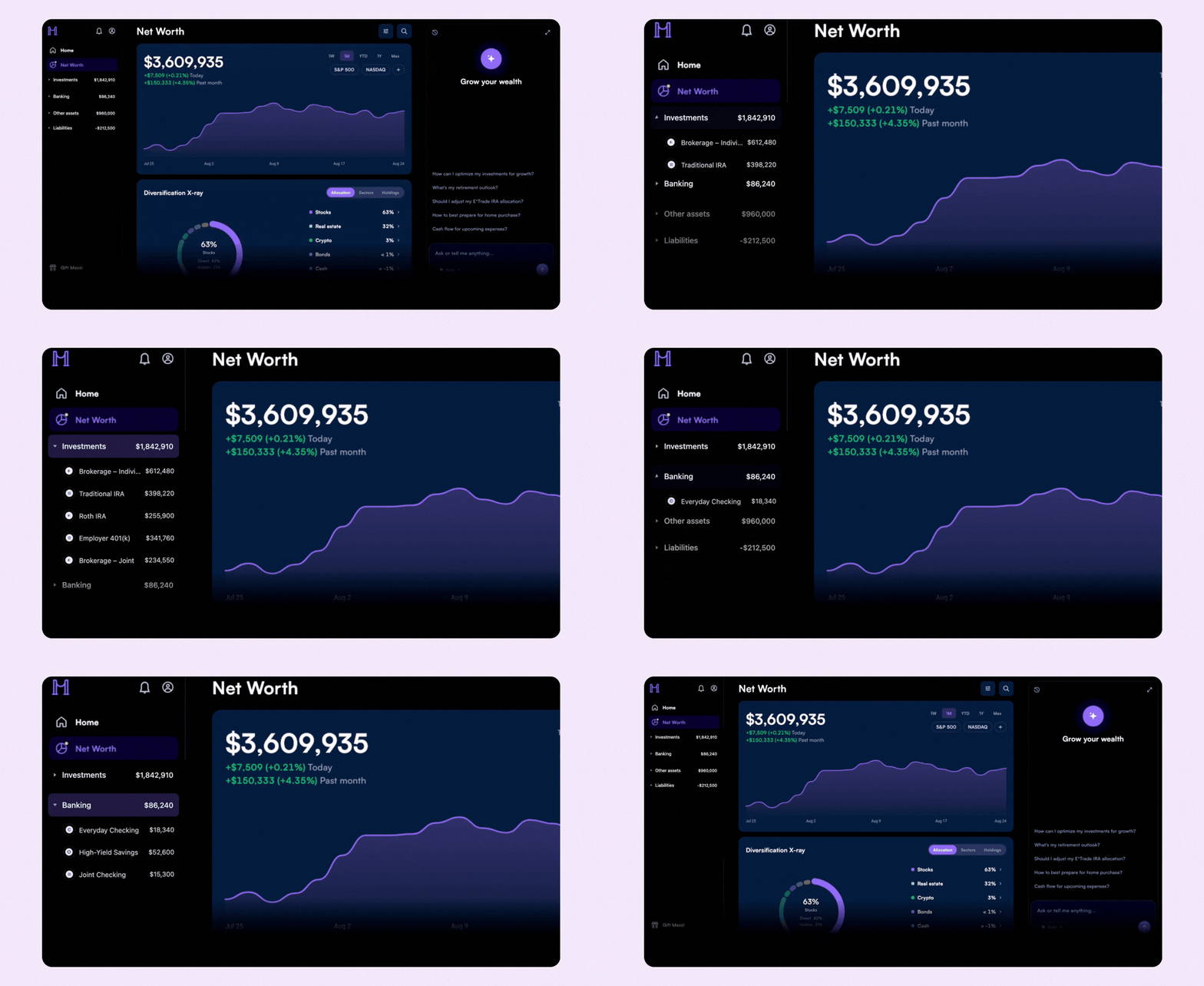
Bring your supported accounts and manually valued assets into view, then ask one question that connects liquidity and your goals.
Start with Mezzi FreePublished by Mezzi for educational purposes. This is not personalized investment, tax, or legal advice. Prices and features were checked September 26, 2026 and can change. Comparisons use official documentation, not a matched product trial. Examples are illustrative, not customer results. Investing involves risk, including loss of principal. Account information can be incomplete or delayed. SEC registration does not imply approval or a particular level of skill.