
Job changes may leave money scattered fast. As of May 2023, one industry estimate put left-behind 401(k) accounts at about 29.2 million, holding roughly $1.65 trillion, which may make old balances, fees, tax forms, and beneficiary details easier to miss.
Here’s the short version: I may sort each old account by tax type first, then test four things before moving anything:
Fees - old plan vs. new home
Investment choices - better, worse, or about the same
Tax cost - especially for ESPP shares and taxable accounts
Reason to keep it separate - or just extra clutter
That framework may point to one of four paths:
Keep it
Move it to a new employer plan
Roll it over to an IRA or other account of the same tax type
Consolidate it if the move may cut clutter without adding tax or record problems
I’d also treat each account type a little differently:
Old 401(k)s / 403(b)s: leaving it, moving it, or rolling it over may each make sense depending on plan fees, fund menu, and plan rules
HSAs: these usually stay with the worker, and transfer costs and monthly fees may drive the choice
ESPP shares: lot dates, cost basis, and sale timing may affect ordinary income vs. capital gains treatment
Taxable brokerage accounts: an in-kind transfer may move holdings without a sale, which may limit tax friction
What Happens to Your 401(k) When You Change Jobs?
Quick comparison
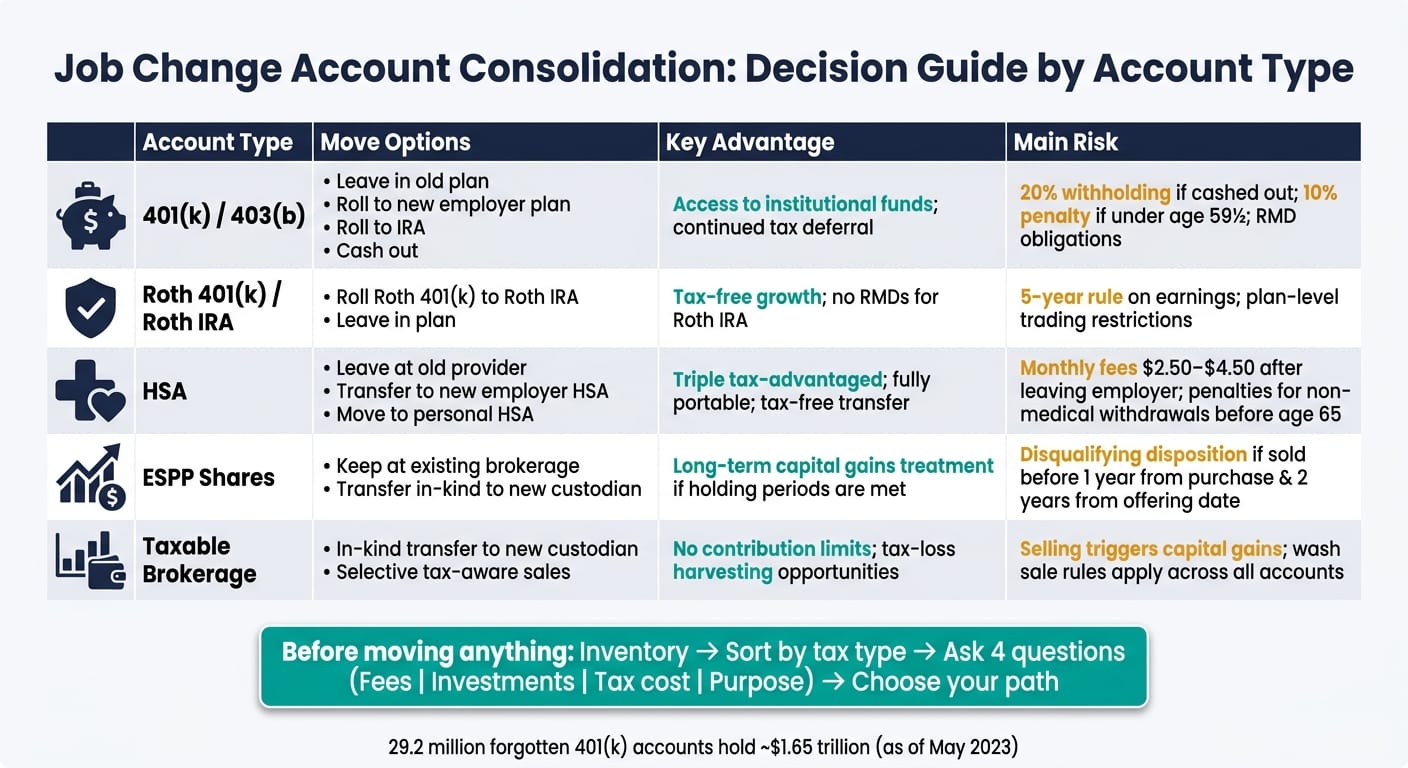
| Account type | Main move options | Main thing to watch |
|---|---|---|
| 401(k) / 403(b) | Leave, move to new plan, roll to IRA, cash out | Tax withholding, penalties, and plan features |
| Roth accounts | Leave or roll to Roth IRA | 5-year rules and plan limits |
| HSA | Leave, transfer to new HSA, move to personal HSA | Monthly fees and transfer method |
| ESPP shares | Keep, transfer, or sell | Holding periods and cost-basis records |
| Taxable brokerage | In-kind transfer or sell | Capital gains, wash sales, and tax lots |
A clean process may be simple: inventory first, direct transfer when allowed, save records, then check balances and tax forms after the move.
Step 1: Apply a top-level decision tree before touching any account
After you build your account inventory, sort each account by tax treatment before moving any money.
That first pass may sound basic, but it sets the rules for everything that comes next. It may show which transfers are even allowed and which ones may trigger taxes. Put each account into one of five buckets:
Pre-tax: traditional 401(k), traditional IRA
Roth: Roth 401(k), Roth IRA
HSA
ESPP shares
Taxable brokerage
Check the label on your statement or online portal. Then confirm the tax status in the plan details and note the tax forms tied to that account. That classification becomes the starting point for every later call.
The four questions that drive every consolidation decision
Once you know what each account is, run it through four questions before deciding what to do.
1. Are the total fees clearly higher or lower than the alternatives?
Compare fund expense ratios, administration fees, and custodial charges. Even small percentage gaps may compound faster than many people expect.[3]
2. Are the investment options clearly better or worse?
Some people lean toward broad, low-cost funds and target-date options. An old plan may be worth keeping only when its menu or share classes appear better.[4][5]
3. What does moving actually cost in taxes?
For taxable brokerage accounts and ESPP shares, selling may create capital gains and, in some cases, ordinary income. Estimate that tax cost before deciding.[7][8]
4. Does keeping this account separate serve a real purpose?
Separate accounts may make sense when each one has a distinct job. If not, overlap may add paperwork without adding much else.
When consolidation helps and when it just creates more work
Consolidation may earn its keep when it cuts fee drag, removes duplicate holdings, and reduces the number of accounts you need to watch. It may create extra work when it triggers taxes you didn't need, removes useful plan features, or shifts money into a weaker investment menu.
The table below ties each account type to its tax treatment and the main trade-offs.
| Account Type | Tax Treatment | Typical Consolidation Options | Key Pros | Key Risks |
|---|---|---|---|---|
| Pre-tax 401(k) / Traditional IRA | Tax-deferred; withdrawals taxed as ordinary income; RMDs apply | Leave in old plan, roll to new employer plan, or roll to traditional IRA | Access to institutional funds; continued tax deferral | RMD obligations; balances below around $7,000 may not be allowed to stay[6] |
| Roth 401(k) / Roth IRA | After-tax contributions; qualified withdrawals tax-free; no RMDs for Roth IRAs under current rules | Roll Roth 401(k) to Roth IRA, or leave in plan if options are strong | Tax-free growth; retirement flexibility | 5-year rule on earnings; plan-level trading restrictions |
| HSA | Triple tax-advantaged: pre-tax contributions, tax-free growth, tax-free qualified medical withdrawals | Leave at old provider, transfer to new employer's HSA, or move to a personal HSA provider | Fully portable; transfer is tax-free with no deadline[1] | Penalties for non-medical withdrawals before age 65 |
| ESPP Shares | Mixed: ordinary income at purchase; capital gains on sale | Keep shares at existing brokerage or transfer in kind to another custodian | Long-term capital gains treatment if holding periods are met | Disqualifying disposition if sold before 1 year from purchase and 2 years from offering date[7][8] |
| Taxable Brokerage | Dividends and realized gains taxed annually; capital gains at sale | In-kind transfer to new custodian; selective, tax-aware sales | No contribution limits; tax-loss harvesting opportunities | Selling to consolidate can realize gains; wash sale rules apply across all accounts[10] |
A well-priced legacy account with strong investment options may still be worth keeping. The point isn't to have fewer accounts just for the sake of it. The point may be to have fewer accounts that do the job better.
Use these filters first, then apply them to each account type.
How Mezzi gives you a full picture before any transfer

Mezzi connects to your 401(k), IRA, HSA, ESPP holdings, and taxable accounts through read-only access via Plaid and Finicity, with no transfers required. That may give you a full view before you move anything, including how each account lines up against the four questions above on fees, overlap, and tax risk.
Mezzi's X-Ray feature shows overlapping holdings across ETFs, mutual funds, and individual positions. It also flags cross-account tax issues, including wash sale risk.
Step 2: Work through each account type with its own decision tree
Former employer 401(k): leave it, move to the new plan, roll to an IRA, or avoid cashing out
Start with the account that may be most likely to create taxes if you move it the wrong way: the old 401(k). For each old 401(k) or 403(b), you usually have four paths:
Leave it where it is
Roll it into your new employer's plan
Roll it into an IRA
Cash it out
The best branch may depend on fees, fund access, and plan features.
Leaving the old plan may make sense if it offers low-cost institutional funds that may be tough to match elsewhere, or if you want the creditor protections that may come with staying in a workplace plan. The downside may be simple but annoying: one more login, one more statement, one more account to track.
Rolling to your new employer's plan may fit when the new plan has competitive fees, a solid fund menu, and you want one retirement balance in one place. It also keeps the money inside an ERISA plan, which may matter for creditor protection. The trade-off may be a smaller investment menu.
Rolling to an IRA may give you the broadest investment choice and more flexibility with beneficiary designations. The trade-off may be more RMD tracking and fewer workplace-plan features.
Cashing out is usually the branch people try to avoid unless the balance is very small and the cash need is urgent. If the money is paid to you, employer plans generally withhold 20% for federal income tax. And if you're under age 59½, a 10% additional tax may apply on top of ordinary income tax.[11][12][13][15][17]
When doing a rollover, many people ask for a direct trustee-to-trustee transfer. That keeps the money moving straight from one institution to another and may avoid the 20% withholding and the 60-day redeposit deadline tied to an indirect rollover.[11][12][13][14][15][17] If the funds are sent to you first, you may need to replace the withheld amount with other cash to keep the full balance tax-deferred.
HSA and ESPP: portability, tax traps, and when consolidation makes sense
Next come the accounts that may be portable, but are also easy to mishandle.
HSAs stay with you after you leave a job. The main question is whether the fees and investment access still make sense. Once you're off the employer plan, you may be on the hook for monthly account fees in the $2.50 to $4.50 range.[2] Moving the account may make sense only if the receiving HSA is cheaper or easier to use.
A trustee-to-trustee transfer may move the balance without tax consequences.[2] Direct transfers also aren't limited in the same way as 60-day rollovers, which are restricted to one per 12-month period and must be finished on time or the distribution may become taxable.[2] One common middle ground: keep using a new employer HSA for payroll contributions while moving older balances over time to an HSA with better investment options.
ESPP shares need a lot-by-lot review. Before you move or sell anything, verify each lot's cost basis and holding period. If that data is off, tax reporting may get messy fast.[9][16][18][19][20] Consolidation may help only if the new brokerage keeps each lot's basis and dates intact.
Taxable brokerage accounts: consolidate for visibility, but protect tax lots
Last up are the accounts that may be the easiest to move and the easiest to mess up from a tax standpoint. Better tracking only helps if it doesn't wipe out tax-lot history.
The cleanest move is usually an in-kind transfer. Your positions move from one brokerage to another without being sold, so you may avoid triggering capital gains, and your cost basis and purchase dates may stay attached to each holding. Before starting the transfer, confirm that the receiving brokerage will carry over lot-level data the right way. Dividend reinvestment may create a pile of tiny lots inside one holding, and each one has its own basis and purchase date.
Also track losses and repurchases across all accounts to avoid wash-sale disallowance.[10]
Sometimes it still makes sense to keep a taxable account separate, such as when it holds a distinct product or uses a different ownership setup like a joint account or trust account. But for many overlapping brokerage accounts, an in-kind transfer may improve visibility without creating a tax event.
Step 3: Execute the consolidation without making avoidable mistakes
A rollover and transfer checklist for clean execution
Once you've picked the right path for each account, the next issue may be simple execution. A short checklist before and after each move may reduce the odds of a messy transfer.
Open the destination account first, and match the tax type exactly. Pre-tax 401(k) money may go to a traditional IRA or another pre-tax plan. Roth 401(k) money may go to a Roth IRA. It's also worth checking whether the old plan requires liquidation to cash before the transfer. Some plans that hold proprietary funds may do that. If positions need to be sold first, model any tax impact before the move.
Many people request a direct rollover or trustee-to-trustee transfer. If a check is paid to you, 20% withholding may apply, and the 60-day redeposit deadline may start. If that deadline is missed, the rollover may be treated as taxable and may also trigger a 10% penalty for people under age 59½.[27][28]
After the transfer finishes, compare the old and new balances. Then check again 30–60 days later for residual dividends, interest, cash, or proceeds from fractional shares. After that, verify the records before closing the old account.
Update beneficiary designations right away. It may also be worth deciding how rollover cash will be invested once it arrives, since idle cash may slow long-term growth.
Tax and recordkeeping details worth checking twice
Once the transfer is in motion, lock down the paper trail. Before closing any old account, download and save at least 1–2 years of statements, trade confirmations, and any prior Forms 1099. Those files may become your audit trail if the IRS asks about an earlier transaction or if a broker changes systems after access is gone.
Save the forms that show each move was handled the right way. The table below covers the main tax forms you may see and the reporting mistake that often shows up with each one:
| Account Type | Form to Expect | Common Mistake |
|---|---|---|
| 401(k) / IRA rollover | Form 1099-R | Treating a direct rollover as taxable income. |
| HSA distribution or rollover | Form 1099-SA | Using an indirect rollover outside the allowed timing rules.[22][24][25] |
| ESPP shares sold | Form 1099-B + W-2 | Double-counting W-2 income or sale gains. |
| Taxable brokerage sale or transfer | Form 1099-B (if positions were sold) | Assuming lot-level cost basis transferred correctly without checking it. |
For ESPP shares, the holding-period rules matter. A qualifying disposition requires more than two years from grant and more than one year from purchase. Miss either date, and more of the gain may shift into ordinary income.[21][23][26] Keep your grant dates, purchase dates, and purchase prices in a separate document. Don't rely only on brokerage records, which may be incomplete after a transfer.
For taxable brokerage accounts, ask the receiving broker to confirm that lot-level cost basis transferred the way you expected. Your own downloaded records may give you a fallback if the new broker's basis report doesn't match.
Conclusion: Fewer accounts, clearer oversight, fewer blind spots
This article’s decision tree comes down to four repeatable steps: inventory every account first, apply the same questions to each account type, favor direct transfers over indirect ones, and consolidate only when it clearly improves clarity, cost, or control. There’s no one-size-fits-all rule for every account, but the same framework may still apply across 401(k)s, HSAs, ESPP shares, and taxable brokerage accounts.
The goal isn’t fewer accounts at any cost. The goal may be fewer accounts that are easier to track and manage. Scattered accounts are common, especially after job changes interrupt follow-up. A decision tree like this may help close that gap without rushing into moves that may create avoidable tax issues.
Before transferring anything, connect your accounts in Mezzi. That may give you a consolidated view of every 401(k), IRA, HSA, and brokerage account in one place - so you may spot overlapping holdings, concentration in employer stock, or a forgotten legacy account sitting in cash before making any decisions. Once the full picture is visible, the decision tree may be easier to use. See everything first, then decide.
After consolidation, Mezzi may keep surfacing issues that are easy to miss when accounts are spread across multiple platforms: hidden fee drag, concentration risk, or tax opportunities. You may check the details anytime based on your connected accounts.
What a clean setup looks like
After the move, the focus may shift from consolidation to maintenance. For many job changers, a clean setup may mean fewer accounts and fewer logins - often one current employer 401(k), one IRA holding prior rollover balances, one HSA with solid investment options, and one main taxable brokerage account, plus any account that may be worth keeping separate.
The test is simple. You may want to be able to answer these questions in minutes:
What is my total retirement balance?
How am I invested across all accounts?
Where are my highest fees?
If those answers are easy to find, consolidation may have done its job.
FAQs
Should I roll my old 401(k) into my new plan or an IRA?
It depends on your situation. Rolling an old 401(k) into an IRA may be one way to simplify your accounts. It may also give you more control, lower fees in some cases, and a broader mix of investment options.
If you go that route, a direct rollover may be the cleaner option. The money moves straight to the IRA provider, which may help you avoid taxes, penalties, and the mandatory 20% withholding that may apply in other cases.
An indirect rollover works differently. You receive the money first, then redeposit it yourself. That may add risk, especially if you don’t redeposit the full amount within 60 days - including the withheld 20%.
When is it better to keep an old account separate?
It may make sense to keep an old account separate if it offers low fees, a solid mix of investment choices, or a way to avoid immediate taxes and penalties.
Using different custodians may also give you access to investment options or fee structures you might lose if you consolidate. And you may still track everything in one place with consolidated reporting tools.
How can I consolidate accounts without triggering taxes?
A direct rollover or trustee-to-trustee transfer moves funds straight from one institution to another, without the money passing through your hands. That approach may help you avoid federal tax withholding and early withdrawal penalties.
For taxable brokerage accounts, some investors use an in-kind transfer to move investments while keeping cost basis and holding periods intact. By contrast, indirect rollovers may come with more tax friction in some cases.
Disclosures:
This content is for informational purposes only and does not constitute investment advice or a recommendation to buy or sell any security.
Past performance is not indicative of future results. No guarantee of future performance or outcomes is implied.
Savings and performance examples are hypothetical and for illustrative purposes only. Actual results will vary based on individual circumstances, portfolio composition, market conditions, and fees.