
A 50/50 split on paper may not end up 50/50 after tax. If one spouse gets low-basis shares and the other gets high-basis shares or cash, the after-tax gap may be large even when both sides receive the same market value.
Here’s the short version:
- A taxable account worth $500,000 may look equal when split into two $250,000 pieces
- But the spouse who receives shares with a low cost basis may also receive a larger future tax bill
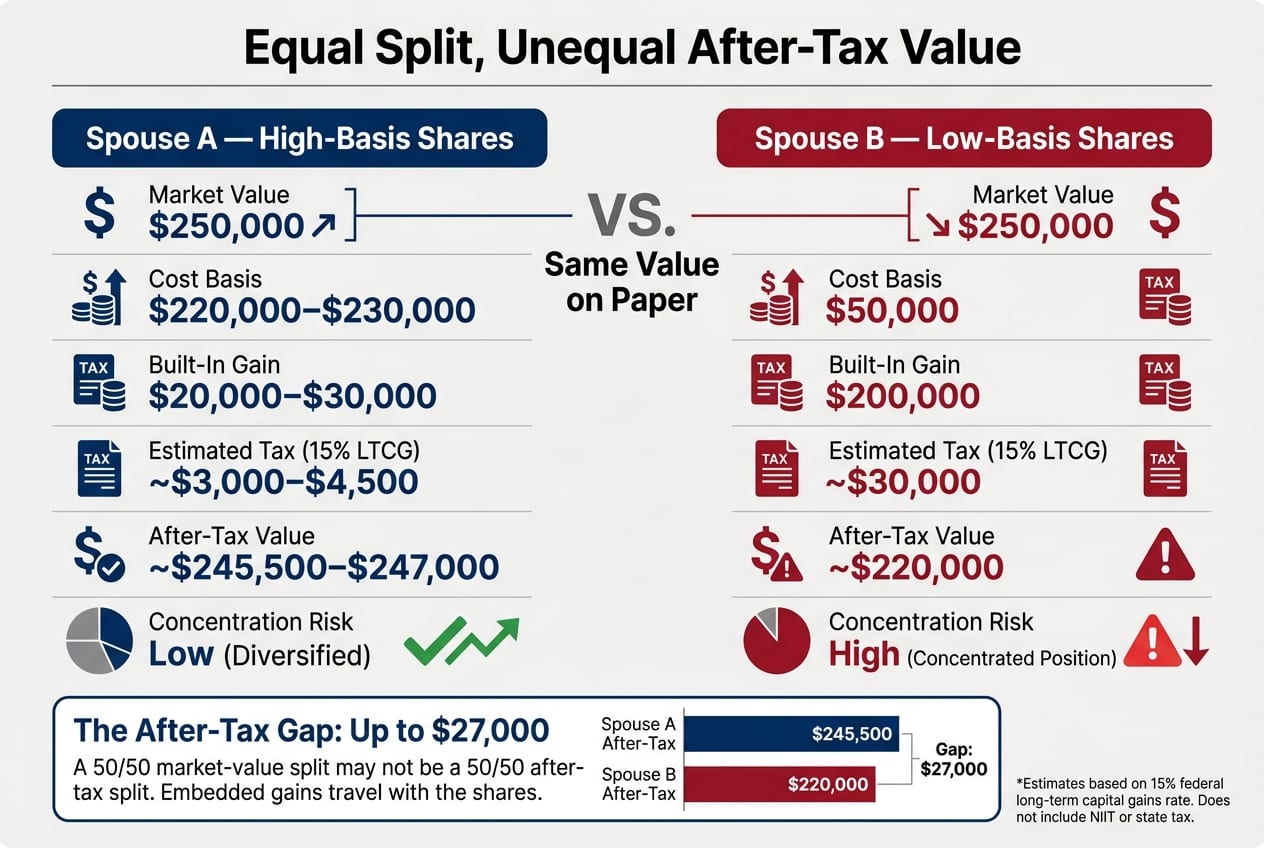
- A spouse getting $250,000 of stock with a $50,000 basis may face tax on about $200,000 of gain if sold later
- A spouse getting $250,000 with a $220,000 or $230,000 basis may face much less tax
- The transfer in divorce may be tax-free at the time, but the basis and holding period may carry over
- A review may need to include lot-level basis, holding period, embedded gain, concentration risk, NIIT, and state tax
- Some settlements use pro rata lot splits or cash/asset offsets to even out the tax load
A simple example shows the issue fast: one spouse may keep about $192,400 after sale, while the other may keep about $241,360. Same account value. Very different net result.
How Are Investment Accounts Divided In Divorce?
Quick Comparison
If I were reviewing a split like this, I’d look past the account balance and compare the after-tax value of each tax lot, not just the statement total.
How Cost Basis Changes the Real Value of a Taxable Portfolio
The problem may not be the statement value. The problem may be the tax sitting inside the shares.
What often matters more is the after-tax value of each lot.
Low-Basis Shares Carry a Built-In Tax Bill
Low-basis shares may carry more embedded gain. The gap between the cost basis and the current market value is the built-in gain - and that gain may become taxable if the shares are sold.
In many divorce transfers, the transfer itself is generally tax-free at the time it happens. But the receiving spouse usually inherits the original cost basis too. In plain English, the tax burden may travel with the shares. The recipient also inherits the original holding period.
Example: Two $250,000 Allocations With Very Different Tax Burdens
The table below shows how two equal-dollar allocations may lead to very different after-tax outcomes, using a 15% federal long-term capital gains rate:
Same pre-tax value. But after tax, the gap may be $27,000.
That’s why many people ask for lot-level cost basis records, not just account balances.
How to Check Whether a Proposed Split Is Actually Fair
The embedded-gain gap from the prior example may show up in real settlements too. To test whether a split may be equal after tax, use lot-level tax data. In other words: don't stop at the account total. Look at each tax lot.
Request Lot-Level Cost Basis Records, Not Just Account Balances
Ask for a lot-level cost basis report, current statements, and unrealized gain/loss detail. If older lots have missing or estimated basis, ask the brokerage to reconstruct or estimate that basis from trade confirmations or past statements. And if the basis still isn't clear, label those lots as unknown-basis instead of treating them as zero basis.
Why does that matter? Because reinvested dividends add to basis. And two positions with the same ticker may carry very different embedded gains based on when each lot was bought.
Once you have the lot report, the next move is to translate each spouse's proposed share into an after-tax value.
Compare Each Spouse's Share After Tax
With the lot-level data in hand, build a simple side-by-side comparison. For each holding, list:
- Market value
- Cost basis
- Unrealized gain
- Estimated embedded tax based on whether each lot may be short-term or long-term
- After-tax value
Then total each column for each spouse's proposed allocation.
The table below shows how a 50/50 split on paper may look different after taxes:
That's the gap that may matter. A fuller review may also adjust for income, holding period, NIIT, and state tax.
Watch for Concentration Risk Too
Low-basis shares and concentrated positions often show up together. Appreciated employer stock, long-held individual names, or shares built up over decades in one company may carry both a large embedded gain and a heavy portfolio weight.
That may create two separate issues. The spouse who receives those shares may owe more tax when selling. That spouse may also end up with more exposure to one company or one sector.
A fair review may look at both pieces at once: the embedded tax and the share of the settlement tied up in a single position. If one spouse ends up with more embedded tax, some settlements may offset that gap with cash or other assets.
Ways to Split Mixed-Basis Holdings More Fairly
If the lot-level numbers suggest uneven tax burdens, these three setups may help rebalance them.
Split Each Security Pro Rata by Tax Lot
The most direct fix may be to divide each holding so each spouse gets a similar mix of low- and high-basis lots. At the tax-lot level, a broker may be able to transfer a set percentage of each lot so both accounts end up with a similar blend of appreciated and less-appreciated shares.
Say a stock is held across 10 tax lots: four lots have large embedded gains, and six sit near current market value. A pro rata split may give each spouse some of both. That may spread the tax exposure more evenly instead of stacking it in one account.
Some mutual funds and fractional shares may not transfer in kind and may need to be sold first, which may trigger tax.
If a holding may not be split neatly, cash or another asset may be used to balance the tax cost.
Use Cash or Other Assets to Offset the Embedded Tax Burden
If one spouse keeps a specific position, it may make sense to look at it on an after-tax basis. A stock worth $200,000 with a $150,000 unrealized gain may not have the same after-tax value as $200,000 in cash, because the built-in gain may still carry a future tax cost. In that setup, the other spouse may receive added cash, retirement assets, or other property to offset the gap.
Retirement assets may also be used to offset taxable holdings. But ordinary income tax and possible early-withdrawal penalties may make them different from taxable shares on a dollar-for-dollar basis. A tax professional may want to review that comparison before the numbers are finalized.
Once the value looks balanced on paper, the next step may be to test a few versions with tax-aware scenario modeling.
Run Settlement Scenarios With Tax-Aware Portfolio Analysis
It may help to model several splits before settling. Mezzi may help with scenario comparisons, spotting low-basis concentrations, estimating embedded gains, and comparing each proposed allocation on an after-tax basis - without changing the account.
Those results may give you a way to compare settlement paths before final terms are set. From there, some people bring the analysis to their attorney and CPA for review and execution. The same scenario results may also help show which records and settlement terms to request next.
What to Ask For When Dividing a Taxable Portfolio in Divorce
Use the after-tax scenarios from the prior section to build your document request list. Before dividing a taxable portfolio, ask for the records needed to measure the after-tax value of each share lot.
Formally request lot-level cost basis records for each holding, along with current statements and 1099-Bs. Ask for:
- Purchase dates
- Share counts
- Basis per lot
- Unrealized gain or loss
- Holding period
- The cost-basis method used, including specific identification, FIFO, or average cost
Once you have those records, ask for an after-tax comparison of each proposed split, not just a market-value split. Two portfolios may look equal on paper, but the tax picture may differ a lot. Concentrated positions deserve extra attention because a low basis may make them more expensive to unwind.
If the split is uneven, these offsets may be used to rebalance the tax cost. Some attorneys or financial advisors discuss two practical options: pro-rata lot division, so both spouses receive a similar mix of high- and low-basis shares, or asset offsets, so the spouse taking more embedded gains may receive additional cash or higher-basis assets
Mezzi may help you work through these comparisons before finalizing anything by identifying low-basis concentrations, estimating embedded gains across connected accounts, and modeling how different splits may compare on an after-tax basis. Bring the lot-level records and after-tax comparison to your attorney or mediator before finalizing the split.
FAQs
How do I find the cost basis for each tax lot?
Start with your brokerage’s unrealized gains and losses report. Most platforms have a tax lots or positions section that may show each purchase’s date, share count, cost per share, and current market value.
If the account is older or was transferred between firms, you may need to check historical trade confirmations, dividend reinvestment statements, and corporate action records to verify the data by hand.
Do I owe tax when shares are transferred in divorce?
Usually, no. If the transfer qualifies under IRS Section 1041 and is tied to the divorce decree or separation agreement, moving shares between spouses or former spouses generally may not be treated as a taxable sale. That means no immediate capital gains tax may be triggered at the time of the transfer.
In many cases, the receiving spouse keeps the original cost basis and holding period. Any tax may then come later, when the shares are eventually sold.
That said, paperwork matters. If the transfer is not documented or structured under Section 1041, the IRS may treat it as a taxable sale instead.
How can we make a 50/50 split fair after taxes?
Focus on after-tax value, not just current market value.
In a divorce transfer under Section 1041, the receiving spouse generally takes on the original cost basis and holding period. That means low-basis shares may carry hidden capital gains taxes that may not show up in the account balance.
So two holdings with the same market value may not be equal on an after-tax basis.
To make the split feel more even, some people compare each holding’s cost basis with its market value and then adjust the asset allocation or the total dollar amount to reflect that embedded tax liability. That kind of review may give a better sense of what each asset may be worth after a later sale, not just what it looks like today.
In-kind transfers may preserve basis and defer taxes until a future sale.
Disclosures:
- This content is for informational purposes only and does not constitute investment advice or a recommendation to buy or sell any security.
- Past performance is not indicative of future results. No guarantee of future performance or outcomes is implied.
- Tax treatment of divorce-related transfers may vary based on individual circumstances. Consult a qualified tax professional for personalized advice.
Related Blog Posts
- Dividing Investment Accounts in Divorce
- Capital Gains Tax Planning for Separation Scenarios
- High net worth divorce: protecting and splitting investment portfolios
- Inheriting a Taxable Brokerage Account: Step-Up Basis and What to Sell First
Start with your brokerage’s unrealized gains and losses report. Most platforms have a tax lots or positions section that may show each purchase’s date, share count, cost per share, and current market value.
If the account is older or was transferred between firms, you may need to check historical trade confirmations, dividend reinvestment statements, and corporate action records to verify the data by hand.
Usually, no. If the transfer qualifies under IRS Section 1041 and is tied to the divorce decree or separation agreement, moving shares between spouses or former spouses generally may not be treated as a taxable sale. That means no immediate capital gains tax may be triggered at the time of the transfer.
In many cases, the receiving spouse keeps the original cost basis and holding period. Any tax may then come later, when the shares are eventually sold.
That said, paperwork matters. If the transfer is not documented or structured under Section 1041, the IRS may treat it as a taxable sale instead.
Focus on after-tax value, not just current market value.
In a divorce transfer under Section 1041, the receiving spouse generally takes on the original cost basis and holding period. That means low-basis shares may carry hidden capital gains taxes that may not show up in the account balance.
So two holdings with the same market value may not be equal on an after-tax basis.
To make the split feel more even, some people compare each holding’s cost basis with its market value and then adjust the asset allocation or the total dollar amount to reflect that embedded tax liability. That kind of review may give a better sense of what each asset may be worth after a later sale, not just what it looks like today.
In-kind transfers may preserve basis and defer taxes until a future sale.