
If I inherit a taxable brokerage account, my first sale may come down to three things: basis, risk, and cash needs. In many cases, I may not owe income tax when the account transfers. Instead, tax may show up later from dividends, interest, or a sale. And for many inherited stocks, ETFs, and mutual funds, the cost basis may reset to the asset’s fair market value on the date of death.
That one rule may change a lot.
Here’s the short version:
- The old purchase price usually may stop mattering for capital gains tax.
- The new basis usually may be the date-of-death value unless the estate used a later valuation date.
- Any later gain or loss may be based on what happened after death, not before.
- Inherited assets are generally treated as long-term for capital gains tax purposes.
- The first assets some people review are often concentrated positions, loss positions, or holdings near the stepped-up basis.
- Broker records may be wrong after a transfer, including $0 basis errors and missing tax lots.
A simple example: if shares were worth $250,000 on the date of death and I sell later for $262,000, the taxable gain may be $12,000. If I sell for $240,000, I may have a $10,000 capital loss instead. The decedent’s old $120,000 purchase price usually may not control my tax result.
Before any trade, some heirs may want to confirm:
- The account title
- The date-of-death valuation
- Each lot’s basis
- Any post-inheritance gain or loss
- Whether a position takes up more than 5%–10% of investable assets
- Whether mutual funds may have taxable distributions
Here’s the basic order many people may use: verify records first, then compare tax cost, then look at risk, then decide what to sell.
The rest of this article walks through that process in plain English.
What Is The Stepped-Up Basis Rule For Inherited Investments?
How Step-Up in Basis Works After Inheritance
When you inherit stocks, ETFs, or mutual funds in a taxable brokerage account, the cost basis for most taxable investments usually resets to the fair market value on the date of death. That stepped-up basis may become the starting point for deciding what to sell first.
In a small number of cases, an executor may choose a later valuation date. But most heirs use date-of-death values.
What Gets Stepped Up and What Does Not
The step-up usually applies to capital assets held in taxable accounts, including:
- Individual stocks
- ETFs
- Mutual funds
- Bonds
After the basis resets, the deceased owner's original purchase price no longer affects your calculation. Pre-death gains and losses generally do not carry over to you.
Taxable brokerage assets may get a step-up. Traditional retirement accounts do not.
Why Inherited Sales Usually Qualify for Long-Term Rates
Inherited property is generally treated as long-term, no matter how long you personally hold it before selling. Long-term federal capital gains rates - 0%, 15%, or 20%, depending on your taxable income - may be lower than short-term rates, which may reach 37%.
That means if you sell inherited shares the week after the account transfers into your name, any gain is generally taxed at the long-term rate.
Next, confirm the account records and basis entries before you trade.
A Tax Example Using Date-of-Death Basis
Example: suppose the decedent originally paid $120,000 for a stock portfolio, but on the date of death those shares were worth $250,000. Your new stepped-up basis is $250,000, so the prior $130,000 of unrealized gain generally does not carry over to your tax calculation.
- Scenario A (gain): You sell the shares for $262,000. Your taxable gain may be $12,000 ($262,000 − $250,000).
- Scenario B (loss): The market dips and you sell for $240,000. You may realize a $10,000 long-term capital loss ($250,000 − $240,000), which may offset other capital gains.
In both cases, the deceased owner's original $120,000 purchase price plays no role in the tax calculation. The gain or loss is the difference between the date-of-death value and the sale price.
Those figures are the ones used to compare positions, gains, and tax cost. Date-of-death basis may be the key number to check before deciding what to sell first.
What to Confirm Before You Place Any Trade
Before trading, verify the account title, trading status, and basis. Those checks may determine whether the basis shown on screen matches the basis you may later report.
Verify the Transfer Path and Account Title
Trading usually may not begin until legal authority has been established and the new account has been opened. The transfer path may shape the paperwork involved:
- TOD accounts usually require a death certificate and beneficiary claim forms.
- Joint accounts (JTWROS) often transfer right away with a death certificate.
- Trust accounts need a death certificate, trust certification, and trustee ID.
- Probate accounts require letters testamentary, a death certificate, and an estate tax ID.
Check the exact account title. It should show your name or your role, such as "Jane Doe, Trustee of the Doe Family Trust" or "Estate of John Smith." If the account still shows only the decedent's name, or it carries a restricted or deceased status, do not place orders until those flags are cleared. Tax cost may be hard to judge until the account is open and the basis is visible.
Once the account is titled correctly and no longer restricted, move to the basis records.
Get Date-of-Death Values in Writing
Request a formal date-of-death valuation report from the brokerage. Many firms provide a PDF that lists the fair market value of each holding on the date of death, using the average of that day's high and low trading prices. If Form 706 was filed, use the estate's valuation schedules as the basis record. Save every valuation letter, the account statement from the month of death, and executor correspondence in one folder, both physical and digital.
Also confirm with the executor or estate attorney whether the estate elected the alternate 6-month valuation date. If it did, your basis may use those later values instead of the date-of-death values.
Check Every Position for Basis Errors
Broker basis records may be wrong or incomplete after an inheritance transfer. Common problems include a $0 basis, wrong lot dates, and missing reinvested-dividend lots. Basis records are what you may use to compare gains, losses, and tax exposure across holdings.
Before any large sale, open the tax lots screen for each position and compare the per-share basis shown there against your written date-of-death valuation. Flag any material discrepancy before selling. If the broker's record is wrong, report the correct basis on Form 8949 with code B.
Once the account is titled correctly and the basis is verified, compare positions by tax cost and risk before selling.
How to Review Inherited Holdings and Decide What to Sell First
Once title and basis are confirmed, it may make sense to rank holdings by risk first and tax cost second. The date-of-death basis may serve as the benchmark for each position.
Start With Concentrated Positions and Unwanted Risk
A single inherited stock that makes up more than 5%–10% of your investable assets may be one of the first positions to review. The step-up may make trimming more practical: if the price is close to the date-of-death value, a sale may create little or no gain.
A simple way to frame it: Would you buy this today with new cash? If the answer may be no - maybe the company sits in a volatile industry, the valuation looks stretched, or the position takes up too much of the account - that may be a strong sign to trim or sell early. Family-stock sentiment may not line up with your risk tolerance or plan.
Separate Post-Inheritance Gains From Post-Inheritance Losses
For each remaining position, subtract the per-share basis from the current price, then multiply by the number of shares. If the current price is above the stepped-up basis, the position has a gain. If it falls below that basis, the position has a loss.
That math may shape the sale order.
- Loss positions may be candidates for tax-loss harvesting. Selling them realizes a capital loss that may offset gains elsewhere in taxable accounts and up to $3,000 of ordinary income per year. Any unused losses may carry forward.
- Modest gain positions - especially those only a few percentage points above the stepped-up basis - may still be worth selling in some cases. That may be tied to diversification goals or a near-term cash need, and the tax bill may stay manageable.
Watch for Mutual Fund Distributions, Overlap, and Cash Needs
Beyond single stocks, it may help to check funds for embedded tax drag. Active mutual funds may pass through taxable capital gain distributions at year-end, reported on Form 1099-DIV, Box 2a, based on the manager's internal trading. Those distributions may be taxable even when reinvested. High-turnover funds may create tax drag even when prices barely move.
Mezzi's account aggregation may show inherited holdings alongside your other accounts, and X-Ray may surface overlap by sector, asset class, and stock.
Cash needs may fit into this order too. If money may be needed for near-term estate expenses or living costs, some people start with concentrated positions or loss positions first. Those sales may improve the risk mix of the account or create a tax offset.
Use that ranking to screen the first trade candidates.
Conclusion: A Practical Order of Operations for Your First Sale
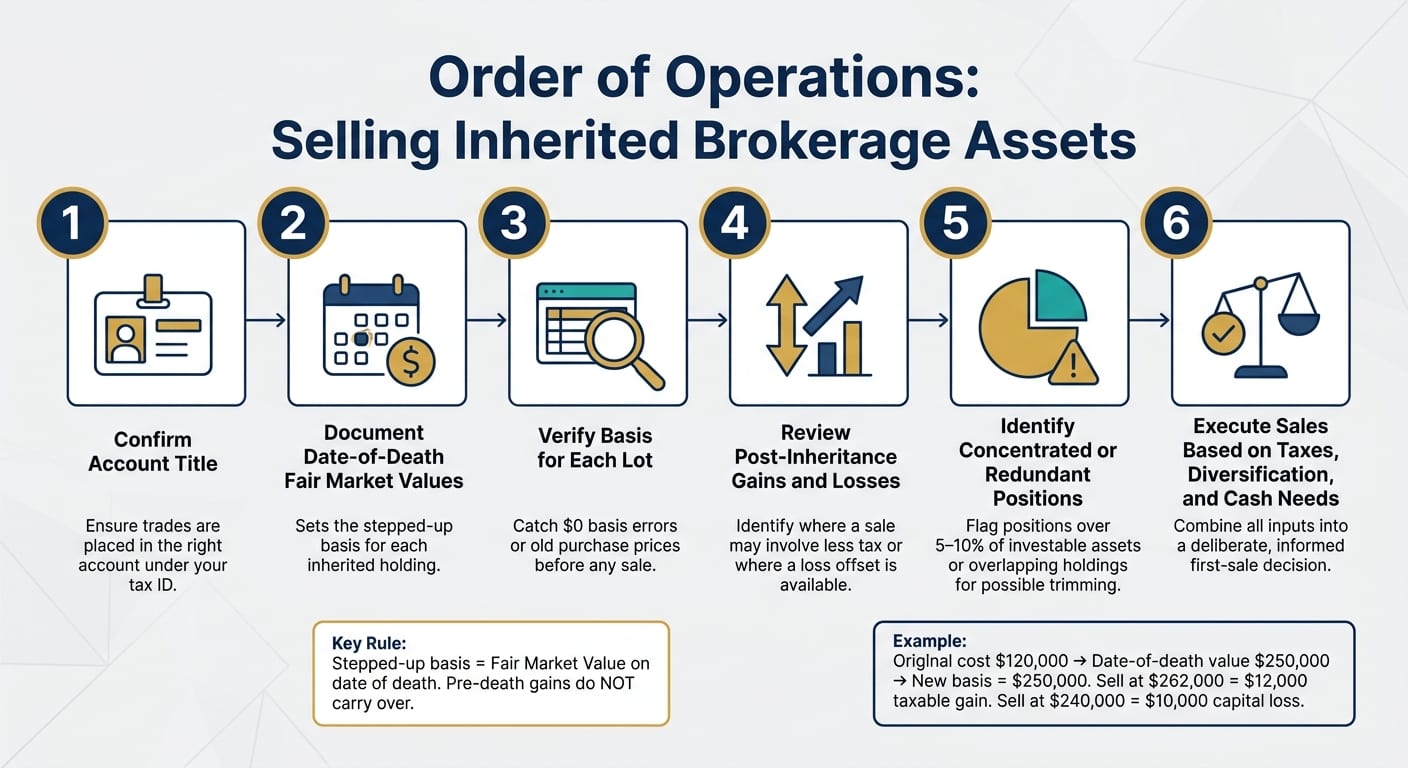
Step-up basis may reduce taxes, but the first sale may only be reported correctly if the records are right.
Here’s a practical order of operations for that first sale. The goal is simple: avoid trading before the basis has been checked.
That order may keep the first-sale decision tied to tax cost, risk, and cash needs.
Reinvested dividends after death create separate lots with their own basis.
Get the records right first, then choose the first sale that may best balance tax, diversification, and cash needs.
FAQs
Do all inherited brokerage assets get a step-up in basis?
No. Inherited brokerage assets often may receive a basis adjustment to fair market value at the owner’s death, but not in every case.
There are a few common exceptions. Some joint accounts may be treated differently, especially if a non-spouse was added during the owner’s lifetime. Assets transferred in a divorce settlement also generally may keep the original cost basis instead of getting that adjustment.
What if my broker shows the wrong cost basis after the transfer?
Compare your new brokerage’s first statement with the final statement from your previous firm. Look closely for places where the cost basis appears wrong or is missing.
That mismatch may happen after a transfer error or from incomplete records. If it isn’t fixed, you may be taxed on the full sale price instead of only on your gain.
If you spot a problem, contact your brokerage and ask about a correction. Some people also consult a tax advisor to estimate the basis and report it as accurately as possible.
Should I sell inherited holdings right away or wait?
Usually, it may make sense to wait before selling inherited taxable brokerage holdings. In many cases, you may receive a step-up in cost basis based on the date-of-death value, so tax may apply only when the assets are sold.
Start by confirming the date-of-death basis and the holding details. From there, some people review:
- Any gains or losses
- Concentrated positions
- Any non-transferable assets
If the account is being transferred, in-kind transfers may be worth using when possible. Some people sell only when they have a real cash need or want to reduce concentration through diversification.
Disclosures:
- This content is for informational purposes only and does not constitute investment advice or a recommendation to buy or sell any security.
- Past performance is not indicative of future results. No guarantee of future performance or outcomes is implied.
Related Blog Posts
- What are the tax implications of adding $10,000 to an existing position with different cost bases?
- What Happens to Your Investments When You Switch Brokerages
- Donor-advised fund: how to donate appreciated stock tax-efficiently
- The Step-Up in Basis Strategy: Holding Appreciated Assets Until Death
No. Inherited brokerage assets often may receive a basis adjustment to fair market value at the owner’s death, but not in every case.
There are a few common exceptions. Some joint accounts may be treated differently, especially if a non-spouse was added during the owner’s lifetime. Assets transferred in a divorce settlement also generally may keep the original cost basis instead of getting that adjustment.
Compare your new brokerage’s first statement with the final statement from your previous firm. Look closely for places where the cost basis appears wrong or is missing.
That mismatch may happen after a transfer error or from incomplete records. If it isn’t fixed, you may be taxed on the full sale price instead of only on your gain.
If you spot a problem, contact your brokerage and ask about a correction. Some people also consult a tax advisor to estimate the basis and report it as accurately as possible.
Usually, it may make sense to wait before selling inherited taxable brokerage holdings. In many cases, you may receive a step-up in cost basis based on the date-of-death value, so tax may apply only when the assets are sold.
Start by confirming the date-of-death basis and the holding details. From there, some people review:
- Any gains or losses
- Concentrated positions
- Any non-transferable assets
If the account is being transferred, in-kind transfers may be worth using when possible. Some people sell only when they have a real cash need or want to reduce concentration through diversification.