
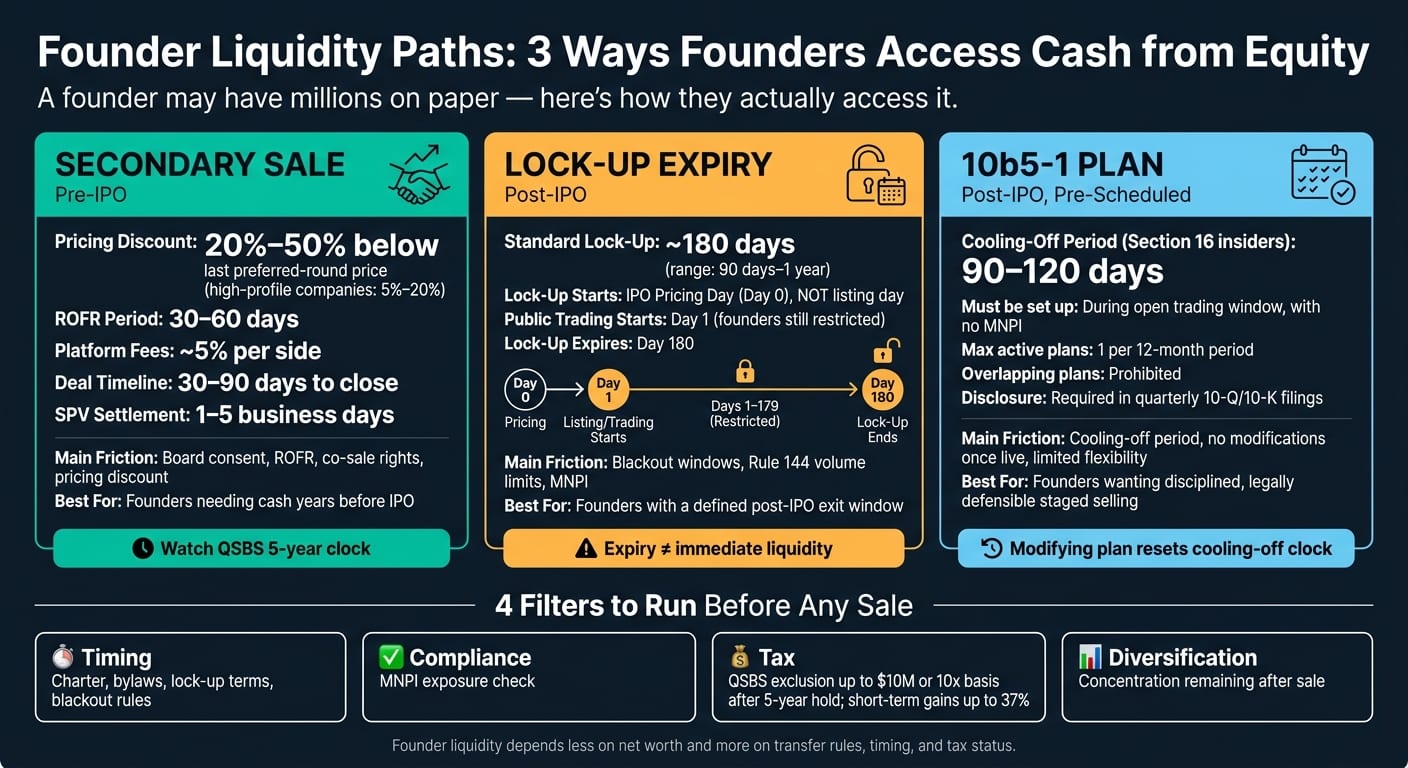
A founder may have millions on paper and still have little cash. That gap may come down to three things: what you may sell, when you may sell it, and what rules may block the sale.
Here’s the short version:
- Secondary sales may let a founder sell private shares before an IPO, but board approval, ROFR, co-sale rights, and buyer discounts may get in the way.
- Lock-ups usually start on IPO pricing day and often last about 180 days, even though public trading may start the next day.
- 10b5-1 plans may let public-company insiders pre-schedule stock sales after IPO, but only if the plan is set up during an open window and without MNPI.
A few numbers frame the issue fast:
- Private secondary discounts may land around 20% to 50% below the last preferred-round price
- ROFR periods may run about 30 to 60 days
- Lock-ups often last about 180 days
- Section 16 insiders may face a 90- to 120-day cooling-off period for a 10b5-1 plan
- QSBS under Section 1202 may exclude up to the greater of $10,000,000 or 10x basis after a five-year hold
Before any sale, I’d run four filters:
- Timing - private or public, early-stage or post-IPO
- Compliance - MNPI, blackout windows, and insider rules
- Tax - QSBS, holding period, and gain timing
- Diversification - how much concentration may remain after selling
Rule 10b5-1 Insider Trading Plans & Material Nonpublic Information | Office Hours with Gary Gensler
Quick Comparison
If I had to reduce the whole topic to one line, it would be this: founder liquidity may depend less on net worth and more on transfer rules, timing, and tax status.
Secondary market sales: how founders create liquidity before or around an IPO
Secondary market sales may let founders turn private equity into cash before an IPO, but only if the company, investors, and securities rules allow it. Before moving ahead, each sale may need to pass the same four checks from the introduction: timing, compliance, tax impact, and diversification.
The main paths are tender offers, direct secondaries, and SPV-led transactions.
Tender offers, direct secondary sales, and SPV-led transactions
Founders usually sell through three setups: company-run tender offers, negotiated direct secondaries, and SPV-led transactions.
A tender offer is company-approved. The company sets the price and opens a sale window, often 20 to 30 days, during which eligible stockholders may sell. You either accept the offered price or pass. There’s no back-and-forth on price.
A direct secondary sale is a negotiated deal between a seller and a third-party buyer, often arranged through marketplaces like Forge Global, EquityZen, or Hiive. The price is negotiated, but the deal still may require board consent and remains subject to the company’s right of first refusal (ROFR). Platforms often charge around 5% to each side, plus company transfer fees, and deals may take 30 to 90 days to close.
An SPV-led transaction pools money from multiple buyers into a single Special Purpose Vehicle (LLC), which then adds one holder to the cap table. Settlement may happen in as little as one to five business days, though the SPV manager often charges a vehicle fee of 1% to 3% plus carry of 0% to 10%. Some founders pursue these during a priced equity round because valuation work and due diligence may already be in motion.
Even then, approval rules, transfer rights, and timing may still stop the sale.
What usually blocks a secondary sale
The most common obstacle is the right of first refusal. Most venture-backed companies give themselves - and sometimes major investors - 30 to 60 days to match any third-party offer. If the company uses that right, the outside buyer is out. If the process drags on, buyers may lose interest and walk.
Board consent is almost always required, and boards may say no if the sale is large, early, or awkwardly timed around a financing round. Co-sale rights add another layer: other investors may join your sale pro rata, which may reduce the number of shares you’re actually allowed to sell. Because founders may hold material nonpublic information, companies often manage that risk through pre-clearance rules or by limiting sales to company-sponsored events.
If a sale gets through those gates, the next issue may be simpler: whether the price and timing make the deal worth doing.
Key tradeoffs: speed, discount, signaling, and taxes
Tender offers are the most controlled. Direct secondaries are the most flexible. SPV-led deals often settle the fastest once approved.
Pricing discounts are the clearest cost. Secondary marketplace bids typically land 20% to 50% below the most recent preferred-round valuation. For high-profile companies like SpaceX or Stripe, that discount may be closer to 5% to 20%. For growth-stage companies valued between $1 billion and $5 billion, discounts may fall in the 20% to 35% range. For earlier or struggling companies, discounts of 40% to 80% are not unusual.
Signaling is a quieter cost, but it still matters. Selling a modest amount - often 10% to 20% of vested holdings - may be seen as normal financial planning. Selling a large stake early, especially in the first two or three years, may lead others to question your conviction. Tax treatment also needs a close look: if shares qualify for QSBS and you haven’t met the five-year holding period, you may lose part or all of the QSBS exclusion. A sale may also affect 409A valuation and future option pricing.
Use these tradeoffs to choose the path that may cause the least disruption.
Lock-up restrictions: what changes between IPO pricing day and when you can sell
After an IPO, founder wealth may still be tied up until lock-up terms and trading rules allow sales. Public trading in the stock does not usually mean founders get immediate liquidity. In many cases, lock-ups keep shares restricted for about 180 days.
The standard 180-day lock-up and why it exists
A lock-up is a contract, not a federal rule. The agreement sets the length. That period may often be 180 days, but it may range from 90 days to a year. The S-1 may spell out the lock-up terms and any early-release triggers. And even when the lock-up ends, other trading limits may still affect founders.
Lock-ups often apply to founders, directors, Section 16 officers, and major early investors. They also usually restrict more than outright sales. In many cases, they bar pledging, gifting, or hedging shares too.
Timeline from IPO pricing to post-lock-up selling
The dates that tend to matter most are pricing day, listing day, and lock-up expiration. That order matters. The lock-up starts on pricing day, not listing day. And expiration may not always mean immediate liquidity.
Some agreements include staggered release schedules tied to stock price performance. For example, a portion of shares may unlock if the stock stays above a set threshold for a sustained period. Those triggers are not automatic. They apply only if the agreement says so.
Early release, blackout windows, and limits after lock-up expiry
Lock-up expiry may open the door, but trading rules may still control whether a founder may actually sell. Blackout windows may still block trades around earnings. MNPI may still prevent sales unless a valid 10b5-1 plan covers them. Rule 144 volume limits may still cap affiliate sales.
Lock-up expirations are often associated with a short-lived price dip and a jump in trading volume. Once those limits lift, founders may begin planning sales under Rule 10b5-1.
Rule 10b5-1 plans: how founders pre-schedule public stock sales
Once shares are public, the main issue usually shifts to when you may sell, not whether you may sell. After the lock-up ends, a Rule 10b5-1 plan may let founders sell public shares during blackout windows by using preset instructions. A broker carries out the trades automatically, and the plan may provide an affirmative defense against insider trading claims.
What must be set in advance
The plan needs to set the trading mechanics before it starts. That includes the number of shares, price conditions, and execution dates or other triggers. Once the plan is live, the founder may not direct trades. If shares sit in a trust, such as a Grantor Retained Annuity Trust (GRAT), those holdings may need their own 10b5-1 instructions at the trust account level.
Two common setups are:
- Periodic selling, such as 5,000 shares on the first trading day of each month
- Limit orders, which execute only if the stock hits the set price
That setup only holds if the plan is adopted and maintained under SEC rules.
Cooling-off periods, modifications, and disclosure rules
The plan needs to be adopted during an open trading window, and the founder must certify that they are not aware of MNPI. For Section 16 insiders, trading may begin only after the longer of 90 days or two business days after the quarter's 10-Q or 10-K filing, with a 120-day cap.
Changes come with tradeoffs. If the amount, price, or timing changes, the SEC treats that as ending the old plan and starting a new one, which resets the cooling-off clock. By contrast, administrative changes, like switching brokers or updating account numbers, do not reset it. Founders are generally limited to one active 10b5-1 plan during a 12-month period, and overlapping plans for the same class of securities are prohibited. The SEC also requires quarterly disclosure of plan adoptions, modifications, or early terminations in 10-Q and 10-K filings.
Setup checklist for a workable 10b5-1 plan
It may also make sense to model taxes before the plan goes live, especially if the plan involves option exercises or income across multiple states. Tax planning may be part of liquidity planning, not something separate.
Choosing the right liquidity path: a decision framework for founders
This framework may help founders match a liquidity path to their stage, timing, and limits. The three levers - secondary sales, lock-up expiry, and 10b5-1 plans - tend to fit different points in the company lifecycle.
Start with the comparison below to narrow the path. Then pressure-test that choice against timing, compliance, tax impact, and diversification goals.
Timing, compliance, tax impact, and diversification goals compared
Once you have a likely fit, it may make sense to run a quick pre-sale check before moving ahead.
How to check a sale against four questions
Before committing to any path, work through four filters in order.
First, timing. Review the charter, bylaws, investor rights, lock-up terms, and blackout rules. On paper, a sale may look simple. In practice, one document or one date may change the whole picture.
Second, compliance. Check MNPI exposure. If you may have material nonpublic information, that may limit what paths are available and when.
Third, tax impact. Run the tax math before agreeing to sell. Selling before the five-year QSBS mark may forfeit a federal capital gains exclusion of up to $10 million or 10x the cost basis. Short-term gains on shares held for less than a year may be taxed at rates up to 37%.
Fourth, diversification. Set the liquidity target before choosing a path. Some founders may want one larger event. Others may prefer sales spread out over time.
Conclusion: key takeaways for founder liquidity planning
Secondary markets may unlock cash before an IPO, but approvals, ROFR timelines, and pricing discounts may add friction. Lock-up expiry creates a defined window for public-market selling, but it does not override blackout periods or MNPI limits. A 10b5-1 plan may make post-IPO selling more disciplined and legally defensible, but only if it is set up during an open window and left unmodified once live.
The best path may be the one that fits your stage, tax position, and compliance window.
FAQs
How do I choose between a secondary sale and waiting for IPO liquidity?
It may come down to a simple tradeoff: cash now versus more upside later.
A secondary sale may give you liquidity right away. But that liquidity often comes with a price. Shares may sell at a 10% to 50% discount, the process may take 30 to 60 days because of right-of-first-refusal rules, and selling early may reduce QSBS tax benefits.
Waiting for an IPO may offer pricing tied to the public market. That said, timing may be uncertain, and post-IPO lock-ups usually delay sales for 90 to 180 days.
It may also make sense to weigh a few other factors alongside price and timing: ownership, investor alignment, and possible tax advantages.
What can stop me from selling shares, even if I have a buyer?
Even if a buyer is lined up, legal and contract terms may still block the sale.
In private companies, a Right of First Refusal may give the company, or someone it names, the option to buy the shares instead. Board approval may also be required, and other transfer limits may apply too.
In public companies, selling may not be allowed during post-IPO lock-up periods, which often last 90 to 180 days. Sales may also be blocked during company blackout periods tied to material nonpublic information.
When should I set up a 10b5-1 plan after an IPO?
Set up a 10b5-1 plan 90 to 120 days before your lock-up expires. The cooling-off period - typically 90 days for most employees or up to four months for Section 16 officers - may run during the lock-up.
That timing may allow the first trade to happen as soon as the lock-up ends. For some people, that may reduce dead time and make it easier to start systematic diversification under the plan.
Disclosures:
- This content is for informational purposes only and does not constitute investment advice or a recommendation to buy or sell any security.
- Past performance is not indicative of future results. No guarantee of future performance or outcomes is implied.
Related Blog Posts
- Pre-IPO stock: how to track value before a liquidity event
- How to manage wealth after a company acquisition or IPO exit
- QSBS: the tax break most startup employees don't know about
- How to avoid a concentrated position in your own employer's stock
It may come down to a simple tradeoff: cash now versus more upside later.
A secondary sale may give you liquidity right away. But that liquidity often comes with a price. Shares may sell at a 10% to 50% discount, the process may take 30 to 60 days because of right-of-first-refusal rules, and selling early may reduce QSBS tax benefits.
Waiting for an IPO may offer pricing tied to the public market. That said, timing may be uncertain, and post-IPO lock-ups usually delay sales for 90 to 180 days.
It may also make sense to weigh a few other factors alongside price and timing: ownership, investor alignment, and possible tax advantages.
Even if a buyer is lined up, legal and contract terms may still block the sale.
In private companies, a Right of First Refusal may give the company, or someone it names, the option to buy the shares instead. Board approval may also be required, and other transfer limits may apply too.
In public companies, selling may not be allowed during post-IPO lock-up periods, which often last 90 to 180 days. Sales may also be blocked during company blackout periods tied to material nonpublic information.
Set up a 10b5-1 plan 90 to 120 days before your lock-up expires. The cooling-off period - typically 90 days for most employees or up to four months for Section 16 officers - may run during the lock-up.
That timing may allow the first trade to happen as soon as the lock-up ends. For some people, that may reduce dead time and make it easier to start systematic diversification under the plan.