
Fractional jet ownership may make sense only for a narrow group of flyers. If you fly often, use the aircraft mostly for business, and are comfortable tying up capital for 3 to 5 years, the math may work. If not, charter may be the simpler path.
Here’s the short version:
- You may pay in three layers: an upfront share purchase, monthly fees, and hourly flight charges
- The model may start to look more competitive around 100 to 150 hours per year
- Below about 50 hours per year, fixed fees may outweigh the upside
- A share may lose value over time, with resale often landing around 50% to 70% of the original price
- Peak-day pricing, fuel surcharges, and taxes may push total cost higher than the quoted base rate
- For qualified aircraft placed in service on or after January 20, 2025, 100% bonus depreciation may be available if tax rules and records line up
- If business use drops to 50% or less, prior tax deductions may be recaptured
This article breaks down the core question in plain English: How much may you pay, what do you get, and when may it compare well with charter or full ownership?
Fractional Jet Ownership 101: Buy Time, Not the Plane
Quick Comparison
If you’re trying to figure out whether a fractional share fits your flying pattern and tax picture, this guide may give you a clean starting point.
What fractional jet ownership is and who it fits
Fractional jet ownership means buying a deeded share of an aircraft through a managed fleet program. The program operator handles the day-to-day work: crew hiring, maintenance, insurance, hangar fees, scheduling, and FAA compliance, often under FAA Part 91 Subpart K. In plain English, you own part of the jet, but someone else runs the machine around it.
That setup may make sense only if flying happens often enough to justify the fixed commitment.
How the structure works
Most programs are built around annual occupied hours, so the first thing to pin down may be usage. Shares are usually tied to a standard of 800 occupied flight hours per aircraft per year. Under that setup, a 1/16 share translates to about 50 hours a year, a 1/8 share to 100 hours, and a 1/4 share to 200 hours.
Most programs ask for a 3- to 5-year commitment. Many also let owners move up or down within the fleet, which may be useful if one trip calls for a light jet and another needs more cabin space or range.
Availability may also be one of the selling points. In many cases, notice times are around 4 to 10 hours for non-peak travel and up to 48 hours during peak periods.
When usage patterns start to matter
This is where the math starts to matter. The main issue is whether the fixed fees are spread across enough flight hours to make the structure make sense.
For many travelers, the model may start to look more competitive at around 100 to 150 flight hours per year, when monthly management fees are spread over enough trips to compare more favorably with on-demand charter pricing. Below 50 hours a year, those fixed costs may outweigh the upside, and on-demand charter may make more sense on cost alone.
It may also be worth checking your actual flight history before signing anything long term. Many first-time users overestimate annual usage by 30% to 50%. A look at the last 12 months of flight logs may tell a clearer story than a rough guess. Fractional ownership may fit best for flyers with steady, predictable travel patterns, not sporadic flying or highly route-specific trips.
Once the share size lines up with usage, the next step may be looking at total annual cost.
The real cost of fractional jet ownership
Once usage is clear, the next step may be total annual cost. The real cost may be the amount you spend each year to fly, not just the share price. In most cases, that starts with the three cost layers buyers often pay.
Upfront purchase, monthly fees, and hourly charges
Core costs usually include the share purchase, monthly management fees, and hourly flight charges.
The acquisition cost may vary by aircraft category and share size. A 1/16 share of a midsize jet typically runs between $500,000 and $1,200,000. A light jet share starts lower, around $300,000 to $850,000, while a large-cabin share may reach $3,000,000 or more.
Monthly management fees are billed whether you fly or not. For a midsize jet, those fees generally fall between $8,000 and $20,000 per month - or about $96,000 to $240,000 per year. They often cover pilots, insurance, hangar costs, and routine maintenance.
Then there’s the hourly flight charge, billed only when you're in the air. For a midsize jet, that rate may range from $5,500 to $12,000 per hour. Those charges often cover fuel, maintenance reserves, and crew per diems.
To see how these layers may stack up, take a 1/8 share of a midsize jet using simplified example pricing - $900,000 acquisition, $18,000 monthly management fee, and an all-in hourly rate of $4,500. At 100 hours per year, the annual cost may look like this:
That same setup may look much cheaper - or much more expensive - depending on how many hours you actually fly.
Maintenance, depreciation, taxes, and exit value
Several other costs may shape total cost too.
Fuel surcharges may move with oil prices. Peak-day surcharges may add 50% to 200% to the hourly rate on roughly 70 high-demand days per year, including major holidays. De-icing, international handling fees, and premium catering are also often left out of the base hourly rate.
Resale value risk is another big piece of the puzzle. Fractional shares generally return only 50% to 70% of the original acquisition cost at the end of a five-year term. That means a $900,000 share might sell back for $450,000 to $630,000. Put another way, the resale loss may land between $270,000 and $450,000, and some buyers include that when looking at total cost.
Owners may also need to account for the 7.5% Federal Excise Tax on domestic flights.
How to calculate your effective cost per flight hour
The key comparison metric may be effective cost per flight hour.
The formula is straightforward:
Effective hourly cost = (Annualized capital cost + Annual management fees + Annual hourly charges) ÷ Hours flown
Using the 1/8 midsize jet example above, $774,000 ÷ 100 hours = $7,740 per hour. At 150 hours, the same fixed costs spread across more flying time, and the effective rate drops to roughly $6,660 per hour. That’s a big reason usage patterns may matter so much when people size up these programs.
When comparing proposals from different programs, it may help to use the same assumptions across each quote:
- Same share size
- Same guaranteed hours
- Same fuel surcharge methodology
That way, the effective hourly rate may reflect a direct apples-to-apples comparison, not just a marketing number.
With the effective hourly cost in hand, the next question may be whether charter or full ownership offers better value.
Fractional ownership versus charter and full ownership
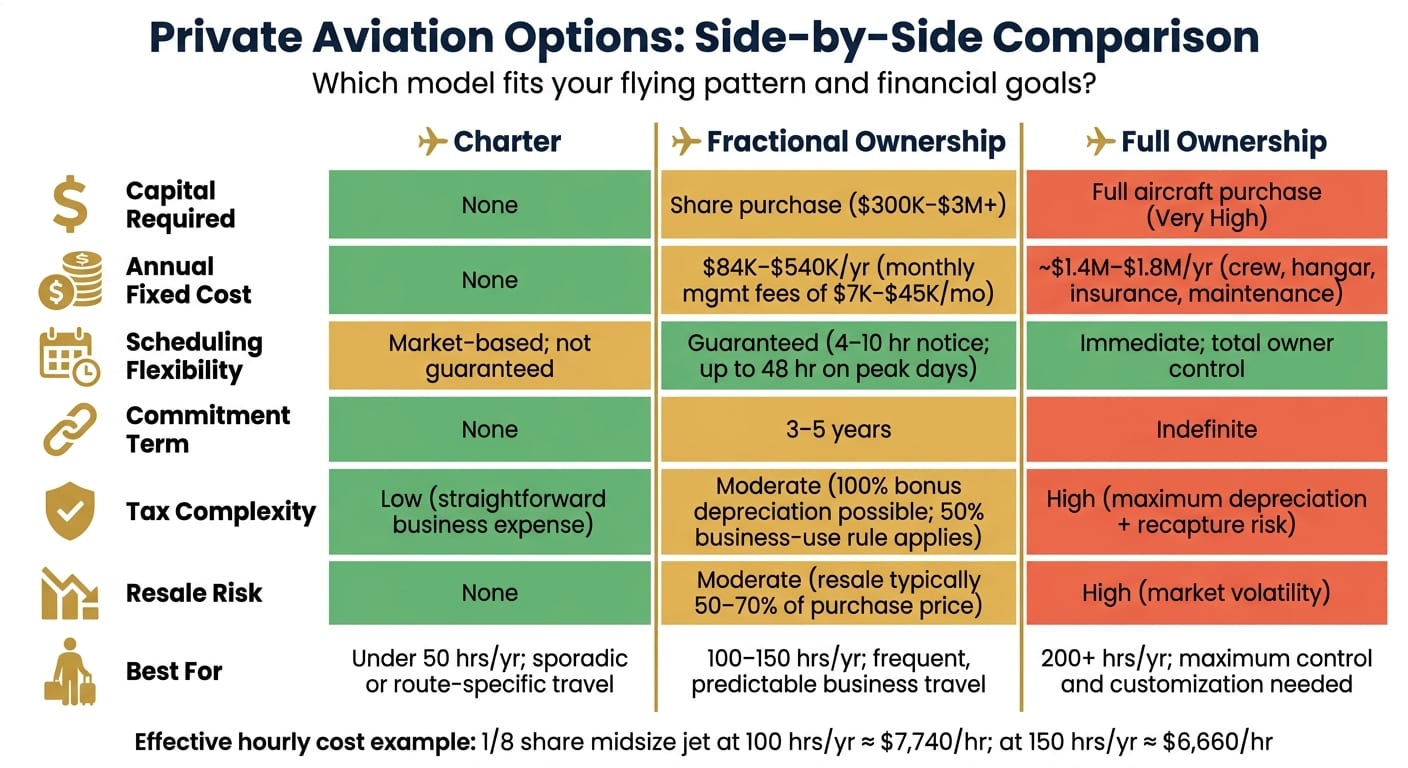
Once you have an effective hourly cost, the next step may be to compare it with the two main alternatives: on-demand charter and full ownership. Each setup may fit a different travel pattern. In practice, the biggest differences are usually cost, access, and control.
Where fractional ownership works well
Fractional ownership may reduce the day-to-day operating burden and may offer faster access than charter. Scheduling may be more predictable too. Some fractional programs may guarantee availability with 4 to 10 hours' notice, while on-demand charter may require 24 to 72 hours in many cases. That kind of access may matter more for travelers with frequent, time-sensitive trips.
Fractional programs also operate under FAA Part 91 Subpart K, which may involve stricter crew duty-time limits and maintenance tracking than the Part 135 standards used by most charter operators. For frequent flyers, that consistency in safety and maintenance standards may be a practical plus. Many programs may also allow owners to switch aircraft types for certain trips.
Then it comes down to cost. The main tradeoff may be whether those access and operating benefits justify the fixed expense.
Where the model falls short
The biggest downside may be the fixed-cost structure. Monthly management fees apply whether you fly or not, and a 3- to 5-year commitment may reduce flexibility if your travel needs change.
Fractional fleets are usually standardized. Full ownership alone may provide complete cabin and scheduling control.
Fractional ownership, charter, and full ownership: a side-by-side comparison
The clearest way to compare these models may be through fixed cost, access, and control.
If the operating math holds up, taxes may be the next thing to look at.
Tax considerations and how this fits your broader financial plan
Depreciation, business-use deductions, and personal-use limits
Once the operating cost model is clear, taxes may change the after-tax cost of a fractional share in a big way.
Under current rules, qualified aircraft shares placed in service on or after January 20, 2025 may qualify for 100% bonus depreciation, but only if the business-use and documentation rules are met. In some cases, a business owner may be able to deduct the full purchase price in year one instead of spreading depreciation over several years.
The main guardrail is the 50% rule. The aircraft must be used more than 50% for qualified business purposes in each year of the recovery period. If business use drops to 50% or less in any year, prior accelerated depreciation may be recaptured, and future deductions may revert to ADS.
Personal use makes the picture more complicated. If an executive uses a company-owned fractional share for personal travel, the IRS treats that benefit as taxable personal-use income. That amount is calculated using SIFL rates tied to distance, aircraft weight, and a terminal charge. Later, when the share is sold or bought back, any gain may be taxed as ordinary income to the extent of prior depreciation deductions under IRC §1245.
Records the IRS expects you to keep
Those tax breaks may hold up only if the records back up the business-use claim.
Keep same-day flight logs that show the date, route, business purpose, passengers, and use classification. It also may help to match internal flight logs to the monthly invoices and flight statements from the fractional operator. Those operator records are often among the first items an auditor requests.
Conclusion: a simple framework for deciding if the numbers work
The last check is pretty simple: do the after-tax savings justify the capital tied up for several years?
In many cases, the math may work better when:
- Flight volume is high enough to justify fixed monthly fees
- Business use stays above 50%, which may preserve depreciation treatment
- Exit costs are modeled upfront, since depreciation recapture may create a tax liability when the share is sold back to the provider
Some owners review these tax and legal issues with a qualified aviation tax professional or CPA before signing. If the share matches flight volume, keeps the tax treatment in place, and leaves the balance sheet flexible, the numbers may work. If not, they may not.
FAQs
How do I know if I fly enough to justify a fractional share?
A useful rule of thumb is your annual flight hours.
Fractional ownership may be the most cost-effective fit if you fly about 50 to 150 hours a year.
A 1/16 share usually covers about 50 hours annually. Below 50 hours, fixed costs like monthly management fees may reduce efficiency. Above 200 to 300 hours, full aircraft ownership may be a better financial fit for some buyers.
What extra costs are usually not included in the quoted rate?
Beyond the upfront share purchase and monthly management fees, owners may also face added costs that may not be included in a base quoted rate. One example is a federal fuel surtax of 14.1 cents per gallon on Part 91k flights.
International trips may bring extra customs, handling, and country-specific fees. In some cases, those charges may exceed $10,000. Some programs may also bill fuel surcharges separately and may apply minimum flight times, typically one hour per leg.
What records do I need to support bonus depreciation and business use?
Keep accurate, contemporaneous records that clearly separate business and personal travel. For flights, the IRS may expect leg-by-leg records for each trip, including:
- date
- destination
- specific business purpose
- identity of every passenger
It may also make sense to keep related invoices and board approvals. Aircraft deductions often face heavy IRS scrutiny, so vague or reconstructed logs may not be enough and may lead to disallowed tax claims.Disclosures:
- This content is for informational purposes only and does not constitute investment advice or a recommendation to buy or sell any security.
- Past performance is not indicative of future results. No guarantee of future performance or outcomes is implied.
- Savings and performance examples are hypothetical and for illustrative purposes only. Actual results will vary based on individual circumstances, portfolio composition, market conditions, and fees.
Related Blog Posts
- Private Jet ownership options and their tax considerations including membership programs, fractional jet ownership, and other options.
- Tax Implications of Short-Term vs. Long-Term Rentals
- Who Pays Taxes on Joint Investment Accounts?
- Short-Term Rental Tax Strategy: Airbnb, VRBO, and Schedule C vs. E
A useful rule of thumb is your annual flight hours.
Fractional ownership may be the most cost-effective fit if you fly about 50 to 150 hours a year.
A 1/16 share usually covers about 50 hours annually. Below 50 hours, fixed costs like monthly management fees may reduce efficiency. Above 200 to 300 hours, full aircraft ownership may be a better financial fit for some buyers.
Beyond the upfront share purchase and monthly management fees, owners may also face added costs that may not be included in a base quoted rate. One example is a federal fuel surtax of 14.1 cents per gallon on Part 91k flights.
International trips may bring extra customs, handling, and country-specific fees. In some cases, those charges may exceed $10,000. Some programs may also bill fuel surcharges separately and may apply minimum flight times, typically one hour per leg.
Keep accurate, contemporaneous records that clearly separate business and personal travel. For flights, the IRS may expect leg-by-leg records for each trip, including:
- date
- destination
- specific business purpose
- identity of every passenger
It may also make sense to keep related invoices and board approvals. Aircraft deductions often face heavy IRS scrutiny, so vague or reconstructed logs may not be enough and may lead to disallowed tax claims.Disclosures:
- This content is for informational purposes only and does not constitute investment advice or a recommendation to buy or sell any security.
- Past performance is not indicative of future results. No guarantee of future performance or outcomes is implied.
- Savings and performance examples are hypothetical and for illustrative purposes only. Actual results will vary based on individual circumstances, portfolio composition, market conditions, and fees.