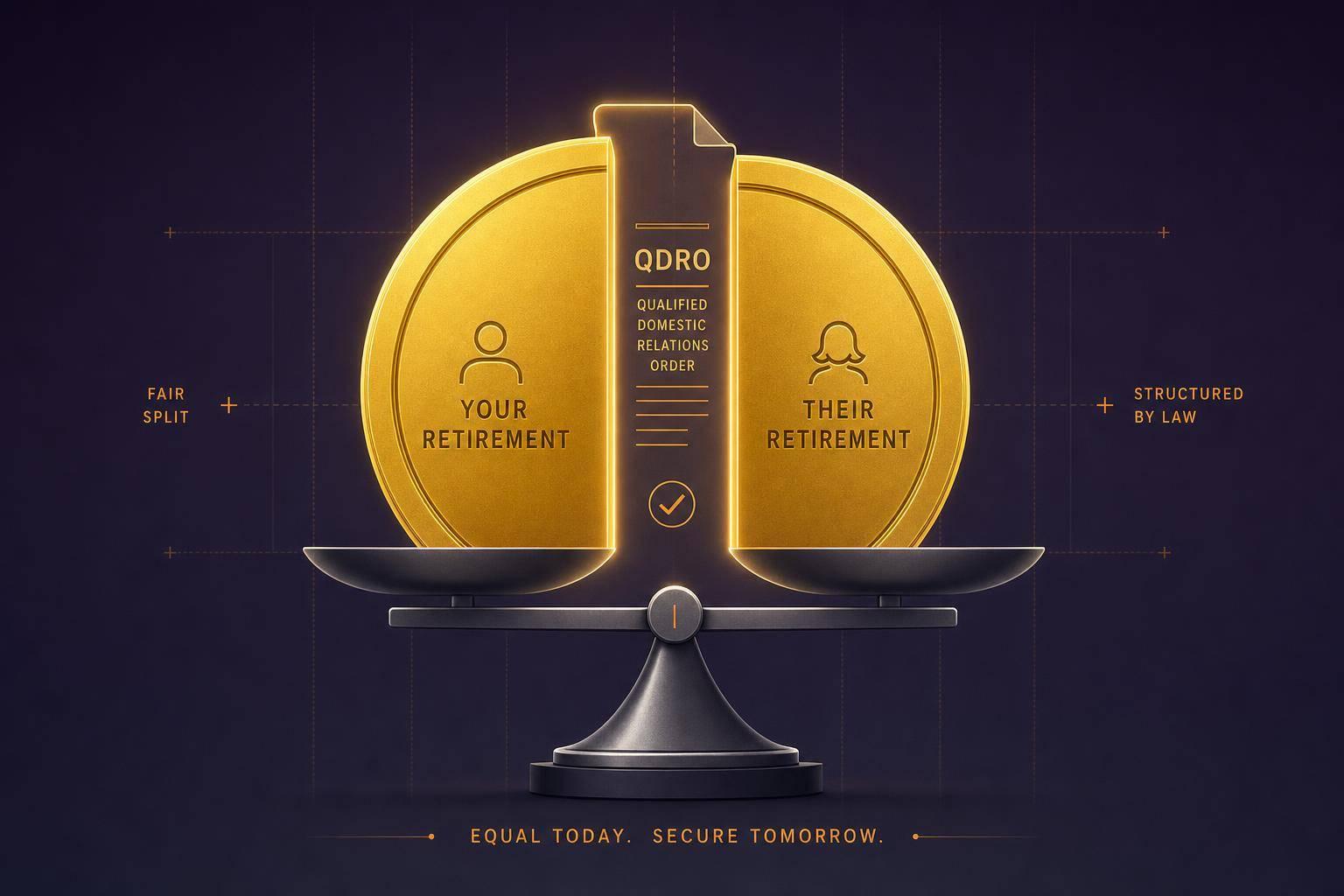
One wrong transfer may turn part of a divorce split into a tax bill. In many gray divorces, retirement accounts may make up a large share of the marital estate, and the rules may change by account type. A 401(k), 403(b), pension, or ESOP may need a QDRO, while an IRA, Roth IRA, SEP IRA, or SIMPLE IRA usually moves by a transfer incident to divorce instead.
Here’s the short version:
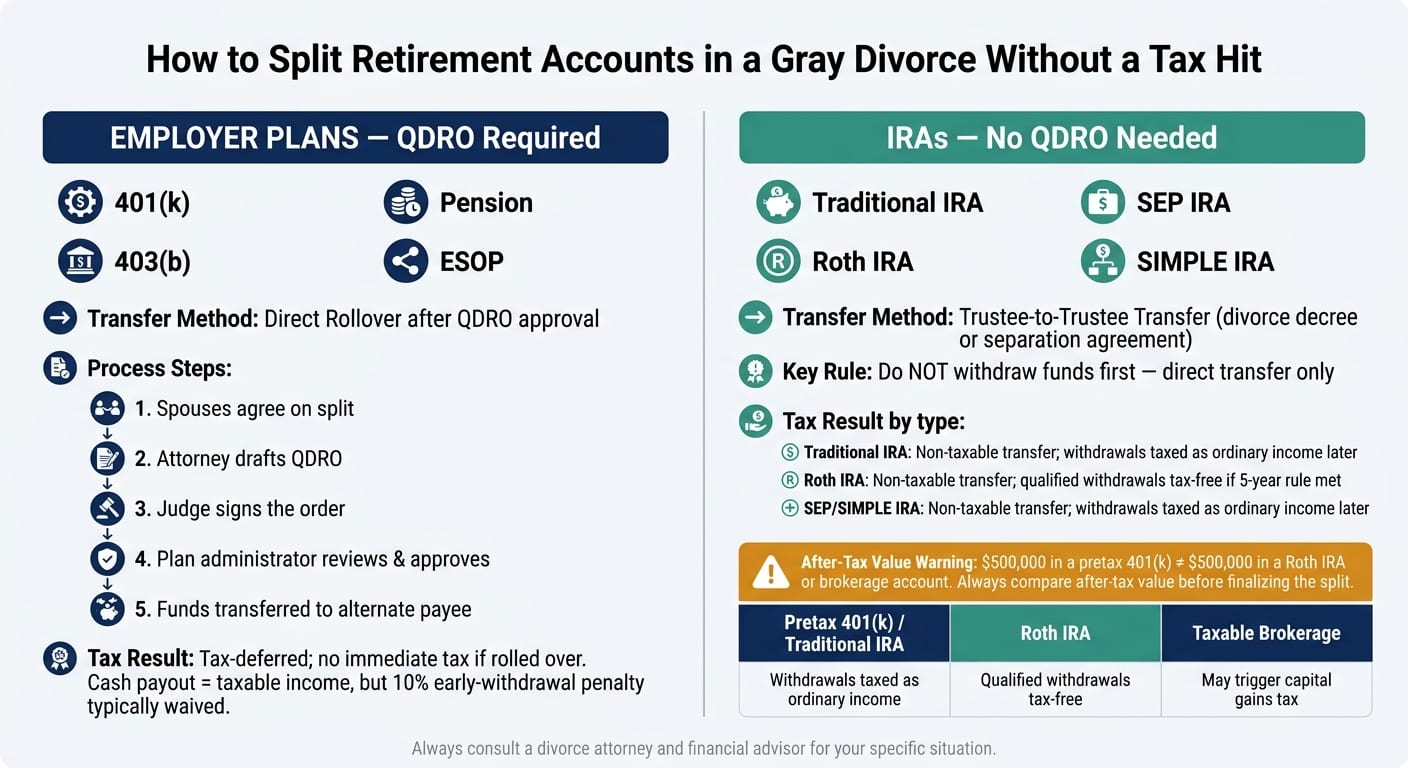
- Employer plans may need a Qualified Domestic Relations Order (QDRO)
- IRAs usually do not use a QDRO
- A direct rollover or trustee-to-trustee transfer may avoid immediate tax
- Taking money out first may make the transfer taxable
- A cash payout under a QDRO may be taxable income, but the 10% early-withdrawal penalty often may not apply
- A split that looks equal by balance may not be equal after taxes
- Divorce paperwork alone may not be enough if the plan administrator does not approve the order
A quick example: $500,000 in a pretax 401(k) may not match $500,000 in a Roth IRA or brokerage account on an after-tax basis. That gap may shape how some couples compare accounts in a settlement.
Divorcing? Why You Need a QDRO to Avoid Massive Taxes
Quick Comparison
That’s the core issue: the right document and the right transfer path may keep the split tax-deferred, while the wrong move may create tax, delay, or both.
How a QDRO works and which accounts need one
A Qualified Domestic Relations Order (QDRO) is a court order that gives an ex-spouse, called the alternate payee, rights to part of an employer-sponsored retirement benefit. In a divorce, it may allow an employer retirement plan to be divided without immediate tax being triggered for the participant spouse. The order tells the plan administrator to assign a share of an existing employer plan to the alternate payee.
The wording matters. Employer plans and IRAs follow different rules, so the language in the order may need to line up with the plan's terms.
Account types that typically require a QDRO
Employer plans such as 401(k)s, 403(b)s, pensions, and ESOPs usually require a QDRO. One detail that often gets missed: each plan may have its own QDRO rules, and the order generally needs to match them.
What a valid QDRO must include and who approves it
A QDRO must be drafted, signed, and approved by the plan. That process usually looks like this:
- Draft and agree - The spouses agree on the split, and an attorney drafts the order using the plan's required language.
- Court signature - A judge signs the order, making it a formal court document.
- Plan administrator review - The signed order is sent to the plan administrator, who reviews and approves it before any transfer takes place.
A divorce decree by itself may not bind the plan.
How a QDRO avoids immediate tax and the 10% early-withdrawal penalty
A proper QDRO may prevent immediate tax at the participant level. Put simply, the amount transferred under the order may avoid immediate tax to the participant spouse.
If the alternate payee rolls the award into an IRA or another eligible plan, the transfer may stay tax-deferred. If they take cash instead, the amount may be taxable to them, though the 10% early-withdrawal penalty usually may not apply.
Next comes the practical split: 401(k)s and pensions use a QDRO, while IRAs use divorce transfer rules.
How to divide each retirement account type without a tax hit
Once the rules are in place, the next step is the transfer itself. And this is where details may matter. The right method may let assets move with no immediate tax, while the wrong one may create tax friction.
401(k)s and pensions: split by QDRO, then roll over to preserve tax deferral
For employer plans, a QDRO may preserve tax-deferred growth while future retirement income is divided. The court signs the order, the plan administrator reviews it, and the plan then pays the assigned share to the alternate payee.
From there, the recipient may roll the award into an IRA or take cash. A direct rollover may preserve tax-deferred growth. A cash payout may be taxed as ordinary income, but it may avoid the 10% early withdrawal penalty. For pensions, the QDRO may split the future monthly benefit or assign a lump-sum payment to the alternate payee, depending on the plan's rules and the spouses' agreement.
Traditional and Roth IRAs: use a transfer incident to divorce, not a QDRO
IRAs don't use QDROs. Instead, they usually move through a direct transfer under the divorce documents.
A direct trustee-to-trustee transfer under the divorce decree or separation agreement may be the cleanest way to move an IRA without an immediate tax event. The key point: move the funds directly between custodians. If the account holder withdraws the money first and then sends a check to the ex-spouse, that may create a taxable event even if the funds were always meant for the divorce settlement.
Traditional and Roth IRAs also differ in after-tax value. Traditional IRA withdrawals may be taxed as ordinary income. Qualified Roth IRA distributions may be tax-free if the five-year rule has been met. That difference may matter when deciding which spouse keeps which account.
Comparison table: QDRO plans vs. IRAs
Once the transfer method is right, the next issue may be paperwork mistakes.
Mistakes that create avoidable tax bills and delays
Once the transfer method is set, the next risk may come from execution. The biggest tax mistakes often happen at this stage: money comes out too early, the wrong form gets used, or the plan's split rules get read the wrong way.
Withdrawing funds before a QDRO is in place
If the participant spouse withdraws money before the QDRO is approved, that distribution may be taxable to the participant spouse, not the ex-spouse. The tax bill may stay with the person who took the withdrawal. Any early-withdrawal penalty may also stay with the participant spouse. Paying an ex-spouse in cash from a retirement withdrawal does not shift that liability.
Until the QDRO is approved by the court and plan administrator, money should not be moved. Even a split that seems correct on paper may fail if the order itself is drafted the wrong way.
Drafting errors: wrong language, valuation date, or split percentage
Plan administrators may reject QDROs that miss the plan's required language, valuation date, or split formula. A rejected QDRO may need to be redrafted and refiled, which may delay the transfer. A QDRO is not valid just because the divorce terms are agreed to; the administrator still has to accept the language.
After the paperwork is corrected, the next step may be checking whether the split looks fair on an after-tax basis.
Ignoring after-tax value and portfolio balance
A split that looks even on paper may not be even in after-tax value. A pretax retirement account, a Roth account, and a taxable account each come with different tax treatment:
- Traditional IRA and 401(k) withdrawals may be taxed as ordinary income
- Qualified Roth distributions may be tax-free
- Taxable accounts may trigger capital gains
So the same dollar amount across these account types may not lead to the same long-term value.
Use Mezzi to compare after-tax value across accounts before finalizing the split.
After the split: rebuild your retirement plan and verify the numbers
Update account titles, beneficiaries, and retirement projections
After the transfer method is set, the next step is making sure the split was recorded the way it was meant to be. Once the QDRO and IRA transfer are complete, the forms may be finished. The planning part may not be.
Ask the plan administrator or IRA custodian for written confirmation that the transfer was completed correctly. Then go through the post-transfer checklist right away:
Paperwork is only part of the job. Both spouses may need to recalculate their retirement date, withdrawal plan, and tax bill. A pension split, a lower 401(k) balance, or a smaller IRA may change the math on when retirement may be possible and how much may be withdrawn each year.
Once the records are clean, the next step is seeing the full post-divorce picture in one place.
Use Mezzi to see your full post-divorce portfolio in one place
After a gray divorce, many people may end up with accounts spread across several institutions: a rollover IRA in one place, a Roth in another, maybe a pension and a taxable brokerage account too. Seeing how those pieces fit together - and whether they may still support your retirement goals - may be tough with account statements alone.
Mezzi connects your 401(k)s, IRAs, Roth accounts, and taxable brokerage accounts, giving you a full picture of your post-divorce portfolio without moving a dollar. You may use Mezzi to review your post-divorce allocation, overlap, and retirement timeline in one view. It may also help you see whether the assets you kept still fit your retirement plan.
Conclusion: the right documents and transfer method keep the split tax-efficient
Use the right document, confirm the transfer, and rebuild around the accounts you actually kept.
FAQs
What if my QDRO is rejected?
If your QDRO gets rejected, it may make sense to work with the plan administrator to see which requirement wasn’t met. A QDRO may need to follow the plan’s own rules, along with federal guidelines.
Check that it clearly lists:
- The participant
- The alternate payee
- The exact amount or percentage to transfer
- When payments are made
Fixing those details may help avoid delays, taxes, or early-withdrawal penalties.
How is a pension divided in gray divorce?
A pension in a gray divorce may be divided with a Qualified Domestic Relations Order (QDRO). This court-approved document lets an employer-sponsored plan be split without triggering immediate taxes or early-withdrawal penalties.
The QDRO needs to follow the plan’s rules and federal law. It also needs to spell out the percentage or dollar amount assigned to the non-employee spouse. The split may take the form of a share of future monthly payments or a present-value lump sum.
How do I compare after-tax account values?
Look past the sticker price and factor in how each asset may be taxed.
Traditional retirement accounts, like 401(k)s and some IRAs, may be taxed when money comes out. So the balance you see on paper may be higher than the amount someone may keep after taxes. Roth IRAs, by contrast, generally allow tax-free withdrawals.
With taxable brokerage accounts, it may help to compare market value with cost basis. Why? Realized gains may trigger capital gains taxes. And whoever receives the asset may also take on those future tax consequences.
Disclosures:
- This content is for informational purposes only and does not constitute investment advice or a recommendation to buy or sell any security.
- Past performance is not indicative of future results. No guarantee of future performance or outcomes is implied.
Related Blog Posts
- Community Property Laws: Impact on Retirement Accounts
- Dividing Investment Accounts in Divorce
- Capital Gains Tax Planning for Separation Scenarios
- Dividing a Taxable Portfolio in Divorce: Who Gets the Low-Basis Shares?
If your QDRO gets rejected, it may make sense to work with the plan administrator to see which requirement wasn’t met. A QDRO may need to follow the plan’s own rules, along with federal guidelines.
Check that it clearly lists:
- The participant
- The alternate payee
- The exact amount or percentage to transfer
- When payments are made
Fixing those details may help avoid delays, taxes, or early-withdrawal penalties.
A pension in a gray divorce may be divided with a Qualified Domestic Relations Order (QDRO). This court-approved document lets an employer-sponsored plan be split without triggering immediate taxes or early-withdrawal penalties.
The QDRO needs to follow the plan’s rules and federal law. It also needs to spell out the percentage or dollar amount assigned to the non-employee spouse. The split may take the form of a share of future monthly payments or a present-value lump sum.
Look past the sticker price and factor in how each asset may be taxed.
Traditional retirement accounts, like 401(k)s and some IRAs, may be taxed when money comes out. So the balance you see on paper may be higher than the amount someone may keep after taxes. Roth IRAs, by contrast, generally allow tax-free withdrawals.
With taxable brokerage accounts, it may help to compare market value with cost basis. Why? Realized gains may trigger capital gains taxes. And whoever receives the asset may also take on those future tax consequences.