
A 5%+ starting withdrawal rate may be possible for some retirees - but usually only if spending may move when markets or inflation shift. That’s the core idea behind guardrails: start higher, check once a year, and cut or increase spending only when your withdrawal rate moves outside preset limits.
Here’s the short version:
- I may start with a 5.0% withdrawal rate instead of 4.0%
- I may set guardrails at 20% above and below that rate
Example: 4.0% to 6.0% around a 5.0% start
- I may use a preset spending change, such as 10% down after an upper-band breach and 10% up after a lower-band breach
- I may give inflation increases only in years when the plan allows them
- This approach may fit best when Social Security, a pension, or an annuity already covers most fixed bills
Put another way: this is not “spend 5% and hope for the best.” It’s “spend more at the start, but follow rules when the numbers move.”
A simple example from the article:
- Portfolio: $2,000,000
- Year-one withdrawal: $100,000
- Starting rate: 5.0%
- Guardrails: 4.0% and 6.0%
- If the portfolio falls enough that the planned withdrawal rate moves above 6.0%, spending may drop by 10%
- If the rate falls below 4.0%, spending may go up by 10%
That setup sits between two other approaches:
- The 4% rule, where spending stays more steady and inflation-adjusted
- Fixed-percentage withdrawals, where spending moves up and down with the portfolio each year
Quick Comparison
The main takeaway is simple: guardrails may give some retirees a way to start above 5%, but only if they’re willing to follow preset rules, review the plan each year, and treat part of spending as flexible.
How Guardrails Withdrawals Work
A guardrails strategy adjusts from year to year based on portfolio value. The main check is simple: planned withdrawal ÷ current portfolio value. Those four inputs shape when spending stays the same and when it may change.
The Four Moving Parts: Starting Rate, Guardrail Bands, Inflation, and Adjustment Size
Every guardrails setup starts with four parts defined before retirement begins.
- Starting withdrawal rate: your year-one withdrawal as a share of portfolio value. A common educational example uses 5.0%, which on a $2,000,000 portfolio works out to a $100,000 first-year withdrawal.
- Guardrail bands: the upper and lower limits around that rate. A common setup puts the bands 20% above and below the starting rate. At 5.0%, that works out to a lower guardrail of 4.0% and an upper guardrail of 6.0%.
- Inflation treatment: when and whether the annual inflation increase applies. A common approach allows the full inflation increase when spending stays inside the bands, and skips or caps it when the portfolio has fallen.
- Adjustment size: the preset cut or raise after a band gets crossed. Many frameworks use 10% - a 10% cut if the upper guardrail is breached, and a 10% raise if the lower guardrail gets crossed.
How Guardrails Differ From the 4% Rule
The traditional 4% rule uses a fixed real spending approach: withdraw 4% of your starting portfolio in year one - $80,000 on a $2,000,000 portfolio - then increase that dollar amount by inflation each year. Fixed real spending stays steady. Guardrails may change.
Guardrails trade predictability for flexibility in three ways.
First, they may allow a higher starting rate - 5% or more - if someone accepts that spending may need to fall in weak years. Second, inflation increases are conditional, not automatic. Third, the strategy includes clear rules for both cuts and raises, which may remove some of the guesswork from year-to-year decisions. The 4% rule may run mostly on autopilot. Guardrails usually involve an annual check-in and a willingness to stick with the preset rules if they trigger.
A Simple Hypothetical Example
Here’s how the rules may work in a good year, a bad year, and a sharper decline.
Take a retiree starting with a $2,000,000 portfolio and a $100,000 withdrawal (a 5.0% starting rate), with guardrails at 4.0% and 6.0% and a 10% adjustment size.
After a strong market year, the portfolio grows to $2,300,000. With 3% inflation, the planned withdrawal rises to $103,000. That puts the withdrawal rate at about 4.48%, which stays inside the band.
Now picture a rough year where the portfolio drops to $1,800,000. That same $103,000 withdrawal comes to about 5.72% - still inside the upper guardrail of 6.0%, so no cut applies yet. But if the portfolio fell further to about $1,667,000, that rate would move past 6.0%. At that point, the upper-guardrail cut would trigger: a preset 10% reduction in spending, with the inflation increase skipped, bringing the withdrawal down to about $93,000.
Next: how to choose a starting rate, band width, and inflation rule.
How to Set a 5%+ Starting Rate
Before picking a 5%+ rate, define how much income your portfolio may need to replace.
Build Your Income Floor Before Setting Portfolio Withdrawals
Split spending into essentials and discretionary items. Your portfolio may only need to cover the gap left after guaranteed income. A 5%+ starting rate may make more sense when the portfolio funds a limited gap, not the full retirement budget.
Add up your guaranteed income - Social Security, pensions, and annuities. Whatever that income doesn’t cover may be the gap your portfolio needs to fund. If spending is $70,000 and guaranteed income is $40,000, your portfolio may need to fund the remaining $30,000 gap.
A stronger income floor may make a 5%+ starting rate more realistic. If guaranteed income already covers most essentials, a guardrail breach may be more likely to lead to cuts in discretionary spending first, not basic needs.
Once you know the gap, the starting rate and guardrails may become simple math.
Choose Your Starting Rate and Guardrail Bands
Once you know your portfolio’s funding gap, divide the annual amount your portfolio may need to cover by your total portfolio value. If your portfolio is $600,000 and it needs to fund $30,000 per year, that works out to a 5.0% starting rate.
Use the same preset bands and the 10% adjustment rule. Pre-committing to those numbers may remove some of the guesswork when markets move.
Your starting rate may also reflect your time horizon and asset mix. Research also suggests that a more flexible guardrails approach may support higher starting rates than fixed real spending.
Decide How Inflation Adjustments Will Work
After the starting rate is set, lock in the inflation rule that controls annual changes.
When withdrawals stay inside the bands, increase them by CPI. In weak years, some retirees skip the increase or cap it at 1%–2%. Those rules may reduce the chance that an automatic inflation increase pushes the withdrawal rate past a guardrail after a bad market year. Inflation control may work best as part of the spending rule, not as something added later. Flexible spending rules, including inflation adjustments, may lift sustainable starting rates from around 3.9% (fixed real spending) to roughly 5.1%–5.7%.
Set the inflation rule in advance and apply it the same way every year.
How to Apply the Rules Each Year
Annual Review: Calculate Your Current Withdrawal Rate
Once the guardrails are set, the yearly task may be pretty simple: run the math again, check the range, and make the preset change only if the rule calls for it.
Once a year, add up the balances in the accounts you expect to spend from. Then divide next year's planned portfolio withdrawal by that total. The formula is straightforward: planned annual portfolio withdrawal ÷ current portfolio value = current withdrawal rate. If you plan to take $52,000 from a $1,000,000 portfolio, your current withdrawal rate may be 5.2%. Then compare that result with your preset guardrails.
If Social Security starts, a pension gets a COLA, or part-time work ends, update the amount the portfolio may need to cover and recalculate the withdrawal rate. A major income change may justify running the numbers again midyear, not only at the annual review.
The Prosperity Rule and the Capital Preservation Rule
For a 5% starting rate, the band may be 4%–6%. The yearly sequence stays the same: recalculate, compare, then adjust.
Two rules handle the next step:
If neither guardrail is triggered, apply the inflation adjustment your plan allows and hold course. Apply the preset adjustment. These rules may depend on sticking to them as written.
What to Do in Bad Markets and High-Inflation Years
When markets drop sharply, the Capital Preservation Rule may trigger a cut. Even in years when the withdrawal rate stays inside the band, a negative portfolio return may be a reason to skip that year's inflation increase.
This may matter most early in retirement, when losses may have a larger effect. Granting a full inflation raise in a down year may force the portfolio to support a larger withdrawal at a time when it may be under more strain. Lower spending in weak markets may help protect long-term income.
Pre-committing to these rules before markets move is what gives them structure. Retirees who decide in advance that a negative-return year automatically freezes the inflation raise may not have to make that call under stress. Follow the rules as written.
Next, compare guardrails with the 4% rule and fixed-percentage withdrawals.
Compare the Tradeoffs and Set Up a Monitoring Process
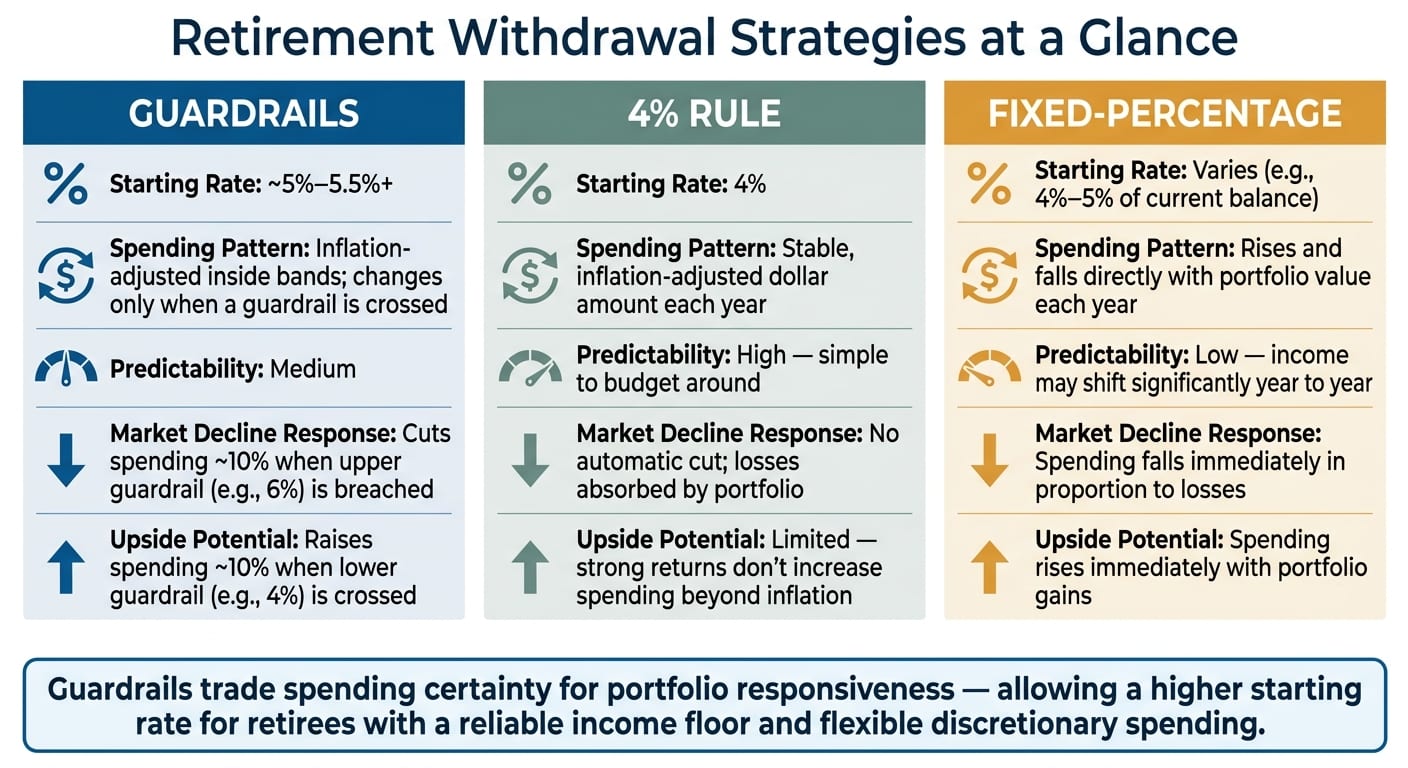
Guardrails vs. 4% Rule vs. Fixed-Percentage Withdrawals
Each approach leans toward a different goal: steadier income, more flexibility, or a higher starting withdrawal. The best fit may depend on how much your spending may bend when markets move.
When Guardrails May Still Be Too Risky
Guardrails work only when withdrawals may move with market conditions. They don't remove risk so much as move part of it from the portfolio to annual spending. That setup may fit only if spending has some room to move.
A few cases where a 5%+ starting rate may fall short:
- Mostly fixed expenses. If housing, healthcare, and debt payments make up most withdrawals, a 10%–20% spending cut triggered by the capital preservation rule may not be realistic.
- A long retirement horizon. Retiring in your early 60s may mean 35–40 years of exposure to poor early returns. A 5%+ starting rate may leave less room if the first decade brings below-average returns.
- Portfolios heavily weighted to one stock or sector. Concentrated exposure may increase volatility. Guardrails may react to that volatility and may force repeated spending cuts.
In these situations, a lower starting rate - or a hybrid approach that leans more on guaranteed income sources like Social Security, pensions, or annuities - may be a better fit than stretching to 5%+.
Conclusion: The Case for 5%+ Spending With Clear Rules
A 5%+ starting withdrawal may work only with a reliable income floor, preset guardrails, and an annual review.
The tradeoff is pretty plain. Guardrails trade spending certainty for portfolio responsiveness. Withdrawals may change over time. That flexibility may be part of what allows a higher starting rate in the first place.
That annual check may be easier when current balances are simple to gather. Mezzi can link brokerage, IRA, 401(k), and bank accounts to pull current balances into the annual review.
FAQs
How often should I review my guardrails plan?
Review your guardrails plan at least once a year to make sure it still lines up with your long-term goals.
It may also make sense to revisit it after major life changes, such as marriage, divorce, receiving an inheritance, or changes in your health or spending needs. Markets and personal circumstances may shift fast, so real-time monitoring may help you spot when changes may be worth considering.
Can guardrails work if most of my spending is fixed?
Yes. Guardrails may still work for people with large fixed expenses.
One common setup is to use guaranteed income sources - such as Social Security, pensions, or annuities - to cover essential costs, then use portfolio withdrawals for discretionary spending.
That split may help keep a guardrails strategy more flexible during market downturns.
What should I do after a market drop and high inflation?
After a market drop, some people try to avoid selling assets at a loss. With a guardrails strategy, they may reduce withdrawals for a period, with the goal of preserving more of the portfolio.
To limit lifestyle changes, some households use accounts that may be less affected by the downturn, or they draw from a cash buffer equal to 6–12 months of expenses. During periods of high inflation, a diversified portfolio may help protect purchasing power.
Disclosures:
- This content is for informational purposes only and does not constitute investment advice or a recommendation to buy or sell any security.
- Past performance is not indicative of future results. No guarantee of future performance or outcomes is implied.
- Savings and performance examples are hypothetical and for illustrative purposes only. Actual results will vary based on individual circumstances, portfolio composition, market conditions, and fees.
Related Blog Posts
- Social Security vs. Retirement Savings: Balancing Income Sources
- What portfolio value and withdrawal strategy would generate a specific monthly after-tax income?
- Retirement Planning at 50: How to Assess If You Have Enough
- Chubby FIRE: Comfortable Early Retirement Between Lean and Fat
Review your guardrails plan at least once a year to make sure it still lines up with your long-term goals.
It may also make sense to revisit it after major life changes, such as marriage, divorce, receiving an inheritance, or changes in your health or spending needs. Markets and personal circumstances may shift fast, so real-time monitoring may help you spot when changes may be worth considering.
Yes. Guardrails may still work for people with large fixed expenses.
One common setup is to use guaranteed income sources - such as Social Security, pensions, or annuities - to cover essential costs, then use portfolio withdrawals for discretionary spending.
That split may help keep a guardrails strategy more flexible during market downturns.
After a market drop, some people try to avoid selling assets at a loss. With a guardrails strategy, they may reduce withdrawals for a period, with the goal of preserving more of the portfolio.
To limit lifestyle changes, some households use accounts that may be less affected by the downturn, or they draw from a cash buffer equal to 6–12 months of expenses. During periods of high inflation, a diversified portfolio may help protect purchasing power.