
Updated September 26, 2026.
Choose YNAB when you want a repeatable system for assigning money to spending and savings. Choose Mezzi when you want personalized guidance that connects your investments, cash, assets, debts, and goals. You can use both. Having more investments does not make a good budgeting routine obsolete.
That is the useful distinction. Both products can contribute to a wider financial picture. The choice is what you want to do after seeing it: maintain a category-based spending plan, discuss an investment decision in the context of your life, or combine those jobs.
Mezzi and YNAB at a glance
| Decision | YNAB | Mezzi |
|---|---|---|
| Everyday routine | Assign money to categories and review transactions | Ask questions using connected finances and saved personal context |
| Investments | Track balances and contributions; investment tracking accounts can contribute to net worth | Review supported holdings and underlying fund exposure with Exposure X-Ray |
| Cash and debt | Spending plan, targets, and debt tools | Banking and liabilities alongside investments and other assets |
| Personalization | Your categories, priorities, and targets shape the plan | AI Personalization stores goals, preferences, and relevant background |
| Annual cost | $109; $14.99 monthly option | Free; Advisory $399; Concierge $999 |
| Best reason to choose it | You want a structured habit for directing money | You want help reasoning through decisions across your finances |
Prices reviewed September 26, 2026. YNAB pricing; Mezzi plans. Annual plans and monthly subscriptions have different payment schedules.
What YNAB does well
YNAB gives spending decisions a place to live. Its core approach asks you to decide what available money needs to do, then adjust those decisions as life changes. Targets, transaction review, and sharing can turn a vague intention such as “save more” into an ongoing household routine. YNAB features
Consider a couple planning a $6,000 trip twelve months from now. An illustrative funding pace is $500 per month. The useful question in a spending plan is whether that contribution still fits after groceries, insurance, and other commitments. A healthy investment balance does not answer that question for them.
The appeal is the discipline of making tradeoffs visible. If a repair costs more than expected, the household must decide which priority changes. That can be valuable at a high income just as it is at a low one. Wealth does not remove irregular expenses or disagreements about priorities.
YNAB can track investments and net worth
It would be inaccurate to say YNAB has no investment tracking. Its documentation explains two approaches: record contributions through a category, or add investment accounts as tracking assets. Those balances can appear in net worth while staying outside the money available to assign to spending categories. YNAB investment tracking
That separation makes sense. Retirement holdings are part of your financial position, but they are not normally the same as cash available for this month's bills. YNAB's account-type guide explains the difference between spending accounts and tracking accounts.
The limit to investigate is the analysis you need beyond balances. If your question is which companies sit inside several funds, or how an investment decision interacts with a planned purchase, a spending plan by itself may leave more work for you. That does not diminish the value of maintaining the spending plan.
What Mezzi adds
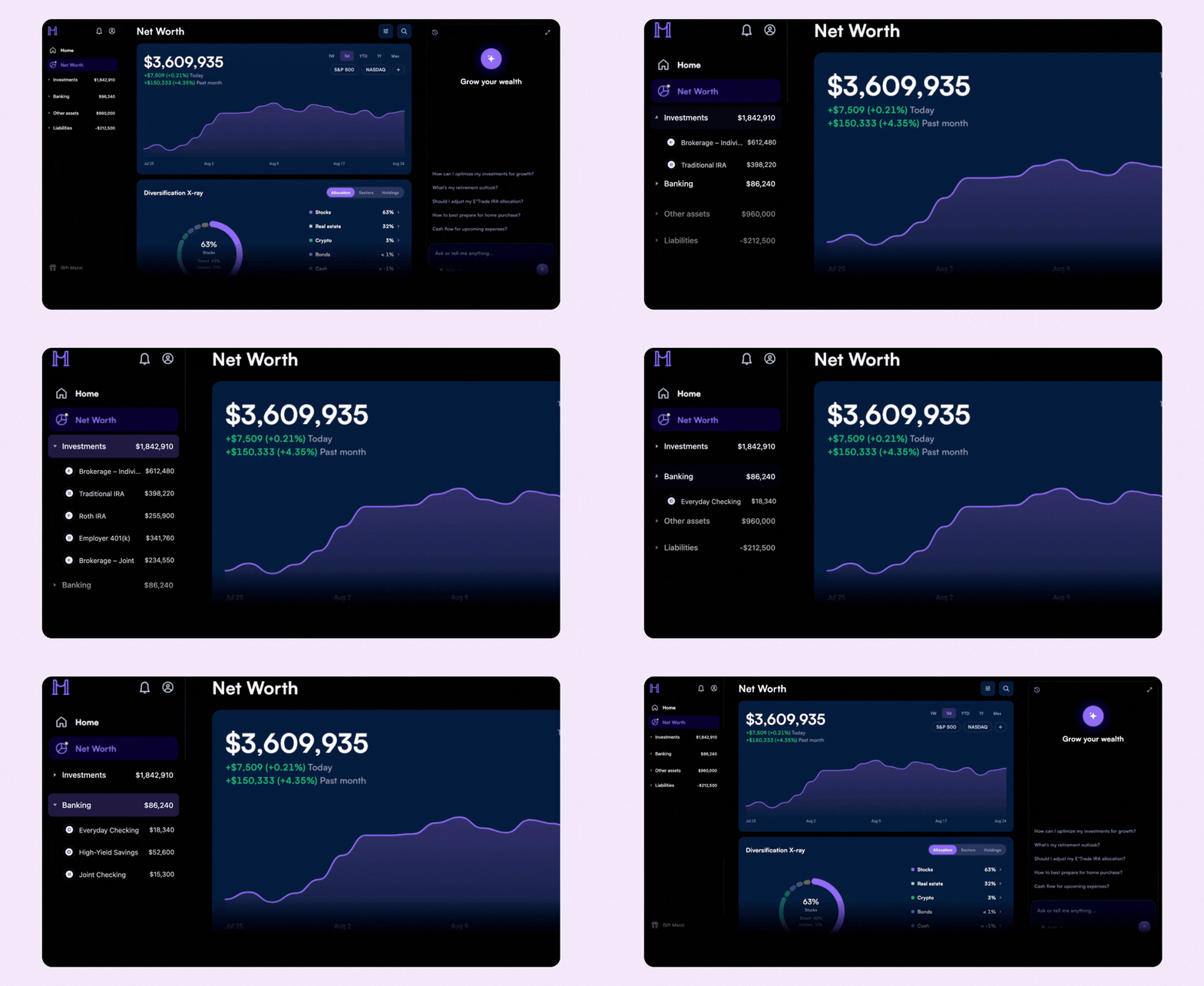
Mezzi brings Investments, Banking, Other Assets, and Liabilities into the same experience. Its scope includes checking and savings, credit cards, and manually entered assets such as real estate. AI Personalization lets you explain goals and preferences so a question is grounded in what you intend to do, as well as what the connected accounts contain. Mezzi account groups
For example, two households can each hold $80,000 in a bank account and have very different needs. One is preparing for a down payment; another has no planned use for the cash. A useful discussion starts by recording that distinction. The account balance alone cannot establish how much is available for long-term investing.
Exposure X-Ray helps review underlying exposures in supported funds. That matters when an individual stock also appears inside several ETFs or mutual funds. You can then ask how the exposure fits your goals and which alternatives deserve investigation. Advice is a starting point for review, not an instruction to place an unexamined trade.
Guidance and execution are separate
Mezzi does not move your money or place trades. You remain responsible for implementation through your financial institutions. A request to monitor something through Delegations does not authorize a transfer, purchase, or sale.
Check the quality of connected information before relying on an answer. A linked account may show a balance without supplying complete cost basis or transaction history. Tax-sensitive questions can require records that are missing from a connection, plus facts about your household that no account feed can supply.
Mezzi is therefore most useful when you want to stay involved in the reasoning. If you want a professional to implement a plan and take responsibility for defined ongoing services, compare those service arrangements separately.
A completed example: assign the surplus, then review the destination
An invented household has $2,000 left after its already funded monthly expenses. A home project needs another $6,000 in six months, a separate credit-card payment of $400 is due, and the household is considering an $800 investment contribution. Assume these commitments have not already been deducted from the $2,000.
The project pace is $1,000 per month. Project funding plus the card payment leaves $600: $2,000 − $1,000 − $400. The proposed $800 investment contribution exceeds that remainder by $200. This arithmetic does not determine which priority should change; it identifies the tradeoff that a useful discussion must address.
YNAB's category-and-target routine gives the household a place to assign the money and maintain the decision. Mezzi's additional job is to discuss the tradeoff with the debt terms, goal deadline, existing cash, and investments in view. No tool should quietly count the same $400 payment twice or call the full $2,000 investable.
Suppose the household separately reviews a $100,000 investment portfolio with $8,000 held directly in Company A and a $40,000 fund with an assumed 5% Company A weight. If the remaining holdings have no additional exposure, Company A totals $10,000, or 10%. A verified look-through review can establish that fact; a spending category cannot supply it merely by tracking the fund's balance.
The completed decision record might say: “The proposed contribution needs a $200 funding adjustment. Before changing it, review the card terms and project flexibility. If investing, compare the destination with our existing 10% Company A exposure.” This is an illustrative record, not a customer outcome or a recommendation to make that allocation. It gives each tool a distinct, observable job.
Pricing: compare the job you are buying
YNAB's annual plan is $109 before applicable taxes, with a $14.99 monthly alternative. A direct signup offers a 34-day trial; one subscription can cover up to six people under YNAB Together. App-store terms can differ. YNAB plans
Mezzi Free includes aggregation, family collaboration, Exposure X-Ray, and limited AI insights. Advisory is $399 annually, including unlimited advice and five active Delegations. Concierge is $999 annually and adds advanced AI, unlimited active Delegations, setup assistance, and quarterly coaching. Mezzi pricing
Using YNAB's annual plan with Mezzi Advisory would total $508 per year before any applicable taxes or pricing changes. Using YNAB with Mezzi Free would keep the quoted subscription total at $109. Those calculations describe software cost; they do not promise financial savings.
A subscription earns its place by supporting a recurring decision. If you seldom use the second product, the fact that it has more features is not enough reason to keep paying for it.
How to test the fit before changing your routine
- Write down three decisions you expect to make this month. Be specific: funding an annual bill, reviewing fund exposure, or deciding what context a retirement question needs.
- Try the relevant workflow in each product using your actual supported accounts. Check balances against statements and note missing data.
- Record what each tool helped you finish. “I understood my bill reserve” is more useful evidence than “the dashboard looked sophisticated.”
- Check the maintenance burden. Determine who will review transactions, update manual assets, and correct stale information.
- Keep both only if their roles are clear. One can be your spending system and the other your financial discussion and analysis tool.
For an implementation checklist, see adding investment review to your YNAB routine. For broader household alternatives, compare Mezzi and Monarch.
Frequently asked questions
Does YNAB track investments?
Yes. YNAB supports investment tracking accounts and contribution tracking. This can support net-worth monitoring. It should not be confused with reviewing the underlying holdings of several funds or receiving personalized investment guidance.
Does Mezzi replace YNAB's spending plan?
Do not assume a one-for-one replacement. Mezzi can include banking, debts, goals, and cash-flow context in its guidance. If you rely on YNAB's categories, targets, and transaction routine, test those specific needs before removing it.
Do I need a certain net worth to use both?
The better test is the work you need done. A household with several decisions across accounts may value additional analysis, while a wealthy household with a simple routine may not need another paid subscription.
What should I try first in Mezzi?
Connect the relevant accounts, confirm the data, and save one real goal in AI Personalization. Then ask a question that depends on both the accounts and that goal. Explore Mezzi's plans before choosing the level of advice you need.
See how Mezzi groups accounts
Give your next financial question the full picture. Connect your accounts and add the goals behind them before deciding whether paid advice fits.
Explore Mezzi FreeMezzi publishes this comparison and offers a competing service. Product descriptions use official documentation reviewed September 26, 2026; this is not a matched performance test. Mezzi is an SEC-registered investment adviser; registration does not imply a particular level of skill or training. Investing involves risk, including loss of principal. Examples are illustrative and are not personalized investment or tax advice. Connected information can be incomplete or delayed.