
Mezzi and M1 Finance cater to different investment styles. Mezzi offers personalized advice for managing accounts across institutions like Fidelity and Schwab without requiring asset transfers. It focuses on tax strategies for multi-asset portfolios, portfolio analysis, and retirement planning through AI-driven insights. M1 Finance, on the other hand, is a brokerage platform emphasizing automation, with features like customizable portfolios ("Pies"), automatic rebalancing, and dividend reinvestment. It requires consolidating assets within its platform.
Key Takeaways:
- Mezzi: Best for investors managing accounts across multiple firms who want tailored advice and tax optimization but prefer to execute trades themselves.
- M1 Finance: Ideal for those seeking a hands-off approach with all assets in one place, leveraging automation for portfolio management.
Quick Comparison
Choose Mezzi for advanced guidance across multiple accounts. Opt for M1 Finance if you prefer streamlined, automated management within a single platform.
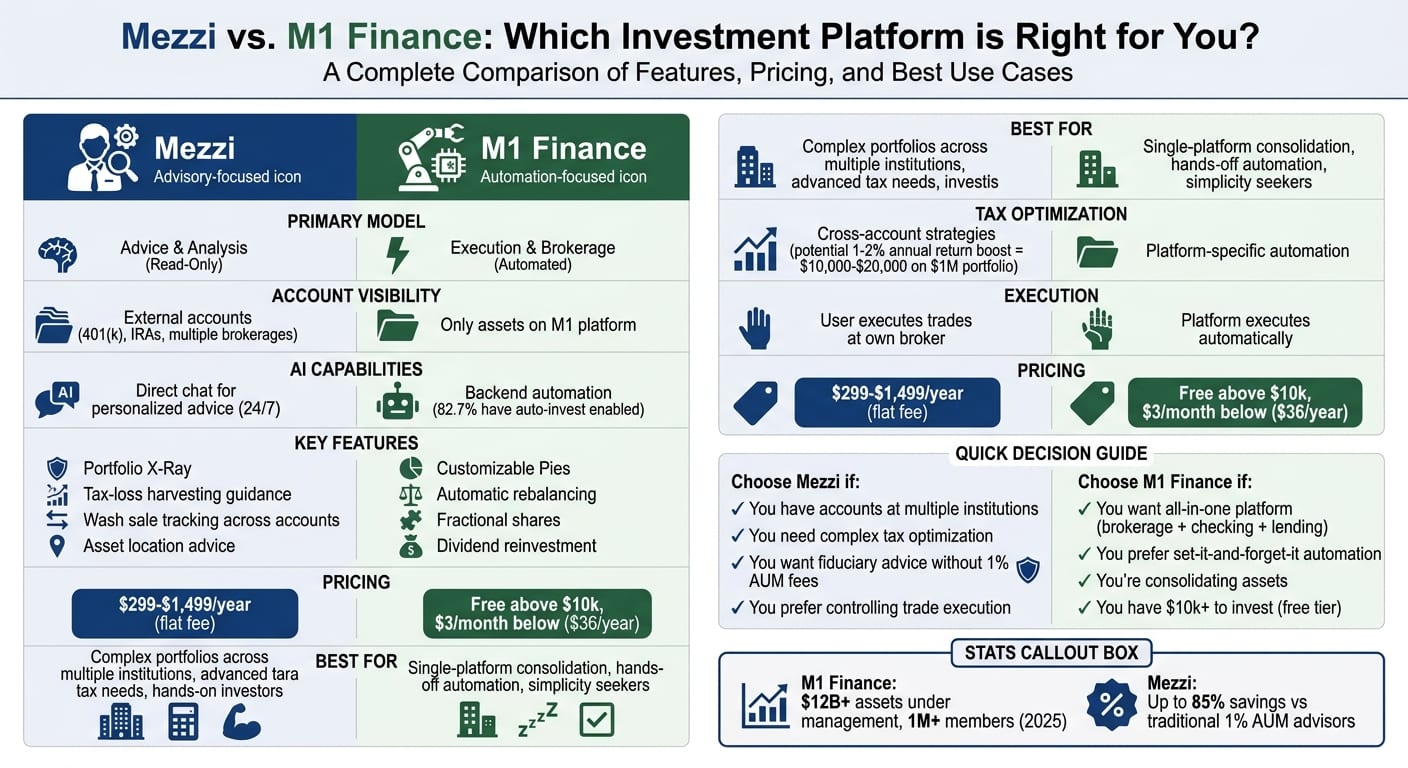
Features Comparison
Mezzi's Features
Mezzi brings together your financial accounts - such as 401(k), Roth IRA, and brokerage accounts - using secure, read-only access through Plaid and Finicity. This gives you a consolidated view of your portfolio alongside SEC-registered fiduciary advice to help guide your next steps. One standout feature is the Portfolio X-Ray, which highlights hidden stock overlaps across ETFs, mutual funds, and individual holdings, helping you uncover risks or exposures you might not have noticed.
"Mezzi's X-Ray feature allowed me to uncover exposure to stocks I didn't realize I had" - Shuping, Founder of Summer AI
Mezzi also allows you to interact directly with its AI to ask financial questions, explore portfolio adjustments, and receive advanced planning advice - all without paying the typical 1% AUM fee. Powered by reasoning models from OpenAI and Google, the AI provides tailored suggestions, such as tax-efficient strategies or rebalancing ideas. However, Mezzi does not execute trades. Instead, it identifies opportunities - like tax-loss harvesting software or rebalancing - and leaves the execution to you via your brokerage account.
"I love the AI insights and the simplicity of the UX. There is just enough info and I loved chatting with the AI to make important changes to my portfolio" - Tim, CEO of Somnee
While Mezzi focuses on delivering in-depth portfolio insights and advice, it doesn't handle trade execution. By contrast, M1 Finance prioritizes automation for investment actions.
M1 Finance's Features
M1 Finance takes a different approach, centering on integrated execution. Unlike Mezzi, M1 Finance operates as a brokerage platform, requiring you to transfer your assets to use its automated "Pies" system. A Pie is a customizable portfolio where you set target allocations - such as 60% stocks and 40% bonds - and M1 automatically rebalances by directing new deposits to underweight areas. As of Q1 2026, 82.7% of M1 investors have auto-invest enabled, showcasing its "set it and forget it" convenience. The platform also supports fractional shares, ensuring even small investments are distributed across your portfolio.
While M1 uses AI to optimize backend processes like margin models and regulatory compliance, its user-facing tools are focused on execution rather than advisory.
"The AI features turned what used to be days of research into minutes or hours" - Jessica S., Head of Product Design at M1 Finance
M1's automation extends to dividend reinvestment, recurring contributions, and dynamic rebalancing. However, it doesn't provide the same level of portfolio analysis or tax optimization guidance that Mezzi offers. This makes M1 more appealing to those who prefer automated management and direct trading over detailed advisory services.
Feature Comparison Table
Here's a quick look at how the two platforms differ:
Could an AI Co-pilot be Better Than Your Financial Advisor?
Tax Optimization
When it comes to maximizing returns, tax optimization plays a crucial role. Both Mezzi and M1 Finance offer tools to help with this, but they approach the process in different ways.
Mezzi's Tax Tools
Mezzi takes a detailed, comprehensive approach to tax management by analyzing your entire portfolio, including 401(k)s, IRAs, and brokerage accounts held at different institutions. Through read-only access, it identifies tax-saving opportunities and flags potential wash sale risks. For instance, if you sell an asset at a loss and repurchase it within 30 days across any of your accounts, Mezzi will alert you to the wash sale risk.
Another standout feature is Mezzi's asset location advice, which helps you determine the best account types for specific investments to minimize taxes. For example, it might suggest holding bonds in a Traditional IRA while placing growth stocks in a Roth IRA. These strategies could potentially increase annual returns by 1%–2%. On a $1 million portfolio, that translates to an extra $10,000 to $20,000 in annual returns.
"Tax optimization can add 1% to 2% to annual returns." - Mezzi
Although Mezzi provides detailed guidance, it stops short of executing trades. It identifies tax-loss harvesting opportunities and advises you on timing. For example, if you sell a position, Mezzi will notify you when the 30-day wash sale period has passed so you can safely repurchase.
M1 Finance's Tax Features
M1 Finance, on the other hand, simplifies tax optimization by automating key processes within its platform. It offers tax-efficient rebalancing and automatic dividend reinvestment. When you deposit funds, M1 allocates them to underweight positions, avoiding unnecessary taxable events. This streamlined approach is ideal for investors who keep their assets exclusively on M1.
The platform also automates tax-loss harvesting, executing trades for you, which is more hands-off compared to Mezzi's guidance model. However, this automation is limited to assets held within M1 accounts, making it less flexible for those with accounts spread across multiple institutions.
Tax Strategy Comparison Table
Pricing Comparison
Mezzi and M1 Finance take very different approaches to pricing. Mezzi uses a flat annual subscription model that doesn’t change based on your portfolio size, while M1 Finance is free for accounts with balances of $10,000 or more but charges a $3 monthly fee for smaller accounts. Knowing how these models work can help you decide which platform offers better value for your specific portfolio size and needs.
Here’s a closer look at how each platform structures its pricing and what they provide.
Mezzi's Pricing
Mezzi offers three subscription tiers, designed to cater to portfolios of varying complexity:
Core ($299/year)
This entry-level plan includes unlimited AI chat, 24/7 monitoring, advanced tax and returns analysis, and the X-Ray overlap tool. It’s a great option for investors who want guidance without relying on human advisors.
Plus ($499/year)
This mid-tier plan builds on the Core features by adding advanced research capabilities, early access to new tools, and concierge support through video, phone, and email. It’s perfect for those who occasionally need human input alongside AI-driven insights.
White Glove ($1,499/year)
The premium tier offers personalized AI coaching through video calls, along with unlimited support from the Mezzi team. This plan is aimed at high-net-worth individuals managing complex portfolios across multiple accounts. It provides a hands-on experience without the hefty 1% Assets Under Management (AUM) fee charged by traditional advisors.
"Saving 1%-plus on an advisor could mean saving over $1M over 30 years, depending on portfolio size, returns, and individual circumstances." – Mezzi
Even at the highest tier, Mezzi's pricing represents a significant cost reduction - up to 85% - compared to traditional advisors, while still offering high-level financial planning.
M1 Finance's Pricing
M1 Finance keeps things simple and cost-effective. Accounts with $10,000 or more in assets pay no platform fees, while smaller accounts incur a $3 monthly fee, totaling $36 per year.
Trading stocks and ETFs is commission-free, but cryptocurrency transactions come with a 1% fee through Bakkt, M1’s crypto partner. There’s also an inactivity fee of up to $50 for accounts with $50 or less that remain dormant for 90 days or more. Notably, M1 Finance has eliminated its paid "M1 Plus" membership, so all premium features are now accessible to users with $10,000 or more in assets.
Cost Comparison Table
For portfolios of $1 million or more, Mezzi’s tax optimization tools - like better asset location strategies and tax-loss harvesting - could add $10,000 to $20,000 in annual returns. This makes even the $1,499 White Glove tier a worthwhile investment. On the other hand, M1 Finance shines for investors who prefer a streamlined, automated approach on a single platform.
This pricing breakdown ties into the broader discussion of AI-powered features and tax strategies, helping you choose the platform that aligns with your financial goals and management style.
When to Use Each Platform
Deciding between Mezzi and M1 Finance comes down to how your accounts are set up and how much control you want over your investments. Mezzi is perfect if your accounts are spread across multiple institutions and you want expert guidance without transferring funds. On the other hand, M1 Finance is great if you're ready to consolidate everything into one platform and let automation handle the heavy lifting. Here's a closer look at when each platform works best.
When Mezzi Works Best
Mezzi is ideal for those juggling accounts across different institutions and looking for top-notch, fiduciary-level advice. For example, if you have a 401(k) with Fidelity, a Roth IRA with Vanguard, and a taxable account at Schwab, Mezzi helps you optimize taxes across all these accounts without needing a robo-advisor. It identifies opportunities for tax-loss harvesting, monitors wash sale risks across brokerages, and offers strategies for placing assets in the best accounts (Roth, Traditional, or taxable).
This platform shines in complex tax scenarios involving multiple accounts. The key advantage? You stay in control. Mezzi tells you what actions to take - like which stocks to sell for tax benefits or when your wash sale window ends - but the decision of when and whether to act is entirely yours. This makes it a great fit for confident investors who want expert insights while retaining full decision-making authority.
When M1 Finance Works Best
If you're looking for a hands-off approach, M1 Finance is your go-to. This platform is designed for investors who want their brokerage, checking, and lending all in one place. Its automation capabilities are where it truly shines. Once you create your portfolio, or "Pie", M1 Finance takes care of everything else - automatic rebalancing, reinvesting dividends, and even buying fractional shares. New deposits are seamlessly allocated to underweight assets, keeping your portfolio on track.
M1 Finance works best for those consolidating their assets into a single platform and who don't have intricate tax needs. If you prefer a streamlined, all-in-one system where the platform executes trades for you, M1 offers simplicity and efficiency.
Pros and Cons Table
How to Choose
What to Consider
When deciding between Mezzi and M1 Finance, focus on three key factors: account structure, tax management, and the balance between control and automation.
Start with account structure. If you have investments spread across multiple institutions, Mezzi allows you to link all your accounts without requiring asset transfers. This means you can manage everything without moving your funds. On the other hand, M1 Finance requires you to consolidate your assets onto their platform, which might not suit everyone.
Next, evaluate tax complexity. Mezzi is designed for users with diverse account types - like Roth, Traditional, and taxable accounts - who need help with advanced strategies such as optimizing asset location, tracking wash sale risks across brokerages, or year-round tax-loss harvesting. M1 Finance, meanwhile, offers basic tax-efficient features but only within its own ecosystem, making it less flexible for those managing external accounts.
Finally, weigh control versus automation. Mezzi provides personalized trade timing and tax strategy recommendations, but you execute the trades yourself. In contrast, M1 Finance automates portfolio rebalancing and reinvestment once you've set up your "Pie." Mezzi's CEO, Manish Jain, highlights a critical difference:
"The vast majority of people... don't get the type of on-demand experience that they're looking for when it comes to working with a traditional financial advisor. Most advisors are not available 24/7... and I think that's what the value of AI brings to the table" - Manish Jain, CEO, Mezzi
These considerations can help you determine which platform aligns better with your needs.
Recommendations by User Type
Go with Mezzi if you’re a professional managing multiple accounts with complex tax scenarios. This includes individuals like doctors, tech employees, or financial professionals who want advanced, fiduciary-level insights without paying high management fees. Mezzi is also a strong choice if you prefer controlling trade execution while benefiting from on-demand advice provided by an SEC-registered AI advisor. This is especially useful for those with diversified portfolios where tax optimization could result in significant savings.
Opt for M1 Finance if you prefer simplicity and enjoy having all your financial services - brokerage, checking, and lending - in one place. With over $12 billion in assets under management and more than 1,000,000 members as of 2025, M1 Finance is ideal for investors who like a "set it and forget it" approach. It’s particularly appealing for those just starting out or looking to consolidate their investments into a single platform.
FAQs
Do I have to move my investments to use Mezzi?
No, there’s no need to move your investments to use Mezzi. The platform links directly to your existing accounts, such as Schwab or Chase, letting you maintain your investments right where they are. This setup means you can take advantage of Mezzi’s AI-powered tax optimization, portfolio analysis, and unified account view without having to transfer or sell any of your current assets.
Can Mezzi spot wash sale risks across all my accounts?
Mezzi is equipped to assist in identifying wash sale risks across all your accounts. The wash sale rules extend beyond just one account - they apply to various types, including brokerage and IRA accounts. With its AI-powered platform, Mezzi helps streamline tax strategies and consolidate accounts by monitoring wash sale risks. This ensures compliance with IRS regulations while helping you make the most of your tax planning.
Which Mezzi plan is best for my portfolio?
For investors, the best Mezzi plan depends on how you like to manage your portfolio, your level of involvement, and your budget. If you’re an active investor who values in-depth insights and advanced tax strategies, Mezzi offers a plan with a flat annual fee starting at $199. This option is designed for those who want personalized, AI-powered recommendations and real-time portfolio tracking. However, if you prefer a more hands-off approach, the active and customizable tools Mezzi provides might not be the right fit for you.
Disclosures:
- This content is for informational purposes only and does not constitute investment advice or a recommendation to buy or sell any security.
- Past performance is not indicative of future results. No guarantee of future performance or outcomes is implied.
- Savings and performance examples are hypothetical and for illustrative purposes only. Actual results will vary based on individual circumstances, portfolio composition, market conditions, and fees.
- Registration does not imply a certain level of skill or that the SEC has approved the company or its services.
Related Blog Posts
- Ally Independent financial advisor vs Mezzi
- Mezzi vs Copilot
- Portfolio Visualizer alternative
- Mezzi vs TradeLog
No, there’s no need to move your investments to use Mezzi. The platform links directly to your existing accounts, such as Schwab or Chase, letting you maintain your investments right where they are. This setup means you can take advantage of Mezzi’s AI-powered tax optimization, portfolio analysis, and unified account view without having to transfer or sell any of your current assets.
Mezzi is equipped to assist in identifying wash sale risks across all your accounts. The wash sale rules extend beyond just one account - they apply to various types, including brokerage and IRA accounts. With its AI-powered platform, Mezzi helps streamline tax strategies and consolidate accounts by monitoring wash sale risks. This ensures compliance with IRS regulations while helping you make the most of your tax planning.
For investors, the best Mezzi plan depends on how you like to manage your portfolio, your level of involvement, and your budget. If you’re an active investor who values in-depth insights and advanced tax strategies, Mezzi offers a plan with a flat annual fee starting at $199. This option is designed for those who want personalized, AI-powered recommendations and real-time portfolio tracking. However, if you prefer a more hands-off approach, the active and customizable tools Mezzi provides might not be the right fit for you.