
Updated September 26, 2026.
Sharesight is a strong candidate for investment records, performance reporting, and ETF exposure analysis. Mezzi is a strong candidate for personalized guidance that connects investments with cash, liabilities, assets, and goals. Both can help you investigate fund exposure.
Sharesight's Exposure Report looks through supported ETFs and identifies overlapping holdings. A comparison that treats overlap analysis as exclusive to Mezzi misses a material feature. The useful question is whether you primarily want a reporting system, a financial discussion grounded in connected information, or both.
A fair side-by-side view
| Need | Sharesight | Mezzi |
|---|---|---|
| Maintain investment records | Transactions, dividends, imports, and reporting | Connected account information; verify the history and detail received |
| Understand performance | Dedicated performance and related reports | Investment analysis and discussion within the broader financial picture |
| Look inside funds | Exposure Report for supported ETFs, including overlapping holdings | Exposure X-Ray for supported funds |
| Review a household decision | Reports can inform your own analysis or an advisor discussion | AI guidance with saved goals, preferences, and background |
| Consider noninvestment finances | Investment tracking is the core comparison here | Banking, other assets, and liabilities alongside investments |
| Execute trades | Sharesight is not a broker | Mezzi does not trade or move money |
References: Sharesight features, Exposure Report documentation, and Mezzi account groups.
Sharesight: understand the record behind the result
Sharesight's focus on transactions, dividends, and reports can suit an investor who wants a clear record of what happened. That is different from merely watching the total account balance. Contributions and withdrawals can change a balance without representing investment gains or losses. Sharesight features
Consider an illustrative account beginning at $100,000 and ending at $112,000 after a $10,000 contribution. The $12,000 balance increase is not automatically a 12% investment return. The timing of cash flows and the return methodology matter. A useful reporting system helps you investigate those distinctions rather than hide them inside a headline number.
This matters for questions such as whether a strategy met its objective, what produced the result, and whether the benchmark is appropriate. A portfolio holding cash for an upcoming expense should not be judged as though every dollar had the same purpose as a fully invested equity index.
ETF overlap is part of Sharesight's current offering
Sharesight's official Exposure Report shows direct and underlying ETF holdings together, identifies overlaps, and works with consolidated portfolios. The documentation also describes coverage limits and residual holdings. It is an analytical tool, not simply a sector label attached to each fund. Sharesight Exposure Report
Its product explanation illustrates how a direct stock holding can also appear inside ETFs, helping investors assess the combined position. Sharesight's exposure overview
Before choosing any look-through tool, test the funds you actually own. A product can support the feature in general while lacking coverage for a particular fund type. An unexplained remainder should not be interpreted as diversified exposure simply because the individual holdings are not visible.
Plan limits and report access matter
Sharesight's US annual prices are $84 for Starter, $216 for Standard, and $279 for Premium. The Free tier permits one portfolio and ten holdings; closed holdings count toward that limit. Starter allows thirty holdings, while the higher tiers allow unlimited holdings and additional portfolios. Sharesight US plans
Choose a tier around the records and reports you need, not the largest asset balance. A small account with many past positions can face a different recordkeeping workload from a large account holding only a few funds.
Check how you will represent accounts and tax entities before importing everything. An account label and a separate portfolio can support different reporting needs. A structure that works for a quick dashboard may be inconvenient for later analysis.
Mezzi: turn connected information into a focused question
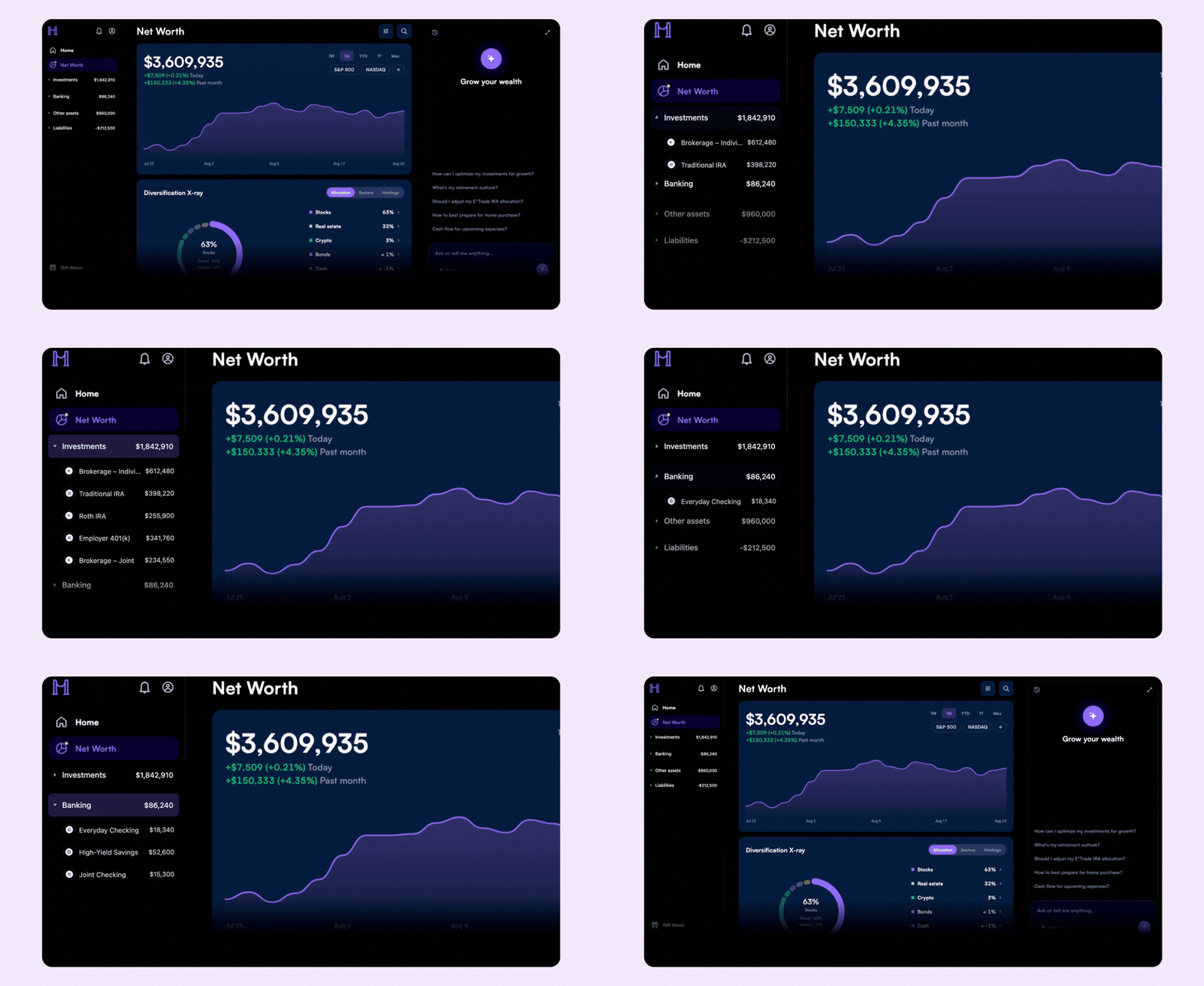
Mezzi combines Investments, Banking, Other Assets, and Liabilities, including checking, savings, credit cards, and manually entered real estate. Its AI Personalization adds goals and preferences that financial feeds cannot infer. Mezzi account-group update
Suppose the exposure review shows a substantial position in one company. The next question depends on the household. An employer-stock position, a known cash need, or a preference to evaluate new contributions before sales can change the discussion. Merely identifying the concentration does not establish the best response.
Mezzi's opportunity is to help you investigate that decision with the relevant context in view. Ask it to explain assumptions, identify missing information, and compare alternatives. Exposure X-Ray contributes the supported underlying fund view; personal context explains why it matters to you.
This broader scope is especially relevant when an investment question intersects with cash or debt. It does not mean a manually entered property value is a specialist real-estate valuation, or that a connected liability provides every term needed for a debt decision.
Guidance does not replace complete records
For tax-sensitive decisions, verify acquisition dates, cost basis, transactions, account ownership, and other relevant household facts. A linked balance does not establish that every tax lot is available. Mezzi's published account update identifies tax-lot support as connection-dependent.
A report that helps you investigate taxes and advice about a prospective decision serve different purposes. Neither should be assumed to complete a tax return or verify every relevant transaction across a household. Use the appropriate tax professional when the decision calls for one.
Mezzi also does not place trades. After reviewing an answer, implementation remains with you and your financial institutions. That is true even if a monitoring request is active through Delegations.
Compare cost on the same basis
Mezzi Free includes account aggregation, Exposure X-Ray, family collaboration, and limited insights. Advisory is $399 annually for unlimited advice and five active Delegations. Concierge is $999 annually with additional AI capacity, unlimited active Delegations, setup assistance, and quarterly coaching. Mezzi plans
Sharesight Standard's $216 annual price is $183 less than Mezzi Advisory. That is a subscription-price difference, not a statement that either service provides the same work for less. If you use both annual plans, the quoted total is $615 before applicable taxes or price changes.
You may not need two paid plans. If reporting is the unmet need, prioritize reporting. If the existing records are sufficient and you want guidance, test that role. If you cannot name a recurring task for the second subscription, defer it.
Match the Sharesight plan to the actual recordkeeping job
The US pricing page explicitly includes Diversity and Exposure reports on Starter, Standard, and Premium, but not Free. Starter is $7 per month with annual billing ($84 annually), or $9.33 billed monthly; Standard is $18 with annual billing ($216 annually), or $24 monthly; Premium is $23.25 with annual billing ($279 annually), or $31 monthly. Standard supports four portfolios and Premium ten. Current US plan comparison
For an invented investor with 22 total open-and-closed holdings in one portfolio whose main need is exposure reporting, Starter meets those stated count and report requirements. An investor needing three separate portfolios would instead look at Standard or above, even if each individual portfolio is small. That is a plan-selection example, not a suitability recommendation or a promise about asset coverage.
For the same exposure check, suppose $12,000 is held directly in Company A, with $50,000 in an ETF that has an assumed 4% Company A weight. The combined amount is $14,000. Sharesight's documented Exposure Report and Mezzi's supported Exposure X-Ray are both relevant to investigating that total; the fact that both can reveal overlap removes it as an exclusive reason to switch.
The additional decision question might be whether the exposure conflicts with an employer-stock position or a planned cash need. Keep the reporting history if it is useful, and evaluate Mezzi's contextual guidance separately. A new connected balance is not a verified replacement for a complete historical transaction record.
A useful comparison test
Start with one account whose records you understand and one genuine question. Use the same date range and holdings when comparing outputs.
- Reconcile the starting and ending values with the institution.
- Identify contributions, withdrawals, and distributions that affect the interpretation.
- Review one supported ETF's underlying exposure and the coverage limits shown.
- Add the goal or constraint that makes the exposure relevant.
- Record whether you need a better report, a better explanation, additional records, or professional help.
This test avoids treating a visual preference as proof of analytical quality. If a number differs between products, investigate the definition and inputs before declaring one correct.
For a detailed example of moving from reporting to a decision, see using performance and exposure reports together. To compare more tools, see the portfolio-analyzer guide.
Who should choose each?
Choose Sharesight when maintaining investment records and reviewing performance is the central job, particularly if its reports and supported assets match your needs. Choose Mezzi when the central job is understanding a financial decision in the context of connected accounts and personal goals.
Use both if the reporting record and the guidance serve clearly different roles. Keep source records available whichever product you choose, and do not discard a working reporting history before testing a replacement.
Frequently asked questions
Does Sharesight detect ETF overlap?
Yes. Its Exposure Report identifies direct and underlying holdings and overlapping exposures in supported ETFs. It also supports consolidated portfolios. Check the documented fund coverage and your plan's report limits.
Is Sharesight only for investors outside the US?
No. Sharesight has a US offering and US pricing. Evaluate the specific securities, institutions, and reports you need rather than rejecting it based on where the company originated.
Can Mezzi replace my investment records?
Do not assume every connected history or report will match your current recordkeeping system. Test the detail available, retain source records, and identify any gaps before replacing a tool.
What is the best first step in Mezzi?
Connect the relevant accounts, verify their information, and ask one question that depends on a real goal or constraint. Review the available plans before deciding whether ongoing advice fits your needs.
See how Mezzi groups accounts
Move from a portfolio number to a clear question. Bring your accounts and goals together, then investigate what the result means for you.
Explore Mezzi FreeMezzi publishes this comparison and offers a competing service. Product descriptions use official documentation reviewed September 26, 2026; this is not a matched performance test. Mezzi is an SEC-registered investment adviser; registration does not imply a particular level of skill or training. Investing involves risk, including loss of principal. Examples are illustrative and are not personalized investment or tax advice. Connected information can be incomplete or delayed.