
Updated September 26, 2026.
Quicken Simplifi is worth considering when you want a structured view of spending, bills, investments, and projected cash flow. Mezzi is worth considering when you want personalized financial guidance using connected accounts and the context of your goals. Both extend beyond a single account balance.
Simplifi should not be described as a budgeting-only product. It has investment tracking and a Retirement Planner. Mezzi should not be described as an investments-only product: its account groups include banking, other assets, and liabilities. A useful comparison looks at how you work with the information.
The important differences
| Your priority | Quicken Simplifi | Mezzi |
|---|---|---|
| Maintain a spending routine | Spending Plan, bills, categories, and savings goals | Banking and goals can inform guidance; test your required budgeting workflow |
| Review investments | Holdings, balances, performance, and transactions | Connected investment analysis and Exposure X-Ray for supported funds |
| Explore retirement | Documented Retirement Planner on the web app | Ask retirement questions with connected accounts and personal context |
| Explain personal constraints | Inputs and assumptions in the relevant tools | Saved AI Personalization and conversational follow-up |
| Understand subscription cost | Annual billing with promotional offers | Free; Advisory $399/year; Concierge $999/year |
| Implement a decision | Take the required action through the relevant institution | You implement; Mezzi does not move funds or trade |
Feature references: Simplifi investment documentation, Simplifi Retirement Planner, and Mezzi plans.
Simplifi: organize the household's financial routine
Simplifi's Spending Plan and projected cash-flow tools can help make the timing of income and expenses visible. Savings goals give planned uses of cash a place in that routine. That can suit a household that wants to know what remains after commitments without maintaining a complex spreadsheet. Simplifi product overview
Imagine a household paid twice a month, with a mortgage near the start of the month and an annual insurance bill approaching. Its question is partly about timing. A comfortable month-end position does not rule out an earlier cash squeeze. Seeing commitments together helps the household investigate that gap.
This is useful work at any income level. Describing it as something investors should graduate from understates how much financial planning depends on reliable spending information.
Investment tools deserve a fair comparison
Simplifi documents a portfolio view with holdings, balances, performance, and transactions. Users can view a specific account or aggregate investment accounts. The application also supports manually maintained holdings. Tracking investments in Simplifi
Before paying for another application, try the investment questions you already have in the tool you use. If your need is a consolidated holdings list and a periodic performance check, Simplifi may provide enough.
A different question may require deeper investigation: how do the underlying companies in several funds interact with an employer-stock position, or how should an upcoming expense change the way you frame an investment decision? Evaluate the actual workflow required for those questions rather than assuming an “investment tracking” label settles the comparison.
Simplifi also has retirement planning
Its Retirement Planner accepts investment and planning inputs to produce projections. The official help describes it as a web-app feature and cautions that the estimates should not be the sole basis for retirement decisions. Simplifi Retirement Planner
The right test is not whether a product uses the word retirement. Review which assumptions you can inspect, which income and expense details you can represent, and how you would validate the result. A projection is only as useful as its inputs and the limits you understand.
If a dedicated planning model is your main requirement, compare specialist tools as well. Our Mezzi and Boldin comparison explains another planning approach.
Mezzi: connect the financial question to your life
Mezzi's Investments, Banking, Other Assets, and Liabilities groups let you bring more than the portfolio into a discussion. Checking, savings, credit cards, and manual real-estate entries can help describe the household picture. Mezzi account groups
AI Personalization stores information the balances cannot communicate: a coming move, a reserve you want to preserve, a goal's deadline, or your preference to understand alternatives before considering a change. That context can be relevant to investment, retirement, and cash-flow questions.
For an illustrative household with $60,000 in savings, the useful first question may be how much is already committed. If $25,000 is earmarked for a known expense, discussing all $60,000 as available investment money would start from the wrong premise. The application needs the purpose as well as the number.
Exposure X-Ray helps review underlying exposures in supported funds. The next discussion can ask how a concentration fits the household's stated priorities, what data is missing, and which options deserve further research. It does not establish that every overlapping holding should be sold.
Know what the product is not doing for you
Mezzi provides guidance and analysis; you carry out decisions through the relevant institutions. It does not trade, transfer funds, or file a tax return for you. Delegations are not trading instructions.
A connected balance is also not proof of complete records. Tax-lot availability varies by connection, and manual assets require maintenance. If an answer depends on missing history, the next step is to obtain the records, not to treat a confident explanation as verification.
This distinction helps you compare fairly with both financial software and professional services. A lower subscription price does not mean it includes the labor or responsibility of a managed advisory relationship.
One household decision, three different outputs
Consider an invented household with $60,000 in savings. It has assigned $25,000 to a known expense and $20,000 to a separate reserve, leaving $15,000 before other obligations. It is considering investing $18,000. Under those assumptions, the proposal has a $3,000 funding gap.
Simplifi's Spending Plan and savings-goal records are relevant to the cash commitments. Its investment views help review existing holdings, and its web Retirement Planner provides a separate projection workflow. These are documented functions, not evidence that an AI conversation is required to perform the arithmetic.
Mezzi's task is to use the same commitments and goals in a personalized discussion: identify the gap, compare changes in timing or amount, and investigate how a proposed investment would affect existing exposure. The answer should not assume the entire $60,000 is available or promise that future market gains will cover a near-term obligation.
Keep Simplifi alone if those records and planning tools already support the decision you need. Add Mezzi if ongoing contextual discussion supplies a recurring missing role. Replacing Simplifi makes sense only after you have a satisfactory home for the specific spending and forecasting routine you use. A completed decision is more informative than a general preference for one dashboard.
Pricing without confusing the offer and renewal
At review on September 26, 2026, Simplifi displayed $3.99 per month billed annually alongside a $6.99 reference rate. The page states offers are for the first year, and renewal is at the then-current rate. Multiplying the displayed monthly offer by twelve gives $47.88, but Quicken says the checkout total can differ from that multiplication. Check the actual charge and renewal terms before subscribing. Simplifi pricing and terms
Mezzi's published annual plans are Free, Advisory at $399, and Concierge at $999. Advisory includes unlimited advice and five active Delegations; Concierge adds advanced AI, unlimited active Delegations, setup assistance, and quarterly coaching. Mezzi pricing
These prices purchase different experiences. Comparing a first-year promotional subscription with a standard annual advice plan without explaining the scope would obscure the decision. Paying less is useful only if the service solves the job you need done.
Try three tasks before choosing
Task one: understand next month's cash. Enter or verify the relevant bills, income, reserves, and balances. Decide whether you need an operational spending tool, an explanation of a tradeoff, or both. Record what each application actually helps you complete.
Task two: inspect one investment question. Use the same accounts and dates. Ask whether you can distinguish balances, holdings, and underlying exposures. Note unsupported assets or incomplete records instead of treating an empty field as zero.
Task three: revisit one goal. Change a real assumption such as timing or expected spending. Look for an understandable explanation of what changes and what remains uncertain. A neat chart or fluent answer is not sufficient if you cannot check the premise.
You can use Simplifi for the recurring household routine and Mezzi for additional guidance. The combination is most useful when you know which record is authoritative and which inputs you will maintain. See a cash-flow-to-investment review workflow for an example.
Who should choose each?
Choose Simplifi if its spending, cash-flow, investment, and planning tools cover the tasks you want in one application. Choose Mezzi if your unmet need is a conversation that uses connected information and personal context to investigate decisions. Use both when their roles are distinct enough to justify the additional subscription and upkeep.
If you want someone else to implement the plan, ask an advisor about the precise services and responsibilities included. Neither an attractive dashboard nor an AI answer is a substitute for clarifying who does the work.
Frequently asked questions
Does Simplifi track investments?
Yes. Its official documentation covers investment holdings, balances, performance, and transactions, including manual investment accounts. Calling it only a budgeting app would be incomplete.
Does Simplifi include retirement planning?
Yes. Its documented Retirement Planner is available on the web app. Evaluate its assumptions and limitations against the retirement decisions you need to make.
Can Mezzi consider bank accounts and credit cards?
Yes. Banking and liabilities are part of Mezzi's broader account picture, alongside investments and other assets. The usefulness of any analysis depends on the information actually available and the context you provide.
Should I cancel Simplifi before trying Mezzi?
First test the exact workflows you rely on. Keep any records you need and confirm that your spending routine will remain covered. Explore Mezzi's plans to assess whether the guidance adds a useful role.
See how Mezzi groups accounts
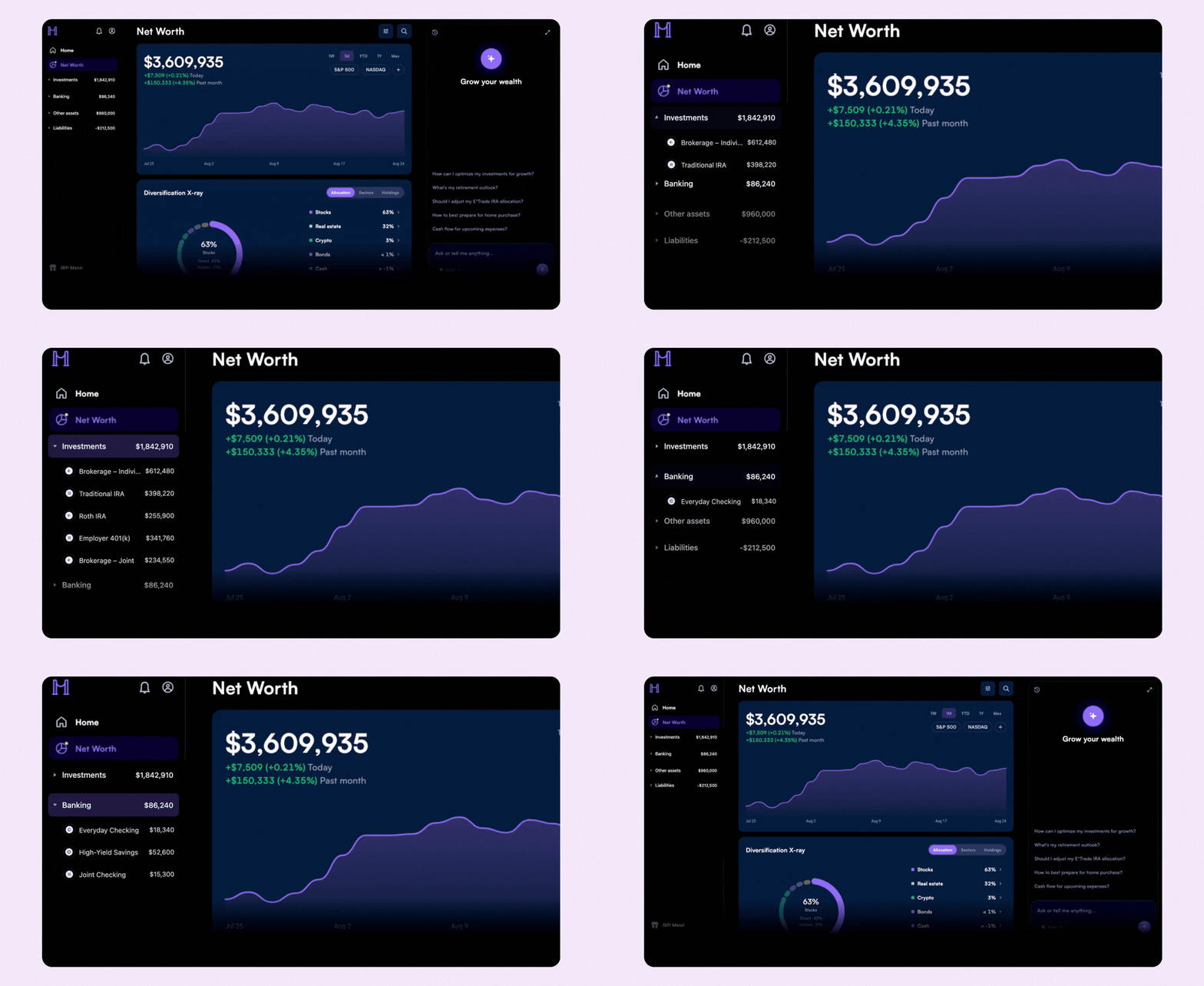
Put your goals beside your account balances. Try a question that depends on both your connected finances and your personal context.
Explore Mezzi FreeMezzi publishes this comparison and offers a competing service. Product descriptions use official documentation reviewed September 26, 2026; this is not a matched performance test. Mezzi is an SEC-registered investment adviser; registration does not imply a particular level of skill or training. Investing involves risk, including loss of principal. Examples are illustrative and are not personalized investment or tax advice. Connected information can be incomplete or delayed.