
You’ve got extra cash each month - should you pay down your mortgage or invest it? Here’s the quick answer:
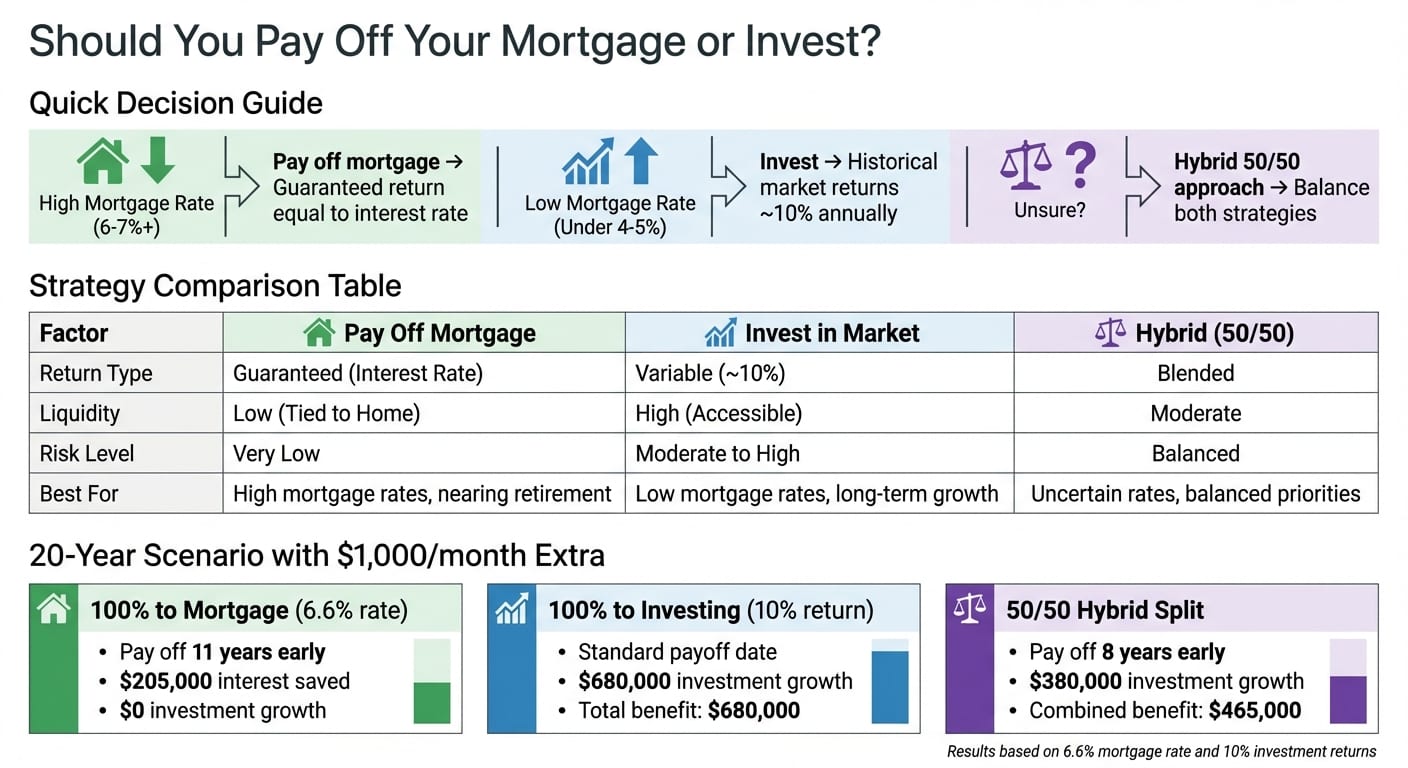
- If your mortgage rate is high (6–7% or more): Paying it off can save you significant interest and offers a guaranteed return equal to your interest rate.
- If your mortgage rate is low (under 4–5%): Investing in the stock market, which has historically returned about 10% annually, might yield better long-term growth.
- If you’re unsure: A hybrid approach - splitting funds between extra mortgage payments and investments - balances both strategies.
Key considerations include:
- Liquidity: Money put into your home is harder to access, while investments remain flexible.
- Risk tolerance: Paying off your mortgage is risk-free, while investing involves market volatility.
- Tax savings: Mortgage interest deductions are less common now, but tax-advantaged accounts like 401(k)s can boost investment returns.
Quick Comparison
Your choice depends on factors like your mortgage rate, financial goals, and comfort with risk. Read on for a deeper dive into each option.
Pay Off Your House or Invest? Here’s What the Math Actually Says
You can also use AI mortgage tools to analyze your specific numbers and determine the best path forward.
Paying Off Your Mortgage Early: Pros and Cons
Putting extra cash toward your mortgage offers a guaranteed return equivalent to your interest rate - typically around 6-7% for most homeowners. Unlike the ups and downs of the stock market, this return is predictable and risk-free. On top of that, reducing your mortgage balance lowers your fixed monthly expenses, which is especially helpful in retirement when you're relying on Social Security or a pension. If you're still paying private mortgage insurance (PMI), paying down your principal faster can help you reach 20% equity sooner, eliminating those extra costs [5,10].
"Permanently (or at least semipermanently) reducing your fixed expenses by paying off your home can be more impactful to your plan than making additional investment contributions later in life." - Morningstar
However, there’s a downside: liquidity. Once you put extra money into your mortgage, it’s tied up in your home’s equity. Accessing it later means selling the property, refinancing (which comes with closing costs), or taking out a home equity line of credit, which could carry interest rates of 9% or higher. In contrast, investments in the stock market or other assets are much easier to access when needed.
Another key consideration is the opportunity cost. Let’s say you make a $100,000 payment on a mortgage with a 6.6% interest rate - that saves you about $66,000 in interest over time. But if you invested that same amount at a 10% return, it could grow significantly over 30 years. By focusing on paying off your mortgage, you’re concentrating your wealth in a single, illiquid asset instead of spreading it across a diversified portfolio.
If you decide to prioritize growth, you'll need a strategy to start investing effectively. Next, we’ll take a closer look at the benefits and risks of choosing to invest instead of paying off your mortgage early.
Investing the Difference: Pros and Cons
Benefits of Investing
Paying off your mortgage can bring peace of mind, but investing offers a chance to achieve greater financial growth. One of the main draws of investing is the potential for higher returns. Historically, the S&P 500 has delivered an average annual return of about 10%. Compare that to mortgage rates in the 6–7% range, and you can see why investing might come out ahead. For instance, over a decade, investing $100,000 at a 7% return could grow by $96,715, while paying off a 3.5% mortgage early might save you just $20,270 in interest.
Another advantage of investing is liquidity. If life throws you a curveball - like unexpected medical bills, job loss, or a major home repair - you can sell investments and access cash within two business days. In contrast, tapping into home equity often involves refinancing, opening a home equity line of credit, or selling your home, all of which take time and come with costs.
Tax-advantaged accounts like 401(k)s and IRAs add another layer of benefit. Contributions to these accounts can lower taxable income, while offering tax-deferred or tax-free growth. And if your employer offers a 401(k) match, that’s an immediate return of 50% to 100% on your contributions.
"Some people's instinct is to get all debt off their plate, but you want to make sure you always have ready funds on hand to ride out a financial storm." - Mark Struthers, CFA and CFP at Sona Financial
Risks of Investing
However, investing isn’t without its downsides. The most obvious is market volatility. Unlike the guaranteed savings from paying off your mortgage, investment returns can fluctuate wildly. For example, during the 2008 financial crisis, the S&P 500 dropped 37%. If you had invested extra cash just before that downturn, you could have faced steep losses while still needing to cover your monthly mortgage payments.
There’s also the risk of emotional decision-making. When markets dip, some investors panic and sell, locking in losses instead of waiting for a recovery. Rising personal expenses - like tuition, medical bills, or home repairs - can also tempt people to pull money out, disrupting their long-term strategy. Meanwhile, mortgage payments act as a form of forced savings, ensuring you steadily build equity.
Finally, achieving those attractive returns isn’t as straightforward as it may seem. After factoring in fees, advisory costs, and inflation, your actual gains might not match historical averages. And if your mortgage rate is in the tricky 4–7% range, the decision becomes less clear. For example, if market returns average just 5.5% in the future, there’s a 26% chance that investing could leave you worse off than simply paying down your mortgage.
Next, we’ll compare mortgage rates and expected investment returns to help guide your decision.
Comparing Mortgage Rates and Investment Returns
Mortgage Rates vs. Expected Investment Returns
Deciding whether to pay off your mortgage or invest often boils down to one key comparison: your mortgage rate versus your expected investment returns. As of early 2026, the average long-term mortgage rate in the U.S. hovered around 6%. By contrast, the S&P 500 has historically delivered annual returns of about 9% to 10%. At first glance, this suggests investing might offer better returns.
Paying off a mortgage, however, provides a guaranteed return equal to your interest rate. For example, if your mortgage rate is 6.6%, every extra dollar you pay effectively "earns" you a 6.6% return without exposing you to market volatility. Investing, on the other hand, has the potential for higher returns but comes with risks, including market fluctuations and potential losses.
"If your mortgage rate is under 4% to 4.5%, it doesn't make any sense to pay it off... Anything 7% or higher and you should seriously consider making an extra payment." – Ben Carlson, CFA
For those who itemize deductions, the effective cost of a mortgage may be lower due to tax savings. This is calculated using the formula: Nominal Rate × (1 - Marginal Tax Rate). For instance, a 6.6% mortgage in a 24% tax bracket has an effective rate of about 5.02%. However, since 2018, more than 90% of taxpayers have opted for the standard deduction, making this tax break irrelevant for most homeowners.
Inflation also plays a role. With inflation at 3%, paying off low-interest debt (under 4%) can be less advantageous. Your mortgage payment stays constant, but the value of the dollar decreases over time, making your debt effectively "cheaper". Similarly, if an investment earns 7% while inflation is 3%, your actual return is closer to 4%.
Ultimately, while the numbers matter, your personal financial circumstances are just as important.
Your Financial Goals and Time Horizon
Numbers aside, your personal goals and timeline heavily influence this decision. For those nearing retirement - say, within 10 years - paying off a mortgage can lower monthly expenses and provide a sense of security, even if investing might technically yield slightly better returns. Younger individuals, however, have more time to weather market volatility and could benefit from long-term investment growth.
Liquidity is another critical factor. Money used to pay down a mortgage becomes tied up in home equity, making it hard to access without selling your home or taking out a high-interest home equity loan. Before making extra mortgage payments, it's wise to keep 6 to 12 months of living expenses in liquid savings.
"If it's cheap debt (a low interest rate) and you have a good history of staying within a budget, then maintaining the mortgage and investing might be an option." – Mark Struthers, CFA, CFP
These considerations highlight how your unique situation shapes the best approach for you.
Tax Considerations
Taxes can further complicate the decision. The mortgage interest deduction is only available to those who itemize and applies to interest on up to $750,000 of mortgage debt. Since most taxpayers now take the standard deduction, this benefit rarely applies.
On the other hand, investments in tax-advantaged accounts like 401(k)s and IRAs can grow more efficiently thanks to tax-deferred compounding and upfront tax savings. If your employer offers a 401(k) match, this can deliver an immediate 50% to 100% return, making investing a better choice than extra mortgage payments in most cases.
For taxable accounts, gains are subject to taxes - typically around 15% - which can reduce your net return. For instance, if you're comparing a 6% mortgage rate to a 7% investment return, taxes might lower your investment return to roughly 5.95%, narrowing the gap significantly.
3 Scenarios to Guide Your Decision
When deciding between paying off your mortgage or investing, it helps to look at how your mortgage rate, potential investment returns, and financial flexibility come into play. These three scenarios break it down to help you weigh your options.
Scenario 1: High Mortgage Rate, Low Investment Returns
If your mortgage rate is around 7% or higher, paying down your mortgage faster might be the smarter move, especially if market returns are uncertain. Why? It guarantees a return equal to your mortgage rate. For example, on a $300,000 mortgage at 7%, adding an extra $1,000 to your monthly payment could cut your loan term by 11 years and save you over $200,000 in interest. This approach works well for those who prefer reducing financial risk and avoiding market volatility.
Scenario 2: Low Mortgage Rate, High Investment Returns
On the flip side, if your mortgage rate is below 5% - or even under 3% - investing often makes more sense. As of mid-2023, over 75% of mortgages had rates below 5%, with 21% under 3%. In this case, keeping your low-interest debt and investing extra cash can yield better long-term results. For instance, $100,000 invested at a 7% annual return could grow to about $96,715 in 10 years, far surpassing the $20,270 you’d save by using that money to pay down a 3.5% mortgage. Over 30 years, the same $100,000 invested at 10% annually could grow to roughly $1.74 million. This strategy is particularly appealing for younger investors who have time to weather market ups and downs.
Scenario 3: Split Strategy
If your situation falls somewhere in the middle - like a 5% to 6% mortgage rate and similar expected investment returns - a balanced approach might be best. A 50/50 split between paying down your mortgage and investing can give you the advantages of both strategies. For example, if you have an extra $1,000 per month, you could put $500 toward your mortgage and $500 into investments. Over 20 years, assuming a 6.6% mortgage rate and 10% investment returns, this approach could shorten your mortgage by 8 years while growing your investments to about $380,000. The combined financial benefit would be approximately $465,000. Plus, this approach keeps some liquidity, as funds in an investment account are accessible, unlike money tied up in home equity.
From here, you can explore how Mezzi's AI tools can help tailor these strategies to fit your specific financial goals and circumstances.
How Mezzi's AI Tools Help You Decide
Balancing guaranteed savings with potential market growth is no easy task. Choosing whether to pay off your mortgage or invest involves weighing factors like your mortgage rate, tax situation, timeline, and risk tolerance. Mezzi's AI-driven tools simplify this process by modeling personalized scenarios and uncovering overlooked details that could significantly impact your decision. Here's how Mezzi's tools sharpen your financial strategy.
Model Your Options with Mezzi's Financial Calculator
Mezzi's Financial Calculator helps you compare two key scenarios: using extra payments to reduce your mortgage principal or investing that money for potential growth. The tool calculates interest savings and loan term reductions for the first option, while projecting compound growth for the second. It uses inputs like your remaining balance, interest rate, extra payment amount, and expected investment returns to provide a clear picture of each strategy.
For instance, imagine you have a $300,000 mortgage at 6.01% (the approximate rate as of February 19, 2026) and consider adding $1,000 per month in extra payments. The calculator shows how many years you could shave off your loan and how much interest you'd avoid. At the same time, it estimates how much that $1,000 monthly could grow if invested at a conservative 7% annual return. It also factors in the "spread" - the difference between the guaranteed return of paying off debt (your mortgage rate) and the uncertain but potentially higher market return. This analysis helps you decide whether to focus on one strategy or consider a mix of both.
Reduce Taxes with Mezzi's Tax Optimization
Returns on paper don’t tell the full story - taxes can significantly shift the outcome. Mezzi’s tax optimization features calculate your after-tax mortgage rate by adjusting for your tax bracket (Mortgage Rate × (1 - Tax Rate)). For example, if you’re in a 30% tax bracket with a 7% mortgage, your effective after-tax rate is 4.9% - but only if you itemize deductions. However, since more than 90% of taxpayers now use the standard deduction, most homeowners don’t benefit from mortgage interest deductions anymore.
Mezzi also helps you avoid wash sales, which can disqualify tax losses and lower your net investment returns. Its tax-loss harvesting feature offsets capital gains, improving your overall returns. Additionally, Mezzi considers whether you qualify for the mortgage interest deduction (limited to interest on up to $750,000 of debt for homes purchased after December 16, 2017). By factoring in these details, Mezzi ensures you’re comparing the true costs and benefits of each option - not just the surface-level numbers.
Identify Hidden Risks with Mezzi's X-Ray Tool
Even when the numbers look good, hidden risks can throw off your plans. Mezzi’s X-Ray Tool highlights these potential pitfalls before they become problems. For instance, it reveals liquidity risks, reminding you that money tied up in your home isn’t easily accessible unless you sell or borrow against it. As Ben Carlson, CFA, explains:
"Once that money is in the house it's not coming out unless you sell it or borrow against it. If you invest in the stock market, you can always get your money back by selling".
The tool also flags sequence-of-return risks, which occur when early market downturns impact long-term investment performance. It contrasts this with the steady, predictable progress of reducing debt. Additionally, it evaluates inflation’s effect on debt repayment, noting that paying off a fixed-rate mortgage early eliminates the advantage of repaying with “cheaper” future dollars. Finally, the X-Ray Tool uncovers hidden costs like expense ratios, advisory fees, and trading costs that can erode investment returns. These insights ensure you’re equipped to navigate the complexities of the mortgage-versus-investment decision with confidence.
Making the Right Choice for Your Situation
There’s no universal answer when it comes to managing your finances. The best strategy depends on factors like your mortgage rate, tax situation, time horizon, and how much risk you’re comfortable taking. For example, a younger homeowner with a low mortgage rate (around 3.5%) and plenty of time before retirement might see more benefit from investing. Meanwhile, someone closer to retirement with a higher rate (around 7%) might prioritize eliminating fixed costs and securing a predictable return. The key is finding a plan that aligns with your financial goals and comfort level.
It’s not just about crunching numbers - it’s about how you feel. As Dave Ramsey famously said, “Personal finance is 80% behavior, 20% math”. If carrying debt stresses you out, the peace of mind that comes with paying off your mortgage could outweigh potential investment gains. On the flip side, if you’re comfortable with calculated risks and have discipline, investing could significantly grow your wealth, especially when the gap between your mortgage rate and expected investment returns is large.
No matter what you decide, building a strong financial foundation is essential. Start by tackling high-interest debt, like credit cards with rates over 20%. Then, make sure to max out your employer’s 401(k) match - this gives you an instant return of 50% to 100%. Don’t forget to establish an emergency fund that covers 6 to 12 months of expenses [6,9]. And if you’re paying PMI, focus on reaching 20% equity to eliminate that extra cost [5,9].
Whether you choose to aggressively pay off your mortgage or focus on investing, the scenarios we covered earlier can guide your decision. If you’re still unsure, a balanced approach - splitting extra funds between paying down your mortgage and investing - can help you reduce debt while growing wealth.
For more clarity, Mezzi’s AI-driven tools can offer personalized insights tailored to your situation. These tools factor in variables like tax implications and hidden risks, helping you make an informed decision. Whether you decide to pay off your mortgage, invest, or do a bit of both, these insights can give you the confidence to move forward.
FAQs
How do I calculate my after-tax mortgage rate?
To figure out your after-tax mortgage rate in the U.S., you need to consider the tax savings from mortgage interest deductions. Here's how you can do it:
- Find your mortgage interest rate: This is the rate your lender charges on your loan.
- Know your total tax rate: Combine your federal and state tax rates (if applicable).
- Apply the formula:
After-tax rate = interest rate × (1 - total tax rate)
This calculation gives you a clearer picture of the actual cost of your mortgage after factoring in the potential tax benefits.
Should I invest even if my mortgage rate is around 5%?
When dealing with a 5% mortgage rate, deciding whether to invest or pay it off boils down to your personal risk tolerance and financial objectives. Historically, investments like the stock market have delivered an average return of around 10%, which could outpace your mortgage rate and potentially grow your wealth faster.
On the other hand, paying off your mortgage offers guaranteed savings on interest, reduces debt, and can provide a sense of financial security. It’s also worth weighing tax considerations and how these decisions align with your priorities. Ultimately, the right choice depends on what brings you closer to your financial goals and peace of mind.
How much emergency savings should I keep before paying extra on my mortgage?
Having at least three months' worth of living expenses set aside in an emergency fund is a smart move before putting extra money toward your mortgage. This cushion helps you stay financially secure and ready to handle unexpected situations without jeopardizing your stability.
Disclosures:
- This content is for informational purposes only and does not constitute investment advice or a recommendation to buy or sell any security.
- Past performance is not indicative of future results. No guarantee of future performance or outcomes is implied.
- Savings and performance examples are hypothetical and for illustrative purposes only. Actual results will vary based on individual circumstances, portfolio composition, market conditions, and fees.
Related Blog Posts
- Should I pay off my mortgage? AI tools to help you know.
- Should I pay off my student loans? AI tools to help you know.
- Should I withdraw from my 401(k) to fund home improvements, or consider alternatives?
- How can I plan a home purchase while maintaining retirement savings goals?
To figure out your after-tax mortgage rate in the U.S., you need to consider the tax savings from mortgage interest deductions. Here's how you can do it:
- Find your mortgage interest rate: This is the rate your lender charges on your loan.
- Know your total tax rate: Combine your federal and state tax rates (if applicable).
- Apply the formula:
After-tax rate = interest rate × (1 - total tax rate)
This calculation gives you a clearer picture of the actual cost of your mortgage after factoring in the potential tax benefits.
When dealing with a 5% mortgage rate, deciding whether to invest or pay it off boils down to your personal risk tolerance and financial objectives. Historically, investments like the stock market have delivered an average return of around 10%, which could outpace your mortgage rate and potentially grow your wealth faster.
On the other hand, paying off your mortgage offers guaranteed savings on interest, reduces debt, and can provide a sense of financial security. It’s also worth weighing tax considerations and how these decisions align with your priorities. Ultimately, the right choice depends on what brings you closer to your financial goals and peace of mind.
Having at least three months' worth of living expenses set aside in an emergency fund is a smart move before putting extra money toward your mortgage. This cushion helps you stay financially secure and ready to handle unexpected situations without jeopardizing your stability.