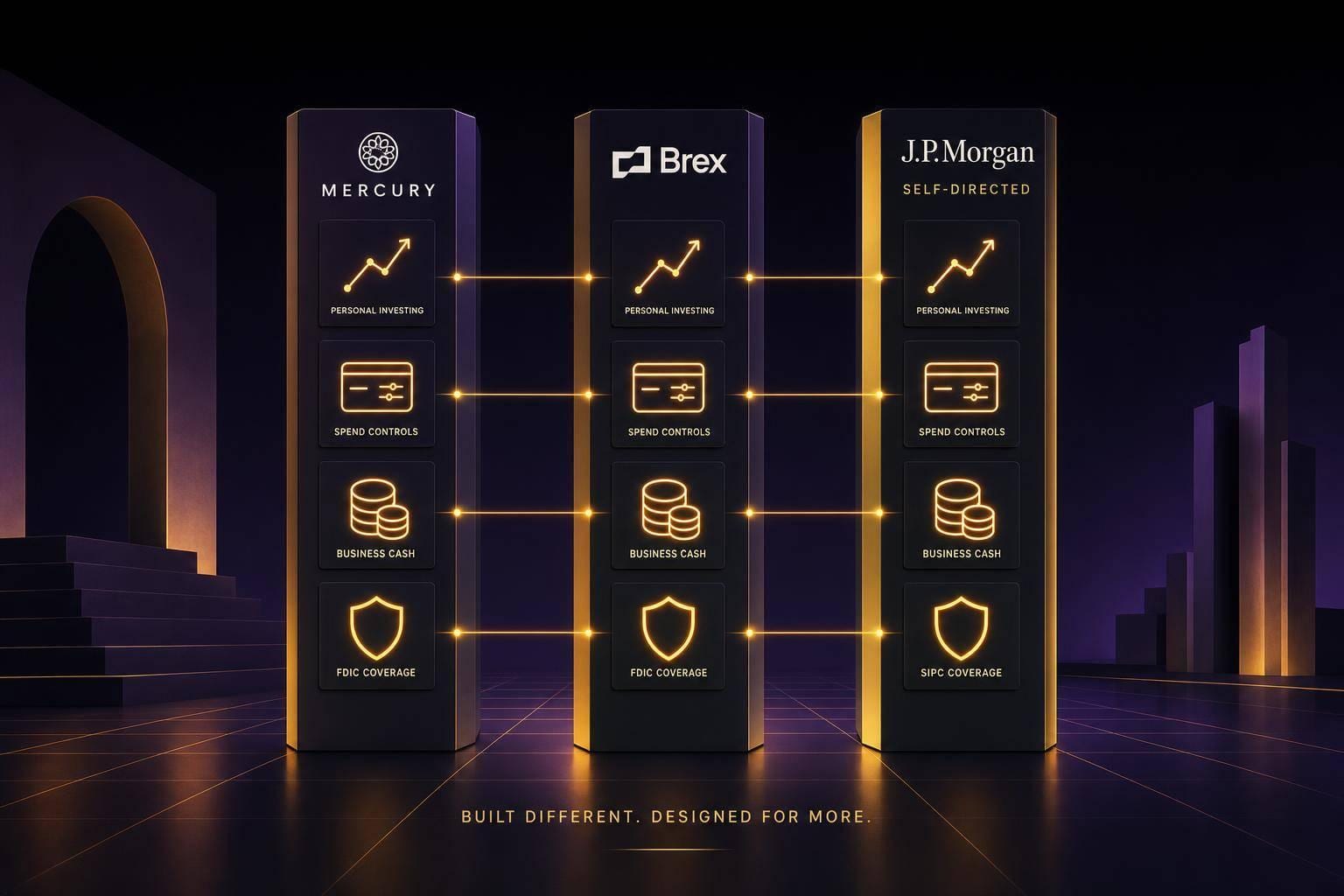
If I had to sum it up in one line: Mercury and Brex may fit business cash, while J.P. Morgan Self-Directed may fit personal investing.
Here’s the short version:
- Mercury may work for founders who want business checking plus yield on idle cash.
- Brex may work for companies that want cash, treasury, and team spend controls in one setup.
- J.P. Morgan Self-Directed may work for DIY investors who want stocks, ETFs, bonds, options, and IRAs inside Chase.
- Mezzi sits on top as a read-only layer that may show cash, portfolio, tax, and risk data across those accounts without moving money or placing trades.
A few numbers stand out:
- Mercury Treasury yield has recently been around 3.0% to 3.61%
- Brex Treasury has recently been around 3.65% to 3.67%
- J.P. Morgan Self-Directed brokerage cash has at times been around 0.01% APY
- J.P. Morgan IRA sweep cash has at times been around 4.3%
- FDIC sweep coverage may reach $5,000,000 at Mercury and $6 million at Brex
The split is simple. Mercury and Brex are mainly cash tools. J.P. Morgan Self-Directed is mainly an investing tool. That means some people may use more than one account if they want business cash management and a personal portfolio at the same time.
Mercury vs Brex: Which Corporate Card & Platform Is Right for You?
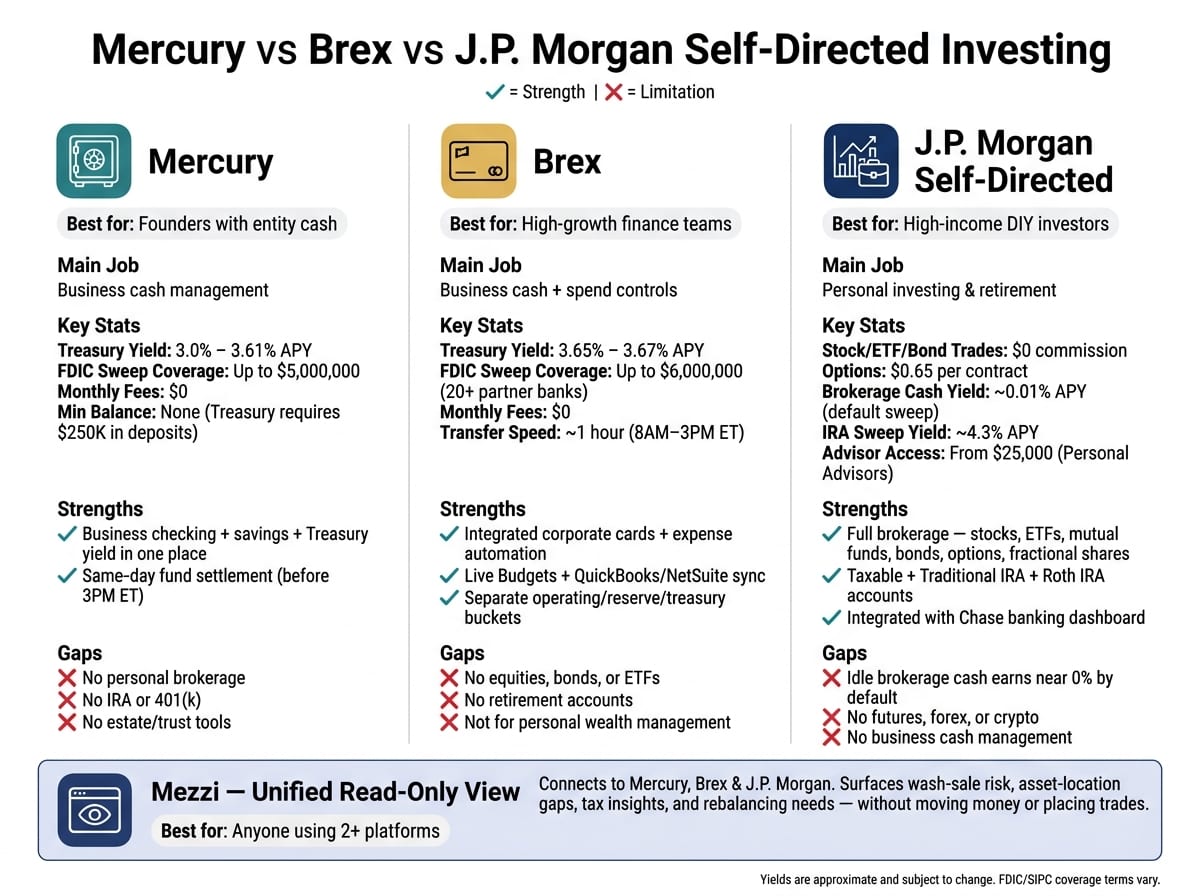
Quick Comparison
So if I were framing the article in plain English, I’d put it this way: pick Mercury or Brex for business cash, pick J.P. Morgan Self-Directed for portfolios, and use a separate read-only layer only if you want one view across accounts.
1. Mercury
For founders managing business cash, Mercury may keep day-to-day banking and idle-cash yield in one place. Mercury is a fintech business banking platform, not a bank. It works through partner banks and centers on three accounts: checking, savings, and Mercury Treasury.
Checking is set up for payroll, vendor payments, card spend, and approvals. Savings is aimed at short-term liquidity and does not pay interest.
The yield piece comes from Mercury Treasury. It places idle cash into low-risk money market funds and short-term U.S. government securities through partners such as J.P. Morgan and Morgan Stanley. Access generally begins at $250,000 in total Mercury deposits, and recent net yields have ranged from about 3.0% to 3.6%, with higher balances reaching about 3.61% annualized.
That setup also comes with different kinds of coverage. Checking and savings balances may receive up to $5,000,000 in FDIC coverage through Mercury’s multi-bank sweep structure. Mercury Treasury is covered by SIPC, which applies to broker-dealer failure, not market losses. Some funds may settle the same day for orders placed before about 3:00 p.m. ET.
Standard accounts have no monthly fees, minimums, or standard transaction fees. Mercury Treasury’s advisory fee is built into the published net yield. For some businesses, that may mean a higher annual yield than a near-zero-rate business account.
Mercury does not support IRAs, 401(k)s, or personal brokerage, and it is not built for estate planning or trust administration. Many affluent founders use it at the entity level, then move distributions into personal accounts for spending and investing. So in practice, Mercury may fit best as a cash layer, not a full personal wealth platform.
2. Brex
Where Mercury keeps treasury pretty simple for founders, Brex adds spend management to banking and cash yield in one setup. It’s built for founders and finance teams that may want banking, spend controls, and cash yield in the same system. That may make it a good fit for companies that want cash management and spending rules inside one workflow.
Brex combines operating cash, FDIC sweep coverage, and treasury yield in one business account. The checking account (held through Column N.A.) is meant for day-to-day operating cash and has no monthly maintenance fees or standard transfer fees. The Vault program sweeps funds across 20+ partner banks, which may extend FDIC coverage on corporate balances up to $6 million. The Treasury account places excess cash in the BNY Dreyfus Government Cash Management Fund (DGVXX), a government money market fund that targets a $1 NAV.
Brex’s treasury return combines DGVXX’s 7-day yield with an added return paid by Brex LLC, with total returns cited at up to 3.65%–3.67% in recent periods. Transfers between checking and treasury may settle in about one hour during business hours (8 a.m. to 3 p.m. ET). In practice, a company may keep operating cash in Vault and shift excess balances into Treasury as liquidity needs change. Brex also states that Treasury holds securities, not deposits, so it falls under SIPC rather than FDIC and may remain exposed to interest-rate risk.
Brex’s main point of difference is spend control. Its corporate card, expense automation, receipt matching, and Live Budgets feature tie directly into the business account. Finance teams may set per-employee or per-department limits, apply transaction-level policy controls, and sync data with QuickBooks or NetSuite, which may make month-end close easier. That said, the platform stays focused on business cash and spend controls, not personal portfolio management.
Brex does not offer access to equities, bonds, ETFs, or retirement accounts. For wealthy clients, it may work best as a corporate operating and short-term treasury hub for cash that may be needed soon, while a separate brokerage may handle personal and long-term investment strategy.
3. J.P. Morgan Self-Directed Investing
Mercury and Brex may work well for business cash. J.P. Morgan Self-Directed Investing may fill a different role: personal investing.
Because it sits inside the Chase ecosystem, taxable brokerage accounts, Traditional IRAs, and Roth IRAs may link straight to Chase checking or savings, with instant internal transfers. That setup may appeal to people who want banking and investing in one place. The upside is a full brokerage account. The downside is simpler: idle cash may earn very little by default.
Online trades for U.S.-listed stocks, ETFs, mutual funds, and U.S. bonds are generally $0, and self-directed accounts have no account minimums. Options trades come with a $0.65 per-contract fee. The platform does not support futures, forex, or crypto.
The biggest drawback may be the yield on uninvested cash. In regular self-directed accounts, uninvested cash typically sits in a default sweep that has earned about 0.01% APY at times, which may be close to negligible on larger balances. IRA accounts have reportedly earned around 4.3% on swept cash at times. Because of that gap, some investors may keep only working cash in the sweep and place the rest in short-term bond ETFs or money market funds inside the brokerage.
It also pulls Chase banking, cards, and portfolios into one dashboard. Advisor-led support starts at $25,000 through Personal Advisors. For wealthier clients, J.P. Morgan Self-Directed may fit best as the long-term investing and retirement layer, while Mercury or Brex may handle business operating cash and short-term Treasury yield. Those trade-offs may stand out more clearly in the pros-and-cons comparison below.
Pros and Cons of Each Platform for Wealthy Clients
The table below boils each platform down to its main use case, biggest plus, and biggest gap.
Put simply, each platform may do one job well. But none of the three may cover cash, spending, and investing in one place. That's why some wealthy users may pair a cash platform with a read-only portfolio layer like Mezzi.
Conclusion
Mercury, Brex, and J.P. Morgan Self-Directed each handle a different job. Mercury may be the best fit for founders who want business cash management and FDIC sweep coverage. Brex may suit high-growth companies looking for spend controls, corporate cards, and yield on operating cash. J.P. Morgan Self-Directed may fit high-income DIY investors who want brokerage and retirement accounts inside a large regulated institution.
For many readers, the better setup may be a mix of roles rather than a single platform. A founder may keep operating cash in Mercury, run company spend through Brex, and build a long-term portfolio at J.P. Morgan Self-Directed. A high-income professional may use J.P. Morgan for brokerage and retirement accounts while skipping Brex.
That said, separate accounts may not create a coordinated wealth strategy on their own. Without a unified view, it may be easy to miss overlap, lose track of wash-sale and tax-loss opportunities, or leave too much cash idle.
That coordination problem is where Mezzi may add value. It connects to Mercury, Brex, and J.P. Morgan through read-only access and surfaces wash-sale risk, asset-location gaps, and rebalancing needs across accounts.
Used together, these accounts may cover cash, spend, and investing, while Mezzi may keep the strategy connected.
FAQs
Can I use more than one of these accounts together?
Yes. Mercury, Brex, and JPMorgan Self-Directed may serve different roles, so some people use them together as part of a more connected approach to business cash management and personal investing.
With a consolidated dashboard, you may keep a single view of your portfolio across accounts. That may make it easier to monitor asset allocation, spot overlapping holdings, and look for tax strategy opportunities across business and personal finances.
What are the main risks behind treasury and sweep yields?
The main risks may include liquidity constraints, market volatility, and opportunity cost.
U.S. Treasuries may be viewed as highly secure, but their market value may fluctuate. Because of that, they may be less liquid than cash if funds are needed before maturity and a sale happens early.
Cash sweep programs may also create cash drag. In plain English, that means large uninvested balances may limit growth compared with market-based investments.
In some cases, these allocations may also align more closely with the institution’s revenue goals than with portfolio growth.
How much cash should I keep uninvested in J.P. Morgan Self-Directed?
Keep enough cash to cover your liquidity needs. A common rule of thumb may be three to six months of core living expenses, plus cash for planned spending over the next one to two years.
For high-net-worth households, keeping a buffer equal to 25% to 50% of one month’s living expenses in a primary checking account may help smooth cash flow. Cash above those reserves may be invested instead, with the goal of reducing inflation drag.
Disclosures:
- This content is for informational purposes only and does not constitute investment, tax, or banking advice.
- Past performance is not indicative of future results. Banking and financial products are subject to change.
- Always consult with a qualified financial advisor before making banking or investment decisions.
Related Blog Posts
- Morgan Stanley Wealth Management vs Mezzi
- Prudential Independent financial advisor vs Mezzi
- JP Morgan Wealth Management vs Mezzi
- Is Personal Capital Free? Not Exactly.
Yes. Mercury, Brex, and JPMorgan Self-Directed may serve different roles, so some people use them together as part of a more connected approach to business cash management and personal investing.
With a consolidated dashboard, you may keep a single view of your portfolio across accounts. That may make it easier to monitor asset allocation, spot overlapping holdings, and look for tax strategy opportunities across business and personal finances.
The main risks may include liquidity constraints, market volatility, and opportunity cost.
U.S. Treasuries may be viewed as highly secure, but their market value may fluctuate. Because of that, they may be less liquid than cash if funds are needed before maturity and a sale happens early.
Cash sweep programs may also create cash drag. In plain English, that means large uninvested balances may limit growth compared with market-based investments.
In some cases, these allocations may also align more closely with the institution’s revenue goals than with portfolio growth.
Keep enough cash to cover your liquidity needs. A common rule of thumb may be three to six months of core living expenses, plus cash for planned spending over the next one to two years.
For high-net-worth households, keeping a buffer equal to 25% to 50% of one month’s living expenses in a primary checking account may help smooth cash flow. Cash above those reserves may be invested instead, with the goal of reducing inflation drag.