
If a debt costs 7%+, paying it down may often look stronger than investing. If a debt costs under 4%, investing while making regular payments may look more reasonable for some people. And if the rate lands between 4% and 7%, the answer may be less clear.
Here’s the short version:
- High-rate debt like credit cards, personal loans, and many private loans may deserve first attention.
- Low-rate debt like some mortgages may be less urgent, especially if the interest may be deductible.
- Federal student loans may sit in the middle because tax breaks, income-driven repayment, and forgiveness rules may change the picture.
- Margin debt may carry extra risk because market drops may force sales at a bad time.
- Before doing either, some people get the full 401(k) match first.
- Small rate gaps may not mean much, so cash needs and risk comfort may matter too.
Invest or Pay Off Debt? The $50,000 Mistake Most People Make
Quick Comparison
A simple way to think about it: debt payoff may offer a known return equal to the interest you avoid, while investing may offer a higher return but with no promise. From there, the choice may come down to after-tax math, time horizon, and whether you may need cash soon.
How to calculate your break-even rate
The break-even rate is the point where paying down debt and investing may roughly come out the same. Below that rate, investing may come out ahead. Above it, paying off debt may make more sense. It’s a shortcut, not a promise, so it may still make sense to check it against the kind of debt you have.
Step 1: Find each debt's after-tax interest rate
For non-deductible debt like credit cards and personal loans, the after-tax cost is just the stated APR. There’s no tax break, so the posted rate may also be your effective cost.
Some debt gets different tax treatment. If you itemize on your federal return, mortgage interest may lower your effective borrowing cost. A simple way to estimate it looks like this: Approx. effective rate = APR × (1 − marginal tax rate).
Student loan interest may lower your cost too, but that deduction is capped and tied to income.
Step 2: Adjust your investment return for taxes, volatility, and time horizon
Then adjust your expected investment return for taxes, volatility, liquidity needs, and time horizon. That part matters more than people sometimes think. A short time horizon may make investing less predictable, even if long-run return estimates look decent on paper.
Step 3: Use decision bands instead of false precision
Small differences in expected returns may not mean much. Markets are uncertain, and decimal-point accuracy may give a false sense of certainty. So instead of treating this like a math contest, it may be more useful to work with broad ranges:
- Above 7%: Payoff may deserve priority.
- Below 4%: Holding the debt while investing may be reasonable for some people.
- Between 4% and 7%: This is the "fuzzy middle." Some people split the difference, while others base the choice on risk tolerance and job stability.
Use these bands as a shortcut, not a forecast. Next, apply them to credit cards, student loans, mortgages, and margin debt.
How the framework applies to common debts
The rate spread may be a simple way to sort common debts fast. In practice, it often starts with the interest rate, then moves to tax treatment and any extra risk tied to the debt.
Credit cards, personal loans, and margin debt: pay these off first
These debts may clear the threshold where payoff comes out ahead, so the rate-spread framework may be fairly direct here. Margin debt adds another layer of risk because a drop in collateral may trigger forced liquidation, on top of a borrowing cost that may move with the market.
That puts credit cards, personal loans, and margin debt in the same rough bucket: debts that many people may choose to pay down first.
Student loans and mortgages: where the decision is less obvious
Federal student loans are the main gray area. They often land in the 3%–7% range, the interest deduction may go up to $2,500, and forgiveness and income-driven repayment options may add flexibility. Private student loans look different. They may more often come with rates above 7% or variable pricing, plus limited deduction and no federal protections, which may place them in the aggressive-payoff bucket for some borrowers.
Mortgages sit in the middle. Low-rate mortgages may fall below the break-even point, while high-rate mortgages may not. A tax deduction may reduce the effective rate, but it may make sense to count that only if it materially lowers the after-tax cost. Mid-range mortgages may lead some people to split the difference rather than go all-in on either payoff or investing.
If cash flow may still be flexible after that, the next step may be figuring out when a split between debt payoff and investing makes sense.
When splitting cash between debt and investing makes sense
When the rate spread sits in the middle, a split may offer a middle path between certainty and market upside. If your break-even spread looks narrow, some people split extra cash between debt payments and investing after getting the full employer match.
Get the full 401(k) match first, then pay down high-interest debt
A common approach starts with the full employer match, then sends extra cash to debt above your break-even band. If money is still left after that, some people split it between mid-range debt and more investing.
Split contributions when debt rates are mid-range or cash needs are near
This type of split may make more sense when the spread is close and liquidity matters. A blended approach may reduce interest costs while still keeping some upside exposure. It may also fit cases where you may need cash for near-term expenses or want to avoid taking on new debt.
Choose debt payoff when certainty matters more than upside
If the choice feels close, paying down debt may be a reasonable way to lock in a certain return. Liquidity may matter too, especially if you may need cash for near-term expenses.
A simple checklist to decide and revisit over time
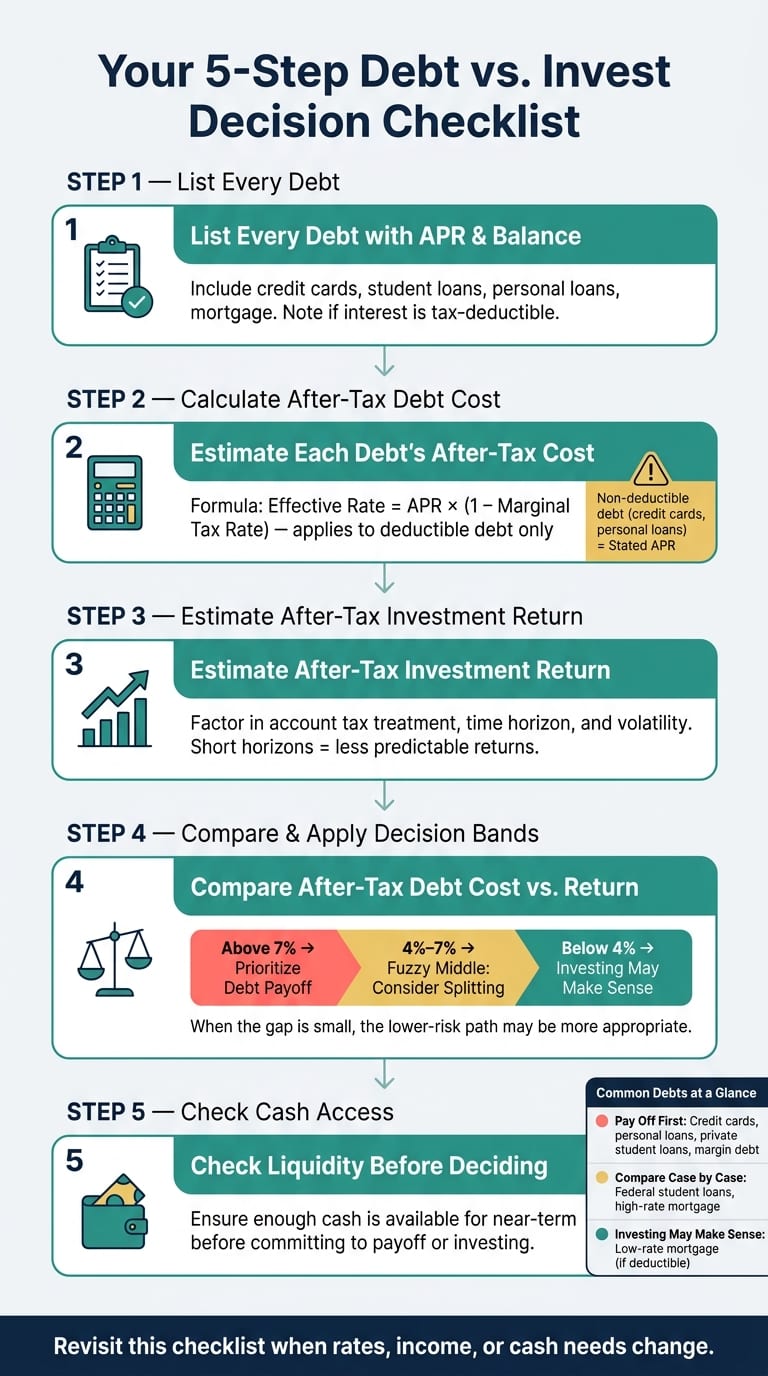
After you estimate your break-even rate, use this checklist to make the call.
Your 5-step debt-vs-invest checklist
- List every debt with its APR and balance. Include credit cards, student loans, personal loans, and your mortgage. Note whether any interest may be deductible.
- Estimate each debt's after-tax cost. Adjust for any tax deduction that may apply.
- Estimate an after-tax return on your investment. Factor in the account's tax treatment.
- Compare after-tax debt cost vs. after-tax return. When the gap is small, the lower-risk path may make more sense. If the spread is narrow, move to Step 5 before deciding.
- Check cash access before choosing payoff or investing. Keep enough cash available for near-term needs.
Revisit the checklist when rates, income, or cash needs change.
Key takeaways: run the math first, then adjust for risk and cash flow
High-interest debt may merit priority. Low-rate debt may leave room to invest. And the answer may change over time. Rates move. Income may shift. Market conditions may look different six months from now than they do today.
That’s why the after-tax math matters more than the headline rate. This may matter even more when debt interest may be deductible or when investments sit in tax-advantaged accounts.
Revisit the math when rates, income, or cash needs change.
FAQs
How do I calculate my break-even rate?
Compare your after-tax debt cost with your after-tax expected investment return over the same time horizon.
In plain English: you're looking for a rough break-even point. That may be the after-tax interest rate on your debt compared with the after-tax return your investments may need to earn over that same period.
In Mezzi, you enter your loan rate and payoff timeline. Then you compare that with your expected after-tax investment return, including taxes and fees, to see which option may come out ahead over time.
Should I still invest if I have high-interest debt?
Usually, no - many people may choose to pay down high-interest debt first. Paying it off may act like a guaranteed return in one narrow sense: it removes interest charges, and that rate may be higher than what investments may deliver after taxes and risk.
If your debt has a lower interest rate, or you may otherwise miss an employer 401(k) match, a blended approach may make sense. Some people invest enough to get the match while putting extra cash toward high-interest balances first.
When does a split strategy make sense?
A split (blended) strategy may make sense when you have a clear must-do contribution or a near-term cash need while also paying down debt.
For example, some people invest enough to get an employer 401(k) match, while putting extra money toward high-interest debt at the same time.
It may also fit when your debt carries lower rates, like a mortgage or student loan, and you already have - or are building - an emergency fund along with steady income.
Disclosures:
- This content is for informational purposes only and does not constitute investment advice or a recommendation to buy or sell any security.
- Past performance is not indicative of future results. No guarantee of future performance or outcomes is implied.
Related Blog Posts
- Dave Ramsey financial advisor vs Mezzi
- Should I pay off my mortgage? AI tools to help you know.
- Should I pay off my student loans? AI tools to help you know.
- Should You Pay Off Your Mortgage or Invest the Difference
Compare your after-tax debt cost with your after-tax expected investment return over the same time horizon.
In plain English: you're looking for a rough break-even point. That may be the after-tax interest rate on your debt compared with the after-tax return your investments may need to earn over that same period.
In Mezzi, you enter your loan rate and payoff timeline. Then you compare that with your expected after-tax investment return, including taxes and fees, to see which option may come out ahead over time.
Usually, no - many people may choose to pay down high-interest debt first. Paying it off may act like a guaranteed return in one narrow sense: it removes interest charges, and that rate may be higher than what investments may deliver after taxes and risk.
If your debt has a lower interest rate, or you may otherwise miss an employer 401(k) match, a blended approach may make sense. Some people invest enough to get the match while putting extra cash toward high-interest balances first.
A split (blended) strategy may make sense when you have a clear must-do contribution or a near-term cash need while also paying down debt.
For example, some people invest enough to get an employer 401(k) match, while putting extra money toward high-interest debt at the same time.
It may also fit when your debt carries lower rates, like a mortgage or student loan, and you already have - or are building - an emergency fund along with steady income.