
When you think you're diversified across multiple investment accounts like a 401(k), IRA, and brokerage, you might still be holding the same stocks in different places. This is called portfolio overlap, and it can lead to concentrated risk, duplicate fees, and tax inefficiencies. For example, funds like S&P 500 ETFs and large-cap growth ETFs often share top holdings like Apple or Microsoft, reducing your diversification.
Key takeaways:
- What is portfolio overlap? It's when the same stocks or assets appear in multiple funds or accounts, creating hidden concentration risks.
- Why it matters: Overlap increases risk, duplicates fees, and may trigger higher taxes on gains.
- How to fix it: Tools like Mezzi help by securely connecting your accounts, analyzing overlaps, and offering actionable steps to rebalance and optimize your portfolio.
What Portfolio Overlap Is and Why It Costs You Money
What Is Portfolio Overlap?
Portfolio overlap happens when the same stocks or assets appear in multiple investment accounts. You might assume you're diversified by holding an S&P 500 ETF in your 401(k), a tech-focused ETF in your brokerage account, and a large-cap growth fund in your IRA. But here's the catch: these funds could all share common holdings like Apple, Microsoft, or NVIDIA. Instead of spreading out your risk, you're concentrating it in just a few stocks.
This creates what’s known as "hidden concentration." You think your portfolio is spread across different funds, but in reality, a significant portion might be tied to a handful of stocks. Even portfolios containing five or six ETFs can end up with this issue. The problem becomes even more pronounced when accounts are managed separately across different brokers. Spotting this overlap is crucial to avoiding unnecessary risks and inefficiencies.
This overlap doesn’t just distort diversification - it also may have financial consequences.
The Real Costs of Duplicate Holdings
Portfolio overlap may impact your finances in several ways: concentrated risk, duplicate fees, and tax inefficiencies.
When multiple funds hold the same stocks, your risk becomes more concentrated. A downturn in those shared holdings may lead to amplified losses across your entire portfolio. For example, if two funds both have heavy exposure to tech stocks, a dip in the tech sector can disproportionately affect your overall portfolio performance. If one stock makes up more than 5% of your total portfolio due to overlap, you’re likely taking on more risk than you realize.
Duplicate fees are another hidden cost. Each fund charges its own management fee, which can range from 0.20% to 1.00% annually, even if they’re holding the same stocks. Consider the SPDR S&P 500 ETF Trust (SPY) with an expense ratio of 0.095% ($9.50 per $10,000 annually) and the Invesco QQQ ETF (QQQ) with a 0.20% expense ratio ($20 per $10,000 annually). If their top holdings overlap significantly, you’re essentially paying both fees for the same exposure. This may reduce your net returns by 1-2% annually on the overlapping portions of your portfolio.
Tax inefficiencies add yet another layer of cost. When multiple funds sell the same appreciated stocks at the same time, you could face capital gains distributions from each fund. This increases your taxable income, potentially pushing you into a higher tax bracket. Long-term capital gains can be taxed at rates up to 20%, plus an additional 3.8% net investment income tax for high earners. Essentially, you may pay taxes multiple times on the same stock exposure, which can reduce your after-tax returns over time.
How to Prevent Portfolio Overlap - ETFs
How to Find Portfolio Overlap Across All Your Accounts
Connect All Your Accounts for a Complete Picture
Once you understand the risks of portfolio overlap, the next step is figuring out how to uncover these duplications across all your accounts.
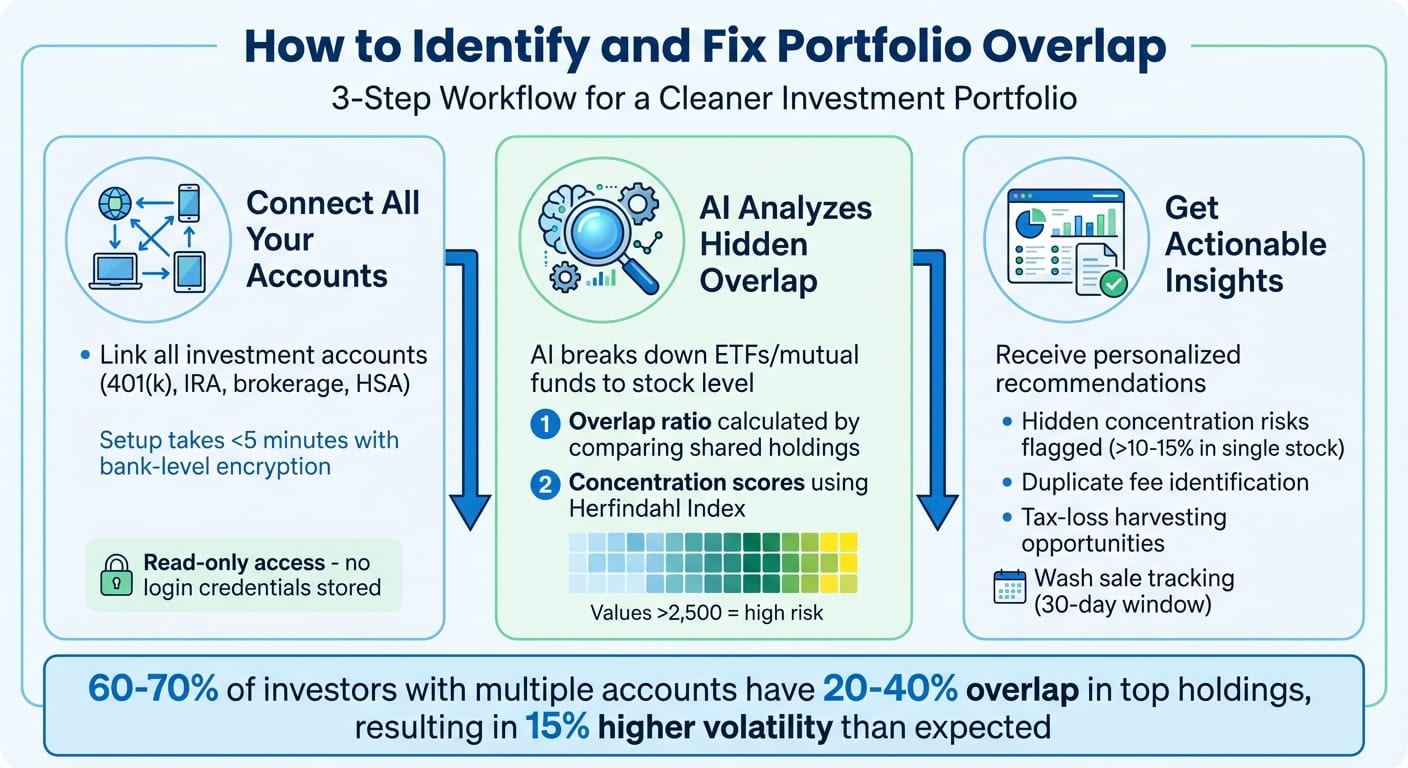
Start by connecting all your investment accounts - this includes your 401(k), Roth and traditional IRAs, taxable brokerage accounts, HSAs, and any other retirement or investment accounts. Overlap happens because many investment accounts share underlying holdings. For instance, an S&P 500 ETF in your 401(k) and a large-cap growth fund in your IRA might both include the same tech stocks.
To get a clear picture, you need a unified view of all your accounts. This is where Mezzi comes in. Mezzi provides a complete overview by securely linking your accounts through services like Plaid and Finicity. Importantly, this process is read-only - Mezzi doesn’t access your login credentials or allow trades. Unlike traditional advisors who only see the assets they manage, Mezzi aggregates everything, making it easier to spot overlap that manual reviews might miss. The setup takes less than five minutes, and your data is protected with bank-level encryption.
Once your accounts are connected, Mezzi’s AI steps in to identify overlapping exposures.
How Mezzi's AI Detects Hidden Overlap
With your accounts consolidated, Mezzi’s AI dives into the details by analyzing each holding at the stock level. It breaks down ETFs and mutual funds to uncover the individual stocks they contain. For example, if you hold both the SPDR S&P 500 ETF Trust (SPY) and the Invesco QQQ ETF (QQQ), Mezzi calculates the exact overlap by comparing their shared holdings and weighting them by percentage.
The AI creates an overlap ratio by aggregating the minimum percentages of common stocks across funds. It also generates concentration scores using the Herfindahl Index (values above 2,500 suggest high risk) and provides heatmaps for easy visualization. This analysis reveals your true exposure. For instance, what might seem like a 10% stake in one stock could actually add up to 23% across all your accounts.
Example: Finding Hidden Concentration in Your Portfolio
Here’s how this works in a real-world scenario. Imagine you have three accounts: a 401(k) with a tech-focused ETF that allocates 5% to Nvidia, an IRA with a mutual fund holding 8% Nvidia, and a brokerage account where you directly own Nvidia shares, making up 10% of that account’s value. Individually, these numbers might seem small. But when Mezzi aggregates them, it reveals something surprising - 23% of your total portfolio is tied to Nvidia.
This level of concentration is flagged as a "'hidden concentration risk"' because it exceeds commonly referenced thresholds for a single holding. Mezzi provides a clear visualization showing exactly where the overlap exists across your accounts. Research shows that 60-70% of investors with multiple accounts unknowingly have 20-40% overlap in their top holdings. This may result in higher volatility than expected. Insights like these turn guesswork into actionable knowledge.
How to Fix Portfolio Overlap and Improve Your Returns
Consolidate and Rebalance Your Holdings
Once you’ve identified overlapping investments in your portfolio, you may choose to take action. Options include streamlining your holdings by selling redundant positions, replacing overlapping funds with distinct investments, and rebalancing your portfolio to align with your target asset allocation.
Start by deciding which overlapping positions to keep and which to sell. A commonly referenced approach is to eliminate the fund with the higher expense ratio. For example, if one fund charges 0.85% annually and another with similar exposure charges only 0.15%, it makes sense to keep the lower-cost option. Similarly, if two funds have significant exposure to the same technology stock, consider selling one and reallocating that money into a completely different sector, such as healthcare or real estate.
After selling redundant positions, use the proceeds to invest in underweighted areas of your portfolio. Let’s say your target allocation is 60% stocks and 40% bonds, but your overlap analysis reveals a heavy 70% concentration in technology stocks. In this case, you’d sell some of those tech-heavy funds and reinvest in bond funds, international stock funds, or other sectors to bring your allocation closer to your goal. The idea is to seek distinct exposure for each fund in your portfolio rather than duplicating what you already own.
Once your portfolio is restructured, don’t forget to consider the tax implications of your trades to further optimize your strategy.
Make Tax-Smart Adjustments
Reducing overlap in your portfolio may also create opportunities to improve your tax situation. While selling overlapping positions might trigger capital gains, you can offset those gains by using tax-loss harvesting strategies. This involves selling investments at a loss to reduce your taxable income, which may help maintain diversification while managing your tax bill.
It’s essential to avoid wash sales across accounts, which occur when you repurchase a similar security within 31 days of selling it at a loss. To comply with regulations, wait at least 31 days before buying a similar investment, or choose a substitute that provides comparable exposure without being substantially identical. For instance, if you sell a large-cap growth fund at a loss, you could either wait 31 days to repurchase it or invest in a different fund with unique holdings in the meantime.
Another key consideration is account placement. Tax-inefficient investments, like high-turnover funds or those that generate frequent capital gains, are better held in tax-advantaged accounts such as IRAs, 401(k)s, or Roth accounts, where gains aren’t taxed immediately. On the other hand, tax-efficient investments, such as index funds or buy-and-hold strategies, are more suitable for taxable accounts where long-term capital gains rates are typically lower. For example, if you consolidate overlapping bond funds, holding the remaining bond fund in a traditional IRA or 401(k) can help you avoid annual taxation on interest income.
How Mezzi Guides You Through the Process
Mezzi simplifies the process of addressing portfolio overlap by offering personalized, actionable recommendations. Building on its overlap analysis, the platform helps you reduce redundancy while keeping you in control of your investment decisions. Mezzi’s guidance considers factors like expense ratios, tax consequences, and your overall strategy to ensure you maintain diversification while eliminating unnecessary overlap.
Mezzi also identifies tax-loss harvesting opportunities throughout the year and flags potential wash sale risks across all your connected accounts. When you sell a position at a loss, Mezzi tracks the 30-day wash sale window and notifies you when it’s safe to repurchase without jeopardizing your tax deduction. Additionally, the platform provides tax-efficient rebalancing suggestions and helps you optimize asset placement across taxable, tax-deferred, and tax-free accounts to minimize your tax burden.
This level of insight is designed to be comparable to what is offered by some high-cost financial advisors, but without the 1% AUM fee. Mezzi delivers fiduciary-level guidance tailored to your actual accounts, providing information to help you execute your investment strategy..
Conclusion
Portfolio overlap can quietly undermine your investment strategy. It concentrates risk, duplicates fees, and reduces the benefits of diversification. When the same stocks or assets show up across multiple funds or accounts, you’re essentially stacking your bets in the same areas while paying extra management fees for exposure you already have. By addressing these overlaps, you may lower your risk, improve diversification, and potentially benefit from tax strategies like loss harvesting and position consolidation.
The challenge? Manually analyzing overlap is a daunting task. With five or six funds - each holding dozens, if not hundreds, of positions - it’s a time-consuming process that quickly becomes outdated as fund managers adjust their holdings. This is where automation becomes essential.
Mezzi’s AI-powered platform simplifies this process. By securely connecting to your accounts through read-only access, it identifies overlapping holdings, measures concentration levels, and provides actionable insights based on your full financial picture. Mezzi goes beyond just flagging overlaps - it provides information to support action. It considers expense ratios, tax implications, and your overall strategy to suggest ways to consolidate redundant positions, rebalance, and optimize your asset placement across taxable and tax-advantaged accounts. Plus, it tracks wash sale windows and uncovers tax-loss harvesting opportunities year-round, offering insights designed to be comparable to those of a traditional advisor - without the 1% management fee.
For investors who want clarity and control, Mezzi delivers. You maintain full ownership of your accounts and handle trades yourself, while the platform provides the kind of advice you’d expect from a $10,000-per-year advisor - accessible anytime. The result? A portfolio with greater diversification, lower fees, and potentially improved tax efficiency, all while you retain control and avoid compounding advisor fees.
Take charge of your investments today. Connect your accounts with Mezzi and build a portfolio designed for diversification and efficiency.
FAQs
What overlap level is too much?
A portfolio overlap exceeding 70% is often considered excessive. This level of overlap can dilute diversification and heighten risk, ultimately reducing the efficiency of your investments. To improve your portfolio's diversification, consider minimizing overlap and maintaining a more balanced mix of assets.
Will fixing overlap raise my taxes?
Fixing portfolio overlap can lead to higher taxes if it involves selling investments, as this may result in capital gains taxes. However, tools like Mezzi are designed to provide information to help you navigate this process efficiently, with the goal of reducing the tax burden while fine-tuning your portfolio.
Can Mezzi spot overlap inside mutual funds?
Mezzi employs its AI-powered X-Ray feature to examine holdings within mutual funds and across various accounts. This process identifies overlapping investments, helping to spot asset duplication. By addressing these overlaps, Mezzi aims to help reduce risks associated with poor diversification and potential inefficiencies in portfolios.
Related Blog Posts
- How to Check If Your ETFs Overlap (And Why 73% of Portfolios Have This Problem)
- How to Find and Fix Portfolio Overlap Across Accounts
- Stock Portfolio Analyzer: See Concentration Risk Across All Your Accounts
- ETF and Mutual Fund Overlap Checker for Retirement Accounts
A portfolio overlap exceeding 70% is often considered excessive. This level of overlap can dilute diversification and heighten risk, ultimately reducing the efficiency of your investments. To improve your portfolio's diversification, consider minimizing overlap and maintaining a more balanced mix of assets.
Fixing portfolio overlap can lead to higher taxes if it involves selling investments, as this may result in capital gains taxes. However, tools like Mezzi are designed to provide information to help you navigate this process efficiently, with the goal of reducing the tax burden while fine-tuning your portfolio.
Mezzi employs its AI-powered X-Ray feature to examine holdings within mutual funds and across various accounts. This process identifies overlapping investments, helping to spot asset duplication. By addressing these overlaps, Mezzi aims to help reduce risks associated with poor diversification and potential inefficiencies in portfolios.