
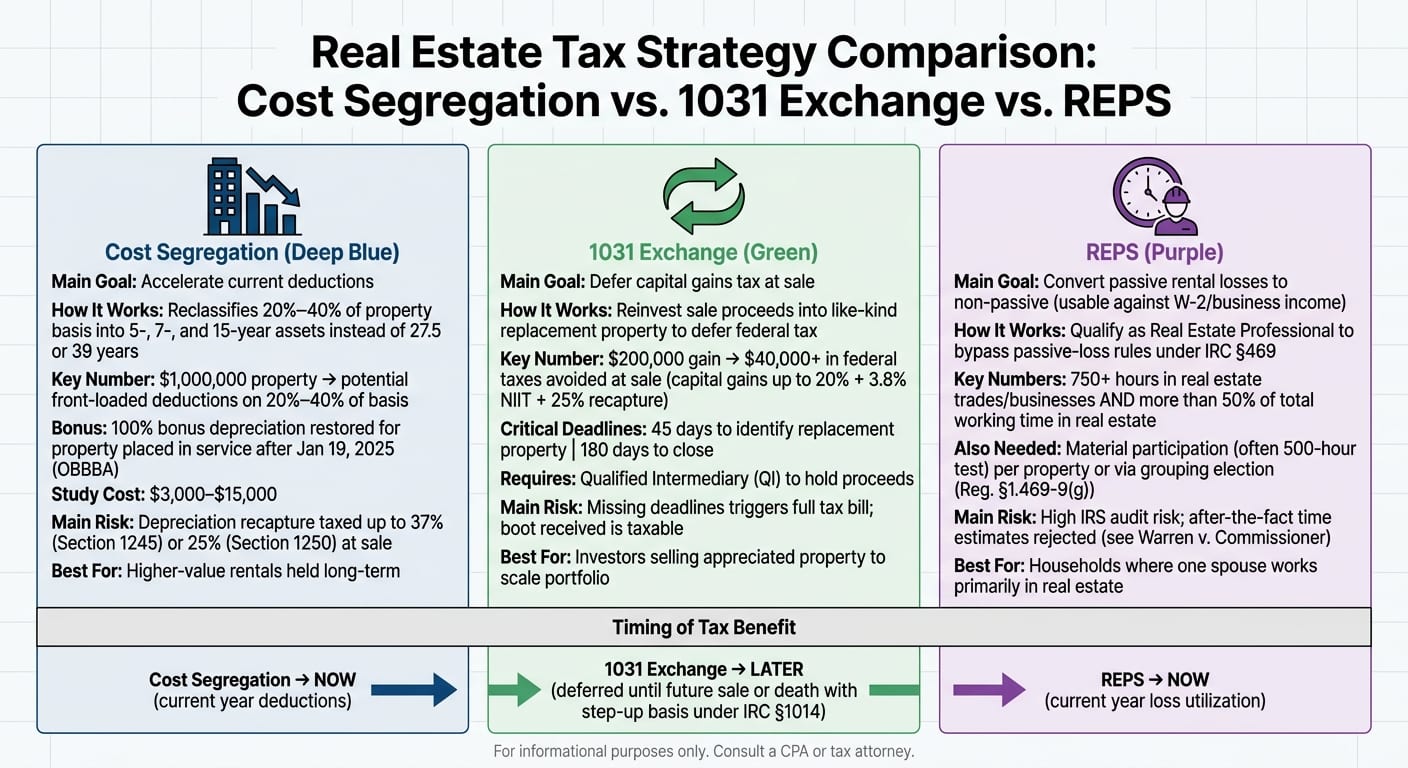
Three tax tools, three different jobs: cost segregation may speed up deductions, a 1031 exchange may defer tax when a property sells, and REPS may let rental losses offset W-2 or business income if the tests are met.
Here’s the short version:
- Cost segregation may move part of a property’s basis into 5-, 7-, and 15-year assets instead of 27.5 or 39 years
- 1031 exchanges may defer capital gains tax, NIIT, and depreciation recapture if the deal follows the rules
- REPS may change rental losses from passive to non-passive, which may make them usable now
- The hard parts are different for each one:
Cost seg: recapture later, study cost now
- 1031: 45-day and 180-day deadlines
- REPS: 750 hours, more-than-half test, and tight records
A few numbers stand out. A cost seg study on a $1,000,000 rental may front-load deductions if 20% to 40% of basis is moved into shorter-life assets. A plain sale with $200,000 of gain may trigger $40,000+ in federal tax in some cases. And REPS often turns on whether one spouse may document enough real estate time during the year.
How Real Estate Investors Legally Pay Less Taxes in 2026 (Cost Segregation Explained)
Quick Comparison
If I strip the article down to one idea, it’s this: these tools do not solve the same tax problem. One may cut current taxable income, one may push sale tax into the future, and one may change whether losses are usable at all.
1. Cost Segregation
Primary tax benefit
Cost segregation breaks a property into shorter-life pieces - carpets, appliances, lighting, and site work - so more of the basis may be depreciated over years 1–15 instead of 27.5 or 39 years. In plain English, it may front-load deductions. That tends to make it a better match for investors looking for near-term tax write-offs rather than sale deferral.
On a $1,000,000 rental property, reclassifying 20% to 40% of basis may increase first-year deductions by a meaningful amount, especially if bonus depreciation applies. Under the One Big Beautiful Bill Act (OBBBA), 100% bonus depreciation is permanently restored for qualified property placed in service after January 19, 2025.
Eligibility rules
Owners of residential and commercial rental property may use cost segregation. Whether the resulting loss may offset other income depends on passive-loss rules, REPS, or short-term rental treatment.
Properties around $500,000 or more may justify a full engineering study, which typically costs $3,000 to $15,000. Smaller properties may use lower-cost automated studies.
Timing and tradeoffs
The main tradeoff is recapture tax, or depreciation recapture. Deductions taken now may be taxed later when the property is sold. Personal property deductions under Section 1245 are recaptured at ordinary income rates up to 37%, which is higher than the 25% cap that applies to standard building depreciation under Section 1250. So if an investor may sell within one to three years, the later tax bill may offset part of the upfront tax break. Cost segregation does not defer gain on sale. It only changes when deductions are taken.
If a cost segregation study was skipped at acquisition, investors may file IRS Form 3115 to claim a catch-up deduction in the current year without amending prior returns.
For a 1031 exchange, only new basis added to the replacement property generally qualifies for bonus depreciation; carryover basis usually does not. Put another way: cost segregation may lower current tax, while 1031 exchanges deal with tax tied to the sale itself.
Documentation burden
A defensible study usually needs:
- A site inspection
- A methodology narrative
- Photos
- Asset schedules
- Pricing data
- CSI codes
If losses are used against active income under REPS, keep contemporaneous time logs that show the 750-hour test and material participation.
In states that decouple from federal bonus depreciation, the upfront tax benefit may be smaller, and dual schedules may be needed. If the goal is to use those losses against active income, REPS may be the next issue to review.
2. 1031 Exchange
Primary tax benefit
If cost segregation speeds up deductions, a 1031 exchange moves the tax conversation to the sale itself. Under Section 1031 of the Internal Revenue Code, someone who sells investment real estate and reinvests the proceeds into like-kind replacement property may defer federal tax on gain and depreciation recapture.
That gap may be bigger than it first looks. A plain sale on a property with $200,000 in gains may create $40,000 or more in federal taxes right away - capital gains taxed at up to 20%, a potential 3.8% Net Investment Income Tax (NIIT), and depreciation recapture taxed at up to 25%. In a 1031 exchange, that money may stay in the next property instead of going out in taxes at closing. When used more than once, the approach may function as a long-range deferral strategy. At death, heirs may receive a stepped-up basis under IRC §1014, which may wipe out the deferred gain and recapture.
Eligibility rules
Since 2018, only real property qualifies. Both the property being sold - the relinquished property - and the one being bought - the replacement property - must be held for productive use in a trade or business or for investment, not for personal use. The IRS reads "like-kind" in a broad way. A single-family rental may be exchanged for a multifamily building, a commercial strip center, or raw land.
There’s also a same-taxpayer rule. The same taxpayer that sells must also buy. Primary residences and vacation homes used personally do not qualify.
Timing and tradeoffs
This strategy turns on two hard deadlines:
- 45 days to identify replacement property in writing
- 180 days to close
Both periods start on the sale closing date. Miss either one, and the full tax bill may come due right away.
Investors also need a Qualified Intermediary (QI), a neutral third party that holds the sale proceeds between deals. If the seller takes control of the money, even for a short time, that may count as "constructive receipt" and the exchange may fail.
Any "boot" received - leftover cash or net debt relief from moving into a lower-value property - may be taxable in the year of the exchange.
Documentation burden
The paperwork side matters. Investors need written identification of replacement properties delivered to the QI within the 45-day window, plus records showing the property was held for investment rather than personal use or a fast resale.
The deed name also has to match exactly. The name on the deed for the replacement property must match the name on the deed for the relinquished property. An LLC that is a disregarded entity for tax purposes may work, but most other title changes in the middle of the exchange are generally not allowed.
If the goal goes beyond deferral and leans toward using losses against active income, REPS may be the next strategy to look at.
3. Real Estate Professional Status (REPS)
Primary tax benefit
REPS tends to matter when rental losses are large enough that passive-loss rules may block their use in the current year.
A 1031 exchange may defer tax at sale. Cost segregation may speed up deductions. REPS deals with a different issue: it may turn rental losses into current deductions that may be used now.
Under IRC Section 469, rental activities are generally treated as passive. That means losses usually may offset only passive income. If REPS applies, rental losses may be treated as non-passive instead. In that case, they may offset W-2 wages or business income, rather than being limited by the $25,000 passive-loss cap or pushed into suspended passive losses. Above the phaseout range, REPS may be the only way those losses may be used in the current year.
Eligibility rules
Qualifying generally means passing two tests each year:
- 750-Hour Test: More than 750 hours of personal services in real property trades or businesses in which you materially participate.
- More-Than-Half Test: More time spent in real estate activities than in all other trades or businesses combined.
Passing both tests may make someone a Real Estate Professional. But that alone may not be enough. The taxpayer also needs to materially participate for the losses to remain non-passive, often by meeting the 500-hour test. If either test is missed, the losses usually remain passive.
For people with more than one property, a grouping election under Treas. Reg. §1.469-9(g) may allow 500 hours across a portfolio to count toward material participation. That election is generally irrevocable.
For joint returns, one spouse may satisfy both tests for the household.
Timing and tradeoffs
A full-time W-2 job tends to be the main obstacle. For many people, that may make REPS hard to claim.
REPS status is determined each year. If someone qualifies one year but misses the threshold the next, that year's rental losses generally go back to passive status and may become suspended.
Documentation burden
REPS is one of the tax positions most often audited on individual returns, especially when large rental losses are used against W-2 income. The IRS rejects after-the-fact estimates.
In Warren v. Commissioner, the Tax Court denied REPS status after the taxpayer logged 1,628 hours in real estate but worked 1,913 hours at his W-2 job, failing the more-than-half test.
The practical answer may be simple, even if the work is not: keep records as you go. A time-tracking app or spreadsheet may be used to log dates, specific properties, task descriptions, and time spent in real time. Calendar entries, contractor invoices, email timestamps, and travel records may also support the log. Investor-only time, like reviewing statements or browsing listings, usually does not count toward the 750-hour test.
The next question is whether the tax savings may justify the time, recordkeeping, and audit risk.
Pros, Cons, and When Each Strategy Fits
Once the rules are clear, the next step is simpler: match each strategy to the tax issue it may address.
The biggest difference comes down to timing: current deduction, sale deferral, or loss use.
Cost segregation may fit best when the property is likely to be held for a longer period, or when a 1031 exchange may be used at exit. If not, recapture may reduce part of the tax value.
With 1031 exchanges and REPS, the weak spot is usually execution. A missed deadline or thin records may wipe out the tax result.
So the last issue is pretty practical: which path may line up with the investor’s timeline, income, and exit plan?
Conclusion
The practical choice usually comes down to timing: current deductions, sale deferral, or loss use. Cost segregation may accelerate deductions into the current year. A 1031 exchange may defer capital gains and depreciation recapture when you sell. REPS may turn passive rental losses into deductions that may offset W-2 or business income. Each tool addresses a different tax issue, so the fit may depend on the goal.
In practice, some investors may use these strategies together. For example, a 1031 may defer gain, cost segregation may speed up deductions, and REPS may allow those losses to be used. Deferral may also mean more money stays invested for longer.
The main pitfalls include carryover basis, recapture, passive-loss carryforwards, and state bonus-depreciation rules. Those details usually aren’t the kind of thing to guess at. Many investors choose to confirm them with a CPA, tax attorney, or Qualified Intermediary. Even when the broad strategy makes sense, the final result may fall short if the execution is sloppy.
FAQs
Can I use cost segregation, a 1031 exchange, and REPS together?
Yes. Used together, these strategies may increase tax savings.
A 1031 exchange may defer capital gains and depreciation recapture into a replacement property. You may then use cost segregation on that property to accelerate deductions. REPS, with material participation, may make those losses non-passive, so they may offset W-2 wages and other active income.
How do I know which strategy fits my tax situation?
It may depend on your income, whether you may meet IRS activity tests, and what you want the property to do for you.
- REPS or the STR loophole: often discussed by higher-income W-2 earners who may want rental losses to offset salary
- Cost segregation: used to speed up depreciation, often with the biggest near-term impact after a property purchase
- 1031 exchange: used to defer capital gains and depreciation recapture when selling a property that may have gone up in value
It also makes sense to weigh compliance, audit risk, and admin costs.
What records do I need to support these tax strategies?
Keep contemporaneous documentation for each strategy.
- REPS: Maintain detailed time logs with dates, hours, activities, and support for material participation. Some taxpayers also formalize any grouping election under Reg. 1.469-9(g).
- Cost segregation: Use a study prepared by a qualified firm with asset classifications that may hold up under review.
- 1031 exchanges: Keep qualified intermediary agreements, 45-day property identification records, and 180-day closing documents.
Disclosures:
- This content is for informational purposes only and does not constitute investment, tax, or legal advice.
- Real estate investments involve significant risks, including potential loss of capital. Always consult with qualified tax professionals before implementing any tax strategies.
- Past performance is not indicative of future results. Tax laws are subject to change, and strategies that are effective today may not remain so in the future.
Related Blog Posts
- Tax Deferral Strategies Beyond 1031 Exchanges
- Capital Gains Tax Strategies For Real Estate Investors
- Tax Implications of Short-Term vs. Long-Term Rentals
- Real Estate Professional Status: Deducting Passive Losses Against W-2
Yes. Used together, these strategies may increase tax savings.
A 1031 exchange may defer capital gains and depreciation recapture into a replacement property. You may then use cost segregation on that property to accelerate deductions. REPS, with material participation, may make those losses non-passive, so they may offset W-2 wages and other active income.
It may depend on your income, whether you may meet IRS activity tests, and what you want the property to do for you.
- REPS or the STR loophole: often discussed by higher-income W-2 earners who may want rental losses to offset salary
- Cost segregation: used to speed up depreciation, often with the biggest near-term impact after a property purchase
- 1031 exchange: used to defer capital gains and depreciation recapture when selling a property that may have gone up in value
It also makes sense to weigh compliance, audit risk, and admin costs.
Keep contemporaneous documentation for each strategy.
- REPS: Maintain detailed time logs with dates, hours, activities, and support for material participation. Some taxpayers also formalize any grouping election under Reg. 1.469-9(g).
- Cost segregation: Use a study prepared by a qualified firm with asset classifications that may hold up under review.
- 1031 exchanges: Keep qualified intermediary agreements, 45-day property identification records, and 180-day closing documents.