
Want to potentially save on taxes during retirement? Your withdrawal strategy matters. The accounts you withdraw from, the timing, and the amounts all directly impact your tax bill and how long your savings last. Here’s how to make smarter choices:
- Taxable accounts first: These withdrawals often have lower tax rates (e.g., 0%-20% for long-term capital gains).
- Tax-deferred accounts next: IRAs and 401(k)s are taxed as ordinary income, with RMDs starting at age 73.
- Tax-exempt accounts last: Roth IRAs grow tax-free and don’t require RMDs, making them ideal for future use or inheritance.
Using dynamic or proportional withdrawal methods may reduce lifetime taxes and extend your portfolio’s lifespan. For example, converting funds to a Roth IRA during low-income years helps avoid higher taxes later. Tools like Mezzi’s AI are designed to simplify this process by analyzing your accounts and suggesting strategies in real-time.
Key takeaway: A well-planned withdrawal strategy isn’t just about following a simple order. Adjusting withdrawals based on tax brackets, market conditions, and income needs can help you save on taxes and make your retirement savings last longer.
Step-By-Step Guide to Tax-Efficient Retirement Withdrawals In Retirement
Know Your Account Types and Tax Rules
To create a smart withdrawal strategy, you first need to grasp how different types of retirement accounts are taxed. Each account type has unique tax rules - some are taxed when you contribute, others when you withdraw, and some avoid taxes altogether. Understanding these differences is key to making informed decisions.
Taxable Accounts
Taxable accounts, like standard brokerage accounts, don’t provide upfront tax advantages. Instead, dividends, interest, and realized capital gains are taxed as they occur. For long-term capital gains, tax rates can be as low as 0% for those in the lowest tax brackets. Plus, when heirs inherit these accounts, they benefit from a "step-up" in cost basis, which can eliminate capital gains taxes on any appreciation. Another benefit? These accounts don’t have required minimum distributions (RMDs), giving you full flexibility over withdrawals.
Tax-Deferred Accounts
Traditional IRAs and 401(k)s are funded with pre-tax dollars, meaning you get a tax deduction when you contribute. However, withdrawals are taxed as ordinary income. Once you turn 73 (if born between 1951 and 1959), you’re required to take RMDs from these accounts. Missing an RMD can result in a hefty 25% penalty on the amount not withdrawn - though this penalty drops to 10% if corrected within two years.
It's usually best to hold on to the accounts with the most generous tax treatment while spending down less tax-efficient assets.
Christine Benz, Director of Personal Finance at Morningstar
Tax-Exempt Accounts
Roth IRAs and Roth 401(k)s, funded with after-tax dollars, offer a major perk: tax-free growth and withdrawals. Roth IRAs don’t have RMDs, and starting in 2024, Roth 401(k)s are also exempt from RMDs. This makes them excellent for late-retirement spending or leaving a tax-free legacy. Since these accounts can grow without forced withdrawals, they’re a powerful tool for long-term financial planning.
Create a Tax-Efficient Withdrawal Sequence
Your withdrawal strategy can make or break your retirement plan. A well-thought-out sequence could save you a fortune in taxes and help your portfolio last longer. On the other hand, a poorly planned approach could drain your savings faster than expected. Using AI insights can fine-tune these strategies, simplifying the complexities of tax-efficient planning.
Standard Withdrawal Order
The traditional withdrawal sequence is pretty straightforward: start with taxable accounts, move to tax-deferred accounts, and save tax-exempt accounts for last. Here’s how it works:
- Withdraw from taxable brokerage accounts first. These withdrawals are taxed at long-term capital gains rates, which range from 0% to 20% - typically lower than ordinary income tax rates.
- Next, tap into traditional IRAs or 401(k)s, where withdrawals are taxed as ordinary income.
- Finally, preserve Roth accounts as long as possible, allowing them to grow tax-free.
For example, let’s say you need $100,000 per year and have $500,000 in taxable accounts, $1 million in tax-deferred accounts, and $500,000 in Roth funds. In the first year, you’d withdraw $100,000 from your taxable account, incurring about $15,000 in taxes at a 15% rate. Once the taxable account runs out (around year six), you’d start withdrawing from your traditional IRA, where taxes jump to 22%-24%, or about $25,000 annually. After Required Minimum Distributions (RMDs) begin at age 73, you’d rely on Roth funds, which are tax-free. Compared to a less organized approach, this method could save around $35,000 in federal taxes and leave an additional $106,000 for your heirs.
But while this standard method works for many, it’s not the only option. Let’s look at alternative strategies for situations where the standard sequence falls short.
Dynamic and Proportional Withdrawal Methods
Sometimes, sticking to the standard order isn’t the best move. That’s where proportional and dynamic withdrawal strategies come into play.
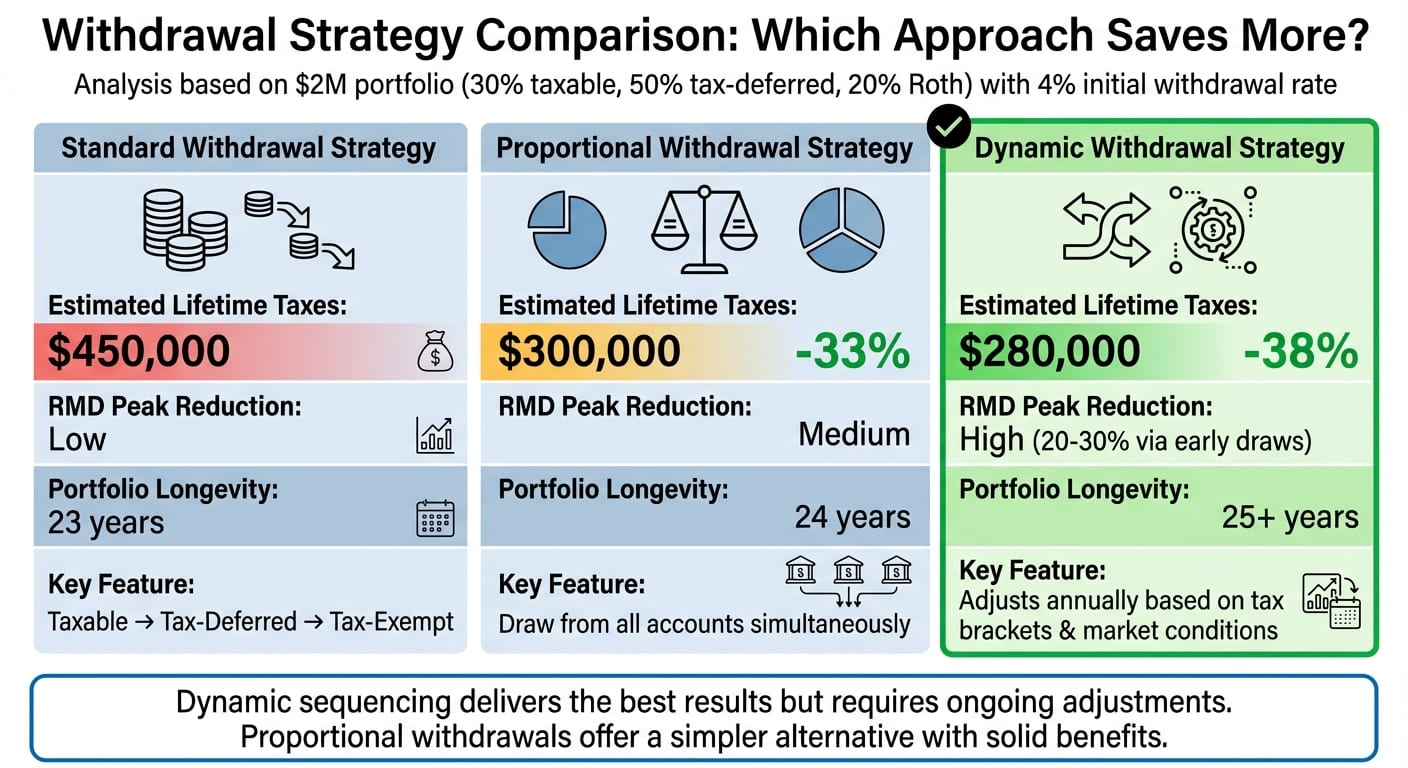
- Proportional withdrawals involve taking money from all account types simultaneously, based on their share of your total savings. This keeps your asset allocation balanced and avoids big swings in your annual tax bill. Research from Fidelity shows this method can extend portfolio life by about a year while potentially reducing taxes.
- Dynamic sequencing takes flexibility to the next level. This approach adjusts withdrawals annually based on your tax bracket, market performance, and income needs. For instance, during high-income years, you might rely on taxable accounts or cash reserves to avoid moving into a higher tax bracket. In low-income years - like the gap before Social Security starts - which requires maximizing Social Security benefits through careful timing - you could draw from your IRA to fill lower tax brackets (e.g., the 12% bracket, which tops out at $96,950 for married couples in 2025). If markets are down, you’d dip into cash reserves or bonds instead of selling stocks at a loss. This strategy minimizes both tax liability and the risk of poor market timing, often outperforming fixed approaches.
Withdrawal Strategy Comparison
Here’s a side-by-side look at how these strategies stack up for a $2 million portfolio (30% taxable, 50% tax-deferred, 20% Roth) with a 4% initial withdrawal rate:
Dynamic sequencing can deliver strong results in terms of tax savings and portfolio longevity, but it requires ongoing adjustments and careful planning. Proportional withdrawals offer a simpler alternative with solid benefits. Ultimately, the right strategy depends on your tax situation, market conditions, and retirement goals.
Use Low-Income Years for Roth Conversions
When refining your withdrawal strategy, low-income years can be an ideal time to carry out Roth conversions. These years provide an opportunity to move funds from a traditional IRA to a Roth IRA at a lower tax cost. Since your taxable income is reduced during these periods, you can strategically convert funds while staying within a favorable tax bracket. This sets the stage for tax-free withdrawals in the future.
Fill Lower Tax Brackets
One effective approach is to convert just enough to fully utilize the unused space in your current tax bracket without moving into the next one. To figure out the right amount, calculate how much room is left in your current bracket and limit your conversion to that amount. For example, if you have space remaining, converting up to that limit lets you lock in a lower tax rate now.
It’s a good idea to finalize conversions in late December when you have a clear picture of your total income, deductions, and credits for the year. This helps ensure you don’t accidentally exceed your tax bracket. Additionally, paying taxes on the conversion from a taxable account (rather than withholding from the converted funds) can maximize the benefits and prevent early withdrawal penalties if you’re under 59½.
Breaking up the conversion across multiple years can make the tax hit easier to manage - and could... reduce the overall tax you pay on the conversion.
Hayden Adams, Director of Tax and Financial Planning, Charles Schwab
This thoughtful approach not only secures lower tax rates now but also sets you up for long-term benefits, such as reduced RMDs.
Reduce Future RMDs
Beyond filling lower tax brackets, Roth conversions can also help minimize future Required Minimum Distributions (RMDs). Unlike traditional IRAs, Roth IRAs are not subject to RMDs for the original account owner. Since RMDs begin at age 73 (rising to 75 in 2033), converting funds to a Roth IRA reduces the taxable balance that would otherwise be subject to mandatory withdrawals.
Lowering your RMDs can also decrease your taxable income in retirement, potentially helping you avoid higher Medicare Part B and Part D premiums (IRMAA surcharges) and reducing the portion of your Social Security benefits that are taxed. However, remember that Roth conversions are permanent, so it’s crucial to carefully calculate the amounts or consult a financial advisor before proceeding.
Mezzi uses your account data, tax profile, and retirement plans to determine the best timing and amounts for Roth conversions.
Use AI-Driven Insights for Better Planning
Once you’ve mapped out structured withdrawal sequences and Roth conversion strategies, the next step is to use technology that adapts these plans in real-time. Tracking tax brackets, RMD projections, and market trends manually isn’t just tedious - it’s prone to mistakes. AI-driven tools can provide real-time analysis of your financial landscape, uncovering potential opportunities and suggesting adjustments that may help you keep more of your money. Instead of wrestling with spreadsheets, these tools deliver tailored, data-backed recommendations in minutes. Mezzi, for instance, uses these capabilities to reveal tax-saving strategies that integrate seamlessly with your withdrawal plan.
AI Tools for Tax Optimization
AI tools take tax-efficient planning to a new level by building on withdrawal strategies. Mezzi continuously monitors your connected accounts, identifying tax-saving opportunities aligned with your retirement goals. One feature is its ability to identify tax-loss harvesting opportunities, pairing losses with gains to potentially offset up to $3,000 of ordinary income annually. It also flags potential wash sale risks, preventing disallowed losses when identical securities are repurchased within 30 days.
For Roth conversions, Mezzi evaluates taxable income scenarios to help determine an appropriate conversion amount. For example, it might help you fully utilize the 12% tax bracket (up to $96,950 for married couples in 2025) without tipping into the next tier. Using such insights, one couple reportedly extended their time in the 10% tax bracket by eight years, saving $35,000 in federal taxes and preserving $106,000 more for their heirs.
The platform doesn’t stop there - it also considers Medicare IRMAA thresholds and Social Security taxation. It adjusts withdrawal strategies dynamically based on current income and market conditions. Imagine holding a stock with a $10,000 loss; Mezzi would flag this as a harvesting opportunity and suggest selling it while recommending a similar, non-identical ETF (like swapping VOO for VTI) to maintain your portfolio allocation without triggering wash sale rules.
Manual vs. AI-Guided Planning
The contrast between manual planning and AI-guided strategies becomes evident in both tax savings and portfolio longevity. Manual methods often rely on static rules or annual projections, missing out on dynamic opportunities. In contrast, AI tools like Mezzi analyze thousands of scenarios in real-time to optimize your withdrawals.
Proportional withdrawals - where you draw from all account types to maintain your asset allocation - may extend portfolio life and reduce total taxes compared to the standard "taxable first" approach. Mezzi’s AI can also adapt strategies to market conditions, such as using cash reserves during market downturns to avoid selling low or prioritizing taxable accounts during high-growth years to manage capital gains effectively. These examples highlight how AI-driven, real-time decision-making enhances tax efficiency and stretches your retirement savings further.
Maintain Liquidity and Rebalance for Tax-Efficient Withdrawals
Having a well-thought-out withdrawal plan is essential, but it won’t work effectively without proper liquidity and smart rebalancing. Keeping cash reserves on hand can prevent you from having to sell investments during market slumps, while a strategic rebalancing approach can turn portfolio adjustments into a tax-efficient income strategy. These practices not only keep your retirement plan adaptable but also help manage your tax obligations.
Build Cash Reserves
Experts suggest setting aside 1–3 years of living expenses in cash or short-term investments to protect against market volatility. This layered approach ensures that immediate needs are covered by cash, while short-duration bonds and certificates of deposit (CDs) mature in time to meet annual spending goals.
For example, say you need $60,000 per year to cover expenses. You could maintain $120,000–$180,000 in cash or short-term investments. This strategy allows you to avoid selling appreciated assets in taxable accounts, which could trigger unnecessary capital gains taxes. Using tools like maturing bonds, CDs, or reinvested dividends can provide a steady and predictable income stream.
Once your liquidity is secure, you can enhance your approach further by incorporating strategic rebalancing to reduce tax liabilities.
Rebalance to Minimize Taxes
Rebalancing plays a dual role: it helps maintain your portfolio’s target allocation and reduces your tax burden. For instance, when equities outperform and exceed your target allocation, selling some of those appreciated positions to fund withdrawals can help you take advantage of long-term capital gains rates, which are typically lower than ordinary income tax rates.
In contrast, during market downturns, you can draw from your cash reserves, bonds, or CDs instead of selling equities. This allows your stock investments time to recover while ensuring your financial needs are still met. For example, you might rely on a 2-year cash cushion or bond maturities during a downturn. Then, when the market rebounds, you can rebalance by selling some appreciated equities to meet your spending needs and restore your portfolio’s target allocation.
Mezzi simplifies this process by monitoring your connected accounts and identifying rebalancing opportunities. It flags moments when rebalancing can fund withdrawals without pushing you into a higher tax bracket, helping you stay both on track and tax-efficient.
Review Your Strategy Annually
It's important to review your retirement withdrawal strategy every year. Why? Because tax laws, market conditions, and personal circumstances can shift, and these changes might affect your financial plans.
Start by assessing all your income sources - this could include Social Security, pensions, rental income, and investment returns. Once you have a clear picture, see if your taxable income allows for additional withdrawals or conversions at lower tax rates. For example, in 2025, married couples filing jointly can take advantage of a standard deduction of around $30,000. Plus, they qualify for a 0% long-term capital gains rate if their income stays under $94,050. If your income is below these thresholds, it might be a good time to withdraw more from tax-deferred accounts or even convert funds to a Roth IRA to lock in those lower rates.
Next, consider how upcoming tax rules and required minimum distribution (RMD) milestones will affect your strategy. Pay attention to key ages: at 70½, you can use Qualified Charitable Distributions (QCDs) to donate up to $100,000 directly from your IRA. This not only satisfies RMD requirements but also reduces your taxable income. Then, at 73 or 75 - depending on your birth year - RMDs officially begin, and they can lead to higher taxes if you're not prepared. Planning ahead with partial Roth conversions in the years leading up to these milestones can help ease future tax burdens.
Finally, refine your plan by factoring in how withdrawals might impact Medicare premiums and the taxability of your Social Security benefits. For joint filers, if your total income exceeds $44,000, up to 85% of your Social Security benefits could become taxable. To boost tax efficiency, consider strategies like tax-loss harvesting or bundling charitable donations.
If you're looking for help, Mezzi can simplify this process. It lets you run "what-if" scenarios to explore different withdrawal strategies. For instance, you could ask, "Which accounts should I withdraw from?" or "Will selling these investments trigger capital gains?" These tools help you align your annual adjustments with a broader, AI-guided strategy, ensuring your retirement income stays tax-efficient and sustainable over time.
Conclusion
Creating a tax-efficient retirement income strategy is essential. Understanding how taxable, tax-deferred, and tax-exempt accounts are taxed - and sequencing withdrawals accordingly - can help you make the most of your tax brackets. Earlier, we explored how strategic withdrawal sequencing and proportional withdrawals may lower lifetime taxes and extend the life of your portfolio. These benefits may be more substantial when you remain adaptable.
To stay on track, revisit your withdrawal strategy regularly, especially as tax laws and market conditions change. An annual review can help you take advantage of opportunities like Roth conversions, tax-loss harvesting, or low-income years. For example, the 0% long-term capital gains rate for taxable income under $98,900 (for married couples filing jointly in 2026) could significantly reduce your tax bill. Staying proactive can also help you avoid surprises, like exceeding Medicare IRMAA thresholds or triggering Social Security taxes.
Mezzi’s AI-driven planning tool simplifies this process. By linking directly to your accounts, Mezzi provides tailored insights based on your specific tax situation and retirement goals. Forget generic advice - Mezzi answers precise questions like, “Which accounts should I withdraw from?” or “Will selling these investments result in capital gains?” in just minutes. It highlights tax-saving opportunities and models different withdrawal scenarios, so you can align your strategy with your financial goals - all without paying the typical 1% advisor fee. With real-time AI guidance, you can seek to maximize your income, minimize taxes, and adjust your approach as your circumstances change.
FAQs
×
×
×
How do I choose between standard, proportional, and dynamic withdrawals?
When it comes to managing withdrawals in retirement, there are a few common strategies to consider:
- Standard withdrawals follow a fixed approach, such as the 4% rule, where you withdraw a set percentage of your savings each year. It's simple and predictable but doesn't account for market fluctuations or personal changes.
- Proportional withdrawals distribute funds based on the share each account holds in your overall savings. This method ensures withdrawals align with the composition of your portfolio.
- Dynamic withdrawals are more flexible, adjusting based on market performance or shifts in your personal circumstances. This approach can help fine-tune income and potentially reduce tax burdens.
Tools like Mezzi can help simplify this decision-making process. By analyzing your goals, risk tolerance, and tax considerations, they can recommend the withdrawal strategy that best suits your situation.
×
×
×
How much should I convert to a Roth IRA in a low-income year?
When you have a low-income year, it might be a good time to convert funds to a Roth IRA. The key is to convert enough to fully utilize your lower tax bracket without moving into a higher one. Since there are no income limits for Roth IRA conversions, you can convert as much as you'd like. However, it’s wise to stick to an amount where you can comfortably cover the tax bill. Tools like Mezzi or consulting a tax professional can help you figure out the right conversion amount based on your income and tax situation.
×
×
×
How can I avoid Medicare IRMAA and Social Security tax surprises?
To steer clear of unexpected Medicare IRMAA charges and Social Security tax surprises, it's essential to carefully plan your withdrawals and manage your income levels within specific tax brackets. Tools like Mezzi can help by analyzing your financial situation and offering strategies to reduce unplanned tax burdens.
- Time withdrawals carefully to stay under IRMAA thresholds and avoid higher premiums.
- Align Social Security benefits with other income sources to keep taxable income in check.
- Leverage AI-powered scenario testing to find the best withdrawal sequences and minimize tax exposure.
Disclosures:
- This content is for informational purposes only and does not constitute investment advice or a recommendation to buy or sell any security.
- Past performance is not indicative of future results. No guarantee of future performance or outcomes is implied.
- Savings and performance examples are hypothetical and for illustrative purposes only. Actual results will vary based on individual circumstances, portfolio composition, market conditions, and fees.
- Users should not rely solely on AI-driven tools for financial decision-making.
- Registration does not imply a certain level of skill or that the SEC has approved the company or its services.