
If you used Schwab Intelligent Portfolios Premium, the main change in 2026 may be the loss of planner access - not the loss of your account. Your money may stay at Schwab, but the paid planning layer may end. The choice now may come down to three paths: stay with Schwab’s no-advisory-fee robo, move to a self-directed account, or use a separate advice service while keeping custody where it is.
Here’s the short version:
- Premium reportedly stopped new enrollments and was phased out in Q1 2026
- Premium had a $25,000 minimum and a monthly fee
- Standard Schwab Intelligent Portfolios remains, with a $5,000 minimum and no advisory fee
- If you move assets, an in-kind ACATS transfer may take 5–7 business days
- Tax-loss harvesting at Schwab may apply only to taxable accounts with at least $50,000
- A simple check order may help: review accounts → compare options → check taxes → move holdings
If I were sorting this out, I’d focus on four things first:
- What Schwab may do by default with each account
- What Premium actually handled for me - planning calls, rebalancing, tax-loss harvesting, projections
- What I may pay next, including fund fees, taxes, and spreads
- How much control I want after the switch
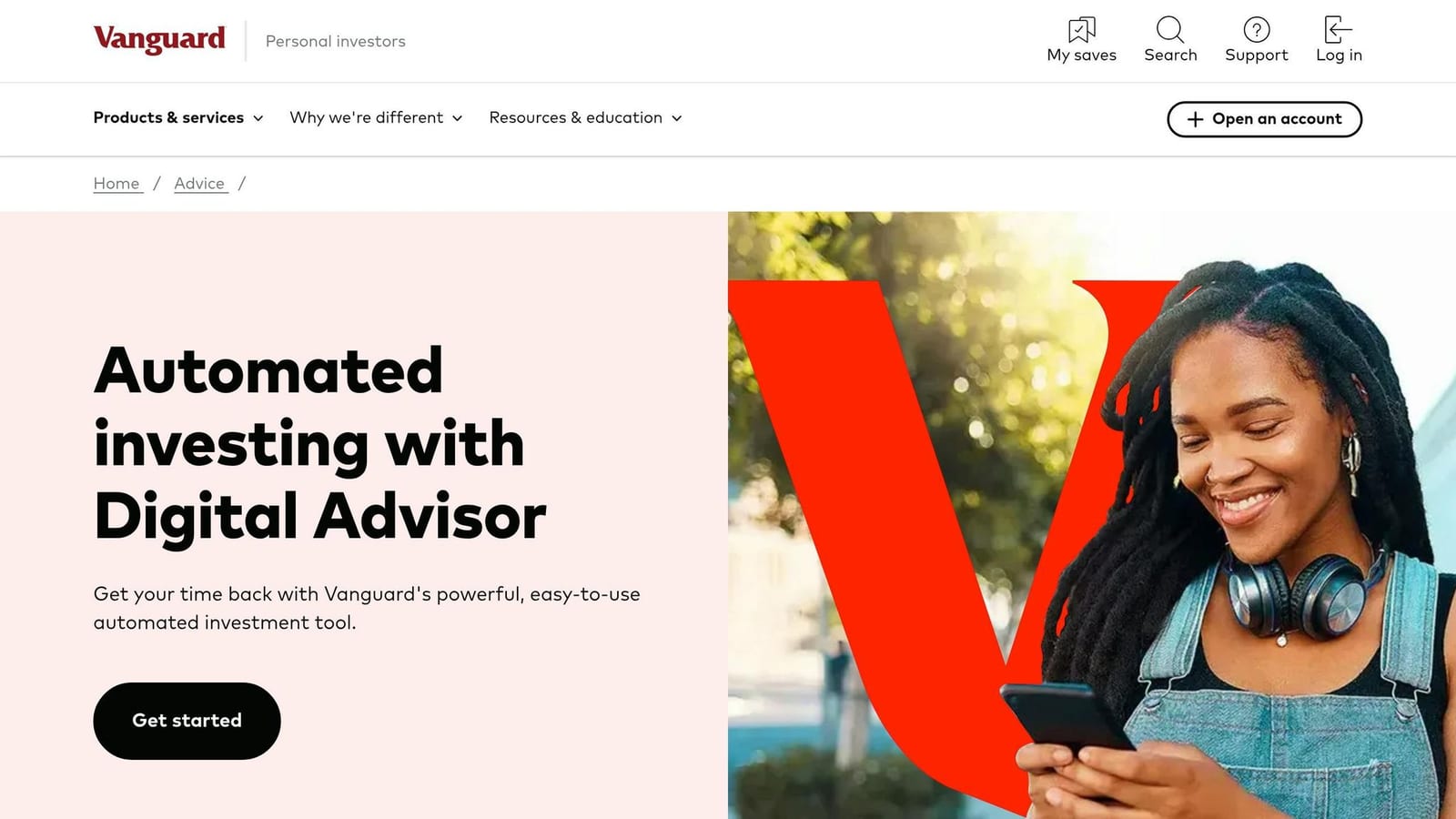
Robo Advisor Comparison: Schwab Intelligent Portfolio, Vanguard Digital Advisor, SoFi Robo Advisor
Quick comparison
OptionWhat you keepWhat you may loseCost styleBest fitStandard Schwab Intelligent PortfoliosAutomated investing, rebalancing, some tax featuresPlanner relationship tied to PremiumNo advisory fee; fund fees and cash drag may still applyPeople who want a simple defaultSelf-directed Schwab accountFull control, no forced robo setupBuilt-in automation and planner accessNo advisory fee; trading and fund costs may still applyPeople who want to place their own tradesHuman advisorDirect planning supportLower control, higher annual cost in many casesOften asset-based, such as 0.75%–1.5% per yearHouseholds with more moving partsMezziRead-only advice layer across accountsTrade execution by the serviceFree to get started; Advisory offers unlimited advice and advanced features for $39/month or $399/year; Concierge adds hands-on support for $99/month or $999/yearPeople who want guidance but want to trade themselves
Bottom line: this may be less about “Where did my account go?” and more about “What support do I want now?” From there, some investors may simply accept Schwab’s default path, while others may move only after checking tax impact, cost basis, and wash-sale risk.
Step 1: Review your current Schwab setup before making any move
Before moving money, it may help to get a clean baseline of what you have at Schwab right now. Making changes without that baseline may create new issues later, like tax surprises, overlapping holdings, or planning gaps that don't show up for months. The goal here isn't just to take stock. It's to keep the parts of Premium that you actually used.
List every account and confirm Schwab's transition plan
Start by listing every Premium-related account: individual and joint taxable brokerage accounts, traditional IRAs, Roth IRAs, rollover IRAs, SEP or SIMPLE IRAs, revocable living trusts, and custodial accounts such as UGMA/UTMA. For each account, write down:
- The account number
- The registration type
- Whether it was enrolled in Premium or the standard Schwab Intelligent Portfolios service
Then check Schwab's official notices - emails, secure messages, or mailed letters - to confirm what may happen to each account. Look for whether the account may move into the standard Schwab Intelligent Portfolios platform or may become a self-directed brokerage account with no ongoing automated management. If anything looks unclear, flag it now so an account doesn't end up unmanaged by default.
Once you know what's there, the next step is simple: map out what Premium was handling for each account.
Document what Premium was doing for you
Premium included CFP access, a written plan, projections, tax-loss harvesting, and rebalancing.
Now narrow that down to the services you actually used. Maybe you had annual planning calls. Maybe you followed a Roth conversion schedule. Maybe you got input on RSUs or stock options, or used retirement income projections. Each item on that list may point to a gap you'll need to fill later - or a service you may decide not to replace.
Record your current allocation, fees, and open planning items
Pull your latest Schwab statements and note your target risk profile, asset-class mix, and the ETF tickers in each account. Also record the expense ratios on those funds and your current cash allocation.
On fees, your all-in annual cost under Premium included the $30/month subscription, billed as $90/quarter, plus the underlying ETF expense ratios. Add those up and use that total as your baseline for comparison.
Then make a short list of any unfinished planning items, such as:
- A Roth conversion timeline
- A retirement date decision
- A concentrated stock position
- College savings targets
That list may give you a clearer way to match each gap with a possible replacement in Step 2.
Step 2: Choose the right replacement based on control, complexity, and cost
Your current setup may point you toward the replacement that fits your needs on control, complexity, and cost. At this stage, the choice may come down to three things: how much control you want, how involved your finances may be, and how much support you may want over time.
Stay at Schwab with standard robo or go fully self-directed
If you want to stay at Schwab, there are two practical paths.
The first option is standard Schwab Intelligent Portfolios. That keeps automated ETF management, rules-based rebalancing, and tax-loss harvesting where available, but removes the dedicated Premium planning support. Schwab says there may be no advisory fee, though fund expenses and a required cash allocation still apply. Tax-loss harvesting is available only for taxable accounts with at least $50,000, and you have to turn it on manually in settings.
The second option is a self-directed Schwab brokerage account. There may be no advisory fee and no built-in automation. In exchange, you get full control over holdings, cash levels, and portfolio design.
If Premium's automation mostly stayed in the background and you rarely used the planning support, the standard robo may feel like the easier default. If you have strong views on your holdings or want to remove the required cash allocation, self-direction may give you more room to do that, with more day-to-day work on your end.
When paying for a human advisor still makes sense
A traditional advisor charging 0.75%–1.5% of assets per year may still make sense in a narrow set of cases. That may include complex estates, business transitions, or multi-generation planning.
Why Mezzi fits investors who want advice without handing over trading authority

For former Premium clients who want fiduciary guidance without giving up control, Mezzi keeps Schwab accounts in place and connects on a read-only basis. Mezzi then builds a full picture of your finances and surfaces overlap, concentration risk, tax-loss harvesting candidates, wash-sale risk across accounts, asset-location opportunities, and retirement-planning insights.
Mezzi is SEC-registered and operates as a fiduciary, but it does not execute trades or move money - it advises, you execute. Pricing is flat:
- Core: $39/month or $399/year
- Plus: $99/month or $999/year
- Concierge: $99/month or $999/year
For investors who are comfortable placing their own trades but want deeper analysis behind each move, Mezzi may fit that middle ground.
Once you choose a path, the next step is moving holdings without triggering avoidable tax or trading issues.
Step 3: Handle transfers, taxes, and portfolio mechanics without creating new problems
Use the least disruptive transfer path available
Once you pick a replacement path, it may make sense to move in this order: transfer, tax check, then portfolio reset.
Staying at Schwab often involves the least friction. Moving from Premium to standard Intelligent Portfolios or to a self-directed Schwab brokerage account may be handled as an internal transfer, so holdings may move without a sale. After the transfer posts, confirm the new account number and update any linked tools.
If you leave Schwab, the new firm usually starts an ACATS transfer. In-kind ACATS transfers are not taxable events because the shares move as-is. The process often takes 5–7 business days. Ask Schwab which holdings may transfer in kind and which may need to be sold. Common blockers include fractional shares, sweep vehicles, and unsupported share classes.
Before the move, save your records so the transfer doesn't turn into a cost-basis mess later. Download Schwab's cost basis report and keep your 1099-Bs and year-end statements before the transfer. After the assets arrive, verify purchase dates and cost basis, especially for positions with large gains or losses.
Watch for taxable sales, wash-sale risk, and hidden transition costs
If taxable positions need to be sold, the tax effect may depend on the holding period and the size of the gain or loss. Short-term gains are taxed at ordinary income rates, which are often higher than long-term capital gains rates. Ask for a gain-loss estimate before approving any liquidation. In some cases, high-gain positions may be better moved in kind and sold later.
Wash-sale risk is easy to miss. A loss disallowance may apply if you buy the same or a substantially identical security within 30 days before or after the sale in accounts you or your spouse control, including IRAs and 401(k)s. If you want to stay invested after a loss sale, some investors use a different index fund with similar exposure.
Total transition cost may include more than the advisory fee. It may also include taxes, spreads, and fund expenses.
Replace lost automation with a monitoring process you will actually follow
After taxes, the next issue may be keeping the portfolio on target without Premium's automation. Once automated rebalancing stops, portfolio drift may become the main risk. Set a target allocation and use it as your reference point.
A simple process may be enough:
- Review the portfolio once a year.
- Or rebalance when an asset class drifts more than 5 percentage points from target.
- In taxable accounts, direct new contributions and dividends to underweight areas first before selling anything.
Mezzi connects to your Schwab account on a read-only basis, along with any other accounts you hold. It shows which positions are drifting, flags tax-loss harvesting candidates year-round, notifies you when the 30-day wash-sale window has passed, and surfaces tax-efficient placement across Roth, Traditional, and taxable accounts.
You make the trades. Mezzi shows what may need attention.
Conclusion: A 30-day action plan for former Premium clients
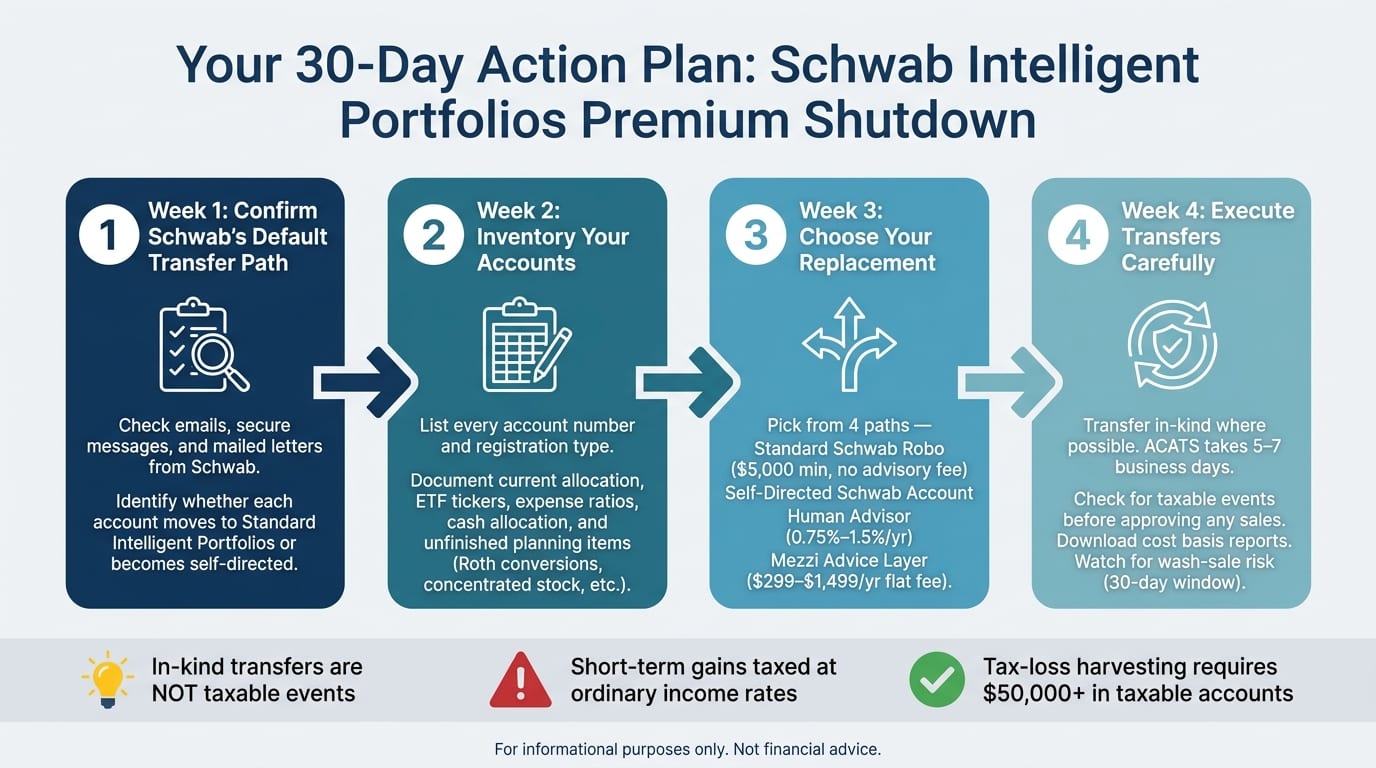
Schwab's shutdown may be more of a planning change than a custody event. Your assets may stay at Schwab; Premium's ongoing planning support may be the part that's ending. From here, the job may be pretty simple: match the replacement to your level of need, then move only after a tax check.
Confirm Schwab's transition details, inventory your accounts and fees, choose your replacement, then move only what you need. If you do nothing, Schwab's default transfer path may usually be an internal move to a Schwab platform, not liquidation.
Your next move in plain terms
Your best path may depend on one honest question: how much guidance do you actually need?
Your situationBest fitSimple finances, no planner neededStandard Schwab Intelligent Portfolios (no advisory fee, $5,000 minimum)Want full control and may follow a written policySelf-directed at Schwab with a documented rebalancing scheduleNeed tax, estate, or coaching helpA human advisorWant advice without giving up controlConnect accounts to Mezzi
If you want guidance without handing over trading authority, the last row may be the middle path. Mezzi connects to your Schwab account on a read-only basis - no transfers, no custody changes. As an SEC-registered fiduciary, it surfaces tax, drift, and wash-sale issues on demand. Mezzi shows what may need attention; you decide what to do.
A simple order may help limit mistakes: assess, choose, then transfer. Thirty days may be enough time to do this well.
- Week 1: Confirm Schwab's default transfer path.
- Week 2: Inventory accounts.
- Week 3: Choose a replacement.
- Week 4: Execute transfers carefully, transferring in kind where possible and checking for taxable events before approving any sales.
Follow the plan in order, and the shutdown may feel more like a controlled transition than a disruption.
FAQs
Will my Schwab account close automatically?
No. Your Schwab account may remain open even if Schwab Intelligent Portfolios Premium shuts down. Your existing assets may stay in your brokerage account.
That said, the automated management features may end. Because of that, some account holders may want to review their next steps and keep an eye on future Schwab notices about the transition.
How do I know whether to stay automated or go self-directed?
It depends on how much control, time, and complexity you may want to take on.
Choose automation if you may prefer a hands-off approach and want rebalancing and tax-loss harvesting managed for you. Go self-directed if you may want full control, want to avoid management fees, and don’t mind researching investments, monitoring holdings, and handling tax rules like wash sales. AI-driven platforms may offer a middle ground.
Could moving my account trigger taxes or wash sales?
Yes, depending on how you transfer it.
A cash transfer means selling your holdings first. That sale may trigger capital gains taxes. It may also create wash sale issues if you buy back substantially identical securities within 30 days before or after the sale.
To lower that risk, some investors use an in-kind transfer when possible. It may also make sense to coordinate trading activity across all accounts, including IRAs and a spouse’s accounts, so you don’t repurchase similar securities during the 61-day wash sale window.
Mezzi is free to get started. Choose Advisory for unlimited advice and advanced features at $39/month or $399/year. Concierge includes the same, plus hands-on support, at $99/month or $999/year.
Disclosures:
- This content is for informational purposes only and does not constitute investment advice or a recommendation to buy or sell any security.
- Past performance is not indicative of future results. No guarantee of future performance or outcomes is implied.
- Mezzi is a paid subscription tool and does not provide investment management or custody services.