
A retiree may post the same average return as someone else and still end up with less money. The difference may come down to when bad returns happen, especially in the first five years after work stops.
Here’s the short version:
- If market losses show up early, withdrawals may take a larger bite from a larger portfolio.
- Selling after a drop may leave fewer shares in place for a later rebound.
- Fixed spending, high stock exposure, and low cash reserves may make this issue worse.
- Some retirees look at flexible withdrawals, cash and bond reserves, and a more balanced mix near retirement to lower the odds of selling stocks after a drop.
A simple example shows the idea: two retirees starting with $1,000,000, taking $60,000 a year, and averaging 6% returns may still finish with very different results based on return order alone. In one example, the gap came to $83,288.
Here’s what I’d take from the article:
Put simply, this article says sequence risk may be less about average return and more about timing, and that the first few retirement years may shape how the whole plan plays out.
Sequence of Returns Risk in Retirement: 6 Ways to Protect Your $1M+ Portfolio
The problem: same average return, very different outcomes
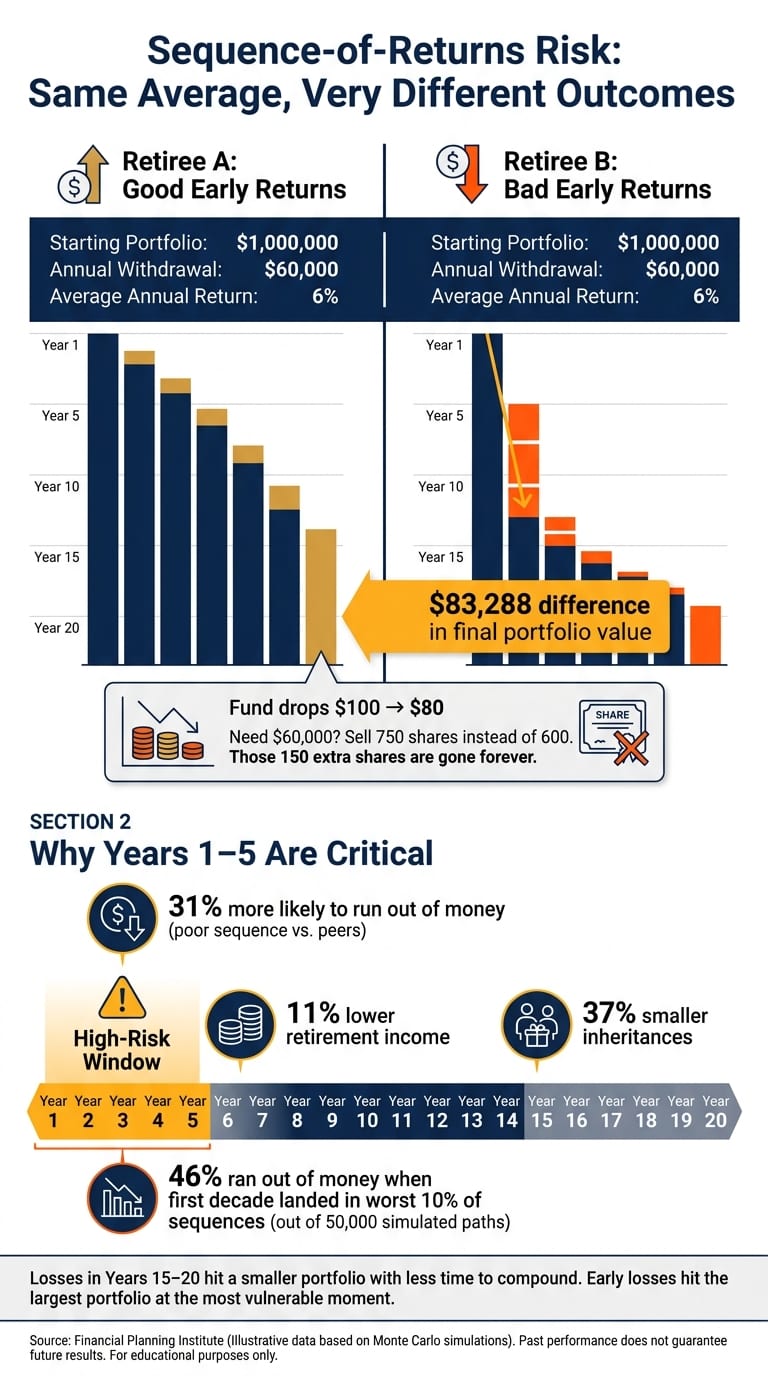
Two retirees may post the same 6% average return over time and still end up with very different retirements once withdrawals start. The gap often shows up when a down market lines up with the need for cash.
How withdrawals turn a market drop into lasting damage
When markets fall and a retiree still needs money for living costs, they may have to sell more shares at lower prices just to pull the same dollar amount. That means fewer shares stay invested for any later rebound, so the portfolio may recover from a smaller base.
Here’s the simple version. If someone needs $60,000 and a fund price drops from $100 to $80, they may need to sell 750 shares instead of 600. Those extra shares sold near the bottom are gone for good. That’s why a market drop during the withdrawal phase may have effects that stick around.
Example: two retirees, one return average
A clear example makes this easier to see. Two retirees each started with $1,000,000, withdrew $60,000 per year, and averaged 6% annually. Even so, they still ended up with an $83,288 difference in portfolio value based only on the order in which returns showed up.
Same average. Different path. Different result.
Why Years 1–5 matter more than Years 15–20
This is why the first five years of retirement may matter more than the long-run average return. Early on, the portfolio is often at its largest, and withdrawals have just begun. If losses hit during that stretch, the drag may be harder to overcome.
Research on bear markets found that, compared with otherwise similar investors retiring in the same periods, those with a poor sequence of returns were 31% more likely to run out of money, had 11% lower income, and left 37% smaller inheritances.
Losses in Years 15–20 may still hurt, but they often hit a smaller portfolio with fewer years left for compounding. And a sharp downturn right before retirement may reduce the starting balance while also pushing up the starting withdrawal rate before the first distribution even happens. That’s where withdrawal rules and cash reserves may become the next layer of protection.
What makes sequence risk worse
Sequence risk may rise fastest when withdrawals stay fixed, cash reserves stay low, and multiple accounts all lean on the same market exposure. Not every retiree faces the same level of risk, but these conditions may stack up and quietly increase the odds that a portfolio may not last through a bad early stretch.
Fixed withdrawals and inflation-adjusted spending
A rigid, inflation-adjusted withdrawal plan may force more share sales after a market drop. That may lock in losses.
Here’s what that may look like. With a $1,000,000 portfolio, a 20% drop before a $40,000 withdrawal may push the withdrawal rate to 5%. If the portfolio then falls another 10% and the withdrawal rises with inflation to $41,200, the rate may move above 5.7%. Research found that retirees locked into constant real-dollar withdrawals who experienced poor early returns were 31% more likely to run out of money and had 11% lower retirement income than peers with better return sequences.
When spending stays fixed and reserves stay thin, asset mix may matter even more.
Too much stock exposure and no cash or bond buffer
Entering retirement with 70%–100% in stocks and little cash or short-term bonds may set up forced selling at the worst time. Without a cash or bond buffer, withdrawals during a slump may come straight from stocks that are already down. Once those shares are sold, the loss may become permanent.
In a large simulation of 50,000 retirement paths, retirees whose first decade landed in the worst 10% of historical sequences ran out of money roughly 46% of the time. Their median terminal portfolio value was about $50,000, compared with nearly $1.8 million across all sequences.
Some retirees use reserves to avoid selling stocks during a downturn. A two- to five-year reserve in cash and short-term bonds may cover spending while stocks recover. One practical starting point may be:
- 1 year of expenses in cash
- 2 to 4 years of expenses in short-term bonds
The same risk may get worse when those stocks sit across multiple accounts that all move together.
Household-level concentration across accounts
Sequence risk may be a household problem, not just an account problem. Even a solid withdrawal plan may fall short if every account holds the same kind of risk.
A 401(k), IRA, taxable account, and employer stock may look diversified on their own while still adding up to the same U.S. equity bet. When a bear market hits, all of those accounts may decline together. That may leave few safer assets available to fund withdrawals without selling at a loss.
Put simply: sequence risk may operate at the household level, not the account level.
Three ways to reduce sequence risk in early retirement
The fixes may be fairly simple: spend with more flexibility, keep some near-term reserves, and lower the odds that you’ll need to sell stocks during a downturn.
Use flexible withdrawal rules instead of a fixed amount
A fixed withdrawal plan may look neat on paper. But in a rough market, that same rigidity may put more pressure on the portfolio than many retirees want.
One approach that has been studied a lot is the guardrails method. You start with a target withdrawal rate, set an upper and lower range, and trim spending by about 10% if the upper guardrail gets crossed. In past research, guardrails have been linked with starting withdrawal rates around 5%–5.5%, with better portfolio survival odds than a rigid 4% plus inflation rule.
There’s also a simpler version. After a bad year, some retirees may skip the usual inflation increase. So if the portfolio drops hard, withdrawals stay flat in nominal dollars instead of moving up with inflation. That pause may reduce forced selling at the worst time.
Keep a cash buffer and bond reserve for near-term spending
The idea here is pretty direct: try to avoid selling stocks in a downturn.
A common setup is the three-bucket approach:
In practice, cash may cover near-term spending, bonds may backstop that cash bucket, and stocks may be left alone until markets recover. During drawdowns, some retirees refill cash from bonds first and wait to sell stocks until after a rebound.
Set an allocation that can survive bad early years
Another lever is asset mix around the retirement date. Some retirees use a bond tent or keep a more balanced allocation during that early stretch.
The bond tent is often tied to Wade Pfau and Michael Kitces. Instead of holding one fixed stock/bond split forever, you gradually increase bonds in the years leading up to retirement. For example, a portfolio may move from 60/40 to 50/50 or even 40/60 by the retirement date, then slowly shift back toward more equities over the next 5–15 years as the highest-risk sequence window passes.
It may sound backward at first. Hold more bonds right when long-term growth still matters? But the logic is simple: a rough market in the first few retirement years may do more harm than a rough market later on. The bond tent is meant to soften that early hit without giving up stock exposure forever.
For many households, putting this in place may be as simple as rebalancing three broad funds once a year.
The next step is turning these rules into a household plan you can monitor in one place.
Putting it into practice with Mezzi
Build a household-level withdrawal plan from your actual accounts
After you spot sequence risk, the next step may be managing it across every account you own. In the first five years of retirement, even small withdrawal errors may have lasting effects.
Mezzi builds a withdrawal plan from your actual balances, holdings, fees, and asset mix. And that matters. The account you draw from first may change taxes and may affect how long the portfolio lasts, so the plan may work better when viewed at the household level, not one account at a time.
Mezzi offers read-only access and household-level insights, so you may see the full picture before making any move.
Track the signals that matter most in the first five years
Once the household plan is clear, the next step may be watching the right early signals. In the first five years, three may matter most:
- Withdrawal rate: If it rises, you may be taking a larger share from a smaller portfolio base, which may make recovery harder.
- Cash runway: If it shrinks, you may be getting closer to selling equities to cover spending.
- Stock-bond drift: This one is easy to miss. After a strong equity rally, a portfolio that started balanced may quietly shift toward a more aggressive mix than the plan originally intended.
X-Ray may also surface hidden overlap and concentration across accounts.
Conclusion: protect the early years to protect the whole plan
Put simply, the goal may be to avoid forced selling during the first five years.
Sequence risk is not about average returns. It is about when bad years happen. If losses show up early and withdrawals continue at the same time, the portfolio may last for a shorter period.
The four tools covered in this article - flexible spending rules, cash buffers, bond reserves, and a balanced allocation - may each lower the chance of selling equities at the worst possible time. Used together, and paired with early monitoring of the right signals, they may improve the odds that a portfolio gets through a rough first five years while keeping withdrawals on track.
FAQs
What is sequence-of-returns risk?
Sequence-of-returns risk refers to the chance that poor investment returns in the early years of retirement - especially during the five years before and after you stop working - may shorten how long a portfolio lasts.
Once withdrawals begin, the math changes. You're no longer adding money; you're taking money out. So if the market drops early on, you may end up selling investments at lower prices to cover spending. That may leave less money in the portfolio for any later rebound and may increase the chance of running out of money sooner than expected.
How much cash should I keep in retirement?
Aim to keep 6 to 12 months of living expenses in a liquid account. Some retirees also use a bucket strategy, with a liquidity bucket covering the first 3 to 5 years of retirement expenses.
Holding this money in cash, certificates of deposit, or short-term Treasury bills may help some people avoid selling long-term investments during a market downturn, especially in the early years of retirement.
Should I reduce stock exposure before retiring?
Yes. Reducing stock exposure as you approach retirement may be one way to lower sequence-of-returns risk - the risk that weak market returns around the time you retire may shorten how long a portfolio lasts.
Many financial planners discuss a bond tent or glide path. In plain English, that means gradually moving from a stock-heavy portfolio toward a more conservative mix of stocks, bonds, and cash as retirement gets closer.
Disclosures:
- This content is for informational purposes only and does not constitute investment advice or a recommendation to buy or sell any security.
- Past performance is not indicative of future results. No guarantee of future performance or outcomes is implied.
- Savings and performance examples are hypothetical and for illustrative purposes only. Actual results will vary based on individual circumstances, portfolio composition, market conditions, and fees.
Related Blog Posts
- What portfolio value and withdrawal strategy would generate a specific monthly after-tax income?
- What is an ideal asset-allocation strategy for a five-year retirement horizon?
- Retirement Planning at 50: How to Assess If You Have Enough
- Guardrails Withdrawals: How to Spend 5%+ Without Running Out
Sequence-of-returns risk refers to the chance that poor investment returns in the early years of retirement - especially during the five years before and after you stop working - may shorten how long a portfolio lasts.
Once withdrawals begin, the math changes. You're no longer adding money; you're taking money out. So if the market drops early on, you may end up selling investments at lower prices to cover spending. That may leave less money in the portfolio for any later rebound and may increase the chance of running out of money sooner than expected.
Aim to keep 6 to 12 months of living expenses in a liquid account. Some retirees also use a bucket strategy, with a liquidity bucket covering the first 3 to 5 years of retirement expenses.
Holding this money in cash, certificates of deposit, or short-term Treasury bills may help some people avoid selling long-term investments during a market downturn, especially in the early years of retirement.
Yes. Reducing stock exposure as you approach retirement may be one way to lower sequence-of-returns risk - the risk that weak market returns around the time you retire may shorten how long a portfolio lasts.
Many financial planners discuss a bond tent or glide path. In plain English, that means gradually moving from a stock-heavy portfolio toward a more conservative mix of stocks, bonds, and cash as retirement gets closer.