
Two investors may earn the same market return and still keep very different amounts after tax. That gap may come from account placement, fund choice, holding periods, and wash-sale mistakes across accounts.
Here’s the short version: many investors may lose after-tax return when ordinary-income assets sit in taxable accounts, when short-term gains get realized too often, when active funds send out taxable distributions, or when a loss sale in one account gets canceled by a purchase in another. Some investors try to reduce that drag by placing assets by tax treatment, harvesting losses with care, rebalancing with new contributions, and checking all accounts together before trading.
A few numbers from the article stand out:
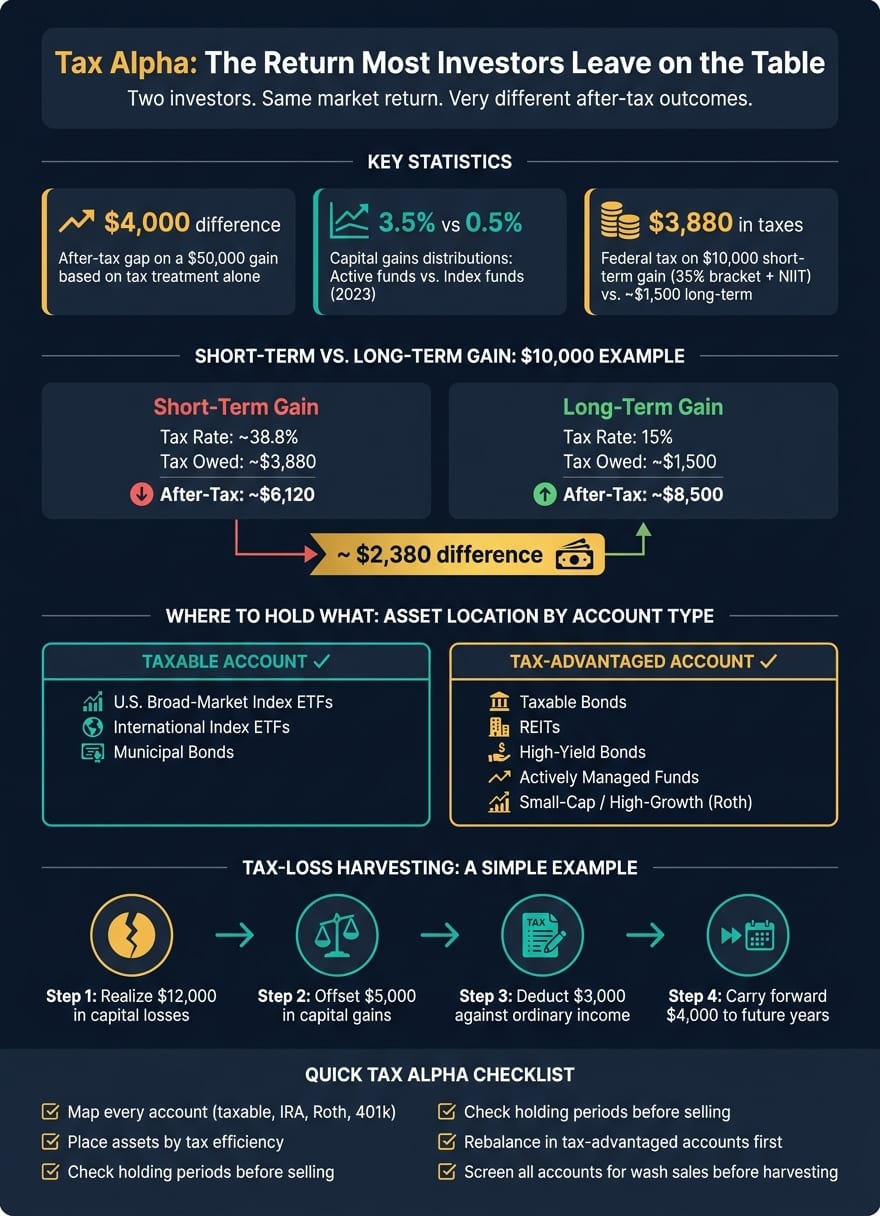
- A $50,000 gain may leave one investor with about $4,000 more than another based on tax treatment alone.
- In 2023, active funds distributed about 3.5% of assets in capital gains, versus about 0.5% for index funds.
- A $10,000 short-term gain for someone in a high federal bracket plus NIIT may lead to about $3,880 in federal tax, while a similar long-term gain taxed at 15% may leave about $8,500 after tax.
- Tax losses may offset gains, and up to $3,000 of net losses per year may offset ordinary income, with extra losses carrying forward.
If I wanted the article’s core point in one line, it would be this: tax alpha may come less from picking better investments and more from avoiding taxes that may not have been needed in the first place.
What the article covers:
- Where after-tax returns may leak
- Why asset location may matter
- How tax-loss harvesting may work
- Why holding periods may change tax treatment
- How rebalancing may trigger taxes
- Why active mutual fund distributions may add drag
- How wash sales may happen across taxable, IRA, Roth IRA, and 401(k) accounts
- Why a household-level account view may make these issues easier to spot
This article is about keeping more of what a portfolio may already earn, not about trying to beat the market.
Where after-tax returns usually leak
Most tax drag may come from account placement, fund choice, and trade timing. In plain English, the biggest leaks often start with what you hold in each account and when you sell it.
Taxable income and avoidable realized gains
Taxable bond interest, REIT payouts, and nonqualified dividends may create ordinary-income tax drag in a brokerage account. Those amounts may be taxed at ordinary income rates, and higher earners may also face Net Investment Income Tax.
Actively managed mutual funds may add another layer. When a fund manager sells holdings at a profit inside the fund, those gains may flow out to shareholders as taxable gains paid out by the fund, also called capital gains distributions. That tax may apply even if you never sold a single share yourself. In 2023, the average actively managed fund distributed 3.5% of assets in capital gains, compared with 0.5% for the average index fund.
Frequent trading may make this worse. Each time a winner is sold in a taxable account, that sale may create a taxable event. If the position was held for less than a year, the gain may be taxed at ordinary income rates instead of the lower long-term rate. For an investor in the 35% federal bracket plus NIIT, realizing $10,000 in short-term gains may lead to about $3,880 in federal taxes, leaving roughly $6,120 after tax. The same gain, if held long term and taxed at 15%, may leave about $8,500.
Once trades and holdings spread across several accounts, this may get harder to track by hand.
Cross-account mistakes that are hard to catch manually
Poor asset location may be one of the most missed sources of tax drag. A common approach is to hold assets that throw off taxable income in tax-advantaged accounts, while keeping tax-efficient assets in taxable accounts. That setup may reduce tax drag without changing the overall allocation.
Wash sales across accounts may be even harder to spot. If you sell a fund in your taxable account to harvest a loss, but an automatic contribution in your 401(k) buys the same fund during the 30-day window, the IRS may disallow the loss for current tax purposes and adjust the basis of the replacement shares. Dividend reinvestment plans, or DRIPs, may trigger the same issue by buying replacement shares in an IRA or Roth right after a loss sale in taxable. Without a household-level view, those problems may slip by unnoticed.
These leaks may be easier to fix when every account is viewed together.
5 ways to capture more tax alpha
Tax alpha may come from better tax handling, not different market bets.
The next gains may come from three repeatable moves.
Tax-loss harvesting without triggering wash sale rules
Tax-loss harvesting means selling a position in a taxable brokerage account that has dropped below your cost basis to realize a capital loss. That loss may first offset any realized capital gains for the year. If losses exceed gains, you may deduct up to $3,000 against ordinary income per year, or $1,500 if married filing separately, and any remaining losses may carry forward indefinitely into future tax years.
Here’s a simple example. Say you realize $12,000 in capital losses and $5,000 in capital gains in the same year. The losses wipe out the gains, leaving a net loss of $7,000. You may deduct $3,000 against ordinary income, and the remaining $4,000 may carry forward for future years.
The rule to watch is the wash sale rule. If you buy the same or nearly the same security within 30 days before or after the sale, the IRS disallows the loss for that year. That means the immediate tax benefit may be lost. Some investors harvest losses, then avoid buying back the same security in any account during that 30-day window.
A common workaround is to use a similar, but not identical, ETF so the portfolio stays invested without creating a wash sale. It may also make sense to pause DRIPs and automatic buys across all accounts before harvesting losses.
Once loss harvesting is in place, account placement may become the next lever.
Asset location across taxable, Traditional, and Roth accounts
A common approach is to place tax-inefficient assets in tax-advantaged accounts and tax-efficient assets in taxable accounts, looking across the whole household instead of reviewing each account on its own.
Assets that produce high ordinary income, like taxable bonds, REITs, and actively managed funds, may fit better in a Traditional IRA or 401(k). Tax-efficient assets, such as broad equity index ETFs with low turnover and mostly qualified dividends, may fit well in a taxable brokerage account. Some investors reserve Roth accounts for higher-growth assets, since future growth may come out tax-free.
Taxable vs. tax-advantaged account placement for common asset classes
A practical example may make this easier to see. If one partner's 401(k) holds most of the household's bond and REIT exposure, the joint taxable account may focus on broad equity index ETFs. The overall allocation stays the same. The location shift may simply reduce how much of the return gets taxed each year.
Holding periods and tax-aware rebalancing
Gains held for more than one year usually qualify for lower long-term capital gains rates. So if a position is close to the one-year mark, and the extra holding period fits the investor's risk tolerance, waiting a bit longer may be worth considering.
Tax-aware rebalancing applies that same line of thinking across the portfolio. Instead of selling appreciated positions in a taxable account to rebalance, some investors direct new contributions and dividends toward underweight asset classes first. When selling becomes necessary, trades inside a Traditional IRA or 401(k) may avoid an immediate tax event. Wider rebalancing bands may also reduce taxable trades. For example, trading only when an asset class drifts more than 5 percentage points from target may cut down on taxable events each year without meaningfully changing risk exposure.
Rebalancing and tax-loss harvesting may also work together. If an overweight position in a taxable account needs trimming, harvesting losses elsewhere in the portfolio may offset some or all of the gain. In some cases, that may turn a needed portfolio adjustment into a more tax-neutral result.
The remaining challenge may be coordinating these moves across every account at the same time.
Avoiding capital gains distributions from active funds
Actively managed mutual funds may generate taxable capital gains distributions even if you haven't sold a single share. When a fund manager sells holdings at a profit inside the fund, those gains may pass through to shareholders as a taxable event. In a taxable brokerage account, that may mean paying tax on gains you didn't choose to realize.
A common fix is to hold actively managed funds inside a Traditional IRA or 401(k), where distributions usually aren't taxed until withdrawal. In taxable accounts, many investors prefer low-turnover index ETFs, which may generate fewer distributions. If you already hold an active fund in a taxable account with a large embedded gain, the tax cost of switching may need to be weighed against the drag from future distributions.
Using new contributions to rebalance before selling
Selling an appreciated position in a taxable account to rebalance may create a taxable event each time. Directing new contributions, whether from savings, dividends, or employer matches, toward underweight asset classes first may reduce or even remove the need to sell.
This may work best when contributions are large enough relative to the portfolio drift. But even partial redirection may delay taxable sales and give positions more time to cross the one-year threshold for long-term treatment. When contributions alone don't get the job done, some investors make the needed sales inside tax-advantaged accounts, where there may be no immediate tax cost.
These tactics may work best when every account is visible together.
Why seeing all your accounts at once matters for tax decisions
Tax alpha may be lost because accounts sit in separate places, not because someone lacks tax knowledge. Tax decisions often happen one account at a time. But moves like tax-loss harvesting, asset location, and rebalancing may work better when a household is viewed as one portfolio.
Those moves may break down when the accounts behind them aren't visible to each other.
Wash sale risk across brokerage, IRA, Roth IRA, and 401(k) accounts
Wash sale risk may extend across taxable, IRA, Roth IRA, and 401(k) accounts. If a repurchase happens inside an IRA or Roth IRA, the loss may be permanently lost.
Here’s where it gets tricky. You may sell an ETF at a loss in a taxable account, then an automatic buy of that same fund may fire in a 401(k) or Roth IRA during the wash-sale window. If that happens, the loss may be disallowed. The issue may not be the sale itself. It may be the hidden purchase in another account that never shows up in the same view.
That kind of cross-account conflict may be almost impossible to catch by hand when accounts are held at different firms and checked one by one.
That’s why the right tool may need to see every linked account at once.
How Mezzi helps you spot tax-saving opportunities using read-only data
Mezzi links taxable, Traditional IRA, Roth IRA, and 401(k) accounts in read-only mode and flags tax-loss harvesting opportunities, wash-sale risk, asset-location mismatches, and tax-inefficient rebalancing. Mezzi is an SEC-registered fiduciary that connects accounts through read-only access via Plaid and Finicity (Mastercard).
In practice, Mezzi may surface conflicts that are easy to miss manually:
- An automatic dividend reinvestment that may trigger a wash sale
- A bond fund that may sit in the wrong account type
- A rebalancing trade that may create an unnecessary taxable event when another path may exist inside a tax-advantaged account
If you sell a position to harvest a loss, Mezzi may also notify you when the wash-sale window has passed so you can consider rebuying.
That household-level view may help catch small conflicts before they turn into avoidable tax drag.
The remaining step may be simple: catch these leaks before you trade.
Conclusion: A short checklist to stop losing tax alpha
Tax alpha refers to the extra after-tax return you may keep by avoiding taxes that may not have been needed. Common leaks may come from poor asset location, short-term gains, tax-inefficient rebalancing, and cross-account wash sales.
Here’s a short checklist to review at the household level:
- Map every account: List all taxable brokerage, Traditional IRA, Roth IRA, and 401(k)/403(b) accounts, including a spouse’s, before making any tax-related move.
- Place assets by tax efficiency: Taxable bonds, REITs, and high-turnover funds may fit better in tax-deferred or Roth accounts. Broad index ETFs and municipal bonds may fit better in taxable accounts.
- Check holding periods before selling: Waiting until you cross the one-year mark may lower the tax rate on gains.
- Rebalance in tax-advantaged accounts first: Some investors use contributions and internal trades before selling taxable winners.
- Screen all linked accounts for wash sales before harvesting a loss.
- Connect all accounts so Mezzi can surface cross-account conflicts, harvest opportunities, and cleared wash-sale windows with read-only access.
Tax-efficient investing may be better viewed as a process rather than a one-time fix. Acting on even one or two items may reduce compounding tax drag.
FAQs
What is tax alpha?
Tax alpha refers to the extra after-tax return an investor may keep by reducing avoidable taxes inside a portfolio. The idea isn’t about picking better investments. It’s about preserving more of what the portfolio may already earn by limiting the drag taxes may have on long-term growth.
Common ways people may try to generate it include:
- Tax-loss harvesting, which involves selling investments at a loss to offset taxable gains
- Asset location, where certain assets may be placed in account types that may fit their tax treatment better
- Ongoing monitoring, with the goal of spotting chances to act and avoiding mistakes like wash sales
Which assets belong in taxable accounts?
Taxable accounts may be a better fit for tax-efficient investments that create little in annual taxes or may receive more favorable tax treatment.
That may include municipal bonds, broad-market index funds or ETFs with low turnover, individual stocks held for long-term growth or that pay qualified dividends, and international equities that may allow foreign tax credits.
How do I avoid wash sales across accounts?
Avoid wash sales by not buying the same, or a substantially identical, security within 30 days before or after selling it at a loss. Put another way, the wash sale window may span 61 days in total.
And this rule may apply across all accounts you control, not just one brokerage account. That may include:
- Taxable accounts
- IRAs
- 401(k)s
- HSAs
- Joint or spousal accounts
One catch: brokerages may not track activity held at other firms. So if assets are spread across multiple institutions, reviewing linked accounts together may make it easier to spot issues.
Mezzi may help flag conflicts and spot automatic reinvestments that may trigger a wash sale.
Disclosures:
- This content is for informational purposes only and does not constitute investment advice or a recommendation to buy or sell any security.
- Past performance is not indicative of future results. No guarantee of future performance or outcomes is implied.
- Registration does not imply a certain level of skill or that the SEC has approved the company or its services.
Related Blog Posts
- How AI Simplifies Tax-Efficient Rebalancing
- Tax-Optimized Rebalancing: Strategies for 2025
- How can I minimize taxes when realizing gains for portfolio rebalancing?
- Which asset-allocation metrics matter most for a taxable account?
Tax alpha refers to the extra after-tax return an investor may keep by reducing avoidable taxes inside a portfolio. The idea isn’t about picking better investments. It’s about preserving more of what the portfolio may already earn by limiting the drag taxes may have on long-term growth.
Common ways people may try to generate it include:
- Tax-loss harvesting, which involves selling investments at a loss to offset taxable gains
- Asset location, where certain assets may be placed in account types that may fit their tax treatment better
- Ongoing monitoring, with the goal of spotting chances to act and avoiding mistakes like wash sales
Taxable accounts may be a better fit for tax-efficient investments that create little in annual taxes or may receive more favorable tax treatment.
That may include municipal bonds, broad-market index funds or ETFs with low turnover, individual stocks held for long-term growth or that pay qualified dividends, and international equities that may allow foreign tax credits.
Avoid wash sales by not buying the same, or a substantially identical, security within 30 days before or after selling it at a loss. Put another way, the wash sale window may span 61 days in total.
And this rule may apply across all accounts you control, not just one brokerage account. That may include:
- Taxable accounts
- IRAs
- 401(k)s
- HSAs
- Joint or spousal accounts
One catch: brokerages may not track activity held at other firms. So if assets are spread across multiple institutions, reviewing linked accounts together may make it easier to spot issues.
Mezzi may help flag conflicts and spot automatic reinvestments that may trigger a wash sale.