The BoostMezzi’s Sunday email about one decision shaping your wealth.
Before you sell a winning investment, think about what you’ll use the money for.
If you already plan to give, consider donating shares directly before selling them. Your most appreciated shares could do more than cash.
Last week, we looked at weighing the tax cost of selling against the risk of a large holding. A planned charitable gift adds another option.
Start with what you plan to give
Set an amount you can comfortably give. Then look for investments that have grown in value and that you’ve held more than a year in a taxable investment account.
Three things may surprise you:
- A gift isn’t automatically deductible. A stock donation gives you a federal charitable deduction only if you itemize.
- Held a year or less? Your deduction generally uses what you paid for appreciated shares, rather than their current value.
- 2026 adds a hurdle. For itemizers, only annual charitable giving above 0.5% of adjusted gross income counts toward the charitable deduction, subject to other limits. See the IRS’s 2026 guidance.
Give winners, not losers. If shares are worth less than you paid, consider selling and giving cash. Selling may give you a loss to use against investment gains; donating the shares won’t. Check replacement purchases across your household first: buying the same or a substantially identical investment within 30 days before or after the sale can delay or disallow the loss deduction. See the IRS guidance on wash sales.
Tax benefit #1: Avoid realizing the capital gain
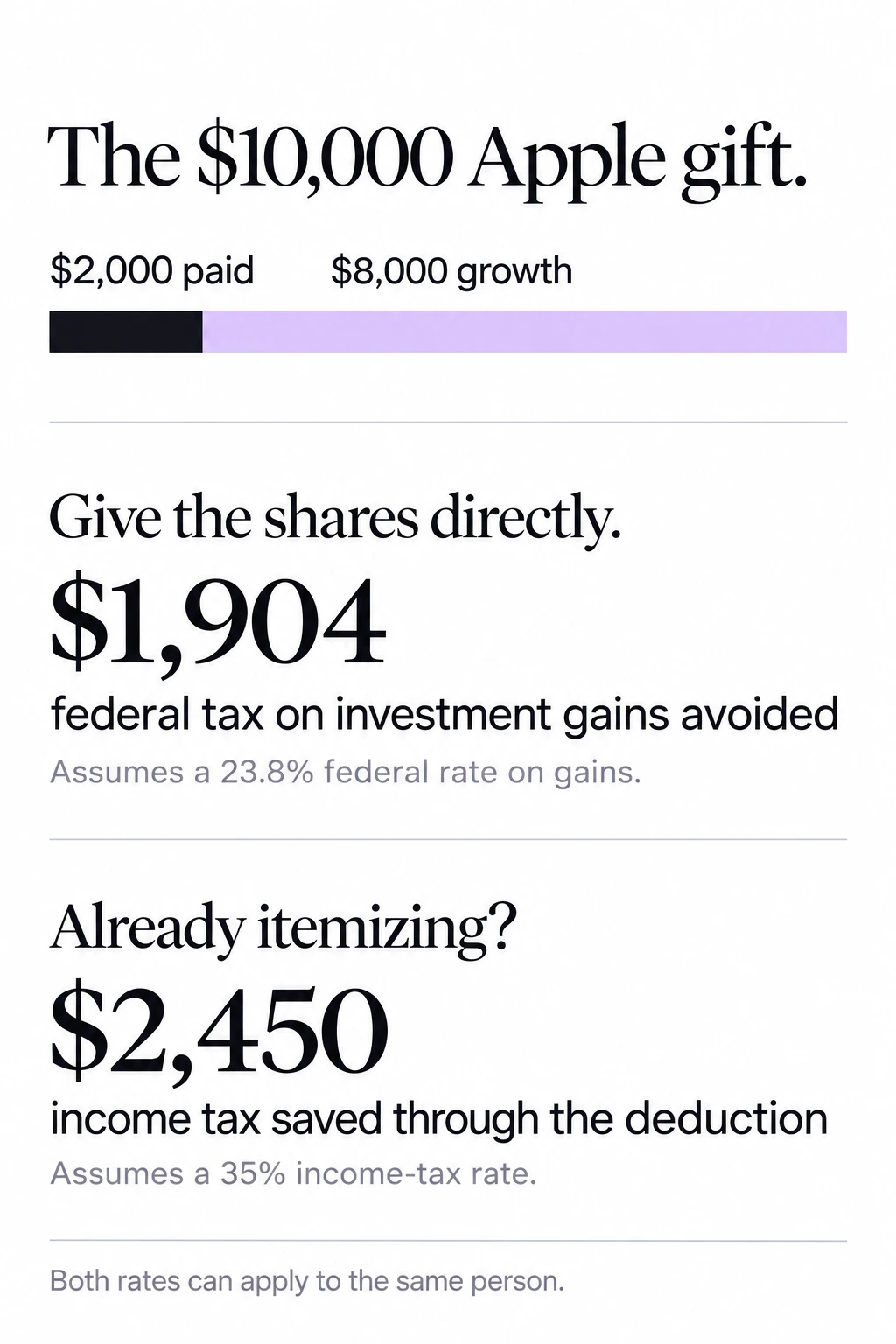
Suppose Apple shares you bought for $2,000 are now worth $10,000. Selling would realize an $8,000 gain.
The example assumes a 20% federal long-term capital-gains rate plus the 3.8% net investment income tax: 23.8% in total. Your rates may differ.
| Example | Amount |
|---|---|
| Current share value | $10,000 |
| Original cost | $2,000 |
| Gain if sold | $8,000 |
| Federal sale tax at an assumed 23.8% | $1,904 |
Give the shares directly to an eligible public charity before a sale is fixed or practically certain, and it receives the $10,000 investment. The charity must have meaningful control over the shares. You generally don’t recognize the capital gain—even if you take the standard deduction.
If a sale is already arranged or your right to the proceeds has matured, confirm the timing and transaction details with a tax professional before transferring shares. The IRS discusses these assignment-of-income issues in a fact-specific memorandum that is not binding precedent.
Sell first, and donating the cash doesn’t erase the gain. The $1,904 illustrates sale tax avoided compared with selling these shares; it is not a refund. Other gains, losses, and your actual tax situation can change the result.
Tax benefit #2: A possible income-tax deduction
The same gift may also qualify for a deduction based on the shares’ $10,000 fair market value, because you held them more than a year. The IRS’s charitable-contribution guidance explains property gifts and the applicable limits.
You must itemize to claim the stock-gift deduction: add up allowed expenses instead of taking the standard deduction, a fixed amount you subtract from income. Compare the two totals.
Assume your 2026 adjusted gross income is $600,000, you already itemize without the gift, and this is your only donation.
| Deduction example | Amount |
|---|---|
| Gift value | $10,000 |
| 0.5% of $600,000 AGI | $3,000 |
| Potential deduction after that floor | $7,000 |
| Income-tax savings if all $7,000 offsets income taxed at 35% | $2,450 |
The $2,450 is a separate illustration of incremental income-tax savings versus making no gift, under those assumptions. It is distinct from the $1,904 of avoided sale tax. A deduction is not a dollar-for-dollar tax credit, and giving still permanently transfers assets to charity.
Income-based limits, carryovers, other gifts, and the limitation affecting taxpayers in the top bracket can change the result.
Taking the standard deduction? Cash could make more sense. In 2026, eligible cash gifts to certain qualified organizations may be deductible up to $1,000, or $2,000 for joint filers, without itemizing. Stock gifts do not qualify for that separate deduction. Compare it with the sale tax you could avoid by giving shares directly. See IRS Topic 506.
Make the gift count for 2026
Once you’ve chosen what to give, the transfer needs to be completed this year.
- Check the charity’s eligibility and confirm that it accepts your shares. Gifts to individuals don’t count.
- Get transfer instructions, specify the exact shares, and check your brokerage’s cutoff. Complete the transfer by December 31; submitting a request isn’t enough.
- Keep the charity’s acknowledgment, purchase records, and transfer confirmation to support the gift’s value, timing, and deduction. Check whether you need Form 8283.
Compare your giving options in Mezzi
Your best choice depends on what you own, your taxes, and the money your family needs. Mezzi can bring that financial picture together to compare cash with shares.
Upload your 2025 return, or a 2026 draft if available, and your latest pay stub if you receive one. Tell Mezzi your giving budget and what has changed since the return was prepared. It can check whether itemizing could help and recommend what to give and why.
Ask Mezzi
Should I give cash or appreciated shares?
Recommend my giving planEach link opens a personalized prompt in Mezzi. The prompts ask for missing facts, compare equal gift amounts, and separate potential deductions from avoided sale tax.
Start with the gift you want to make. Then choose how to fund it.