The BoostMezzi’s Sunday email about one decision shaping your wealth.
Before 2026 ends, look at your paycheck and investments together.
What you earn, what you sell, and what you keep at risk can change your plan.
Last week, we looked at what your tax return can reveal about your investments. Now, use that picture to evaluate the decisions still ahead.
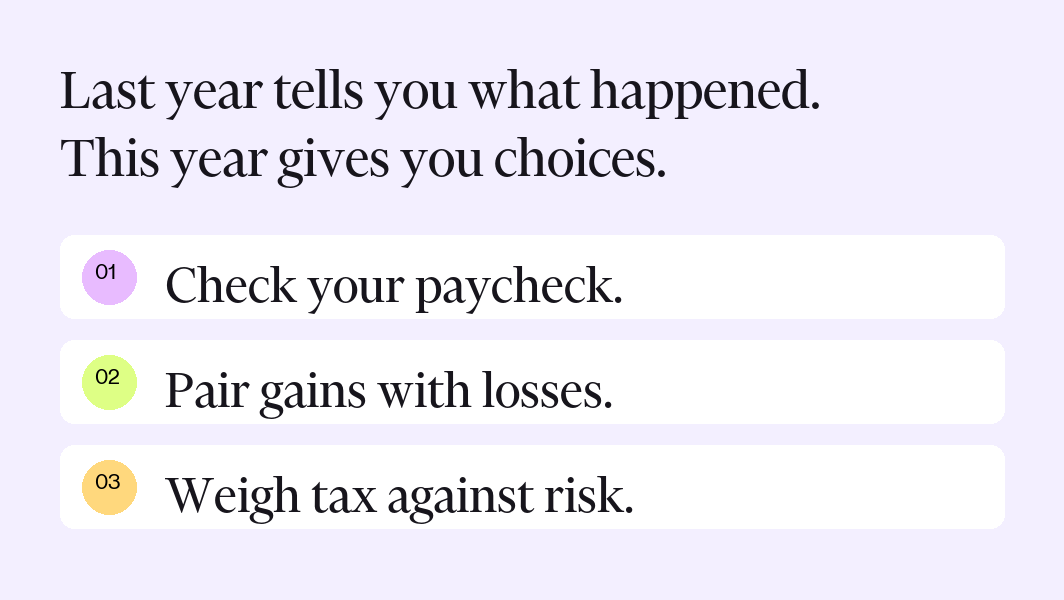
1. Check the tax withheld from your paycheck
Your employer withholds tax from your pay. It may not account for investment gains, your spouse’s income, or a big bonus.
Compare what you’ve earned and paid so far with what you expect for the full year. There’s still time to review the tax withheld from remaining paychecks. The IRS Tax Withholding Estimator can help you estimate federal withholding and prepare an updated Form W-4.
Check: Am I paying enough as I go?
2. Use investment losses to offset gains
Realized investment losses in taxable accounts can offset gains from a sale you wanted to make.
For example, $30,000 in gains minus $10,000 in eligible losses leaves a $20,000 net gain. That is a smaller taxable gain, not $10,000 off your tax bill. The tax effect depends on factors including whether gains and losses are short- or long-term.
Buying the same or a substantially identical investment within 30 days before or after a loss sale can trigger the wash-sale rule and disallow the current loss deduction. Check purchases across accounts, including automatic reinvestments. The IRS’s investment income guidance explains capital losses and wash sales.
Look into: Could losses make a planned sale less costly?
3. Weigh taxes against the risk of a large stock holding
Keeping a big winner avoids realizing a gain today. It can also leave a large share of your family’s wealth tied to one stock.
Suppose a stock makes up 30% of your portfolio. A 20% drop in that stock would mean a 6% portfolio loss, if everything else stayed flat. This is a hypothetical illustration, not a forecast.
Taxes matter. So does the risk you continue to hold.
Ask: How much risk am I keeping to avoid paying tax?
Bring it together in Mezzi
Your 2025 tax return gives you last year’s tax picture and can help identify loss carryforwards. Your latest 2026 pay stub adds income, withholding, and retirement contributions for the year so far. Your connected accounts show what you currently own.
Make sure your Financial Profile is complete. Choose a question below, then upload your latest pay stub and 2025 tax return together in the same chat.

Ask Mezzi
What should I review before the year ends?
Put my paycheck in contextOr start with an investment decision:
The prompts ask for missing information before estimating and help you prepare specific strategy questions for your CPA. Current holdings alone do not show every sale or available loss.
Leave with one decision to evaluate, the information still needed, and a date to act. December should be for finishing your plan.