Updated September 26, 2026.
How many 401Ks have you had? If you’re like my wife and me, you’ve ended up with multiple 401Ks over the years. We’ve had seven in total. After leaving a job, we’d often forget about our old 401K for months, or even years. In fact, we recently discovered a 401K from over 10 years ago. While the funds were fully invested, we were paying hefty fees that hurt our returns.
What you need to know
Forgetting about a 401K isn’t crazy considering people switch jobs every few years. When they do, they often participate in a new 401K plan, given an employer match as well as overall tax-saving opportunities offered by retirement accounts.
Unfortunately, each new plan could be through a new provider. Let’s say your first job offered a 401K through Empower. Two years later you start a new job and contribute to a new 401K offered through Fidelity Net Benefits. Again, you switch jobs a couple of years later and now the new system is offered through Schwab. If you are young, you could find yourself with several more 401Ks through the years. In addition to remembering a lot of passwords, each 401K plan requires researching a unique set of investment options, which can vary significantly between providers. For example, below is a list of investment options in a Fidelity 401K:

Finding an old plan is only the first step. Review its current balance, investments, beneficiary record, fees, and available services. Compare those facts with your goals before changing the account. Contribution limits change by year; the original issue’s dollar limit should not be used as a current limit.
Compare the complete cost before consolidating
Consolidation can simplify recordkeeping, but moving a workplace plan is not automatically beneficial. Compare keeping the account, an eligible new employer plan, and an IRA based on costs, investment options, services, withdrawal rules, and applicable protections. A Roth conversion is a separate tax decision, not simply another name for a tax-free rollover.
Administrative fees: Read the plan fee disclosure and statements. Some charges are fixed, some depend on assets, and some may be paid by the employer. Compare actual costs with the proposed destination; an IRA can also have account, advisory, transaction, and investment expenses. A claimed industry average cannot establish whether your plan is expensive.

Here’s a snapshot of what your fees may look like in your account’s transaction history. They may seem small, but they will add up before you know it.

Lower investment fees: While many 401K plans now have low-cost ETF and mutual fund options, it’s important to make sure you aren’t paying a high expense ratio.
Variety of investment options: An IRA allows you to invest in a significantly wider range of investments - essentially most of the stocks, bonds, ETFs, and mutual funds available in most brokerage accounts. The employer plan offers its selected menu; broader choice alone does not guarantee better or cheaper investments.
For an eligible rollover, a direct transfer to the receiving retirement plan can avoid the mandatory withholding that generally applies when a taxable eligible distribution is paid to you. A pre-tax transfer to Roth is generally taxable; not every distribution qualifies for rollover. Confirm the source, destination, and tax character with the institutions and your tax professional. IRS rollover guidance
A fee comparison you can reproduce
Editorial update, September 26, 2026. Suppose an old plan holds $100,000, charges $60 a year for administration, and contains funds with a weighted expense ratio of 0.40%. A proposed destination has no account fee and a hypothetical 0.10% fund cost, but optional advice costs 0.50%.
| Arrangement | Calculation at a constant $100,000 | Approximate annual cost |
|---|---|---|
| Old plan | $60 + $100,000 × 0.40% | $460 |
| Destination, self-directed | $100,000 × 0.10% | $100 |
| Destination, with advice | $100,000 × (0.10% + 0.50%) | $600 |
These are invented numbers for a calculation, not quotes or industry averages. The self-directed comparison suggests $360 less annual cost; adding advice makes the destination $140 more expensive. The added service may still be worth paying for, but the claim would be service value, not a fee saving.
Record each option's investment menu and the responsibilities you would assume alongside this cost table. Keep copies of the plan's fee disclosure, the receiving account agreement, and the confirmed rollover instructions. A simpler dashboard is useful; it does not settle the rollover decision.
How can Mezzi help?
Mezzi can bring supported retirement-account information into the broader household view. Use it to discuss allocation alongside other accounts, with AI Personalization supplying your goals and constraints. Institution and account coverage vary. Confirm data completeness against plan records; Mezzi does not execute a rollover. See the current account-group explanation for the Investments, Banking, Other Assets, and Liabilities views.
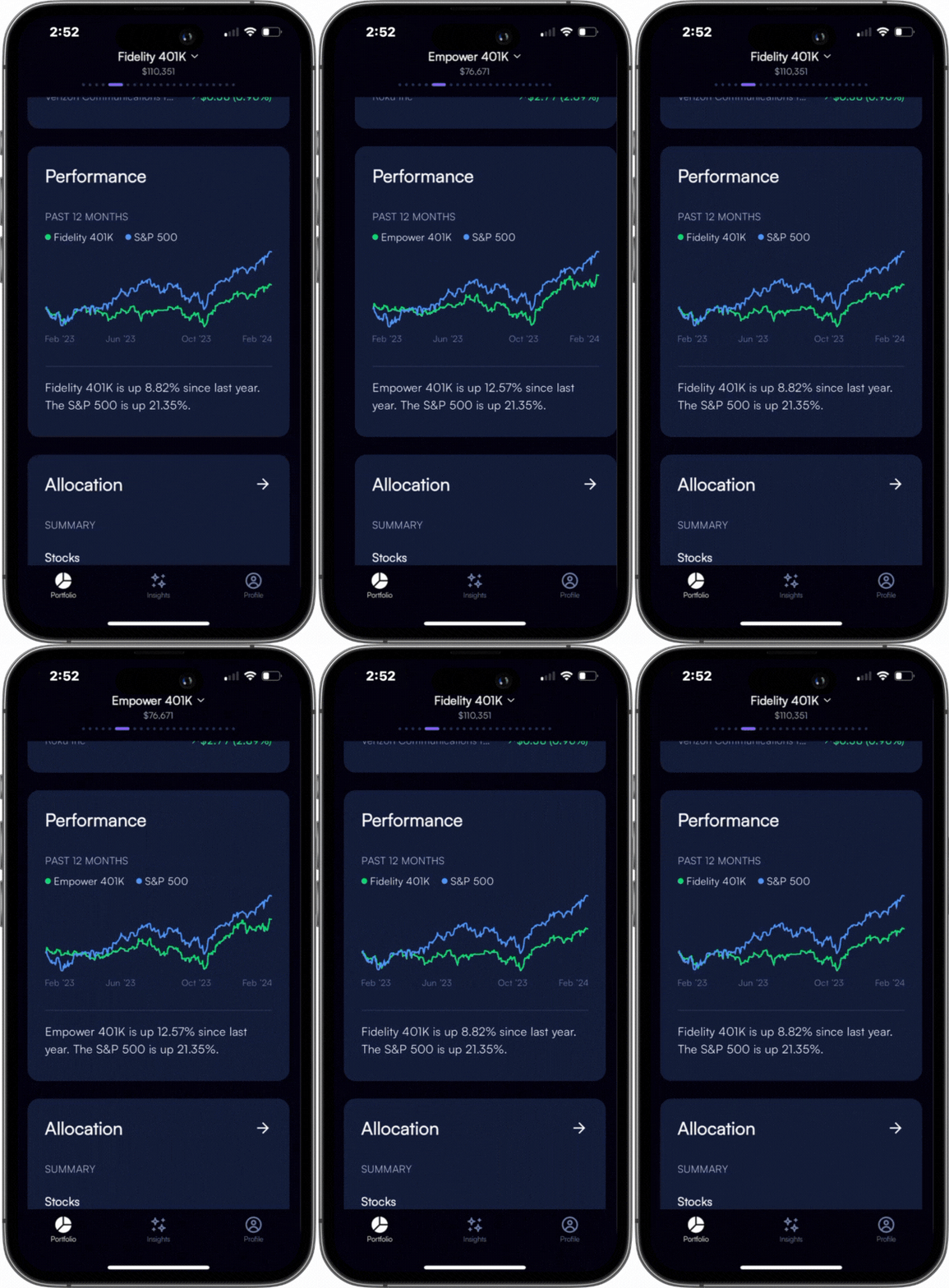
Explore Mezzi today. See how your available accounts and personal goals fit together.
Explore MezziFor current product details, visit the Mezzi help center.
This archived newsletter is educational and is not personalized investment, tax, or legal advice. Historical product descriptions, prices, and market examples may no longer apply. Investing involves risk, including loss of principal.