
Want to retire early? The FIRE movement - Financial Independence, Retire Early - focuses on saving aggressively, investing wisely, and cutting unnecessary expenses to leave work behind years ahead of the common retirement age.
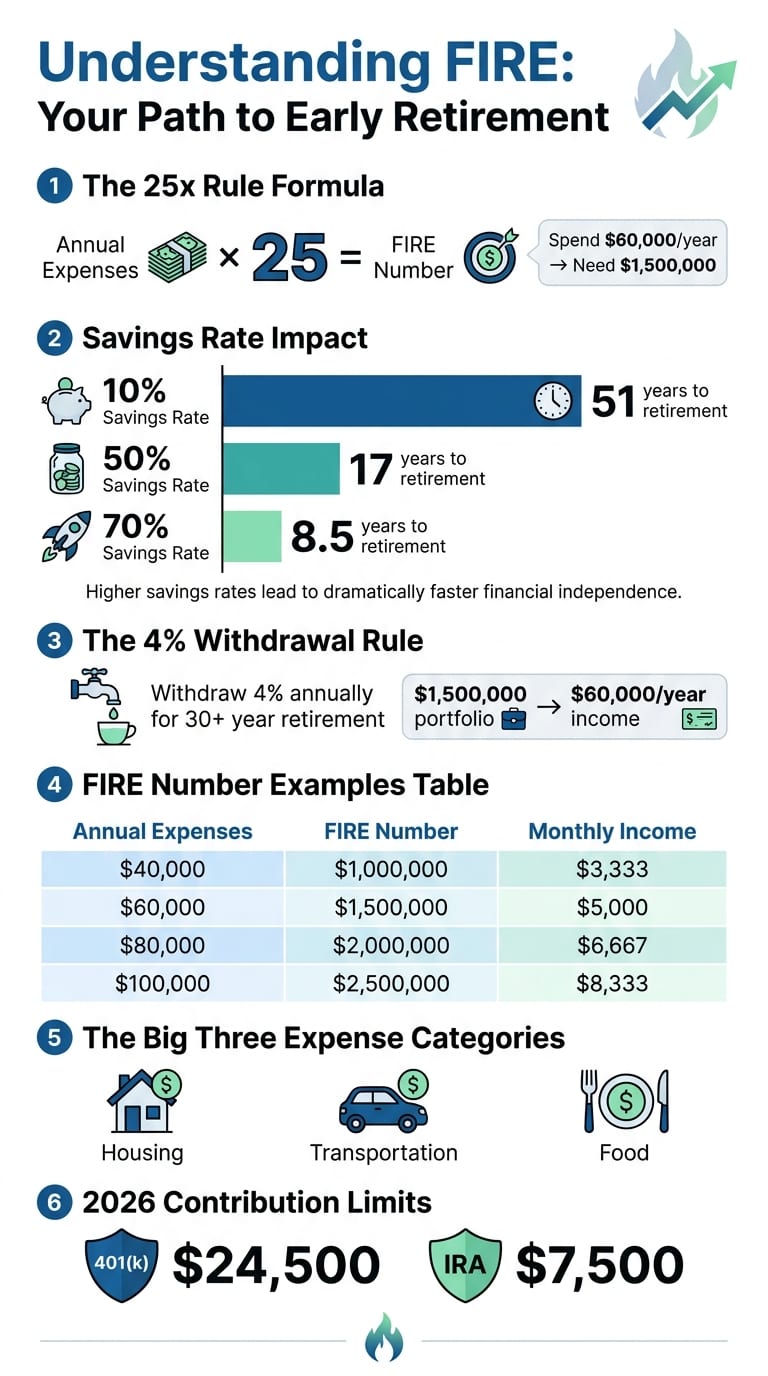
Here’s the core idea: Save 50–70% of your income, invest strategically, and build a portfolio large enough to cover your annual expenses indefinitely. Many use the "25x Rule" to calculate their target savings, meaning you’d need 25 times your annual expenses to retire comfortably. For example, if you spend $60,000 a year, your target is $1.5 million.
Key Takeaways:
- Savings Rate Matters: Saving 10% of your income might mean working 50+ years. Boosting that to 50% could cut it down to 17 years.
- The 4% Rule: Withdraw 4% of your investments annually to sustain a 30+ year retirement.
- Expense Control: Focus on reducing costs in housing, transportation, and food.
- Income Growth: Maximize earnings through skill-building, career moves, or passive income streams.
- Smart Investing: Use low-cost index funds and tax-advantaged accounts like 401(k)s and IRAs.
The movement has gained traction among high earners - like tech professionals and doctors - who aim for "Fat FIRE" (retiring early with a luxurious lifestyle). Tools like Mezzi are making the path easier by offering AI-driven insights to optimize savings, investments, and tax strategies.
While the path to FIRE requires discipline, it’s about achieving freedom over your time and choices. The rest of the article dives deeper into strategies, risks, and tools to help you reach financial independence faster.
The Ultimate Guide to FIRE in 2026 (Step-by-Step)
The 3 Core Principles of FIRE
FIRE (Financial Independence, Retire Early) revolves around three main strategies that help you create a gap between what you earn and what you spend. As the firenum team puts it:
The key insight: it's not about how much you earn, it's about the gap between earning and spending.
These strategies are designed to turn that gap into wealth that lasts. Here's how they work in practice.
Maximize Your Income
Boosting your income can be one of the easiest ways to increase your savings rate without making drastic lifestyle changes. One effective method is skill stacking - combining complementary skills to qualify for better-paying opportunities. For example, a software engineer who learns product management can expand their career options and earning potential.
Strategic career decisions, like switching to higher-paying roles or negotiating raises, can result in significant income growth. Some people also develop passive income streams, such as rental properties or dividend-paying investments, which can provide additional funds for savings and investments.
For the 2026 tax year, individuals can contribute up to $24,500 to a 401(k) and $7,500 to an IRA. Growing your income makes it easier to take full advantage of these tax-advantaged accounts, accelerating your journey to financial independence.
Minimize Your Expenses
Cutting back on expenses is just as important as increasing income. FIRE enthusiasts often focus on the "Big Three" expenses - housing, transportation, and food - to find the largest opportunities for savings. For instance, house hacking - such as renting out extra rooms or living in part of a multi-family home - can reduce housing costs significantly. Another strategy, geographic arbitrage, involves moving to areas with a lower cost of living to stretch your income further.
Take Marcus and Jen, for example. In 2008, they started their FIRE journey with a combined income of $108,000. Instead of buying a $325,000 house, they chose a $189,000 home and drove paid-off used cars. By maintaining a 62% savings rate and maximizing their retirement contributions, they reached their Lean FIRE goal of $815,000 by summer 2026, retiring at ages 47 and 45.
While traditional advice suggests saving 10–15% of your income, FIRE followers often aim for savings rates of 50–70%. The difference is striking: saving 10% might mean working for about 51 years, but saving 50% could reduce that to 17 years. Push it to 70%, and you could retire in just 8.5 years.
Invest Aggressively
Saving money is only part of the equation. To achieve FIRE, your savings need to grow through smart investing. Many in the FIRE movement focus on low-cost index funds with expense ratios below 0.1% to 0.2%, ensuring fees don’t eat into long-term returns. A well-diversified portfolio often includes domestic stocks, international stocks, and bonds.
The order in which you invest matters, too. Start by maximizing employer-sponsored 401(k) contributions (especially to get the full match), then move on to IRAs and HSAs before using taxable brokerage accounts. Automating your investments helps you stay consistent, regardless of market ups and downs.
As Surplus explains:
The FIRE movement is not magic... it is a framework for buying more freedom through intentional spending, a higher savings rate, and long-term investing.
How to Calculate Your FIRE Number
Understanding the FIRE Number
Your FIRE number represents the amount of money you may need in your investment portfolio to make work optional. It’s calculated by multiplying your annual expenses by 25. This formula, often called the "Rule of 25", is tied to the 4% safe withdrawal rule, which research, including the Trinity Study, suggests has a high likelihood (95% or more) of sustaining a 30-year retirement.
Here’s how it works: If your annual expenses are $50,000, multiplying that by 25 gives you a FIRE number of $1,250,000. The table below provides additional examples:
Annual ExpensesFIRE Number (25x Rule)Monthly Passive Income (4%)$40,000$1,000,000$3,333$50,000$1,250,000$4,167$60,000$1,500,000$5,000$80,000$2,000,000$6,667$100,000$2,500,000$8,333
Your expenses - not your income - are the key factor in determining your FIRE number. For instance, cutting $100 from your monthly expenses could reduce your target by about $30,000, while trimming $1,000 per month might lower it by $300,000.
For those planning for a longer retirement, a more conservative withdrawal rate, such as 3.25% or 3.5%, may be worth considering. This adjustment increases the multiplier to approximately 28.6 to 30.8. Additionally, if your savings are primarily in traditional tax-deferred accounts like 401(k)s or IRAs, you might want to increase your FIRE number by 10–15% to account for potential tax obligations.
Using Mezzi to Calculate Your FIRE Number

Mezzi takes the traditional FIRE calculation a step further by using advanced data analysis to refine your target.
Instead of relying on rough estimates, Mezzi securely links to your financial accounts through read-only access, analyzing your real income, spending patterns, and investments. This approach allows Mezzi to calculate your FIRE number based on actual financial activity instead of generic assumptions.
Mezzi also applies the 4% safe withdrawal rule to help you understand how much you may need to save and how long it could take to reach financial independence. You can ask specific questions like, "What happens if I increase my 401(k) contributions?" or "How would moving to a lower-cost area impact my timeline?" Mezzi provides tailored answers grounded in your actual transaction history.
Beyond calculation, Mezzi identifies ways to potentially speed up your progress. It highlights opportunities such as tax-loss harvesting, optimal timing for Roth conversions, and tax-efficient rebalancing strategies. Mezzi also tracks your progress around the clock, offering insights akin to what you'd expect from a high-cost financial advisor - all while simplifying the path to early retirement.
How to Accelerate Your Path to FIRE
Speeding up your journey to FIRE (Financial Independence, Retire Early) often boils down to smart strategies: reducing taxes, avoiding overlapping exposures, and leveraging AI-powered tools for actionable insights. Mezzi's platform is designed to help you implement these methods effectively.
Reduce Taxes to Boost Savings
Taxes can take a big bite out of your investment returns. Strategies like tax-loss harvesting, Roth conversions, and avoiding wash sales may help reduce your tax bill and free up more money to reinvest.
- Tax-loss harvesting: This involves selling investments at a loss to offset capital gains, potentially lowering your taxable income. However, wash sales - buying the same or a substantially similar asset within 30 days - can cancel out these benefits, so timing is key.
- Roth conversions: Moving funds from a traditional IRA to a Roth IRA can result in tax-free growth, but the timing of the conversion can significantly impact your tax liability.
Mezzi simplifies these processes by monitoring your portfolio across accounts and flagging opportunities. For instance, it can alert you when the wash sale period ends or identify the best timing for a Roth conversion. You can even ask specific questions, like, “Which positions are good candidates for tax-loss harvesting right now?” Mezzi tailors its answers based on your actual holdings and transaction history.
According to Mezzi's data, users may uncover over $1,000 in annual tax and fee savings. If reinvested, a $10,221 tax saving could potentially grow to $76,123 over 30 years, assuming a 7% annual return.
Avoid Overlap and Strengthen Diversification
Owning multiple funds doesn’t always mean true diversification. Many investors unknowingly hold the same stocks across different ETFs and mutual funds, leading to false diversification and unnecessary fees.
For example, seven companies - Apple, Nvidia, Microsoft, Google, Amazon, Tesla, and Meta - accounted for approximately 32.5% of the S&P 500 as of Q1 2026. If your portfolio includes a total market fund, a large-cap growth fund, and a tech-focused ETF, you might have much higher exposure to these companies than you realize.
"The number of funds is not the measure of diversification. The overlap between them is." - Mike Young, Author, Truthifi
Mezzi’s Portfolio X-Ray feature identifies hidden overlaps in your portfolio. It scans your ETFs and mutual funds to reveal the actual exposure to individual stocks, helping you avoid over-concentration. You can toggle this feature on the Mezzi dashboard to see if a stock you thought was a small holding is actually a major concentration due to overlapping funds.
The platform also uses a 40/70 framework to flag funds with over 70% overlap as being in the "Red Zone", suggesting they may be consolidated to reduce fees unless specific tax reasons justify keeping them. Additionally, Mezzi’s Fee & Fund Analyzer can recommend lower-cost alternatives to high-expense funds. Saving even 1% on fees could add as much as $186,877 to your portfolio over a lifetime.
"Mezzi's X-Ray feature allowed me to uncover exposure to stocks I didn't realize I had." - Shuping, Founder, Summer AI
Leverage AI for Smarter Financial Decisions
Traditional financial advisors often charge around 1% of assets under management (AUM) annually, which can amount to $5,000 on a $500,000 portfolio. Mezzi is free to get started. Choose Advisory for unlimited advice and advanced features at $39/month or $399/year. Concierge includes the same, plus hands-on support, at $99/month or $999/year.
The platform connects to over 10,000 financial institutions through services like Plaid and Finicity, giving you a comprehensive view of your finances, from brokerage accounts to 401(k)s and even crypto holdings. You can ask complex financial questions - like whether to prioritize mortgage payments or max out HSA contributions - and receive tailored answers based on your financial data. Mezzi’s hybrid approach combines real-time market information with your portfolio details to provide accurate, actionable insights.
"Mezzi leverages AI to educate and inform users, and offer ideas and suggestions, but the user remains in control and makes all final decisions about their investments." - Manish Jain, CEO, Mezzi
With a 4.9/5 rating on the Apple App Store, users often highlight the convenience of seeing all accounts in one place and the value of uncovering hidden stock concentrations through Mezzi’s X-Ray tool.
Managing Early Retirement Risks
Early retirement comes with challenges that aren't typically part of traditional retirement plans. Issues like healthcare costs, market fluctuations, and the possibility of outliving your savings can put your FIRE (Financial Independence, Retire Early) strategy at risk. Successfully addressing these concerns is crucial to enjoying early retirement without needing to re-enter the workforce.
Healthcare Costs and Longevity Risk
Retiring before age 65 means covering steep healthcare premiums and planning for a longer retirement period. For example, in 2025, the average monthly premium for an unsubsidized silver-tier ACA plan for a 62-year-old is projected to be $1,116. A 35-year-old planning to retire at 50 might face an estimated $380,000 in healthcare costs before becoming eligible for Medicare.
Additionally, early retirement can last far longer than the typical 30-year planning horizon. Retiring at 40 could mean financing 50 years or more of expenses. To account for this, economists suggest lower withdrawal rates - around 3.25% to 3.5% - for extended retirements. This adjustment means you may need savings equal to 30 times your annual expenses, rather than the standard 25 times.
To prepare for these challenges, maximizing contributions to a Health Savings Account (HSA) can be a smart move. HSAs offer triple tax benefits: deductible contributions, tax-free growth, and tax-free withdrawals for qualified medical expenses. Some early retirees also explore "Barista FIRE", working part-time to maintain employer-sponsored health insurance until Medicare eligibility. As personal finance educator Shang Saavedra explains:
I have heard of some early retirees working part-time or just enough hours to get health insurance. If you plan to retire fully... keep in mind that the premiums increase as you age.
Beyond healthcare, market volatility introduces another layer of complexity to early retirement planning.
Market Volatility
Experiencing a market downturn early in retirement can lead to sequence-of-returns risk, which may derail even the most well-thought-out plans. Deepak Shukla, CEO of Pearl Lemon Accountants, highlights the danger:
One market downturn could unwind years of planning and leave a person wondering if they had seriously underestimated long-term living expenses.
One way to address this risk is by adopting a dynamic spending approach. This involves setting a spending "ceiling" and "floor" that adjusts based on market performance. Diversifying your portfolio with international stocks and bonds can also help strengthen your financial position over a long retirement period. Certified Financial Planner Rachael Burns advises:
FIRE is a long-term strategy, and you can't be too reactive to short-term economic events. You may need to adjust spending or saving in certain years based on market events, but the underlying strategy should stay the same.
Another effective tactic is maintaining a cash reserve. Many early retirees keep 1–2 years' worth of living expenses in low-risk investments to avoid withdrawing from their portfolio during market downturns.
How Mezzi Helps Reduce Risks
Mezzi's platform offers tools designed to help you manage these risks effectively. By linking all your financial accounts - such as 401(k)s, IRAs, taxable brokerage accounts, and HSAs - it provides a complete view of your financial situation and identifies potential problem areas before they escalate.
If market volatility threatens your withdrawal strategy, Mezzi allows you to model various scenarios and adjust your spending plan accordingly. For example, its AI-driven tools can answer questions like, "How long will my portfolio last if I withdraw $50,000 per year during a bear market?" or "Should I focus on HSA contributions over Roth conversions this year?" - all tailored to your specific financial data.
When it comes to healthcare planning, Mezzi helps you calculate how much to save in your HSA and taxable accounts to cover costs until Medicare kicks in. It also guides you on strategies like Roth conversion ladders, which allow you to access retirement funds before age 59½ without triggering a 10% early withdrawal penalty.
Conclusion
Achieving financial independence and early retirement (FIRE) involves a combination of increasing income, reducing expenses, and making thoughtful investment decisions. The ultimate goal? Accumulating 25 times your annual expenses to step away from mandatory work years ahead of traditional retirement timelines.
The real challenge isn’t understanding these principles - it’s applying them consistently while navigating tax rules, portfolio diversification, healthcare planning, and market fluctuations. That’s where Mezzi steps in. By integrating your financial data, Mezzi provides actionable insights tailored to your situation - guidance that often costs thousands through traditional advisors but is offered here at a fraction of the price.
Mezzi’s platform connects theory to practice with features like dynamic tax strategies and portfolio monitoring. It answers critical FIRE questions based on your unique financial picture: “Can I retire by 45 with my current savings?” “Should I focus on Roth conversions or HSA contributions this year?” “How might a market downturn impact my withdrawal plan?” As your circumstances evolve, Mezzi’s recommendations adapt to keep you on track. As Andre, Author of FAANG Fire, shares:
I've tried a lot of personal finance products. This is the only one with deeply integrated AI and the team is shipping updates quickly.
Even small improvements, like effective tax strategies, may enhance returns by 1%–2%. For a $1 million portfolio, this could mean an extra $10,000–$20,000 annually - potentially exceeding $1 million in savings over 30 years. These gains might be the difference between retiring early with confidence or delaying retirement due to uncertainty.
Reaching financial independence requires thoughtful planning, regular adjustments, and flexibility. Mezzi simplifies this process by turning complex strategies into clear, actionable steps. With its personalized insights, early retirement can shift from being a dream to a well-calculated, achievable goal.
FAQs
Is the 4% rule safe for a 40–50 year retirement?
The 4% rule is often viewed as a reasonable guideline for managing withdrawals during a 40–50 year retirement. This approach assumes you adjust your withdrawals annually to keep pace with inflation and maintain a diversified investment portfolio. However, if your retirement stretches beyond 30 years, you may need to modify this strategy. Longer time horizons can introduce additional challenges, such as market volatility and the uncertainty of how long your savings will need to last.
How can I access retirement accounts before age 59½ without penalties?
You may be able to access retirement accounts early without penalties through specific strategies. For example, the Roth conversion ladder involves converting funds to a Roth IRA and waiting five years before withdrawing them penalty-free. Another option is the Rule 72(t) SEPP, which allows fixed annual withdrawals based on life expectancy calculations.
Additionally, Roth IRA contributions (not earnings) can often be withdrawn at any time without penalties. For more flexibility, taxable brokerage accounts can provide a source of funds without early withdrawal penalties, acting as a helpful bridge in certain situations.
How much should I budget for health insurance before Medicare?
Before reaching Medicare eligibility at age 65, early retirees in the U.S. often need to plan for health insurance expenses on their own. The costs can differ based on the type of coverage chosen, but ACA marketplace plans may offer a more affordable option for some, especially with income-based subsidies. Other possibilities include COBRA continuation coverage, private insurance plans, or high-deductible plans paired with Health Savings Accounts (HSAs).
It’s a good idea to budget several hundred dollars a month for health insurance, though the exact amount varies depending on factors like income, coverage preferences, and whether subsidies are available. Planning ahead can help manage these costs effectively.
Disclosures:
- This content is for informational purposes only and does not constitute investment advice or a recommendation to buy or sell any security.
- Past performance is not indicative of future results. No guarantee of future performance or outcomes is implied.
- Savings and performance examples are hypothetical and for illustrative purposes only. Actual results will vary based on individual circumstances, portfolio composition, market conditions, and fees.
- Registration does not imply a certain level of skill or that the SEC has approved the company or its services.