
Looking for the best wealth management platform? Here's the quick breakdown:
- Vanguard: Focuses on passive investing with low-cost index funds and a hybrid model combining human advisors and AI tools. Fee-based structure starting at 0.30% of assets under management. Best for long-term, conservative investors who prefer advisor guidance.
- Mezzi: Fully AI-driven platform offering real-time portfolio adjustments, AI portfolio optimization for risk management, advanced tax optimization, and tailored strategies. Flat-rate pricing at $39/month or $399/year for Premium. Ideal for self-directed, tech-savvy investors seeking cost-efficient, dynamic portfolio management.
Quick Comparison
FeatureVanguardMezziManagement StylePassive, index-focusedActive, AI-drivenFees0.05%-0.30% of assets$39/month or $399/year (flat rate)Tax StrategyBasic ETF tax-loss harvestingAdvanced AI tax optimizationAccount Minimum$100No minimumTechnologySupplemental AI toolsCore AI-powered platformBest ForConservative, advisor-led investorsSelf-directed, tech-savvy investors
Bottom Line: Vanguard is a trusted name for traditional, hands-off investing, while Mezzi stands out for its cost savings and advanced AI tools tailored to modern investors. Choose based on your goals, preferences, and budget.
Investment Methods
Vanguard's Index Fund Approach
Vanguard focuses on passive investing through index funds, offering broad market exposure with low-cost options. Their wealth management strategy relies heavily on their own index funds, which track various segments like the S&P 500, international markets, and bond indices.
This platform takes a long-term, conservative approach with minimal trading. Key elements of their strategy include:
- Strategic asset allocation based on established market principles
- Automated rebalancing to maintain target allocations
- Diversification across a wide range of asset classes
Mezzi's AI-Driven Investment Strategy
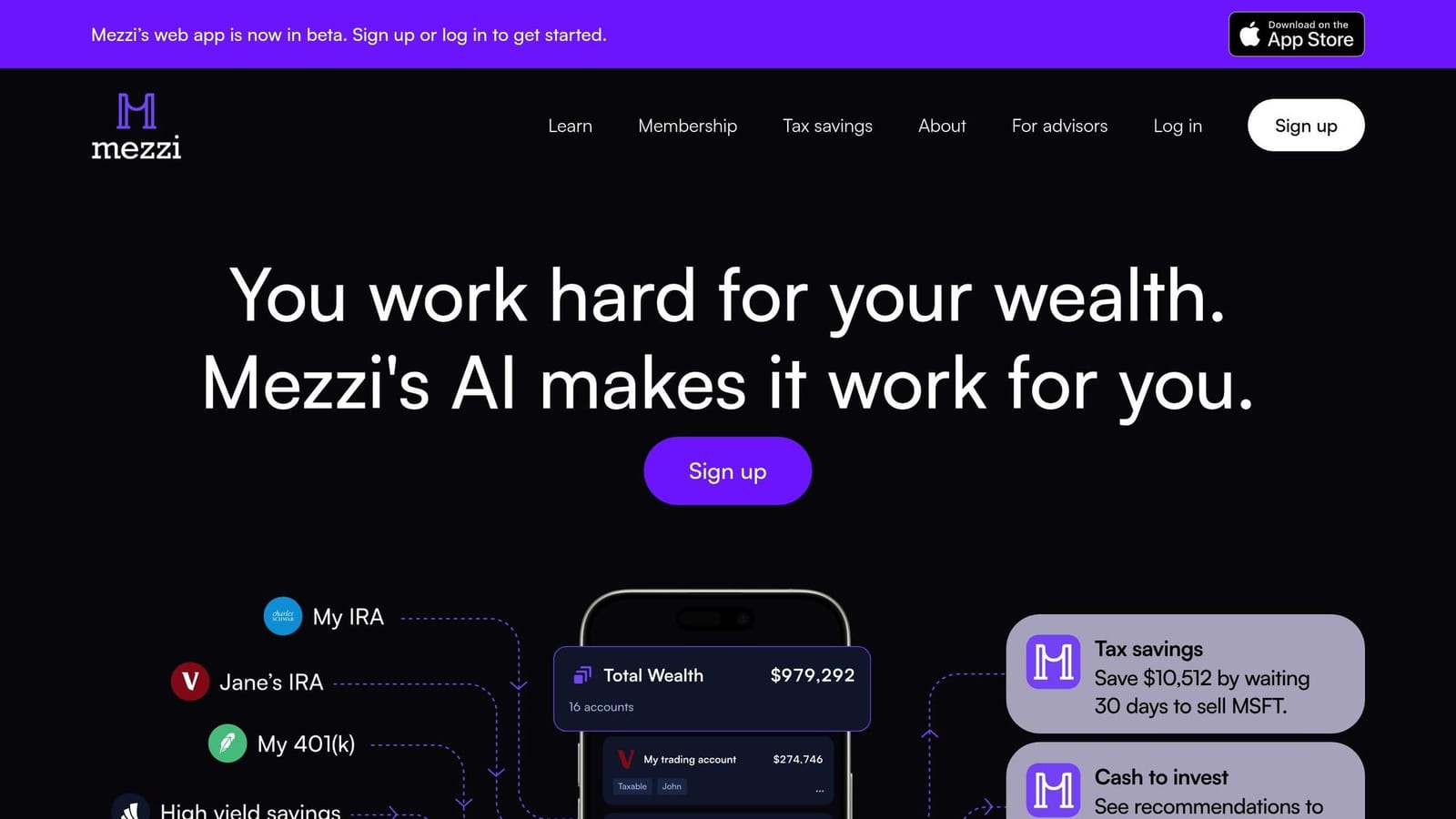
Mezzi, on the other hand, uses artificial intelligence to craft customized investment strategies. The platform's AI engine evaluates multiple factors to build tailored portfolios:
FactorAI ImplementationRisk ToleranceInstant risk assessmentFinancial GoalsAdapts portfolios to evolving goalsMarket ConditionsContinuously adjusts strategiesTax EfficiencyAutomates tax-loss harvesting
Mezzi's advanced AI features include:
- Real-time portfolio optimization suggestions
- Tools to uncover potential risks with AI
- Performance tracking across all accounts
- Unlimited AI chat support for investment advice
These tools allow Mezzi to offer a highly dynamic and responsive investment experience.
Comparing Investment Styles
The main difference between these platforms lies in their portfolio management approach. Vanguard aims for market-matching returns through passive index investing, while Mezzi uses AI-powered active management to seek opportunities for improvement.
AspectVanguardMezziManagement StylePassive, index-focusedActive, AI-drivenCustomizationLimited to pre-set allocationsFully tailored portfoliosTrading FrequencyLow and consistentAdaptive to market changesTechnology UseSupplemental toolsCentral to the strategy
Mezzi stands out by delivering real-time insights and portfolio adjustments through its AI system, which tracks performance and adapts to market shifts and individual needs. Its account grouping and family collaboration features also provide a unified view of investments across multiple accounts.
Wealthfront vs Vanguard Robo Advisor - Which is Best for You?
AI Features
Both platforms leverage AI to enhance portfolio management, aligning with their investment strategies.
Vanguard's AI Portfolio Tools
Vanguard uses AI to improve portfolio optimization and manage risk effectively. Their Portfolio Analytics Tool offers features like on-demand diagnostics, portfolio comparisons, and detailed reporting (available in PDF or Excel formats). It also allows for AI scenario analysis to test various strategies. Additionally, their Bond Duration Tool helps fine-tune fixed income portfolios, while the Portfolio Strategies team provides customized insights for more complex analyses.
Mezzi's AI Analysis System
Mezzi's AI platform focuses on delivering real-time insights to make wealth management simpler. Key features include:
AI CapabilityFunctionImpactAI Tax OptimizationIdentifies tax-saving opportunitiesAverage annual savings of over $1,000 Risk AnalysisAssesses portfolio risk in real timeImmediate risk evaluationsPerformance AnalyticsTracks overall account performanceConsolidated financial insights
The AI engine works continuously, spotting opportunities for improvement and offering instant recommendations.
AI Tool Comparison
The platforms' AI tools reflect their distinct approaches to portfolio management:
FeatureVanguardMezziPrimary FocusDetailed portfolio analysis and modelingReal-time insights with tax and risk focusCore ToolsPortfolio Analytics and Bond Duration Tools, plus personalized consultations$39/month or $399/year (Advisory)
Vanguard appeals to investors seeking deep, data-driven analysis, while Mezzi is ideal for those who want fast, actionable insights and ongoing financial optimizations.
Portfolio Management
Both platforms use advanced AI to offer distinct approaches to portfolio management, balancing automation with user control.
Vanguard's Portfolio Options
Vanguard Digital Advisor Services (VDAS) creates portfolios tailored to individual needs by considering various factors:
FactorCustomization ElementPersonalAge, marital status, income levelFinancial GoalsRetirement age, spending needsInvestment PreferencesRisk tolerance, savings ratePortfolio TypesAll-index, index/active mix, ESG options
VDAS uses automated management to maintain portfolio balance with features like:
- Daily rebalancing within 5% bands
- Over 300 personalized glide paths
- Portfolios built using four core ETFs (VTI, VXUS, BND, BNDX), ensuring diversification
- Tax-loss harvesting for taxable accounts
"In our robo discretionary offers we provide online financial planning tools designed to help you create a goal-based financial plan, and the service will create an investment strategy aligned with your personal inputs. We'll monitor your enrolled accounts frequently using an algorithm. We'll have full investment discretion in order to transact as necessary to align your account(s) with your goal(s)." - Vanguard Digital Advisor Services
Mezzi, on the other hand, takes a more dynamic approach with its AI-driven portfolio system.
Mezzi's Portfolio System
Mezzi leverages AI to provide real-time portfolio insights and wealth-building strategies:
FeatureBenefitReal-time AI AnalysisContinuous portfolio adjustmentsMulti-Account IntegrationUnified view across platformsAccount GroupingBetter organization for portfolio managementFamily CollaborationShared insights for joint planning
The platform emphasizes actionable insights for tax efficiency and portfolio improvement. Premium features add continuous AI-driven insights and risk discovery tools.
User Control Options
Vanguard and Mezzi differ in how much control they give users over their investments:
Control AspectVanguardMezziInvestment DecisionsAlgorithm-driven with preset optionsAI-assisted with user flexibilityRebalancingAutomatic within 5% bandsUser-guided with AI recommendationsAccount Minimum$100 as of September 2024No minimum requiredPortfolio MonitoringDaily automated checksReal-time monitoring with AI alerts
Recent updates have further enhanced user experience. For instance, VDAS added household-level management in June 2024 and introduced fractional share investing in August 2024 for more precise allocations.
Pricing also sets the two apart. Vanguard's all-index option costs 0.20% of assets managed annually, while Mezzi offers a flat $39/month or $399/year annual Advisory, a straightforward option that may appeal to users with larger portfolios.
Cost Comparison
Vanguard's Pricing
Vanguard uses a tiered, percentage-based fee structure, meaning the advisory fee depends on the size of your portfolio. Here's how it breaks down:
Portfolio SizeAnnual Fee RateFirst $5 million0.30%$5 million to $10 million0.20%$10 million to $25 million0.10%Over $25 million0.05%
Keep in mind, this fee only covers portfolio management. Other costs like fund expense ratios, trading fees, and capital gains taxes are additional.
"Your annual cost for Personal Advisor Wealth Management starts at just 0.3% of your advised assets." – Vanguard
Mezzi's Pricing
Mezzi offers a flat-rate pricing model, which keeps pricing the same regardless of portfolio value. Here's a look at their plans:
PlanAnnual CostKey FeaturesFreeFree to get startedBasic account consolidation, family collaboration, basic insightsPremium$39/month or $399/yearReal-time AI prompts, unlimited AI chat, risk discovery, advanced tax/fee analysis
This subscription-based approach can be especially appealing as your portfolio grows, keeping fees predictable and low.
Cost Examples
Here's how the costs compare across different portfolio sizes:
Portfolio SizeVanguard Annual CostMezzi Annual CostSavings with Mezzi$100,000$300$39/month or $399/year$181$500,000$1,500$39/month or $399/year$1,381$1,000,000$3,000$39/month or $399/year$2,881$5,000,000$15,000$39/month or $399/year$14,881
The difference is clear: Mezzi's flat-rate model can save you thousands over time. For example, a $10 million portfolio would cost $25,000 annually with Vanguard (calculated as $15,000 for the first $5 million at 0.30% and $10,000 for the next $5 million at 0.20%). With Mezzi, you'd pay just $39/month or $399/year for their Advisory.
Mezzi also highlights potential long-term benefits. They estimate that avoiding a 1% advisor fee could add $186,877 to your retirement savings. Their tax optimization tools claim to save $10,221 in capital gains taxes initially, which could grow to $76,123 over 30 years if reinvested.
"Saving 1%-plus on an advisor means saving over $1M over 30 years." – Mezzi
Final Analysis
After exploring investment methods, AI features, and portfolio management, let’s break down the key differences to help you decide which platform suits your needs.
Main Differences
Vanguard and Mezzi stand apart in several areas, including fees, management style, technology, and tax strategies:
AspectVanguardMezziFee StructurePercentage-based (0.05% – 0.30%)Flat rate ($39/month or $399/year)Management StyleAdvisor-led, traditionalAI-driven, self-directedTechnology FocusSupplementary AI toolsCore AI-powered platformTax StrategyBasic tax-loss harvestingAdvanced AI tax optimizationAccount IntegrationLimited consolidationComprehensive account integrationUser ExperienceAdvisor-dependentReal-time AI prompts
These differences highlight which platform works best for different types of investors.
Best Choice By Investor Type
- Self-directed investors: Mezzi’s AI tools simplify trade evaluations and help avoid wash sales. Over 30 years, this could save more than $1 million in advisor fees.
- High-net-worth individuals: Mezzi’s flat-rate pricing and advanced tax features provide significant savings. For example, $10,221 in initial tax savings can grow to $76,123 over 30 years if reinvested. Predictable costs are especially helpful for larger portfolios.
- Tech-savvy investors: Mezzi’s real-time AI prompts and consolidated account views save time and make decision-making easier. Users often report smoother portfolio management.
- Family financial planners: Mezzi’s collaboration tools and account integration make it easier to manage multiple portfolios. The flat-rate fee structure ensures cost efficiency while handling family finances.
Mezzi is free to get started. Choose Advisory for unlimited advice and advanced features at $39/month or $399/year. Concierge includes the same, plus hands-on support, at $99/month or $999/year.