
The short answer: the "8% a year" line may sound simple, but claiming Social Security is usually a tradeoff between smaller checks sooner and larger checks later. That 8% refers to delayed retirement credits after full retirement age, not an investment-like return.
Here’s the plain-English version:
- If I claim at 62, my monthly check may be much lower for life.
- If I wait until full retirement age, I may get my baseline benefit.
- If I wait until 70, my monthly check may be at its highest, but I may collect fewer total checks.
- The best fit may depend on life expectancy, cash flow, taxes, portfolio withdrawals, and survivor benefits.
- Break-even math may help, but it may not settle the decision on its own.
For example, with a $2,500 full retirement age benefit, the monthly amount may look like this:
That gap is large. But so is the timing gap. Claiming at 62 may mean getting money for eight extra years. Waiting until 70 may mean a bigger monthly check and, for some couples, a larger survivor benefit.
A simple way to frame it: this may be less about getting "8% a year" and more about choosing when income starts, how large it may be, and how that choice may fit with taxes and retirement spending.
Quick Comparison
If I were sizing this up, I’d treat the 8% figure as just one input. The bigger question may be whether waiting fits my health, household income, tax picture, and spouse planning.
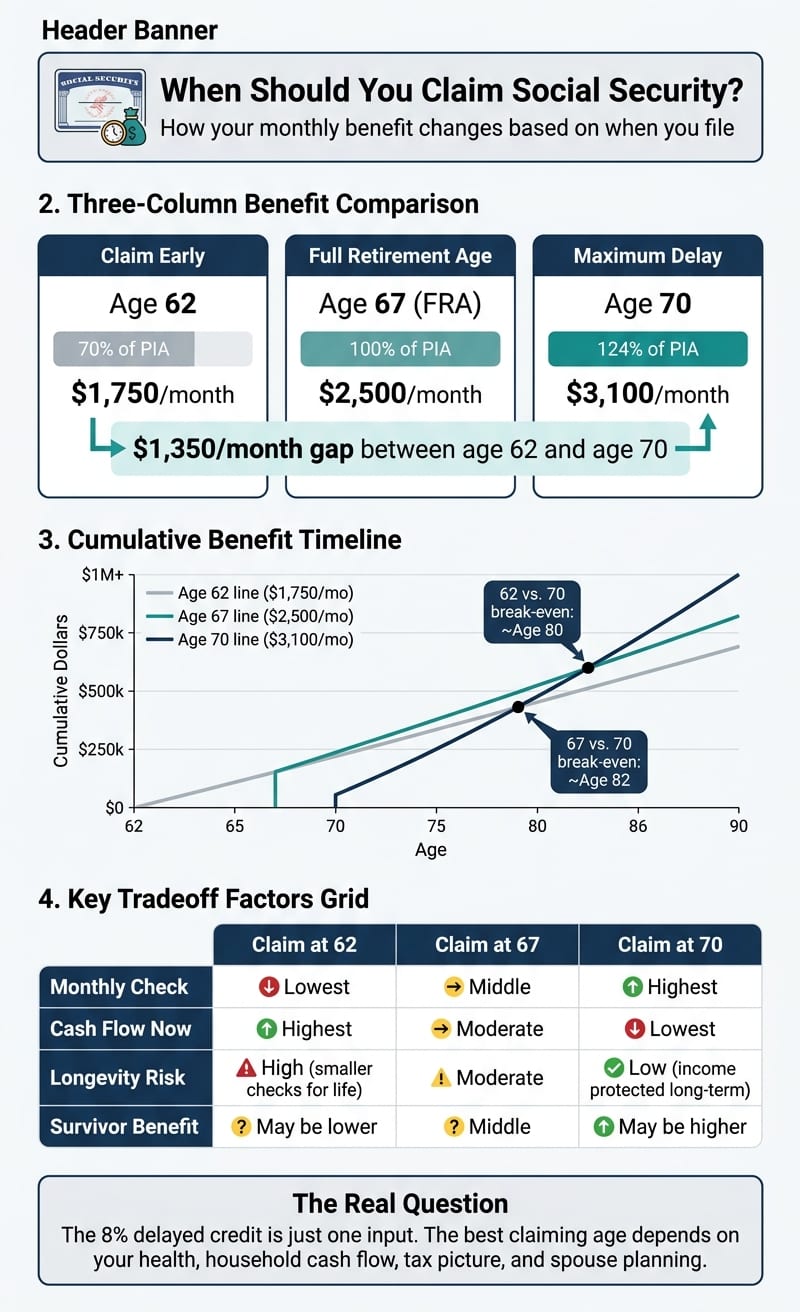
Social Security at 62 vs 67 vs 70: When should you start claiming your benefits?
How your benefit changes at 62, full retirement age, and 70
Your full retirement age benefit - called your primary insurance amount (PIA) - is the 100% baseline for the rest of the math. If someone claims earlier, the monthly amount may be lower for life. If they wait longer, the monthly amount may be higher for life.
For workers born in 1960 or later, FRA is 67. Claiming at 62 brings the benefit down to 70% of PIA. Waiting until 70 lifts it to 124%. On a $2,500 monthly PIA, that works out to $1,750 at 62 and $3,100 at 70 - a $1,350 monthly gap. That change stays in place, and COLAs apply to the amount claimed.
Here’s how that may look at 62, 67, and 70.
Claiming-age comparison table
Smaller checks sooner vs. larger checks later: the core tradeoff
The monthly gap stands out right away. But the timing matters too.
Claiming at 62 may put money in someone’s pocket years earlier. Claiming at 70 may mean a larger monthly check, but it also means fewer years of payments. That’s the tradeoff in plain English.
One detail is easy to miss: the 8% figure refers to a change in the monthly benefit, not a guaranteed gain over a full lifetime. The next step is figuring out when those bigger checks may catch up, which is where break-even analysis comes in.
Break-even age and lifetime benefit math
How break-even age works
Break-even age shows when delaying Social Security may start paying more in total dollars.
The idea is simple. One table may show the early claimant's head start. Break-even age shows when the larger delayed benefit may finally catch up. In plain English, it's the age when the total amount from waiting may exceed the total amount from claiming earlier, if you live that long.
Using a $2,000 full retirement age benefit, claiming at 62 pays about $1,400 per month, while waiting until 70 increases that to about $2,500 per month. By age 70, the person who claimed early has collected $134,400. Based on that gap, break-even lands at about age 80.
The same math applies to 67 versus 70. With the same $2,000 FRA benefit, waiting from 67 to 70 means giving up $72,000 in checks upfront, and the break-even point comes at about age 82.
Why break-even alone should not set your claim date
Break-even age may be a helpful starting point, but it may not tell the whole story. Three things often shape the decision more than the crossover age.
First, taxes. Up to 85% of Social Security benefits may be included in taxable income depending on combined income, and claiming early while taking larger withdrawals from a traditional IRA may reduce the after-tax value of those early checks.
Second, portfolio withdrawals. Delaying until 70 may mean drawing more from investment accounts during the gap years. If a market downturn hits early in retirement, the portfolio may end up smaller in a way a break-even table does not show.
Third, survivor benefits. The higher earner's benefit sets the survivor benefit, so waiting until 70 may lock in a larger base for a surviving spouse.
Break-even may show when waiting wins on paper. The next step may be to look at cash flow, taxes, and spouse planning before treating that number as the answer.
When to delay and when to claim earlier
Break-even age shows the math. This section looks at when that math may or may not fit real life.
When waiting until 70 makes sense
Waiting until 70 may fit best if you have enough savings, a pension, or part-time income to cover the gap years. In that case, your benefit may rise to about 124% of your full retirement age amount, and COLAs would apply to that larger base.
This path may look strongest for couples where one spouse earned much more than the other, especially if the household may have a long retirement. It may also increase the survivor benefit for the surviving spouse, which some households view as a form of income protection later in retirement.
A simple way to think about it: it may work a bit like longevity insurance. For example, if a primary insurance amount is about $2,400, waiting until 70 may lead to roughly $93,000 more in cumulative benefits by age 85 than claiming at 62.
Still, the answer may change fast when cash flow is tight, health is uncertain, or work income makes waiting hard to pull off.
When claiming at 62 or full retirement age can make sense
Claiming at 62 may be less about optimization and more about cash flow. If you've lost a job, have health limits, may have a shorter-than-average life expectancy, or may not have enough savings to bridge the gap years, early benefits may be the most practical move. For people born in 1960 or later, the reduction to about 70% of the full benefit is permanent, but in some cases it may compare favorably with selling investments during a market downturn.
Full retirement age - 67 for people born in 1960 or later - sits in the middle. At that point, there is no early-claiming reduction and no earnings test.
The next piece is how those claim dates may affect taxes and withdrawals.
Tax timing, portfolio withdrawals, and spousal coordination
Claiming age may also affect how much of your benefit gets taxed. Up to 85% of Social Security benefits may be included in taxable income, depending on combined income. If you claim early and also take withdrawals from a traditional IRA, those withdrawals may stack on top of your benefits and may push more of your Social Security into taxable income.
Delaying benefits may create a window - often from ages 62 to 70 - when income may be lower than it may be later, once Social Security and required minimum distributions (RMDs) begin. Some people use that window for Roth conversions, moving money from a traditional IRA to a Roth while in a lower tax bracket. Once Social Security starts and RMDs begin, that tax flexibility may narrow.
Medicare premiums add another layer. Higher income may trigger IRMAA surcharges on Part B premiums. For example, in 2026, a single filer with MAGI above $137,000 pays a total Part B premium of $405.80, compared with the standard $202.90. Large Roth conversions or portfolio withdrawals during the bridge years may push income into a higher IRMAA bracket, so withdrawal sequencing may matter.
That’s the real test: the best claiming age may depend on how it fits with your household’s tax picture, withdrawal plan, and spousal strategy.
A claiming checklist for your household
Use this checklist to turn the 62 vs. FRA vs. 70 tradeoff into a household decision.
Five questions to answer before you claim
Work through these before filing:
- How long may each spouse live? Family history and current health may give you a rough sense of whether a higher benefit may matter for many years.
- Which spouse may need the larger survivor benefit? For many couples, the higher earner delaying to 70 may protect the surviving spouse for life, because the survivor may receive up to 100% of the higher earner's benefit, including delayed retirement credits.
- Can your household fund spending until 70 without straining the portfolio? If bridging those gap years may require large withdrawals at the wrong time, such as during a market downturn, the case for delaying may look weaker in practice.
- What may you do in the tax window before Social Security and RMDs start? Once both begin, that flexibility may narrow.
- Does early claiming buy enough flexibility to justify a smaller lifelong check? Sometimes it may, especially if health is uncertain, cash flow is tight, or the portfolio may otherwise take on extra stress.
If the answers point in different directions, some households weigh flexibility, survivor protection, and cash flow before focusing only on the highest monthly check.
Key points to carry forward
- Treat the 8% credit as one input, not the full answer.
- Compare 62, FRA, and 70 as permanent income choices.
- Use break-even as a screen, not a decision rule.
Test the decision with your actual balances and cash flow. Mezzi may surface Roth-conversion timing, withdrawal planning, and whether your portfolio may fund a delay to 70.
FAQs
Is the 8% a year a real return?
Not in the traditional investment sense.
The 8% annual increase refers to delayed retirement credits: a guaranteed, permanent increase in your monthly Social Security benefit for each year you wait to claim after full retirement age, up to age 70.
That may act more like a guaranteed boost to lifetime income than a market-based return. Whether waiting may be worth it may depend mostly on your life expectancy and your other income sources.
What if I claim early and keep working?
You may claim Social Security as early as age 62 and keep working. But if you start that early, your monthly benefit may be permanently lower - often by about 25% to 30% compared with waiting until full retirement age.
There’s another piece to watch. If you’re under full retirement age, some benefits may be temporarily withheld if your earnings go over Social Security Administration limits.
For some people, the choice may come down to a few personal factors, such as:
- Health
- Life expectancy
- Overall financial goals
It’s not just about starting checks sooner. It may also shape how much you receive month after month.
How should couples coordinate claiming?
Couples may sometimes get more household income by coordinating when each spouse claims Social Security.
One approach some households use: the lower-earning spouse may claim earlier to add near-term cash flow, while the higher-earning spouse may wait until age 70.
That delay may increase the higher earner’s benefit by about 8% per year after full retirement age. It may also increase the survivor benefit if that spouse dies first.
Disclosures:
- This content is for informational purposes only and does not constitute investment advice or a recommendation to buy or sell any security.
- Past performance is not indicative of future results. No guarantee of future performance or outcomes is implied.
Related Blog Posts
- Social Security vs. Retirement Savings: Balancing Income Sources
- Top 5 Social Security Strategies for Couples
- Maximizing Social Security for Early Retirement
- The Retirement Tax Torpedo: How Provisional Income Taxes Your Social Security
Not in the traditional investment sense.
The 8% annual increase refers to delayed retirement credits: a guaranteed, permanent increase in your monthly Social Security benefit for each year you wait to claim after full retirement age, up to age 70.
That may act more like a guaranteed boost to lifetime income than a market-based return. Whether waiting may be worth it may depend mostly on your life expectancy and your other income sources.
You may claim Social Security as early as age 62 and keep working. But if you start that early, your monthly benefit may be permanently lower - often by about 25% to 30% compared with waiting until full retirement age.
There’s another piece to watch. If you’re under full retirement age, some benefits may be temporarily withheld if your earnings go over Social Security Administration limits.
For some people, the choice may come down to a few personal factors, such as:
- Health
- Life expectancy
- Overall financial goals
It’s not just about starting checks sooner. It may also shape how much you receive month after month.
Couples may sometimes get more household income by coordinating when each spouse claims Social Security.
One approach some households use: the lower-earning spouse may claim earlier to add near-term cash flow, while the higher-earning spouse may wait until age 70.
That delay may increase the higher earner’s benefit by about 8% per year after full retirement age. It may also increase the survivor benefit if that spouse dies first.