
A small income bump may make your tax bill jump more than expected. If extra income pushes your provisional income over certain IRS lines, up to 85% of your Social Security may become taxable, and each extra $1 may make as much as $1.85 taxable in that range.
Here’s the short version:
- Provisional income may equal AGI + tax-exempt interest + 50% of Social Security
- Common triggers may include IRA withdrawals, pensions, wages, dividends, capital gains, and muni bond interest
- Federal thresholds may start at $25,000 and $34,000 for single filers, and $32,000 and $44,000 for married filing jointly
- In the so-called torpedo zone, a 12% bracket may act more like 22.2%, and a 22% bracket may act more like 40.7%
- Roth withdrawals may stay out of this formula, while late-year withdrawals and Roth conversions may change the tax result
That’s the core issue: this isn’t just about how much income you have. It may also be about where it comes from, when it shows up, and whether it pulls more of your Social Security into taxable income.
If I were boiling the article down to one point, it would be this: retirement taxes may not move in a straight line, and even a modest withdrawal may have a bigger tax effect than it first appears.
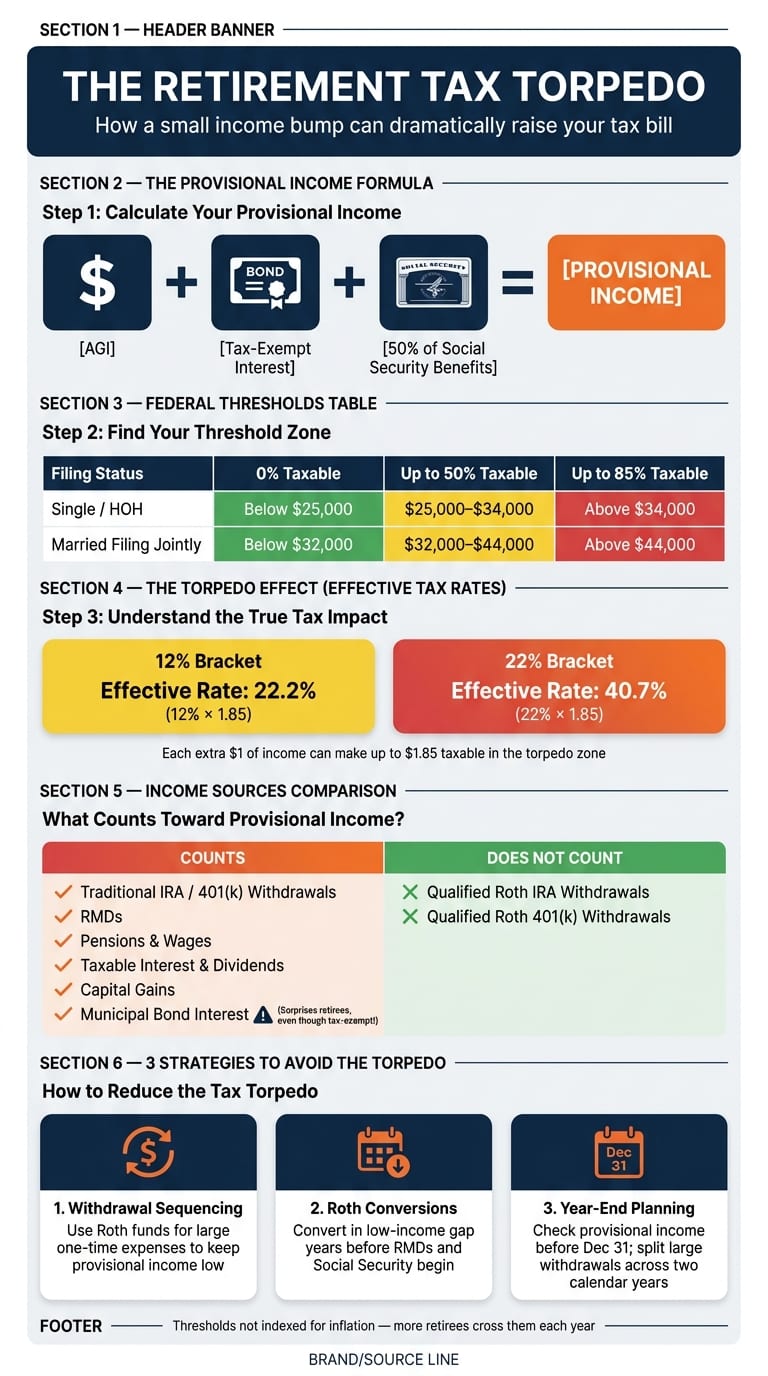
The Social Security Tax Torpedo Explained: Why Your 12% Bracket Could Cost You 30%
How Provisional Income Determines Whether Social Security Is Taxable
The IRS uses provisional income, also called combined income, to figure out how much of your Social Security may be taxable. The formula is:
Adjusted Gross Income (AGI) + Tax-Exempt Interest + 50% of your Social Security benefits
That total may place your benefits into one of three buckets: 0%, 50%, or 85% taxable. So the key is pretty simple: understand which income sources may push that number up.
One point trips up a lot of retirees. This formula uses AGI, not taxable income. So even if the standard deduction and senior deduction lower what you may owe, they do not lower provisional income.
What Counts Toward Provisional Income
A lot of common income sources may increase provisional income. That includes:
- Traditional IRA and 401(k) withdrawals
- RMDs
- Pensions
- Wages
- Taxable interest
- Dividends
- Capital gains
- Rental income
Qualified Roth withdrawals generally do not count, which may be one reason some people view them as a useful planning tool.
Municipal bond interest surprises plenty of retirees too. It may be federally tax-exempt for ordinary income, but it still gets added back into the provisional income formula, even though it does not appear in regular AGI.
The Federal Thresholds That Trigger 50% and 85% Taxation
Once you know your provisional income, the thresholds below may determine how much of your Social Security benefit becomes taxable:
*Applies if the taxpayer lived with their spouse at any time during the year \[1\]*.*
These thresholds have not been indexed for inflation, so more retirees may cross them over time. And that may happen with pretty ordinary withdrawals, not just unusually high income.
Next: the income sources that most often trigger the torpedo.
Which Retirement Income Sources Set Off the Tax Torpedo
IRA Withdrawals, Pensions, and Wages Often Cause the Biggest Surprise
Once you know the thresholds, the next step is figuring out which income sources may push you over them.
Traditional IRA and 401(k) withdrawals, RMDs, pensions, and wages all add to provisional income dollar for dollar. On paper, that may look simple. In practice, the way these income sources stack in the same tax year may be easy to miss.
A retiree may have a modest pension, a small RMD, and part-time wages. None of those amounts may seem large by themselves. But together, they may push provisional income past the 85% threshold before any extra withdrawal is taken.
Capital Gains, Dividends, and Municipal Bond Interest Also Count
Taxable brokerage income counts too. Taxable interest, dividends, and realized capital gains all increase AGI, and AGI feeds straight into provisional income.
Here’s a quick look at how common income sources fit into the formula:
One row tends to catch people off guard: municipal bond interest. It may be tax-exempt for federal income tax purposes, but it still gets added back into the provisional income formula. So income that seems sheltered in one part of the tax return may still affect how much of Social Security becomes taxable.
By contrast, qualified Roth IRA and Roth 401(k) withdrawals do not go into AGI and do not go into provisional income. For this formula, they stay out of sight.
Hypothetical Example: How One Extra Withdrawal Raises Your Effective Tax Rate
The issue may come into focus with a simple year-end withdrawal example.
Say a married couple filing jointly has:
- $28,000 in pension income
- $18,000 in Social Security benefits
- $6,000 in dividends from a taxable brokerage account
Their provisional income comes to $43,000, which leaves them just under the 85% threshold.
Then they take an extra $5,000 from a traditional IRA to pay for a home repair. That one withdrawal pushes provisional income to $48,000, which moves them into the 85% zone. At that point, the withdrawal does more than add $5,000 of taxable income by itself. It may also increase the taxable share of their Social Security.
So the tax impact may apply to more than just the extra $5,000.
In the 12% bracket, the marginal tax rate may rise to 22.2% (12% × 1.85). In the 22% bracket, it may reach 40.7%. In other words, the stated tax bracket may not reflect the full rate once Social Security taxation is part of the picture.
That’s why strategically planning your retirement withdrawals may matter just as much as withdrawal size.
How to Reduce or Avoid the Tax Torpedo
Once a withdrawal may cause more of your Social Security to become taxable, the next step may be deciding which accounts to tap first.
Use Withdrawal Sequencing to Control Provisional Income
If provisional income is the trigger, withdrawal order may be the control knob. In plain English: the account you pull from may shape whether a modest expense turns into a torpedo-triggering event.
Qualified Roth IRA withdrawals are invisible to the provisional income formula. So if you need to cover a big one-time expense, using Roth funds may help keep more of your Social Security from becoming taxable.
Taxable brokerage withdrawals may also give you more control. That’s because only realized gains - not the full sale proceeds - add to AGI. For a lump-sum expense, that may make a taxable account a better fit than a traditional IRA.
There’s a tradeoff, though. Spending taxable assets first and leaving tax-deferred accounts alone may lead to larger future RMDs, right when Social Security may already be part of the picture. On the other hand, holding on to Roth assets for later may leave you with more flexibility when provisional income becomes harder to manage.
Time Roth Conversions, Gains, and Social Security Claiming Carefully
Once account order is set, timing becomes the next lever.
Many retirees may have a lower-income window after they stop working but before Social Security starts or RMDs begin at age 73. During those years, partial Roth conversions may move money out of a traditional IRA at a lower effective rate than what a person might face later. A common approach is to fill the 10% or 12% bracket each year while keeping provisional income below the 85% line and building more room for future Roth withdrawals.
Earlier Roth conversions may also reduce future RMDs and preserve tax-free withdrawal room later.
Delaying Social Security to age 70 may stretch this window and increase the monthly benefit. It may also give you more years to make tax-aware withdrawals and conversions before benefits begin.
Check Your Provisional Income Before Year-End
Sometimes the last chance to avoid crossing the line comes down to the calendar.
Check your estimated combined income before December 31 and compare it with the 50% and 85% thresholds before taking any late-year withdrawals. Late-year withdrawals, sales, and conversions may change the tax result even when the annual total looks small.
If a large traditional IRA withdrawal is needed, splitting it across two calendar years - December and January - may keep provisional income below the 85% threshold in both years. For people age 70½ or older, a qualified charitable distribution of up to $111,000 per person in 2026 may satisfy RMDs without raising AGI or provisional income.
Conclusion: Factor Social Security Taxation Into Your Retirement Income Plan
Provisional income thresholds haven’t been updated for inflation, so more retirees may cross them now. In the torpedo zone, even a small IRA withdrawal may trigger tax on more of your Social Security and may push your effective tax rate higher.
That’s why the decision isn’t only about how much to withdraw. It may also be about when you withdraw and which account you draw from. IRA withdrawals, Roth conversions, capital gains, and Social Security claiming may work less like separate moves and more like one connected planning choice.
A Roth conversion during lower-income gap years may reduce future RMDs. Smaller RMDs may mean lower provisional income once Social Security starts. Lower provisional income may mean less of your benefit gets taxed. One choice may shape the next.
The starting point may be seeing all retirement accounts together and testing withdrawal timing before taking action. Mezzi shows your accounts in one place, so you may model Roth conversions, withdrawal sequencing, and Social Security timing side by side.
Coordinating withdrawals, conversions, and claiming timing may keep more Social Security out of taxable income.
FAQs
How do I calculate my provisional income?
Use the IRS formula: AGI + tax-exempt interest + 50% of your total Social Security benefits.
For this calculation, AGI comes from line 11 on Form 1040. It may include IRA or 401(k) withdrawals, pensions, wages, dividends, and capital gains.
A couple of items stay out of the math:
- Roth IRA withdrawals
- Return-of-basis amounts from non-qualified annuities
One more detail matters here: because the formula uses AGI, deductions like the standard deduction do not reduce provisional income.
Are Roth conversions treated differently from Roth withdrawals?
Yes. A Roth conversion may count as taxable income in the Social Security provisional income formula, much like a distribution from a traditional IRA.
By contrast, qualified withdrawals from a Roth IRA or Roth 401(k) do not count toward provisional income. That’s one reason Roth balances may help some retirees avoid the “tax torpedo” later.
Can state taxes affect how my Social Security is taxed?
Yes - but only for your overall tax burden. State taxes stay separate from the federal tax torpedo.
The federal provisional income formula uses:
- your adjusted gross income
- tax-exempt interest
- half of your Social Security benefits
State rules on taxing Social Security do not change how the federal government calculates that formula or how much of your benefits may be taxable at the federal level.
Disclosures:
- This content is for informational purposes only and does not constitute investment advice or a recommendation to buy or sell any security.
- Past performance is not indicative of future results. No guarantee of future performance or outcomes is implied.
Related Blog Posts
- Retirement Withdrawal Planner: Build a Tax-Efficient Income Strategy
- How to do a Roth conversion without triggering IRMAA
- Tax-efficient withdrawal sequencing: which accounts to pull from first
- The RMD Tax Bomb: Why Your 70s Could Be Your Highest-Tax Decade
Use the IRS formula: AGI + tax-exempt interest + 50% of your total Social Security benefits.
For this calculation, AGI comes from line 11 on Form 1040. It may include IRA or 401(k) withdrawals, pensions, wages, dividends, and capital gains.
A couple of items stay out of the math:
- Roth IRA withdrawals
- Return-of-basis amounts from non-qualified annuities
One more detail matters here: because the formula uses AGI, deductions like the standard deduction do not reduce provisional income.
Yes. A Roth conversion may count as taxable income in the Social Security provisional income formula, much like a distribution from a traditional IRA.
By contrast, qualified withdrawals from a Roth IRA or Roth 401(k) do not count toward provisional income. That’s one reason Roth balances may help some retirees avoid the “tax torpedo” later.
Yes - but only for your overall tax burden. State taxes stay separate from the federal tax torpedo.
The federal provisional income formula uses:
- your adjusted gross income
- tax-exempt interest
- half of your Social Security benefits
State rules on taxing Social Security do not change how the federal government calculates that formula or how much of your benefits may be taxable at the federal level.