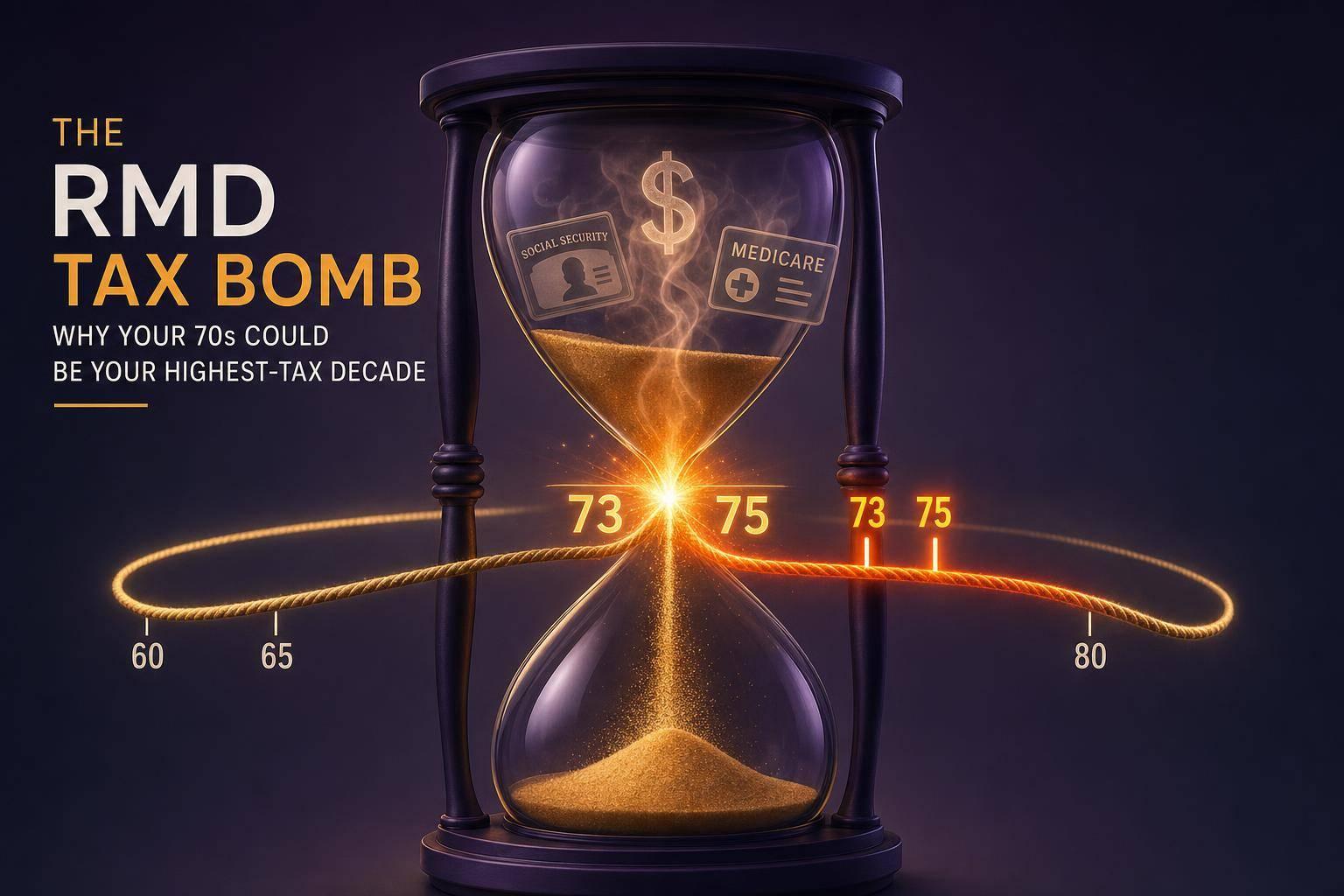
Your tax bill may go up in your 70s even if your spending does not.
If you have large pre-tax retirement accounts, required minimum distributions, or RMDs, may force taxable withdrawals at age 73 for many people, or 75 if you were born in 1960 or later. Those withdrawals may stack on top of Social Security, pensions, and investment income. That may push more income into higher tax brackets, make up to 85% of Social Security taxable, and trigger Medicare IRMAA surcharges two years later.
Here’s the short version:
- RMDs may create taxable income whether you need the cash or not
- A first-year RMD from a $2,000,000 pre-tax balance may be about $75,400 at age 73
- That extra income may move a couple from a lower bracket into the 22% to 24% range on part of income
- It may also push Medicare premiums higher and make taxes tougher for a surviving spouse filing single
- Some retirees look at partial Roth conversions, early withdrawals, and household account planning before RMD age to lower future forced income
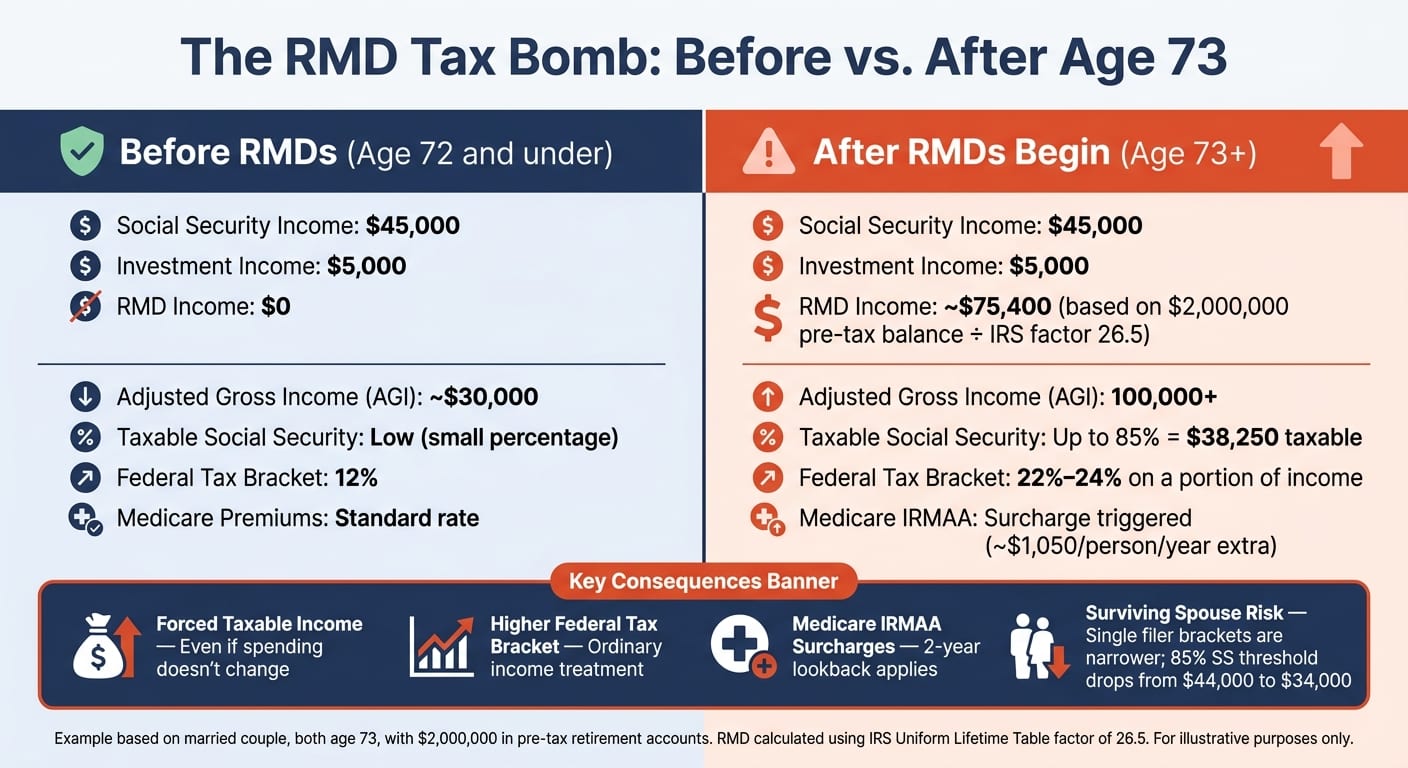
A simple example shows the issue. A retired couple with $45,000 of Social Security, $5,000 of investment income, and $2,000,000 in pre-tax accounts may see adjusted gross income jump from about $30,000 to more than $100,000 once RMDs start. Same lifestyle. Different tax picture.
The main idea is simple: the problem may be forced taxable income, not spending. That’s why many households start looking at this in their 60s, before the first RMD year arrives.
The Tax Bomb Hiding In Your Retirement Account (Don’t Wait)
How the RMD tax bomb works
The formula is simple: take your prior December 31 account balance and divide it by the IRS life expectancy factor for your age from the Uniform Lifetime Table. That amount may be treated as ordinary taxable income and added to your other taxable income for the year. In plain English: the rule may create taxable income even if you don't need the cash.
Here’s where that rule may apply and when it starts.
Which accounts trigger RMDs and when they start
RMDs apply to traditional IRAs, rollover IRAs, SEP and SIMPLE IRAs, and most employer plans such as 401(k)s, 403(b)s, and 457(b)s. Account type may shape tax exposure, and that difference may affect your retirement tax picture over time. For most retirees, RMDs begin at age 73. For people born in 1960 or later, they begin at 75.
Roth IRAs are the main exception. The original owner has no lifetime RMD requirement, so there may be no forced ordinary income from that account type. That one difference may explain why account type gets so much attention in retirement tax planning.
One timing trap may be easy to miss. Your first RMD may be delayed until April 1 of the following year. But if you wait, you may owe two RMDs in that same calendar year: the delayed first-year distribution and the second-year distribution due by December 31. Two RMDs in one tax year may push income much higher than either one would by itself. That rule may lead to a larger tax bill than many retirees expect.
A hypothetical example: how taxable income can jump after RMD age
The effect may stand out in a retired couple's tax return. Consider a married couple, both 73, with $2,000,000 in pre-tax retirement accounts, $45,000 of Social Security, and $5,000 of investment income.
The year before RMDs begin, their taxable income may stay fairly modest. A smaller share of Social Security may be taxable, their federal bracket may remain on the low end, and Medicare premiums may stay at the standard rate.
Then age 73 arrives. Using the IRS factor of 26.5, their combined RMD is roughly $75,400. That one line item may change the tax picture in a big way:
- Adjusted gross income may jump from roughly $30,000 to over $100,000
- As much as 85% of their Social Security - $38,250 - may become taxable because provisional income now clears the Social Security taxation thresholds
- Their marginal federal bracket may move from 12% into the 22%–24% range on a portion of their income
- Their income may now cross a Medicare IRMAA threshold, which may mean higher Part B and Part D premiums two years later
Their spending stays the same. The only change is that the IRS has started requiring withdrawals from accounts that had been compounding tax-deferred for decades.
The tax consequences that make RMDs costly
That income spike may not stay in one bucket. An RMD may increase federal tax, make more Social Security taxable, trigger Medicare surcharges, and leave the surviving spouse with a larger tax bill.
Higher federal income tax from ordinary-income distributions
RMDs are taxed as ordinary income, so a large distribution may wipe out bracket control in a single year.
More Social Security becomes taxable and Medicare premiums rise
For married couples filing jointly, once provisional income goes above $44,000, up to 85% of Social Security benefits may become taxable. Those thresholds have not kept pace with inflation, so more retirees may now hit the 85% cap.
Medicare has its own surcharge through IRMAA. In 2026, a single filer with modified adjusted gross income (MAGI) above $109,000 may pay an extra surcharge on top of the standard Part B premium. And because IRMAA uses a two-year lookback, a large RMD in 2026 may affect premiums in 2028, long after the chance to adjust income may have passed.
The risk gets worse after the first death in the couple.
After one spouse dies, the survivor may file as Single, and the tax rules may become less generous almost overnight. The survivor may keep the higher of the two Social Security benefits and may still receive similar RMD income, but the single tax brackets are narrower, the provisional income threshold for taxing 85% of Social Security drops from $44,000 to $34,000, and the IRMAA cutoff falls from $218,000 to $109,000 in 2026.
That means the same dollar amount of income that may have stayed below surcharge territory for a couple may place the survivor in higher Medicare surcharge tiers. For some households, that may add thousands of dollars per year in Medicare costs even if day-to-day spending does not change.
That shift may add tens of thousands of dollars in lifetime taxes and Medicare costs. If one spouse held most of the pre-tax assets and named the survivor as sole beneficiary, the issue may get worse: the survivor may inherit a large traditional IRA, take RMDs on the full balance under single filer rules, and face each of these tax effects alone. Some couples look at account ownership and beneficiary design before either spouse dies in hopes of softening that outcome.
How to reduce future RMD exposure before it becomes a problem
The cleanest way to deal with future RMD pressure may be to pull some income into lower-tax years before RMDs start forcing the issue. For some households, that may mean dealing with bracket creep, Social Security taxation, and survivor tax pressure earlier, while those numbers may still be more manageable. One of the main tools people often look at here is a partial Roth conversion.
Roth conversions during lower-income years
The stretch after retirement and before RMD age may create a low-income window. Paychecks are gone, Social Security may not have started, and balances in pre-tax accounts may still be growing tax-deferred. That gap may be one of the better times to consider partial Roth conversions.
With a conversion, you move part of a traditional IRA or 401(k) into a Roth account. You pay ordinary income tax on the amount converted now, and those dollars - plus any future growth - come out of the RMD system. Each dollar converted leaves the RMD system.
The hard part is sizing the conversion. Many retirees try to fill up unused lower brackets without spilling into a higher one. If the conversion is too large, it may also trigger IRMAA and Medicare premiums may rise two years later. Spreading conversions over several years may make those threshold jumps easier to avoid.
Rule: if you already have RMDs, take them first; RMD dollars cannot be converted.
Early withdrawals and coordinated account placement across the household
The same basic idea may apply to withdrawals before RMD age and to how assets sit across both spouses. Pulling money from pre-tax accounts before RMD age - even without converting to Roth - lowers the balance that future RMD calculations may be based on. If income is low enough in early retirement, planned withdrawals now may lock in a known tax rate before larger RMDs arrive. For some people, that may also reduce the odds of a later jump in Social Security taxation.
For married couples, the split of assets between spouses may matter just as much as the household total. This may matter most when one spouse holds most of the pre-tax assets. A household where one spouse holds nearly all of the traditional IRA assets may have less room to maneuver if that spouse dies first, because the survivor often files as single and may face higher effective tax rates on the same income. Spreading pre-tax balances more evenly between spouses - and coordinating Roth conversions, withdrawals, and beneficiary planning - may reduce that survivor-tax risk before it becomes harder to address.
Starting early may give you more control over future RMD size. To use these moves well, it may help to estimate future RMDs and tax drag across the whole household.
How to estimate your future RMD tax exposure using connected-account analysis
After you coordinate withdrawals and account placement, the next step may be to model the whole household. Looking at just one account misses the bigger tax picture. Your future tax exposure may depend on the combined balance of every pre-tax account, and a one-account estimate may understate it.
Here’s what that may look like in practice. Say a married couple has one spouse with a $900,000 traditional 401(k) and the other with a $300,000 traditional IRA. A single-account estimate may show a first-year RMD of about $46,000. But when you look at the full household balance, the first-year RMD may be closer to $60,000 to $65,000. Add $45,000 in combined Social Security and $5,000 in dividends, and that income may bring up to 85% of Social Security into taxable income and may cross the first IRMAA tier, adding about $1,050 per person per year in Medicare surcharges.
What to model before your first RMD year
It may help to model a few inputs ahead of time:
Mezzi pulls household accounts into one read-only view, which may let you model tax exposure from actual balances. With the full household picture connected, Mezzi's AI may flag when your projected MAGI is nearing an IRMAA tier and may help you review retirement decisions using real data instead of generic calculator assumptions. That may show when RMD pressure starts and how large it may be.
With those inputs, you may get a clearer sense of which years carry the most exposure before the first RMD hits.
Conclusion: The best time to address an RMD problem is before your 70s
RMDs may do more than add taxable income. They may set off a chain reaction. A larger-than-expected distribution may move you into a higher federal tax bracket, bring more Social Security into taxable income, and increase Medicare premiums two years later.
If one spouse dies, the surviving spouse may face similar income under single tax brackets and single IRMAA thresholds, which may lead to higher taxes and Medicare costs. Households that fare better are often the ones that ran the numbers in their 60s, during the lower-income window before RMDs began, and used that time to convert with care, draw down pre-tax balances over time, and split assets across both spouses. Connected-account analysis and early Roth planning may leave more room to act. Once RMDs are already in motion, the available moves may be fewer.
FAQs
How are RMDs calculated?
To figure out your RMD, take your retirement account balance from December 31 of the prior year and divide it by the IRS life expectancy factor that applies to you.
Here’s a simple example. A 74-year-old with a $200,000 IRA balance on December 31, 2025, may divide that balance by 25.5. That would result in a 2026 RMD of $7,843.14.
There’s one small wrinkle. IRAs are calculated separately, but the total amount may often be withdrawn from one IRA or spread across more than one IRA. By contrast, 401(k)s generally require separate withdrawals from each account.
Should I delay my first RMD?
Usually not. The IRS may let you delay your first RMD until April 1 of the next year, but that timing may create a tax trap.
If you wait, you may need to take two distributions in the same tax year: your delayed first RMD and the next year's RMD. That may increase taxable income, may move you into a higher tax bracket, and may increase Medicare IRMAA surcharges.
For some people, taking the first RMD by December 31 of the year they turn 73 may be the better fit.
When should I start planning for RMD taxes?
Start planning for RMD taxes 5 to 10 years before retirement. Once RMDs begin at age 73 or 75, the ways to reduce their tax impact may be much more limited.
A common planning window may open after retirement and before Social Security or RMDs start. During those lower-income years, moves like Roth conversions may reduce tax-deferred balances and may lower future RMDs.
Disclosures:
- This content is for informational purposes only and does not constitute investment advice or a recommendation to buy or sell any security.
- Past performance is not indicative of future results. No guarantee of future performance or outcomes is implied.
Related Blog Posts
- How can I minimize taxes when withdrawing from tax-advantaged accounts?
- Required Minimum Distributions Explained: When They Start and How to Plan
- How to do a Roth conversion without triggering IRMAA
- Tax-efficient withdrawal sequencing: which accounts to pull from first
To figure out your RMD, take your retirement account balance from December 31 of the prior year and divide it by the IRS life expectancy factor that applies to you.
Here’s a simple example. A 74-year-old with a $200,000 IRA balance on December 31, 2025, may divide that balance by 25.5. That would result in a 2026 RMD of $7,843.14.
There’s one small wrinkle. IRAs are calculated separately, but the total amount may often be withdrawn from one IRA or spread across more than one IRA. By contrast, 401(k)s generally require separate withdrawals from each account.
Usually not. The IRS may let you delay your first RMD until April 1 of the next year, but that timing may create a tax trap.
If you wait, you may need to take two distributions in the same tax year: your delayed first RMD and the next year's RMD. That may increase taxable income, may move you into a higher tax bracket, and may increase Medicare IRMAA surcharges.
For some people, taking the first RMD by December 31 of the year they turn 73 may be the better fit.
Start planning for RMD taxes 5 to 10 years before retirement. Once RMDs begin at age 73 or 75, the ways to reduce their tax impact may be much more limited.
A common planning window may open after retirement and before Social Security or RMDs start. During those lower-income years, moves like Roth conversions may reduce tax-deferred balances and may lower future RMDs.