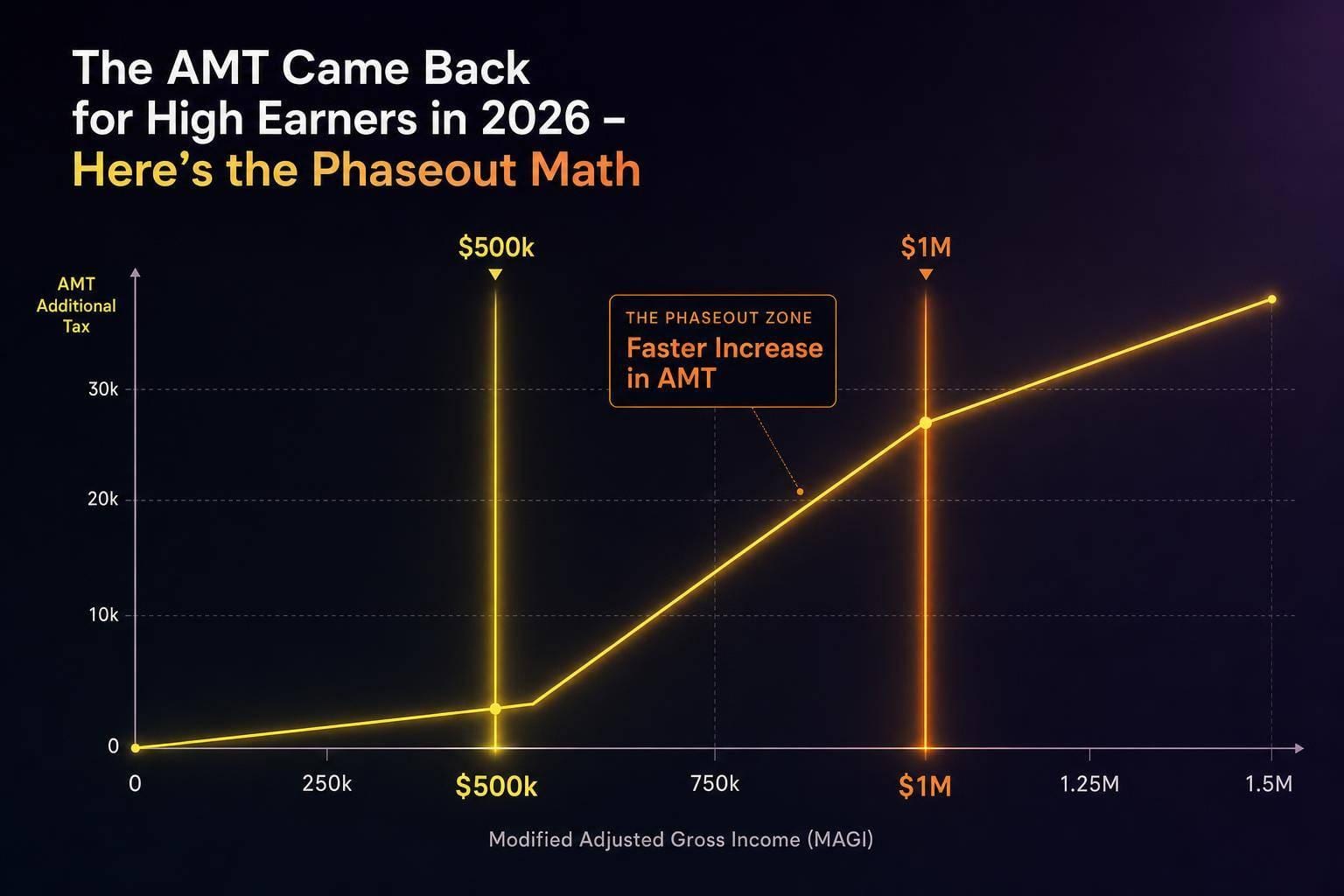
If your 2026 income may jump above $500,000 (single) or $1,000,000 (MFJ), your AMT exemption may shrink twice as fast as it did in 2025.
Here’s the short version: in 2026, the AMT exemption may start phasing out at lower income levels, and the reduction rate may move to $0.50 for every $1 above the threshold. That means some high earners may lose the exemption much faster, especially if they have ISO exercises, RSU income, capital gains, commissions, or other uneven income.
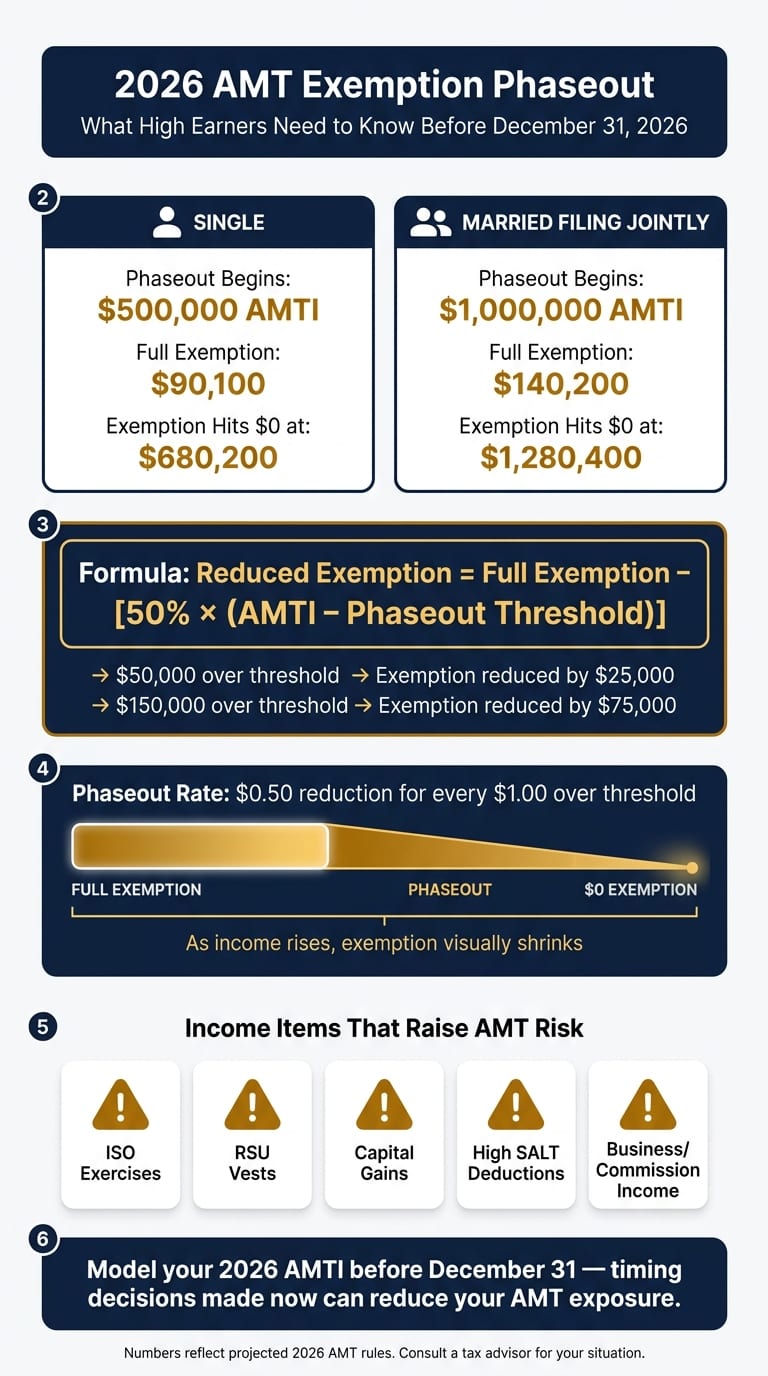
The main numbers:
- Single: threshold of $500,000, full exemption of $90,100
- Married filing jointly: threshold of $1,000,000, full exemption of $140,200
- Phaseout rate: 50% of income above the threshold
- Exemption may hit $0 at:
$680,200 for single filers
- $1,280,400 for MFJ
Simple math:
- Go $50,000 over the threshold, and the exemption may drop by $25,000
- Go $150,000 over, and it may drop by $75,000
This piece explains the phaseout math, who may be exposed, and which year-end income items may be worth modeling before December 31, 2026.
Alternative Minimum Tax Exemptions
What changed in 2026 and where the phaseout begins
In 2026, the AMT exemption phaseout begins at $500,000 of AMTI for single filers and $1,000,000 for married filing jointly, with the exemption reduced by $0.50 for every $1 above those levels. That’s a big shift in practice. For higher-income households, it may become easier to lose part - or even all - of the exemption.
The table below shows the 2026 phaseout starting points by filing status.
2026 AMT thresholds by filing status
Once AMTI moves above these thresholds, the exemption begins to drop under the phaseout formula.
Why more high earners get pulled in
Some higher earners may cross the phaseout threshold sooner than they expect, especially if they have ISO exercises, RSU vests, NSO exercises, capital gains, high state taxes, commissions, or business income.
The key number to track may be AMTI, not AGI. That distinction matters. Above the threshold, the exemption may shrink fast, which is why the next step may be figuring out exactly how much of it starts to disappear.
How the AMT exemption phaseout math works
The 50% phaseout formula, step by step
Once AMTI moves above the threshold, the exemption may start to shrink by $0.50 for every $1 of excess income.
Reduced Exemption = Full Exemption − [50% × (AMTI − Phaseout Threshold)]
Floor: $0.
For 2026, the full exemption is $90,100 for single filers and $140,200 for married filing jointly (MFJ).
Put simply, this works like a slow haircut on the exemption. If AMTI goes over the phaseout threshold by $50,000, the exemption may be reduced by $25,000. If AMTI goes over by $150,000, the reduction may be $75,000.
Side-by-side examples for single and married filers
The table below shows how the exemption shrinks at different AMTI levels for both filing statuses.
You can see the pattern pretty fast: every extra $2 of AMTI above the threshold may cut the exemption by $1.
Where the exemption hits zero
For single filers, the exemption is completely eliminated at $680,200 AMTI. For married filing jointly, it is eliminated at $1,280,400 AMTI.
Near those levels, the exemption may be fully gone.
If your AMTI is near these breakpoints, the next question may be which income items push you there fastest.
Who is most at risk and what to model before year-end
Income patterns that raise AMT exposure
Once you know where the phaseout starts, the next step is figuring out which income items may push you into it.
A few patterns tend to show up more often than others:
- Large capital gains: A late-year sale may push AMTI over the threshold in one move because realized gains count in AMTI.
- ISO exercises with a large bargain element: This may add an AMT adjustment before you sell the shares.
- High state-tax households: These households may face more AMT because SALT deductions lower regular tax, not AMTI.
The numbers to track in your projection
If any of those patterns may apply to you, these inputs may be worth modeling before December 31, 2026.
The point of this projection is pretty simple: see whether year-end income may push you past the threshold for your filing status while there may still be time to respond.
How Mezzi can help you check the estimate
Mezzi brings brokerage, retirement, equity compensation, and taxable accounts into one read-only view. From there, it flags AMT-related items before year-end.
If these inputs look close to your phaseout threshold, the next step may be looking at the timing of year-end moves to limit the hit.
Planning moves to reduce the hit before year-end
Timing and sizing decisions that can reduce the phaseout impact
When AMTI is close to the phaseout line, the main idea may be pretty simple: try not to cross it with one big event. Before December 31, 2026, timing and deal size may matter more than the type of income.
If you hold ISOs, spreading exercises across tax years may help manage AMTI. One large exercise in a single year may push AMTI past the threshold and reduce the exemption faster than splitting that same activity between 2026 and 2027. For a tech executive household with more than $1 million in projected 2026 income, the same ISO exercise created nearly $30,000 more AMT in 2026 than in 2025. Large ISO spreads may be more likely to trigger AMT in 2026. The same basic pattern may apply to appreciated stock sales.
The same timing check may make sense for capital gains. If you're planning to sell a position with a large embedded gain, it may be worth comparing a sale in 2026 with one in early 2027. A larger gain may push you deeper into the phaseout range fast.
And one thing is easy to miss: last year's tax return may not tell you much about 2026 exposure. Last year's return may be a poor proxy for 2026. That's why a current-year projection may matter more than looking backward.
Conclusion: the 2026 AMT numbers to keep in mind
The key thresholds may be worth keeping on your radar: $500,000 for single filers and $1,000,000 for MFJ, with a $0.50 exemption reduction for every $1 over the line. Action taken before December 31, 2026 may matter most for the 2026 tax year.
FAQs
How do I know if my income is AMTI?
Start with your adjusted gross income, then apply AMT adjustments to arrive at Alternative Minimum Taxable Income (AMTI).
For higher earners, one common adjustment may come from exercised ISOs. That adjustment is the bargain element - the difference between the stock’s fair market value and your exercise price.
AMT works as a parallel tax system. If your tentative minimum tax ends up higher than your regular income tax, you may owe AMT.
Can I owe AMT even if my taxable income stays below the threshold?
Yes. The Alternative Minimum Tax (AMT) is a separate tax system from the regular income tax.
You may owe AMT when your tentative minimum tax is higher than your regular tax liability, even if your regular taxable income may be below the threshold. One common trigger may be exercising ISOs. That’s because the spread may count as an AMT adjustment, even though it may not be taxed under the regular system at that time.
What year-end moves can help reduce my AMT exposure?
- Some employees choose to exercise ISOs early, ideally when the spread between fair market value and the strike price may be small.
- Some spread exercises across multiple tax years to avoid triggering, or speeding up, the AMT phaseout.
- If AMT appears high, a same-year sale of ISO shares may remove the AMT adjustment, but the gain may then be treated as ordinary income.
- It may make sense to model projected income and the option bargain element before year-end.
Disclosures:
- This content is for informational purposes only and does not constitute investment advice or a recommendation to buy or sell any security.
- Past performance is not indicative of future results. No guarantee of future performance or outcomes is implied.
Related Blog Posts
- 7 Tax-Saving Strategies for High-Income Earners in 2025
- 2025 Tax Planning Checklist for Independent Investors
- Incentive Stock Options and AMT: Exercise Strategy to Minimize Tax
- The $40K SALT Cap Sunsets in 2029: A Four-Year Planning Window
Start with your adjusted gross income, then apply AMT adjustments to arrive at Alternative Minimum Taxable Income (AMTI).
For higher earners, one common adjustment may come from exercised ISOs. That adjustment is the bargain element - the difference between the stock’s fair market value and your exercise price.
AMT works as a parallel tax system. If your tentative minimum tax ends up higher than your regular income tax, you may owe AMT.
Yes. The Alternative Minimum Tax (AMT) is a separate tax system from the regular income tax.
You may owe AMT when your tentative minimum tax is higher than your regular tax liability, even if your regular taxable income may be below the threshold. One common trigger may be exercising ISOs. That’s because the spread may count as an AMT adjustment, even though it may not be taxed under the regular system at that time.
- Some employees choose to exercise ISOs early, ideally when the spread between fair market value and the strike price may be small.
- Some spread exercises across multiple tax years to avoid triggering, or speeding up, the AMT phaseout.
- If AMT appears high, a same-year sale of ISO shares may remove the AMT adjustment, but the gain may then be treated as ordinary income.
- It may make sense to model projected income and the option bargain element before year-end.