
The short version: from 2026 through 2029, the federal SALT deduction cap may sit far above the old $10,000 limit, then may drop back in 2030. For some households, that may create a brief window to review itemizing, payment timing, PTET elections, and deduction bunching.
If I were boiling this down for a reader in 30 seconds, I’d say this:
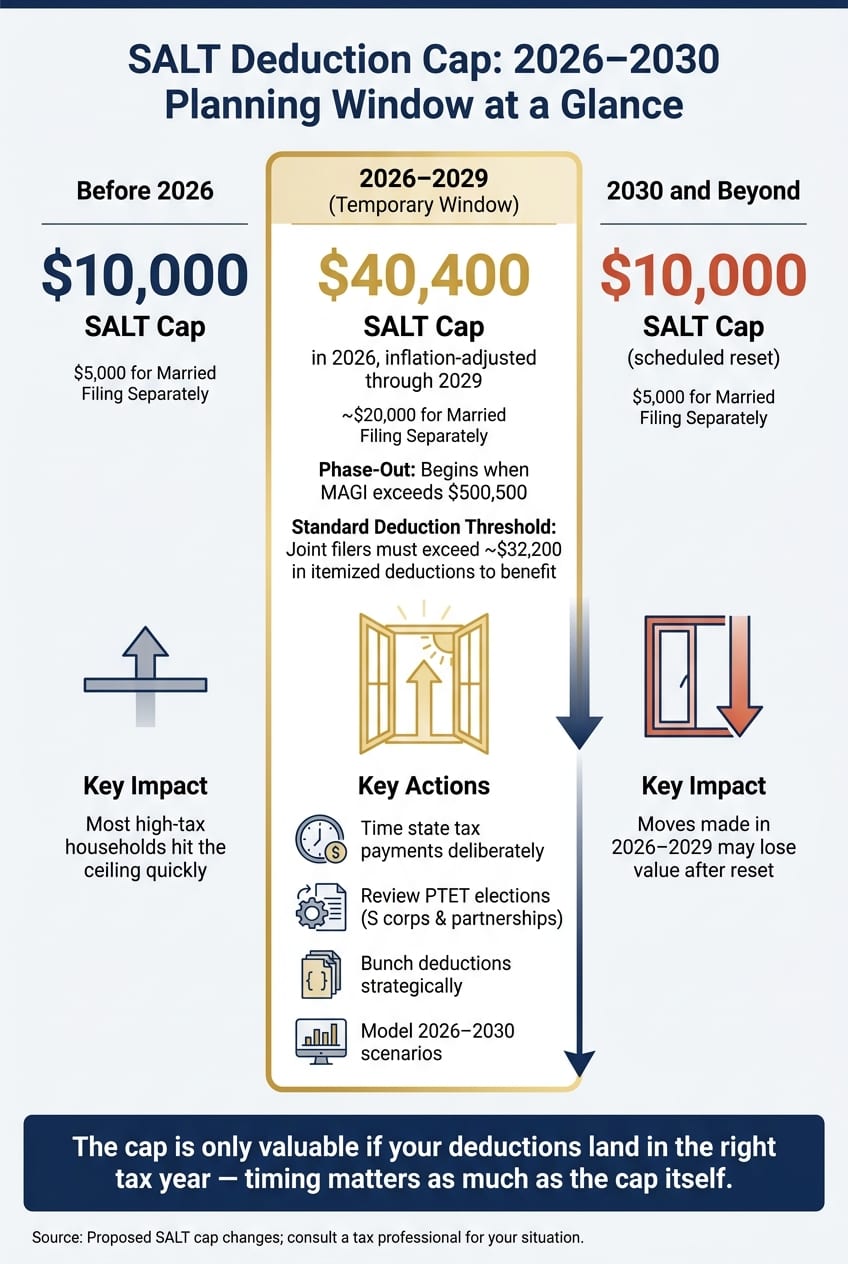
- The SALT cap may be $40,400 in 2026, with inflation adjustments through 2029
- The cap may start phasing down when MAGI exceeds $500,500
- The higher cap may matter only if itemized deductions exceed the standard deduction
- Owners of S corporations and partnerships may also look at PTET elections
- The current setup may sunset after 12/31/2029, with a scheduled return to $10,000 in 2030
That means the main question may not be “Is the cap higher?”
It may be: “Do my deductions land in the years when the higher cap still has value?”
Quick comparison
I’d frame the article around one simple idea: a temporary tax rule may be easy to waste if income, deductions, and tax payments are not lined up by year.
How the temporary $40,000 SALT cap works
Cap amounts, phase-outs, and the 2030 reset
The main planning issue is how the cap may interact with filing status, phase-outs, and whether itemizing may still come out ahead.
The temporary SALT cap increased from $10,000 to $40,000, with annual inflation adjustments through 2029. Unless Congress acts, it may reset to $10,000 in 2030.
The cap applies to single filers, heads of household, and married couples filing jointly. Married filing separately (MFS) taxpayers are generally limited to half the joint amount, or about $20,000.
Those rules may matter only if the deduction puts a household above the standard deduction. And because the higher cap may last only through 2029, timing may matter almost as much as the deduction itself. For households near the phase-out threshold, it may make sense to model MAGI before assuming the full deduction may apply.
When itemizing beats the standard deduction
The higher cap may help only if you itemize.
Taxpayers still need to compare itemized deductions with the standard deduction for their filing status. For some households, especially in high-tax states, the higher cap may make itemizing worth another look. But that may happen only when total deductions exceed the standard deduction after the SALT cap is applied.
That comparison may affect after-tax cash flow and the timing of other tax moves.
That makes timing and deduction strategy the next things to review.
SALT Deduction Is Back: What the New $40,000 Cap Means For Taxpayers
Why a temporary tax break can still be wasted
Once itemizing comes into play, timing may matter just as much as the cap itself. A household that pays state taxes without thinking about when those payments land may miss the one year when itemizing beats the standard deduction.
Paying deductible taxes in the wrong year
For joint filers, 2026 itemized deductions may need to exceed $32,200 before the SALT cap even starts to matter. A bonus or RSU vest may also push MAGI high enough to reduce the tax value of those deductions before filing. And for high earners in the top bracket, the tax value of itemized deductions may be limited as well.
That same timing problem may show up for business owners and employees with equity compensation. Money may arrive in lumps, income may jump from one year to the next, and a deduction that looks useful on paper may land in the wrong tax year.
Missing the connection to broader wealth decisions
Income changes may move a household into the phase-out range, so some people model those shifts before making year-end payments. For pass-through owners, a PTET election may move state tax payments to the entity level and avoid the individual SALT cap. Missing that review may leave some federal deduction value unused before 2030.
That’s why the next step may be mapping payments, elections, and deduction timing across the full 2026–2029 window.
4 planning moves to review before 2030
The window only matters if deductions land in the right tax year. The temporary cap may help only when households use the four-year window on purpose. It may make sense to review these moves now, since the sunset may change the math after 2029.
Time state estimated tax payments and withholding deliberately
If itemizing may beat the standard deduction in 2026–2029, payment timing may matter as much as payment size. Moving a Q4 state estimated payment from January to December, for example, may pull a deduction into a year when total itemized deductions clear the standard deduction threshold.
That said, the timing change may need to stay within IRS safe harbor rules to avoid an underpayment penalty. This may matter most for households with bonuses, RSUs, or uneven business income.
Review pass-through entity tax elections where available
This may be especially relevant for S corp and partnership owners. Entity-level state tax payments may preserve a federal deduction that would otherwise be capped. PTET rules vary by state, and election deadlines often fall before year-end.
Because of that, some owners review personal estimated payments and distributions at the same time so cash flow stays balanced. In practice, PTET may be more of a year-by-year planning item than a set-it-and-forget-it election.
Bunch deductions and model itemizing before and after the sunset
The higher cap may make itemizing worthwhile again. Bunching - concentrating property taxes, charitable contributions, and other deductible expenses into selected years - may push total itemized deductions above the standard deduction in the years that count most.
It may also help to model itemizing separately for 2026–2029 and 2030, because the sunset may flip the result. The next step may be to test these moves against 2026–2030 income and deduction scenarios.
How to build a four-year SALT plan with Mezzi
Those timing choices may only make sense if you test them against your own income and deduction pattern. Mezzi connects in read-only mode through Plaid and Finicity, so it may model SALT moves using data from your actual accounts.
What to model across 2026–2030
A practical way to review this window is to model each year's deductible state-tax value from 2026 to 2030, then compare those years with the lower 2030 cap. For that to be accurate, Mezzi pulls from the data points that may shape the outcome:
Mezzi may flag years when itemizing appears to win clearly and years when moving a state payment into another tax year may change very little. That year-by-year view matters. It may give you a way to compare each move on its own terms instead of treating the full four-year window like one lump.
Conclusion: the key decisions to review this year
Because the cap resets in 2030, some people model 2026–2029 against the post-sunset year. In practice, that review may center on four decisions already covered:
- Whether you may itemize in 2026–2029
- The timing of state estimated payments and withholding
- A PTET election if you own a pass-through business
- How deduction bunching may shift value across the window
From there, the model may help sort which tax moves appear to fit better in 2026–2029 and which ones may lose value after the 2030 reset.
FAQs
How do I know if itemizing will save more than the standard deduction?
Compare your total qualified itemized deductions with the standard deduction for your filing status. You may claim the SALT deduction only if you itemize.
Add up costs like mortgage interest, charitable donations, and state and local taxes, up to the $40,000 cap. If that total ends up higher than your standard deduction, itemizing may offer a larger deduction.
What happens to my SALT planning if my MAGI exceeds the phase-out threshold?
If your modified adjusted gross income (MAGI) goes above $505,000, the tax benefit of the SALT deduction may start to phase out. And because the current $40,000 SALT cap is temporary and scheduled to expire after 2029, it may make sense for planning to account for that shift.
For higher-income households, it may be worth modeling whether itemizing still comes out ahead of the standard deduction, since changes like this may affect after-tax cash flow. A tax advisor may be able to place these rules in the context of a broader wealth strategy.
Should I change when I pay state taxes before the cap drops back in 2030?
Yes. Changing when you pay state income or property taxes may help you get more from your deductions while the $40,000 SALT cap stays in place through 2029.
Because the cap is scheduled to go back to $10,000 in 2030, some taxpayers may want to review whether prepaying taxes into one year may make itemizing more worthwhile. Since excess SALT deductions don't carry forward, it may make sense to look at this during the year instead of waiting until late December.
Disclosures:
- This content is for informational purposes only and does not constitute investment advice or a recommendation to buy or sell any security.
- Past performance is not indicative of future results. No guarantee of future performance or outcomes is implied.
Related Blog Posts
- 7 Tax-Saving Strategies for High-Income Earners in 2025
- 2025 Tax Planning Checklist for Independent Investors
- Year-end tax planning checklist for investors with $500K+
- The SALT Cap Jumped to $40K - Then the Phaseout Claws It Back
Compare your total qualified itemized deductions with the standard deduction for your filing status. You may claim the SALT deduction only if you itemize.
Add up costs like mortgage interest, charitable donations, and state and local taxes, up to the $40,000 cap. If that total ends up higher than your standard deduction, itemizing may offer a larger deduction.
If your modified adjusted gross income (MAGI) goes above $505,000, the tax benefit of the SALT deduction may start to phase out. And because the current $40,000 SALT cap is temporary and scheduled to expire after 2029, it may make sense for planning to account for that shift.
For higher-income households, it may be worth modeling whether itemizing still comes out ahead of the standard deduction, since changes like this may affect after-tax cash flow. A tax advisor may be able to place these rules in the context of a broader wealth strategy.
Yes. Changing when you pay state income or property taxes may help you get more from your deductions while the $40,000 SALT cap stays in place through 2029.
Because the cap is scheduled to go back to $10,000 in 2030, some taxpayers may want to review whether prepaying taxes into one year may make itemizing more worthwhile. Since excess SALT deductions don't carry forward, it may make sense to look at this during the year instead of waiting until late December.