
The short version: the new SALT cap may look like $40,000, but many households may not get that full amount.
Here’s the core idea in plain English:
- For 2025, the federal SALT deduction cap may go from $10,000 to $40,000
- But if your MAGI goes above $500,000, that cap may start shrinking by 30 cents per $1
- By $600,000 MAGI, the cap may fall back to $10,000
- If you take the standard deduction instead of itemizing, this change may do nothing for your return
- The higher cap may matter most for people in high-tax states who already itemize and stay under the income cutoff
So the headline may be a little misleading. The stated cap may be $40,000, but your usable cap may be much lower once income and itemizing are factored in.
Quick check:
My takeaway: this law may offer more room on paper, but the phaseout and itemizing rules may decide who actually gets it.
SALT Deduction Is Back: What the New $40,000 Cap Means For Taxpayers
What changed with the SALT deduction from 2025 through 2029
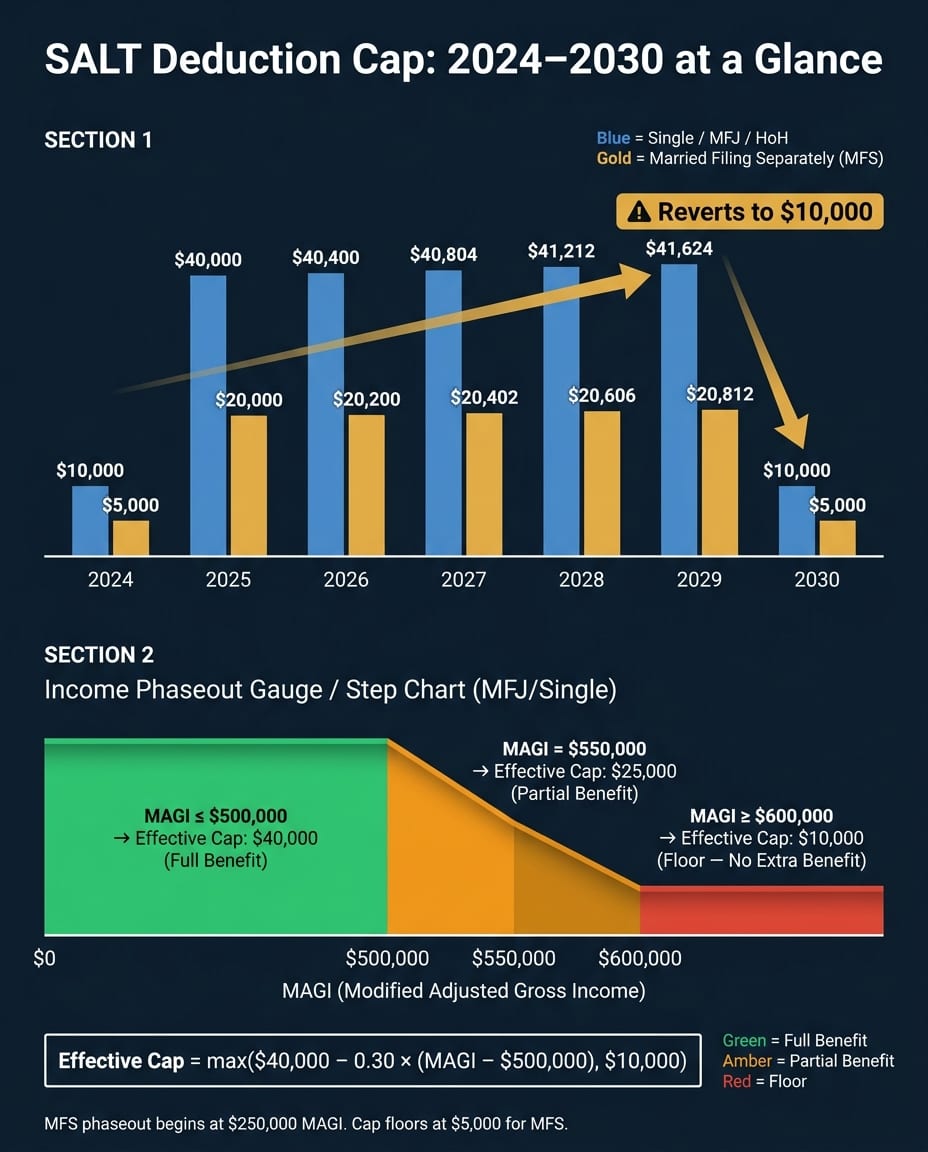
For 2025, the SALT cap rises to $40,000 for most filers and $20,000 for those who are married filing separately (MFS). Starting in 2026, that cap goes up by 1% each year through 2029. Then, in 2030, it is scheduled to drop back to $10,000 - or $5,000 for MFS. The catch is that the higher cap may not stay fully available once income moves up.
Next, the phaseout shows how much of that cap you may actually keep.
Which taxes count toward the cap
The cap applies to one combined SALT total, not separate limits for each tax. You may deduct income taxes or sales taxes, plus real estate taxes and personal property taxes, all under the same cap.
So the first step is simple: add those amounts together. If your total SALT amount may be far below the cap, the higher limit may not change much on your return. If it falls between $10,000 and $40,000, the higher cap may create more room for deductions, depending on your income and whether you itemize.
Why the higher cap only helps if you itemize
The higher cap only matters if your itemized deductions are more than the standard deduction. For 2026, that threshold is $32,200 for married couples filing jointly and $16,100 for single filers.
That includes SALT, mortgage interest, charitable contributions, and other eligible write-offs. If those itemized deductions do not get past that line, the SALT cap change may have no effect on your federal tax bill. For many higher earners, though, the bigger issue may not be the standard deduction. It may be the income-based phaseout that cuts down the $40,000 cap itself.
How the income phaseout shrinks the $40,000 cap
For higher earners, the $40,000 cap may shrink fast. If you already know you itemize, the next step may be figuring out how much of that higher cap still applies at your income level.
Once your Modified Adjusted Gross Income (MAGI) goes above $500,000 - or $250,000 if you file married filing separately - the cap starts to shrink by $0.30 for each $1 above that threshold. At $600,000 MAGI, the cap goes back to $10,000. At that point, the higher cap may no longer provide any extra tax break.
The phaseout formula in dollars
Effective cap = max($40,000 − 0.30 × (MAGI − $500,000), $10,000)
The cap cannot drop below $10,000. For example, at $560,000 MAGI, the cap falls to $22,000. So the effective cap may be $22,000.
Examples at $500,000, $550,000, and $600,000 MAGI
The table below shows how fast the cap may shrink.
At $500,000 MAGI, you keep the full $40,000 cap. At $550,000, it drops to $25,000. By $600,000, the effective cap is back to $10,000 - the same limit that applied before 2025.
Who gets the full benefit, a partial benefit, or almost nothing
The phaseout puts taxpayers into three rough buckets: full benefit, partial benefit, or almost none. Where you land may depend on three things: how much SALT you paid, whether you itemize, and your MAGI.
Households most likely to see real savings
In practice, the households most likely to see meaningful tax savings may be fairly easy to spot. They may live in high-tax states, already itemize, and have MAGI at or below the threshold. That combination may put them in the best position to use the higher cap.
A California couple with $450,000 of MAGI and $46,600 of SALT, for example, may save about $11,264 by itemizing. In that case, the full $40,400 cap applies, and their SALT alone is above the cap.
Once the cap drops to $10,000, extra SALT payments may no longer add to the deduction.
Why some high earners should expect little to no change
For very high earners, much of the upside may fade out. Once the cap hits the $10,000 floor, paying more in SALT may not produce any extra SALT deduction.
There’s another catch too: the cap only matters if itemizing comes out ahead of the standard deduction. The HOH threshold for 2026 is $24,150, which was not part of the earlier standard deduction comparison for MFJ and single filers. So if capped SALT, mortgage interest, and charitable giving still add up to less than the standard deduction that applies to you, the higher SALT limit may not change your return.
How to estimate your real benefit and plan around the phaseout
Once you know how the phaseout works, the next step is simple: run your own numbers.
Start with three inputs:
- Your projected MAGI for the tax year
- Your expected SALT payments
- Your total itemized deductions
A practical place to begin may be last year's Schedule A, line 5, which includes state income tax, local taxes, and property taxes.
From there, apply the phaseout. For every $1 of MAGI above $500,000, the cap may shrink by $0.30, until it reaches a floor of $10,000 at $600,000.
Then compare your effective cap with the rest of your itemized deductions. In plain English, you're looking at:
- Capped SALT
- Mortgage interest
- Charitable giving
Add those up and compare the total with the standard deduction for your filing status. If your itemized deductions don't get past that line, the higher SALT cap may not change your tax bill.
Because these rules expire after 2029, it may make sense to run this comparison for each year in the window, not just the current one. An annual check may matter because both your income and the cap may shift from year to year.
Planning moves if your MAGI is near the phaseout threshold
If your MAGI is close to the cutoff, timing may matter a lot.
One common lever people look at is lowering MAGI before year-end. Maxing out a 401(k), SEP-IRA, or another pre-tax account may lower MAGI dollar for dollar and may preserve part of the SALT deduction. Deferring a year-end bonus or delaying the sale of an appreciated asset may also keep MAGI below the threshold and protect more of the deduction.
On the deduction side, some taxpayers look at timing there too. Prepaying a property tax installment or bunching charitable contributions into one year may increase total itemized deductions for that year.
Why seeing all your accounts matters for SALT planning
A full view of your accounts may make it easier to spot income spikes early.
MAGI rarely comes from one neat source. If you're only looking at your W-2, you may miss bonus income or capital gains that push you into the phaseout range.
Mezzi's read-only account aggregation connects your 401(k), brokerage accounts, Roth IRA, and other holdings through Plaid and Finicity - without requiring any transfers or giving up control. Because Mezzi sees all accounts at the same time, it may help you spot when projected income or gains are likely to push your MAGI deeper into the phaseout range, which may give you more time to respond instead of finding out at tax time.
Conclusion: The bigger SALT cap is real, but the phaseout decides how much you actually keep
The $40,000 SALT cap is higher, but that larger number may apply only to taxpayers who stay below the phaseout. And it may matter only if itemizing still beats the standard deduction. In practice, your deduction may depend more on your MAGI than on the headline cap itself. That may make year-end planning more relevant than the big number in the headline.
Before assuming you get the full $40,000 deduction, it may make sense to estimate your effective cap. Some taxpayers run the numbers before year-end to see whether accelerating payments, realizing gains, or bunching deductions may change the outcome. The window may be real, but your effective cap may be the part that counts.
FAQs
How do I know if I should itemize?
You may itemize if your total itemized deductions, including the expanded SALT deduction, are higher than the standard deduction for your filing status.
Because the SALT cap may be $40,400 for 2026, some homeowners in high-tax states may benefit from itemizing when they previously took the standard deduction. It may make sense to run the numbers both ways or use a tax estimator for a side-by-side comparison.
What counts toward the SALT cap?
The SALT cap covers two buckets of taxes:
- Your state and local property taxes
- Either your state and local income taxes or sales taxes - but not both
For property taxes, that generally includes real estate you own for personal use, plus personal property taxes on things like cars and boats.
There’s one key carveout. Taxes tied to a trade, business, or income-producing activity are not subject to the cap. In plain English, the cap may apply to personal taxes, but business-related or income-related taxes may fall outside it.
How can I lower MAGI to keep more of the deduction?
Because the SALT deduction cap may start phasing out when your MAGI goes above $500,000 to $505,000, lowering MAGI may help you keep more of that deduction.
Some people look at a few common ways to manage MAGI:
- Deferring or accelerating income when that option is available
- Maximizing tax-advantaged retirement contributions
- Bunching deductions, such as property taxes or charitable contributions, so itemized deductions may line up better with those income thresholds
The basic idea is simple: if income and deductions are timed well, some taxpayers may keep more itemized deductions than they otherwise would.
Disclosures:
- This content is for informational purposes only and does not constitute investment, tax, or legal advice. Please consult a qualified professional regarding your individual circumstances.
- Past performance is not indicative of future results. No guarantee of future performance or outcomes is implied.
Related Blog Posts
- 7 Tax-Saving Strategies for High-Income Earners in 2025
- 2025 Tax Planning Checklist for Independent Investors
- The AMT Came Back for High Earners in 2026 - Here's the Phaseout Math
- NIIT Bracket Creep: The 3.8% Tax Now Hits 7M+ Households
You may itemize if your total itemized deductions, including the expanded SALT deduction, are higher than the standard deduction for your filing status.
Because the SALT cap may be $40,400 for 2026, some homeowners in high-tax states may benefit from itemizing when they previously took the standard deduction. It may make sense to run the numbers both ways or use a tax estimator for a side-by-side comparison.
The SALT cap covers two buckets of taxes:
- Your state and local property taxes
- Either your state and local income taxes or sales taxes - but not both
For property taxes, that generally includes real estate you own for personal use, plus personal property taxes on things like cars and boats.
There’s one key carveout. Taxes tied to a trade, business, or income-producing activity are not subject to the cap. In plain English, the cap may apply to personal taxes, but business-related or income-related taxes may fall outside it.
Because the SALT deduction cap may start phasing out when your MAGI goes above $500,000 to $505,000, lowering MAGI may help you keep more of that deduction.
Some people look at a few common ways to manage MAGI:
- Deferring or accelerating income when that option is available
- Maximizing tax-advantaged retirement contributions
- Bunching deductions, such as property taxes or charitable contributions, so itemized deductions may line up better with those income thresholds
The basic idea is simple: if income and deductions are timed well, some taxpayers may keep more itemized deductions than they otherwise would.