
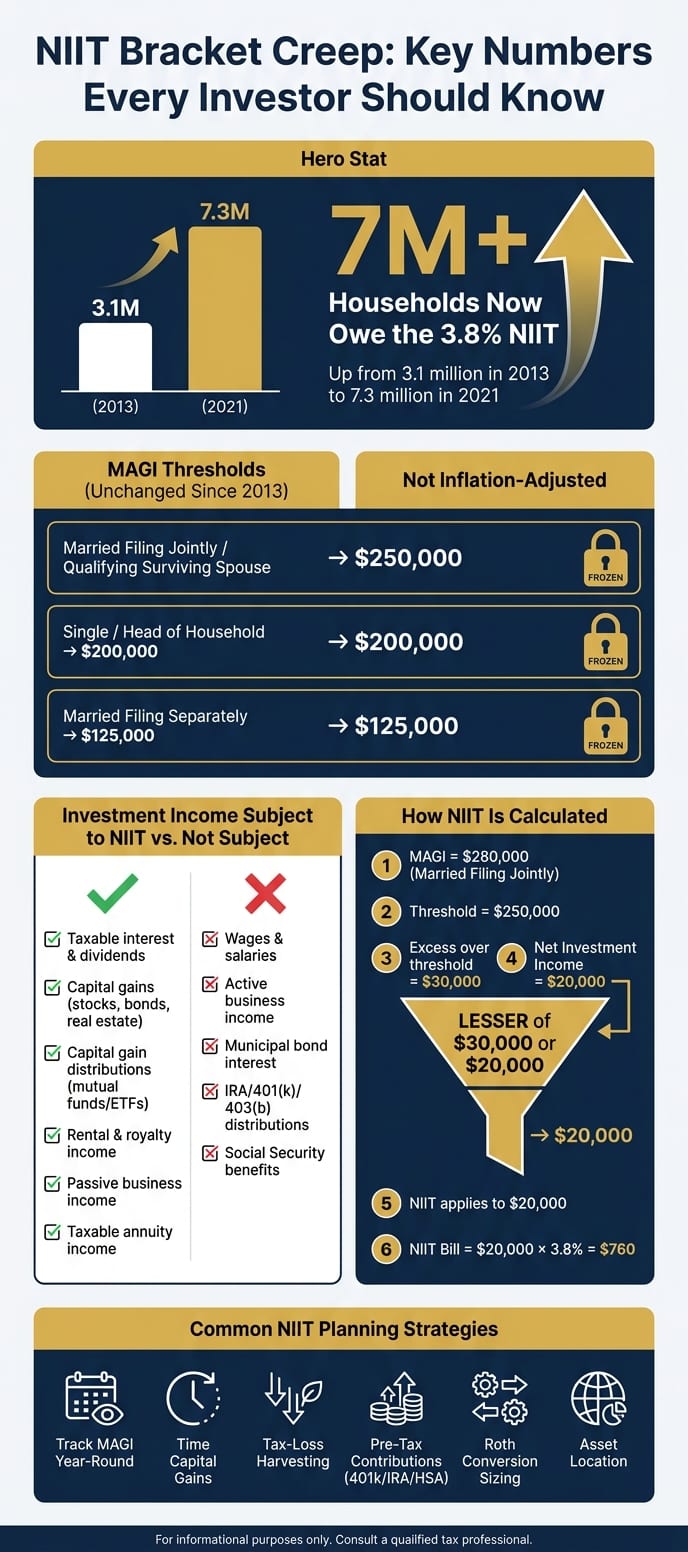
More than 7 million households may now owe the 3.8% NIIT, largely because the income thresholds have stayed fixed at $200,000, $250,000, and $125,000 for years.
If your income has gone up over time - or if you had a one-time event like a stock sale, home sale, business sale, or Roth conversion - you may cross the NIIT line without planning for it. The tax may apply to the lesser of your net investment income or the amount your MAGI sits above the threshold.
Here’s the short version:
- NIIT rate: 3.8%
- Main trigger: MAGI above fixed thresholds
- Who may get pulled in: dual-income households, pre-retirees, retirees, and investors with taxable portfolios
- Income that may count: interest, dividends, capital gains, rental income, royalty income, passive income, and some annuity income
- Income that generally does not count as NII: wages, IRA distributions, Social Security, and municipal bond interest
- Common planning angles people may look at: tracking MAGI, timing gains, tax-loss harvesting, pre-tax contributions, Roth conversion sizing, installment sales, and asset location
A simple example: if a married couple filing jointly has $280,000 of MAGI and $20,000 of net investment income, they may owe NIIT on $20,000, which may mean $760 in tax.
This article explains why more households may be affected now, what income may be exposed, and which planning moves some people review to limit surprise tax bills.
How to Avoid the Net Investment Income Tax (NIIT)
How NIIT bracket creep works
NIIT applies only when your net investment income or MAGI goes above a fixed threshold. The tax rate is 3.8%, and it applies to the lesser of:
- your net investment income (NII)
- the amount your MAGI exceeds your filing-status threshold
Here’s the simple version: if a married couple filing jointly has MAGI that is $100,000 above the threshold, and they also have at least $100,000 of NII, their NIIT may be $3,800.
The fixed NIIT thresholds that drive the problem
Current NIIT thresholds:
The issue is pretty plain. Those thresholds do not rise with inflation, so more households may cross them over time.
Why over 7 million households now owe NIIT
The number of NIIT-paying returns grew from about 3.1 million in 2013 to about 7.3 million by 2021. As wages and portfolio values move up, more households may end up above the same unchanged threshold.
This may catch pre-retirees off guard. If investment income grows and MAGI slowly drifts above the limit, NIIT may show up even if nothing feels all that different year to year.
That leads to the next step: which income counts as NIIT?
Who owes NIIT and what income counts
High earners, dual-income households, and retirees with large taxable portfolios may be pulled into NIIT as MAGI rises. That’s why the type of income may matter just as much as the amount.
Investment income that is subject to NIIT
Income that may count as net investment income includes taxable interest, dividends, taxable capital gains from selling appreciated assets, capital gain distributions from mutual funds or ETFs, rental and royalty income, passive business income, and taxable annuity income.
Wages are not NII, but they may push MAGI above the threshold.
Income that is not subject to NIIT
The items below are not NII, though they may still increase MAGI.
A simple NIIT calculation example
Here’s a simple way to think about it in practice:
A married couple filing jointly with $280,000 in MAGI and $20,000 of net investment income may exceed the $250,000 threshold by $30,000. The 3.8% tax may apply to the lesser of their NII ($20,000) or the excess over the threshold ($30,000). In this example, it applies to $20,000, which may produce a NIIT bill of $760 ($20,000 × 3.8%).
The tax is capped by the smaller number. Even so, NIIT exposure may increase once both investment income and MAGI move up. As a result, some households focus on year-round MAGI planning to reduce the chance of a surprise NIIT bill.
Planning moves that may reduce NIIT exposure
Most NIIT planning tends to focus on lowering MAGI or NII. In practice, that often comes down to three things: timing income, limiting taxable gains, and holding the right assets in the right accounts.
Track MAGI year-round and time capital gains deliberately
A stock sale, RSU vesting, or a business or property sale may push MAGI above the NIIT threshold. That’s why some people track MAGI during the year instead of waiting until December, so they may still have time to react before year-end.
If a large asset sale may be coming, it may make sense to model the MAGI effect before moving ahead. In some cases, spreading a sale across two tax years may reduce the odds of a one-year income spike. For a business or property sale, an installment sale that spreads payments over two or three years may also keep annual income under the threshold.
If timing by itself doesn’t do enough, deductions and account placement are often the next areas people look at.
Roth conversions, pre-tax contributions, and tax-loss harvesting
Pre-tax contributions to a 401(k), traditional IRA, or HSA reduce current-year MAGI, which may help keep income below the NIIT threshold. The tradeoff, of course, is that taxable withdrawals later on may increase MAGI in retirement.
Roth conversions work differently. They raise MAGI in the year of the conversion, so NIIT exposure may go up for that year. Over a longer stretch, Roth assets may reduce future RMDs and may keep MAGI lower later.
Tax-loss harvesting offsets realized gains dollar-for-dollar, which may reduce the amount of NII subject to NIIT. The catch is simple: replacement positions end up with a lower cost basis.
When MAGI still sits close to the threshold, asset location may end up being the deciding factor.
Use asset location to keep income that creates NIIT out of taxable accounts
Asset location matters here. Taxable bond funds, REITs, and high-dividend equity funds produce interest and ordinary dividends that count as NII, which may make them less tax-friendly in a taxable brokerage account.
Some investors place REITs and taxable bond funds in tax-advantaged accounts like a traditional IRA, 401(k), or Roth. Then they use taxable brokerage accounts for broad, low-turnover index funds and growth stocks.
For fixed-income needs inside a taxable account, municipal bonds may be worth a look. Municipal bond interest is not subject to NIIT, so it does not count toward the tax calculation.
How Mezzi helps households stay ahead of NIIT bracket creep
See MAGI-related risk across all accounts in one place
NIIT moves may be easier to manage when every account sits in one view. MAGI planning may get messy when accounts are spread across different institutions. Mezzi connects them through read-only account connections, so households may see more of the full picture at once.
With that broad view, Mezzi may spot tax-inefficient assets in the wrong accounts and show income-producing assets that may be misplaced. That may make MAGI tracking, gain timing, and asset-location checks more practical year-round.
Use Mezzi's tax insights to find actionable NIIT moves
Once accounts are connected, Mezzi turns NIIT planning into a set of clear next steps. It surfaces moves tied to NIIT risk, including loss opportunities that may lower realized gains, Roth conversions sized around MAGI thresholds, account analysis that may show income-producing assets in taxable accounts, and tax-impact estimates before a sale.
Mezzi surfaces the move; you decide and act.
Conclusion: The 3.8% tax affects more investors than most realize
Track MAGI, coordinate gains, harvest losses, and place assets in the right accounts. Mezzi keeps those decisions visible year-round.
Tax results depend on your individual circumstances. This article is for informational purposes only and does not constitute tax or legal advice. Consult a qualified tax professional before making decisions based on your specific situation.
FAQs
How do I know if NIIT applies to me?
NIIT may apply if you have net investment income and your MAGI is above the threshold for your filing status.
Net investment income may include:
- Dividends
- Interest
- Capital gains
- Rental profits
- Royalties
Employment income, Social Security, and tax-deferred accounts like IRAs and 401(k)s are not subject to NIIT.
If your MAGI is below the threshold, your NIIT liability may be $0.
You may use IRS Form 8960 to calculate what you may owe.
Can a one-time income event trigger NIIT?
Yes. A one-time income event may trigger the Net Investment Income Tax if it creates net investment income and pushes your Modified Adjusted Gross Income (MAGI) above the related threshold.
That may come up with events like selling a business or a large capital asset. In some cases, people look at ways to spread the transaction across multiple years or time it for a lower-income year, which may reduce the tax impact.
What are the best ways to reduce NIIT?
Focus on two levers: lowering your MAGI and reducing net investment income.
Some people use pre-tax contributions to accounts like a 401(k), 403(b), or HSA to lower MAGI. That may reduce the income counted for this purpose.
Some also look at municipal bonds, since their interest does not increase MAGI.
Other moves that may come up include:
- Tax-loss harvesting
- Timing capital gains for lower-income years
- Gifting appreciated assets
- Placing tax-inefficient investments in tax-deferred accounts
These steps may affect taxes in different ways depending on income, account type, and timing.
Disclosures:
- This content is for informational purposes only and does not constitute investment advice or a recommendation to buy or sell any security.
- This article is for informational purposes only and does not constitute tax or legal advice. Consult a qualified tax professional.
Related Blog Posts
- 7 Tax-Saving Strategies for High-Income Earners in 2025
- 2025 Tax Planning Checklist for Independent Investors
- The AMT Came Back for High Earners in 2026 - Here's the Phaseout Math
- IRMAA's Two-Year Lookback: The 2026 Income You Set Today Bills You in 2028
NIIT may apply if you have net investment income and your MAGI is above the threshold for your filing status.
Net investment income may include:
- Dividends
- Interest
- Capital gains
- Rental profits
- Royalties
Employment income, Social Security, and tax-deferred accounts like IRAs and 401(k)s are not subject to NIIT.
If your MAGI is below the threshold, your NIIT liability may be $0.
You may use IRS Form 8960 to calculate what you may owe.
Yes. A one-time income event may trigger the Net Investment Income Tax if it creates net investment income and pushes your Modified Adjusted Gross Income (MAGI) above the related threshold.
That may come up with events like selling a business or a large capital asset. In some cases, people look at ways to spread the transaction across multiple years or time it for a lower-income year, which may reduce the tax impact.
Focus on two levers: lowering your MAGI and reducing net investment income.
Some people use pre-tax contributions to accounts like a 401(k), 403(b), or HSA to lower MAGI. That may reduce the income counted for this purpose.
Some also look at municipal bonds, since their interest does not increase MAGI.
Other moves that may come up include:
- Tax-loss harvesting
- Timing capital gains for lower-income years
- Gifting appreciated assets
- Placing tax-inefficient investments in tax-deferred accounts
These steps may affect taxes in different ways depending on income, account type, and timing.