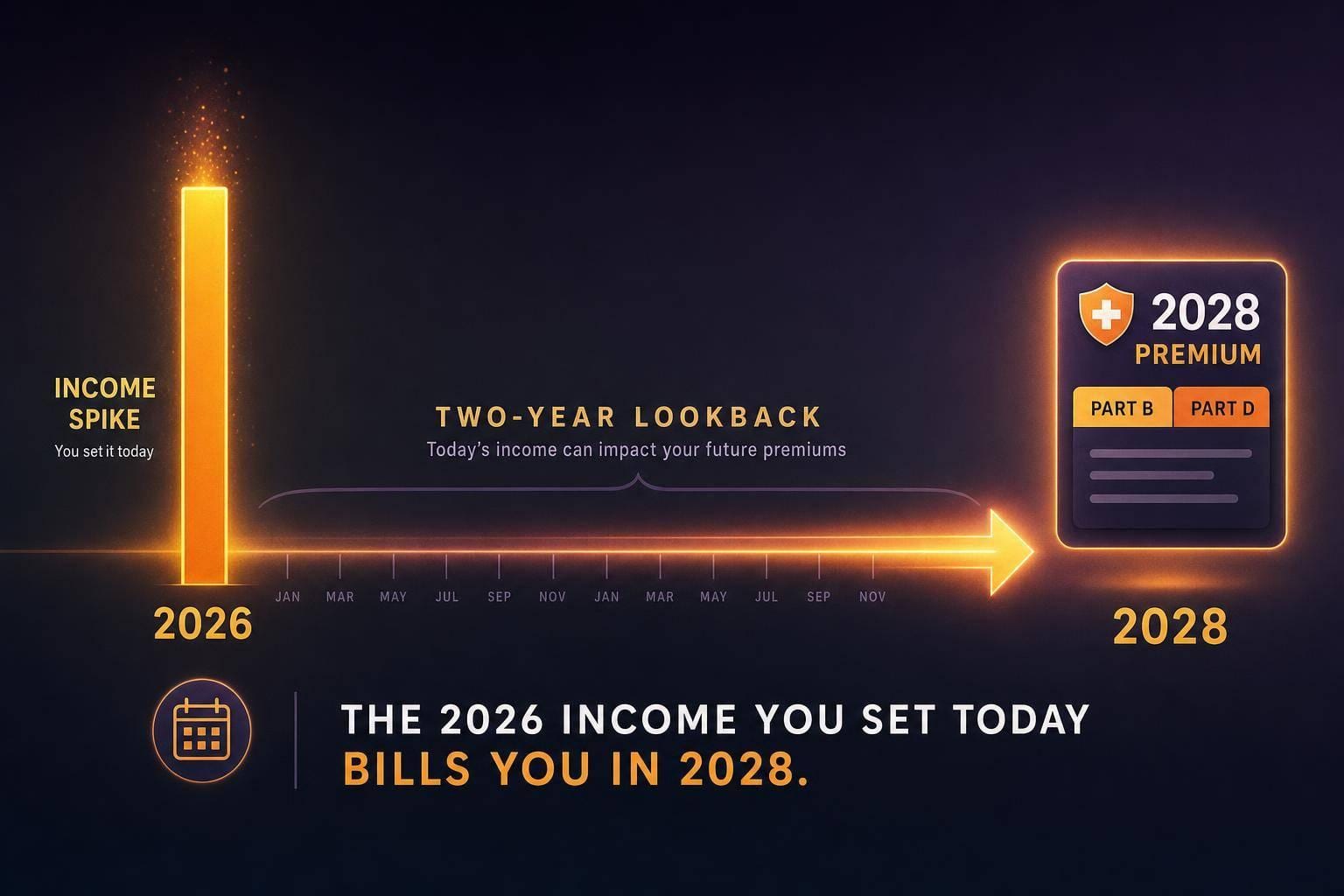
A one-year income spike in 2026 may show up in your 2028 Medicare bill. Medicare generally uses your tax return from two years earlier, so a Roth conversion, stock sale, bonus, or large distribution in 2026 may push you into a higher IRMAA tier later.
Here’s the short version:
- 2026 income may set 2028 Part B and Part D premiums
- In 2026, the standard Part B premium is $202.90/month
- Crossing the first IRMAA line at $109,000 single or $218,000 joint may move Part B to $284.10/month
- IRMAA works in cliffs, not gradual steps - going over by $1 may move you into the next tier
- The surcharge generally applies per Medicare enrollee, so married couples may each get billed
- Common triggers include:
Roth conversions
- Capital gains
- RSU or stock sales
- Bonuses or severance
- IRA distributions and first RMDs
- Tax-exempt interest
What this may mean in plain English: the timing of income may matter just as much as the amount. Some households may look at year-end MAGI, remaining room before the next tier, gain timing, loss offsets, and where withdrawals come from before December 31, 2026.
A quick way to think about it:
So this piece comes down to one idea: if your 2026 MAGI may land near an IRMAA threshold, small timing choices now may be associated with a higher or lower Medicare bill in 2028.
2026 Medicare IRMAA Tax & What To Do
How IRMAA's Two-Year Lookback Works
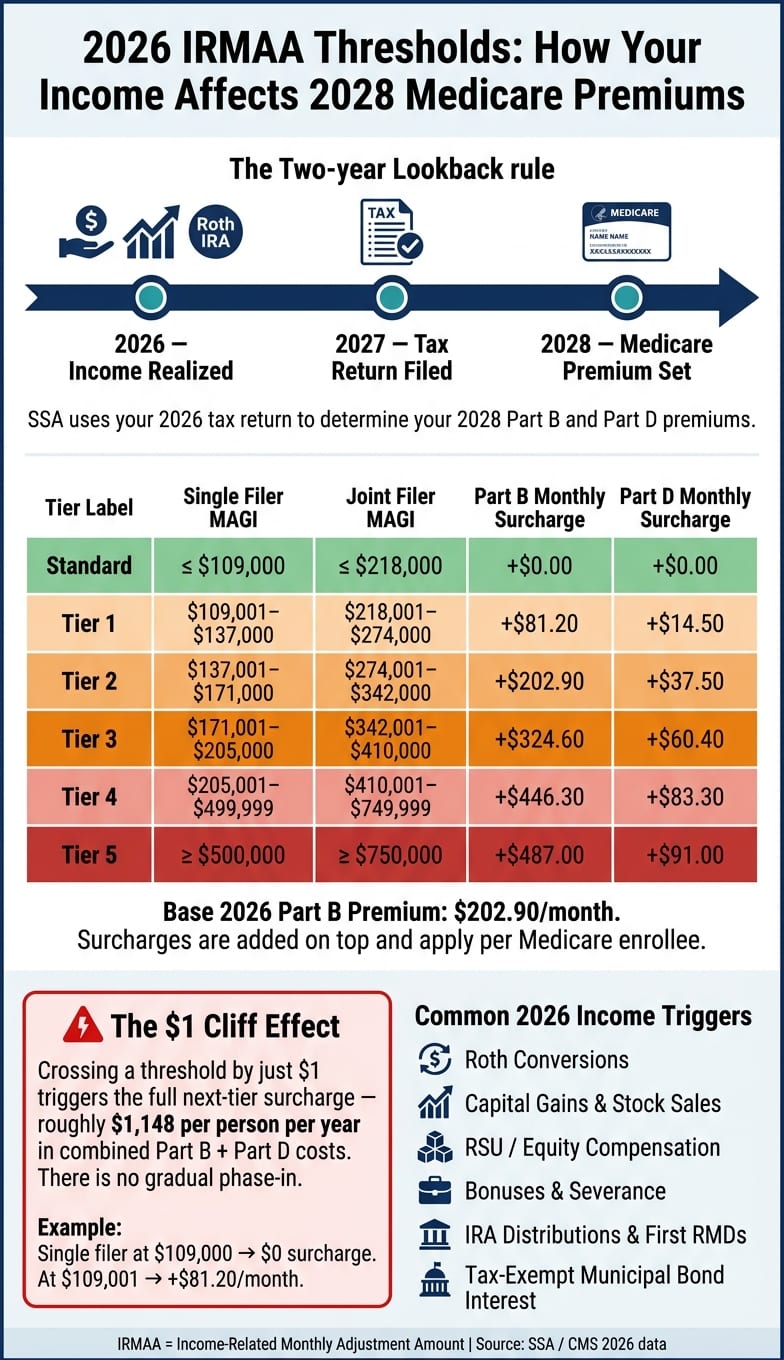
IRMAA is a surcharge added to Medicare Part B and Part D premiums. To set your premium for the current year, SSA looks at tax return data from two years earlier. So if income jumps in 2026, that change may show up in your 2028 Medicare premiums.
What Medicare Counts as MAGI for IRMAA
For IRMAA, MAGI equals AGI plus tax-exempt interest. In plain English, a lot of income types may count, including:
- Wages and bonuses
- Taxable IRA and pension distributions
- Roth conversions
- Capital gains
- Business income
- Rental income
- Municipal bond interest
That’s why one-time income events - like a Roth conversion, a stock sale, or a large distribution - may matter more than people expect.
The 2026 to 2028 Timeline, Step by Step
Here’s how the timeline works:
- You realize income in 2026.
- SSA receives your 2026 tax data after you file.
- SSA uses that data to set your 2028 Medicare premiums.
There’s one detail that often catches people off guard: each spouse enrolled in Medicare gets a separate IRMAA determination. SSA may use joint MAGI to check the couple against the joint-filer thresholds, but the surcharge itself is billed per person. So when both spouses are on Medicare, a high joint MAGI may lead to two separate surcharges - one for each spouse.
Why Going Over by $1 Can Cost You More
IRMAA does not phase in bit by bit. If your income goes over a threshold by $1, you move into the next tier, and that tier’s full surcharge may apply right away. There’s no partial adjustment inside a bracket.
At $109,000, a single filer pays the base premium. At $109,001, the monthly bill jumps by $81.20.
Once you see that cliff effect, it gets easier to spot which 2026 income events may push someone over the line.
2026 Income Events Most Likely to Raise Your 2028 Premiums
Once the lookback rule is on the table, the next step is pretty simple: figure out which 2026 income events may push your 2028 Medicare premiums into a higher IRMAA tier.
Capital Gains, Stock Sales, and Concentrated Position Cleanup
Long-term capital gains count dollar-for-dollar in IRMAA MAGI, even when they may be taxed at lower rates. That means a stock sale doesn't get special treatment for IRMAA just because the tax rate may be lower.
This is where a lot of people get tripped up. A concentrated stock sale, a mutual fund capital gain distribution, and RSU-related gains may all land in the same calendar year. When that happens, they may stack on top of each other and may push MAGI over an IRMAA threshold.
Roth Conversions, Bonuses, and Large Retirement Distributions
A Roth conversion adds its full taxable amount to MAGI in the year of the conversion. So a $50,000 conversion adds $50,000, with no offset. For newer retirees in their 60s, that may matter more than expected, because catch-up conversions may land in the same year as wages, capital gains, or Social Security.
Bonuses, severance, and consulting income are treated the same way for MAGI purposes. Retirement account distributions may have a similar effect because they add on top of other income already in the picture.
Take a simple example. A couple with $60,000 in taxable Social Security and $40,000 in pension income already has $100,000 of MAGI before taking anything from a retirement account. A $50,000 RMD brings them to $150,000, which stays below the $218,000 joint threshold. But if that same $50,000 RMD shows up alongside a $70,000 Roth conversion, MAGI rises to $220,000, which crosses into Tier 1.
A Hypothetical Example: One High-Income Year, a Higher Bill Two Years Later
Here's how that may look in one year.
Consider Mark and Susan, a married couple filing jointly, both age 63 in 2026. In a normal year, their combined taxable Social Security and pension income totals $130,000, which sits below the $218,000 joint IRMAA threshold for standard premiums.
In 2026, they sell a concentrated stock position and realize $70,000 in long-term capital gains. They also convert $50,000 from a traditional IRA to a Roth. Their 2026 MAGI rises from $130,000 to $250,000, which places them in Tier 1 for joint filers ($218,001–$274,000). In 2028, SSA uses that 2026 return to set their premiums. Each of them then faces an $81.20 monthly Part B surcharge and a $14.50 monthly Part D surcharge - an added $1,152 per person per year, or $2,304 combined, tied to one year's income decisions.
If they had kept 2026 MAGI below $218,000 by limiting the Roth conversion or spreading stock sales across two years, they may have avoided the surcharge. The jump came from crossing the bracket, not from income in the abstract. That's why year-end timing may matter more than total income by itself.
How to Reduce 2026 MAGI Before Year-End
Several levers may still be available before December 31, 2026. The goal isn't only lower taxes. It may also be keeping 2026 MAGI below the IRMAA line that sets 2028 premiums.
Coordinate Withdrawals Across Taxable, Traditional, and Roth Accounts
Account order may matter more than many people expect. Withdrawals from a Traditional IRA or 401(k) generally add fully taxable ordinary income to MAGI. Qualified Roth IRA withdrawals and HSA withdrawals used for qualified medical expenses generally do not increase MAGI. Nonqualified HSA withdrawals may.
Here's the plain-English version: where the money comes from may matter as much as how much you spend.
A simple example makes this easier to see. If you need $30,000 for living expenses, taking it from a Roth IRA may leave your 2026 MAGI unchanged. Taking that same $30,000 from a Traditional IRA may increase MAGI by $30,000. That gap may be enough to stay under the next IRMAA bracket - or move above it.
Once spending is sourced from the right accounts, the next lever may be the gains you choose to realize.
Pair Gain Realization With Losses and Smarter Sale Timing
Long-term capital gains count in MAGI no matter what tax rate applies to them, so the timing of those gains may affect IRMAA exposure. Tax-loss harvesting - selling positions with embedded losses to offset gains from appreciated holdings - may reduce net taxable gains while keeping your market position fairly close to where it was. Some investors reinvest in a similar, but not substantially identical, fund to avoid wash-sale issues.
Specific-lot selection may give you one more layer of control. When selling from a taxable account, choosing higher-cost-basis lots may reduce the gain you realize. If lower-cost-basis lots are sold by default, the taxable gain may end up larger than needed, which may push MAGI over a bracket that might otherwise have been avoided.
In practice, some people look at a few moving parts together:
- Roth or qualified HSA withdrawals for spending
- Gains spread across tax years
- Loss harvesting when losses offset appreciated sales
After gain timing, the next lever may be conversion timing.
Use Bracket-Aware Roth Conversion and RMD Planning
Bracket-aware conversion planning usually means capping conversions at a target income level. The basic idea is fairly direct: estimate your 2026 ordinary income, capital gains, and planned withdrawals first. Then calculate how much room may remain before the next IRMAA line, and leave some buffer for surprises like bonuses, dividend changes, or year-end sales.
Crossing a bracket may still make sense in some cases, but usually only if the future RMD reduction may outweigh the 2028 surcharge. For example, if a 2026 Roth conversion increases 2028 premiums but also meaningfully reduces future required minimum distributions that might otherwise push MAGI higher in later years, that temporary surcharge may still make sense for some households.
That turns into a multi-year math problem, not a one-year snapshot. The better answer may depend less on this year's income alone and more on your projected RMD path over time.
Track IRMAA Exposure and Avoid Last-Minute Surprises
What to Track Between Now and December 31, 2026
IRMAA management may be a year-round coordination issue, not something to handle only in December. Start with the one number that matters most: your running 2026 MAGI.
Track your running 2026 MAGI - AGI plus tax-exempt interest - after each major event: capital gains, dividends, bond interest, Roth conversions, IRA/401(k) distributions, RMDs, bonuses, and self-employment income. These routine transactions may add up fast across accounts. Once you know that number, the next step is to check how much room may remain before the next IRMAA tier.
Track your headroom too: how much more 2026 income you may realize before crossing the next IRMAA tier. Crossing a line by even $1 may trigger a full-tier jump - roughly $1,148 per person per year in combined Part B and Part D surcharges in 2028.
Update your projected full-year MAGI after each major transaction and compare it with the next threshold. That kind of monitoring may be easier when all accounts sit in one view.
How Mezzi Helps You See the Full MAGI Picture
For many households, the hardest part of IRMAA monitoring may be fragmentation. Taxable brokerage accounts, Traditional IRAs or 401(k)s, and Roth IRAs often sit at different custodians, and a decision made at one institution may not reflect what is happening at another.
Mezzi connects taxable, Traditional IRA, 401(k), and Roth accounts in one read-only view. That combined picture may let you see gain-heavy holdings, realized and unrealized gains, and dividend and interest income across every account at once. Mezzi also flags wash sale risk across accounts, which may matter if you sell one position at one broker while holding a similar fund somewhere else.
Mezzi does not execute trades or move money - it surfaces insights and points out possible opportunities; you decide what to do and when.
Conclusion: The Bill You Get in 2028 Starts With the Income Choices You Make in 2026
2026 income may set 2028 Medicare premiums, so every Roth conversion, capital gain, bonus, and distribution may matter. The goal is simple: spot a tier jump before December 31, not after SSA locks it in.
Bottom line: estimate your 2026 MAGI now, compare it to the thresholds in the table below, and make deliberate account-by-account decisions before December 31. There may still be time to adjust - but only if you start looking before the year closes.
FAQs
What counts toward IRMAA MAGI?
IRMAA MAGI starts with your Adjusted Gross Income (AGI) from your tax return. From there, it adds back certain non-taxable income, such as tax-exempt interest, untaxed foreign income, and non-taxable Social Security benefits.
Income that may already be included in AGI for IRMAA purposes includes wages, self-employment income, pensions, annuities, taxable Social Security, dividends, rental income, capital gains, and distributions from a traditional IRA or 401(k). The standard deduction does not reduce IRMAA MAGI.
Can I appeal IRMAA after a major life change?
Yes. You may appeal an IRMAA surcharge after a major life-changing event, but SSA may not adjust your premiums on its own. You need to file Form SSA-44 to ask for a new review.
To qualify, the event must happen after the tax year used to set your premiums and may need to be tied to a major drop in your Modified Adjusted Gross Income.
Qualifying events may include:
- Retirement or a work stoppage
- Death of a spouse
- Divorce or annulment
- Loss of income-producing property
- Loss of pension income
- Certain employer settlement payments
How can I estimate my 2028 surcharge now?
Estimate your 2028 Medicare surcharge by projecting your 2026 MAGI, because Medicare uses a two-year lookback.
That estimate may include income sources such as:
- wages
- pensions
- Social Security
- interest
- dividends
- capital gains
- tax-exempt municipal bond interest
Then compare that number with the next IRMAA threshold. The gap between the two may give you a rough sense of how much room you may have for income events like Roth conversions.
To reduce the chance of surprises, some people leave a $2,000 to $5,000 buffer below the next threshold.
Disclosures:
- This content is for informational purposes only and does not constitute investment advice or a recommendation to buy or sell any security.
- Past performance is not indicative of future results. No guarantee of future performance or outcomes is implied.
Related Blog Posts
- Roth Conversion Before Tax Day: Deadline, Rules, and Calculator
- How Do I Avoid Medicare IRMAA Surcharges in Retirement?
- How to do a Roth conversion without triggering IRMAA
- Roth Conversions vs. IRMAA vs. the ACA Subsidy: The Three-Way Squeeze
IRMAA MAGI starts with your Adjusted Gross Income (AGI) from your tax return. From there, it adds back certain non-taxable income, such as tax-exempt interest, untaxed foreign income, and non-taxable Social Security benefits.
Income that may already be included in AGI for IRMAA purposes includes wages, self-employment income, pensions, annuities, taxable Social Security, dividends, rental income, capital gains, and distributions from a traditional IRA or 401(k). The standard deduction does not reduce IRMAA MAGI.
Yes. You may appeal an IRMAA surcharge after a major life-changing event, but SSA may not adjust your premiums on its own. You need to file Form SSA-44 to ask for a new review.
To qualify, the event must happen after the tax year used to set your premiums and may need to be tied to a major drop in your Modified Adjusted Gross Income.
Qualifying events may include:
- Retirement or a work stoppage
- Death of a spouse
- Divorce or annulment
- Loss of income-producing property
- Loss of pension income
- Certain employer settlement payments
Estimate your 2028 Medicare surcharge by projecting your 2026 MAGI, because Medicare uses a two-year lookback.
That estimate may include income sources such as:
- wages
- pensions
- Social Security
- interest
- dividends
- capital gains
- tax-exempt municipal bond interest
Then compare that number with the next IRMAA threshold. The gap between the two may give you a rough sense of how much room you may have for income events like Roth conversions.
To reduce the chance of surprises, some people leave a $2,000 to $5,000 buffer below the next threshold.