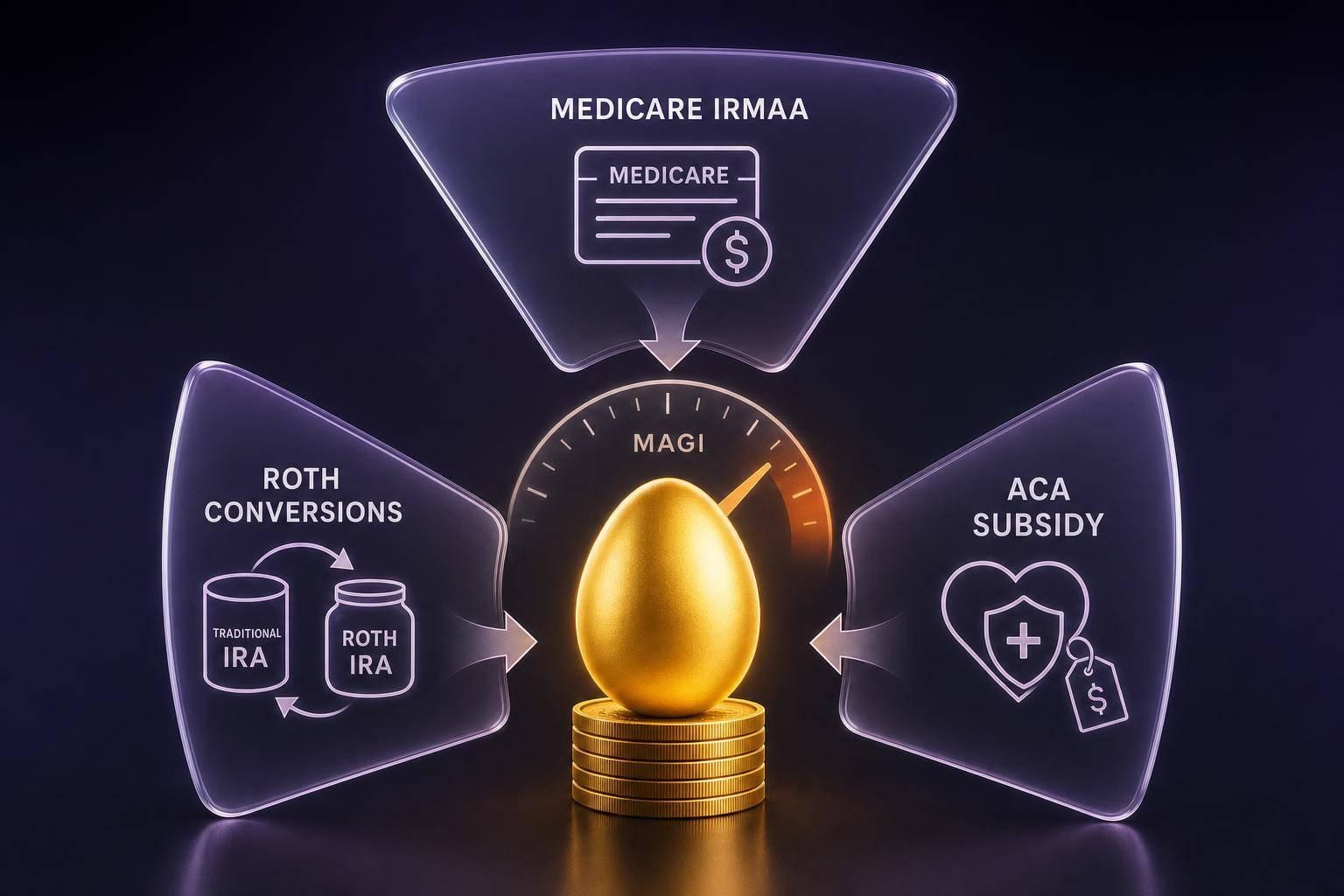
A Roth conversion may cost more than the tax bill. It may also push income high enough to reduce ACA premium tax credits now or add Medicare IRMAA surcharges later.
Here’s the short version:
- A Roth conversion may add to MAGI
- Higher MAGI may mean more federal tax
- If you’re under 65 on an ACA plan, higher MAGI may cut or end 2026 subsidies in the same year
- If you’re on Medicare, higher MAGI may trigger IRMAA surcharges two years later
- The main issue may be how much to convert before crossing a line
For many people, the limit may not be a tax bracket alone. It may be one of these income lines:
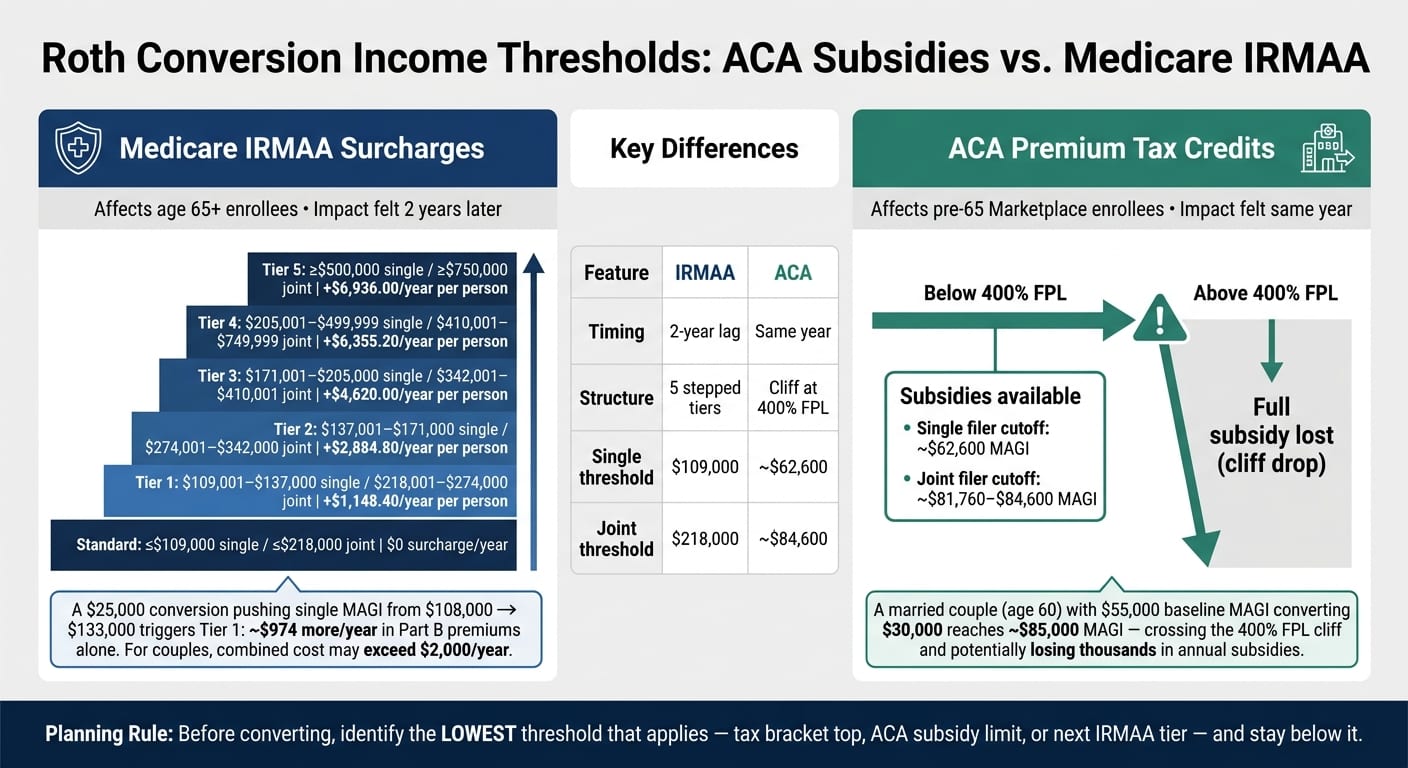
- ACA cutoff (2026): about $62,600 for a single filer and about $84,600 for a married couple, if the 400% FPL cutoff applies
- First IRMAA tier (2026 premiums): $109,000 single or $218,000 married filing jointly
- A conversion that goes just a little over one of those lines may add $1,000+ in Medicare premiums or wipe out thousands of dollars in ACA help
Is a Roth Conversion a Mistake? 7 Scenarios Where It Makes Less Sense
Quick Comparison
My takeaway: a Roth conversion may still make sense for some households, but the better question may be how much fits this year after tax brackets, ACA limits, and IRMAA tiers are all checked together.
Roth conversions: future tax savings vs. current-year income
How a conversion changes your taxes this year
A Roth conversion may be taxed as ordinary income in the year you do it. That may increase AGI and, in turn, MAGI. The amount you convert stacks on top of your other income and may be taxed at your marginal rate. It may also push long-term capital gains into a higher bracket.
So the key issue often isn't just whether to convert. It's how much may fit before you cross into a new bracket or lose a tax break. In that sense, conversion size may be a threshold question, not a simple yes-or-no call. The tricky part is that the same conversion dollars may land in very different penalty zones.
When conversions tend to make the most sense
For some people, the strongest case for converting may show up in the retirement window before RMDs begin, when wages have stopped and there may still be room in a lower tax bracket. That gap between retirement and RMDs may offer more flexibility. A retiree living on withdrawals from a taxable account may be able to convert part of a pre-tax IRA without moving beyond the 12% or 22% bracket.
Some investors choose to pay the tax from cash outside the IRA. Using money from the converted account itself may leave less in the Roth and may reduce the long-run upside.
Next, that same added income may trigger two very different issues: IRMAA for Medicare and ACA subsidy loss before age 65.
IRMAA vs. ACA subsidies: two different income penalties
Both use MAGI, but they don’t hit at the same time.
IRMAA for Medicare enrollees: surcharges that hit two years later
IRMAA is the income-based surcharge tied to Medicare Part B and Part D. It uses a two-year lookback, which means a 2026 Roth conversion may affect 2028 premiums.
The surcharge moves up in steps. Go even $1 over a threshold, and the higher rate may apply for the full year, per beneficiary. In 2026, the base Part B premium is $202.90 per month. As MAGI goes up, the added annual cost may look like this:
Take a single Medicare enrollee with 2024 MAGI of $108,000. That sits just under the Tier 1 cutoff. A $25,000 Roth conversion may push MAGI to $133,000, which falls into Tier 1. In that case, the Part B premium may move from $202.90 to $284.10 per month - about $974 more per year for Part B alone - plus a smaller Part D surcharge.
If a spouse is also on Medicare, the same conversion may trigger IRMAA for both people. Once Part B and Part D are included, the combined added cost may go above $2,000 per year.
For retirees under 65, the same income bump may play out in a different way. Instead of higher Medicare premiums later, it may reduce ACA subsidies right away.
ACA premium tax credits for pre-65 retirees: subsidy loss in the same year
With ACA Marketplace coverage, the effect is immediate. A 2026 conversion changes 2026 premium tax credits and may lead to repayment of advance credits. That’s why the same conversion may feel fine for one retiree and far more costly for another.
For 2026 coverage, premium tax credits are available only from 100% to 400% of FPL. Go above 400% of FPL, and the full credit may disappear. For a two-person household, that cutoff is around $81,760–$84,600 in MAGI. For a single person, it’s about $62,600.
So the gap isn’t just about the income line. It’s also about when the cost shows up.
These timing differences set up the next issue: how much conversion income may fit before a higher threshold comes into play?
The three-way squeeze in real planning scenarios
The timing gap between ACA subsidies and IRMAA surcharges changes which Roth conversions may make sense and which ones may cost more than the tax bill alone suggests.
These examples show why the same conversion may look smart in one year and much less appealing in another.
Scenario 1: Early retiree on ACA coverage before age 65
Consider a married couple, both age 60, filing jointly with baseline MAGI of $55,000 from a small pension and some investment income. They’re enrolled in an ACA Marketplace plan and qualify for a meaningful premium tax credit.
A $25,000 Roth conversion lifts MAGI to $80,000, still below the cutoff. But if they convert $30,000 instead, MAGI reaches $85,000, crossing the 400% FPL line. If the credit is large, that extra $5,000 of income may cost far more than the tax bill alone shows.
The practical ceiling here may not be the top of their tax bracket. It may be the ACA subsidy cutoff. A partial conversion that stays below the threshold may be worth doing. One that crosses it may not be.
Once the couple moves past Medicare age, the same conversion may run into a different threshold, with a different timing lag.
Scenario 2: Retiree age 65 and older managing around IRMAA thresholds
Now consider a couple, both age 67, both on Medicare, filing jointly with a 2026 MAGI of $200,000. They’re below the first IRMAA tier for joint filers, which starts at $218,001. A $25,000 conversion lifts MAGI to $225,000 and crosses into Tier 1.
IRMAA is delayed and tiered, so the tradeoff may look different. If long-term tax savings may outweigh the higher premiums later, the conversion may still make sense.
Here’s how the two scenarios compare side by side:
Why the same $25,000 conversion can be smart one year and costly the next
The conversion amount doesn’t determine the outcome. The income threshold it crosses does.
A $25,000 conversion at age 62 on ACA coverage may be very different from the same conversion at age 68 on Medicare. In the first case, the household may be close to losing ACA credits. In the second, the household may be approaching an IRMAA tier that adds premium costs two years later.
MAGI may shift with Social Security timing, part-time income, portfolio distributions, and capital gains. A conversion that fits cleanly under the ACA subsidy cutoff in one year may not fit the next if other income rises. The better question may not be just what bracket you’re in, but which threshold comes next.
That threshold test may determine how much to convert.
How to plan conversions without crossing the wrong threshold
Use partial conversions spread across multiple years
Those examples point to a simple planning rule: convert only up to the lowest threshold that matters for that year. Instead of doing one large conversion, some people spread conversions across several years so each year may stay below the nearest tax or benefit line.
A useful way to set an annual ceiling is to compare three numbers and use the lowest one:
- your target tax bracket top
- the ACA subsidy limit
- the next IRMAA tier
For a 2026 joint filer, that may often mean staying under about $84,600 of MAGI while using ACA coverage, or $218,000 on Medicare.
From there, you may estimate your baseline MAGI, add planned income, and see how much room may remain before you hit that ceiling. Repeating that process each year may create a multi-year glide path that gradually reduces a pre-tax balance without crossing benefit cliffs.
That ceiling may shift once ACA subsidies fall away and Medicare enters the picture.
Time larger conversions around the ACA-to-Medicare transition
Before age 65, ACA subsidies usually set the ceiling. After 65, IRMAA usually does. At ages 63–64, both may matter: income at 63 may affect Medicare premiums at 65 because of IRMAA's two-year lookback.
The years between Medicare enrollment and the start of required minimum distributions may be the most flexible window for larger conversions - but only if MAGI stays under the IRMAA tier you choose.
The next step is to check all three thresholds together before converting.
Conclusion: the thresholds to check before you convert
Roth conversions may work best when the tax savings are higher than the cost of the threshold you cross. Before converting, check your tax bracket, ACA limit, and IRMAA tier in that order.
Mezzi shows your accounts in one read-only view and models conversion scenarios against tax and benefit thresholds. It connects IRAs, 401(k)s, taxable brokerage accounts, and other accounts to show which thresholds a proposed conversion may cross and whether the long-term benefit may still outweigh the near-term cost.
FAQs
How do I calculate my MAGI before a Roth conversion?
First, estimate your baseline MAGI using year-to-date income from wages, pensions, Social Security, dividends, interest, realized capital gains, and any RMDs already taken.
Then add tax-exempt interest, since it counts for IRMAA. Standard deductions don’t reduce MAGI for IRMAA.
To estimate a safer conversion amount, subtract your projected MAGI from your target IRMAA threshold. After that, leave a $2,000 to $5,000 buffer for unexpected income that may show up later in the year.
When does a Roth conversion still make sense despite IRMAA or ACA costs?
A Roth conversion may still make sense when the long-term tradeoff looks favorable. The main upside may be tax-free growth and lower future required minimum distributions. The near-term downside may be higher taxes now, plus possible IRMAA surcharges.
This move may fit best during low-income gap years. In those years, income may be low enough to stay within your target tax bracket and below the next IRMAA threshold. Some people also leave a $2,000 to $10,000 buffer for unexpected year-end income.
How should I plan conversions around age 63 to 65?
Plan ahead with IRMAA, because Medicare may look back two years. That means income reported on your tax return at age 63 may affect the Medicare premiums you pay at age 65.
A common approach may be to estimate your baseline MAGI, identify the next IRMAA threshold, and leave a $2,000 to $5,000 cushion for surprise income. If it fits your situation, some people do larger conversions before age 63. If that timing doesn’t work, others spread partial conversions across a few years and finish them by December 31.
Disclosures:
- This content is for informational purposes only and does not constitute investment advice or a recommendation to buy or sell any security.
- Past performance is not indicative of future results. No guarantee of future performance or outcomes is implied.
Related Blog Posts
- Roth Conversion Before Tax Day: Deadline, Rules, and Calculator
- How to Do a Roth Conversion Ladder in Early Retirement
- Should I Do a Roth Conversion in a Low-Income Year?
- How to do a Roth conversion without triggering IRMAA
First, estimate your baseline MAGI using year-to-date income from wages, pensions, Social Security, dividends, interest, realized capital gains, and any RMDs already taken.
Then add tax-exempt interest, since it counts for IRMAA. Standard deductions don’t reduce MAGI for IRMAA.
To estimate a safer conversion amount, subtract your projected MAGI from your target IRMAA threshold. After that, leave a $2,000 to $5,000 buffer for unexpected income that may show up later in the year.
A Roth conversion may still make sense when the long-term tradeoff looks favorable. The main upside may be tax-free growth and lower future required minimum distributions. The near-term downside may be higher taxes now, plus possible IRMAA surcharges.
This move may fit best during low-income gap years. In those years, income may be low enough to stay within your target tax bracket and below the next IRMAA threshold. Some people also leave a $2,000 to $10,000 buffer for unexpected year-end income.
Plan ahead with IRMAA, because Medicare may look back two years. That means income reported on your tax return at age 63 may affect the Medicare premiums you pay at age 65.
A common approach may be to estimate your baseline MAGI, identify the next IRMAA threshold, and leave a $2,000 to $5,000 cushion for surprise income. If it fits your situation, some people do larger conversions before age 63. If that timing doesn’t work, others spread partial conversions across a few years and finish them by December 31.